
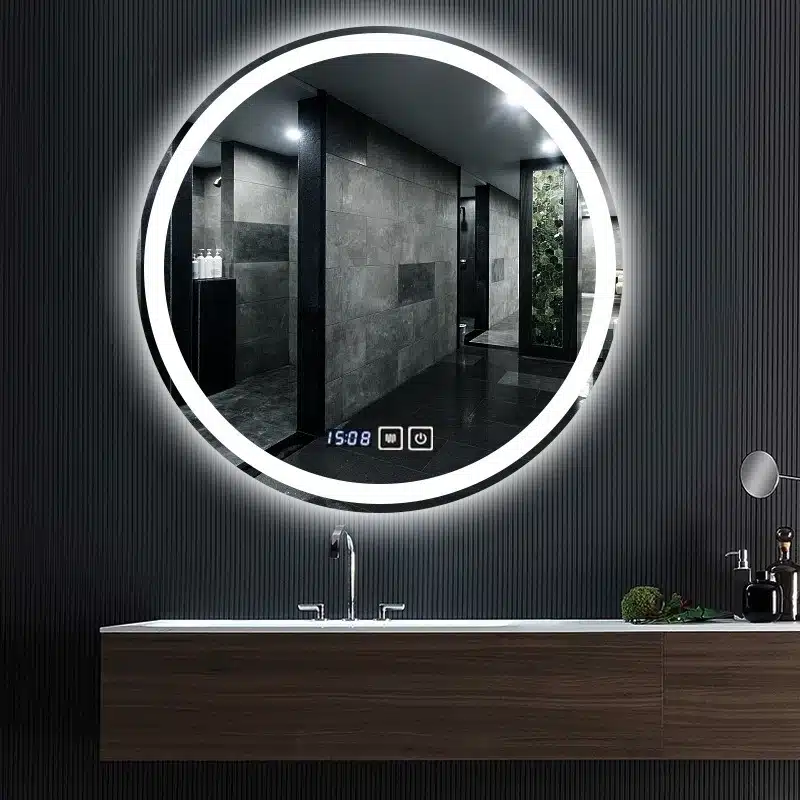
Choosing the wrong hotel lighted mirror directly impacts guest satisfaction scores and creates maintenance liabilities that compromise bathroom safety and operational budgets. A mirror that fogs up after a shower or provides poor lighting for makeup application isn’t just an inconvenience; it’s a primary source of negative online reviews and costly service calls. These failures stem from misunderstood technical specifications, from insufficient defogger pads to non-compliant electrical ratings.
This guide provides the technical data needed to specify and maintain these critical assets. We’ll break down the engineering behind heated defogger pads, clarify the required lumen output for guest satisfaction, and explain the IP44 rating for bathroom safety compliance. We also cover easy-hang installation systems for contractors and the process for replacing LED drivers to minimize room downtime.
Why Every Hotel Bath Needs a Lighted Mirror?
Lighted mirrors are no longer a luxury but a competitive necessity, directly impacting guest satisfaction, operational costs, and modern design standards.
Elevating the Guest Experience
A lighted mirror transforms a standard bathroom into a modern, spa-like environment. It delivers even, shadow-free illumination perfect for grooming and makeup application—a small detail that directly improves guest satisfaction and their perception of the property’s value. This functional upgrade is a key differentiator in a competitive hospitality market where bathroom quality heavily influences reviews and loyalty.
- Provides flattering, consistent light that eliminates the harsh shadows common with overhead fixtures.
- Creates a high-end ambiance that guests associate with premium and luxury properties.
- Features like adjustable color temperature allow guests to personalize the lighting to their preference.
Improving Operational Efficiency
For hotel management, LED mirrors are a practical, long-term investment. Their superior energy efficiency and long operational lifespan significantly cut ongoing expenses, from lower utility bills to reduced maintenance labor. An integrated mirror and light fixture means fewer components to service and a more durable final product built for high-traffic commercial use.
- LEDs use substantially less energy than traditional bulbs, resulting in direct electricity cost savings.
- Fixtures rated for up to 50,000 hours drastically reduce the frequency and cost of bulb replacements.
- The durable, all-in-one design minimizes service calls for separate vanity lights and mirrors.
Modernizing Design and Saving Space
A lighted mirror is both a light source and a design centerpiece. Its slim profile removes the need for bulky, dated vanity light bars, making bathrooms feel larger and more contemporary. This space efficiency is especially valuable in compact room layouts where every inch of wall space counts. The mirror becomes a functional focal point that elevates the entire room’s aesthetic.
- The integrated design offers a clean, minimalist look that modernizes any bathroom decor.
- It frees up critical wall space around the vanity, improving the sense of openness in smaller rooms.
- It acts as a primary design element, enhancing the room’s visual appeal and perceived quality.
Defogger Technology (Heated Pad Specs)?
The anti-fog function isn’t a chemical coating; it’s an active heating system using a resistive pad to warm the mirror surface above the dew point, physically preventing condensation from forming.
Core Heating Element Technology
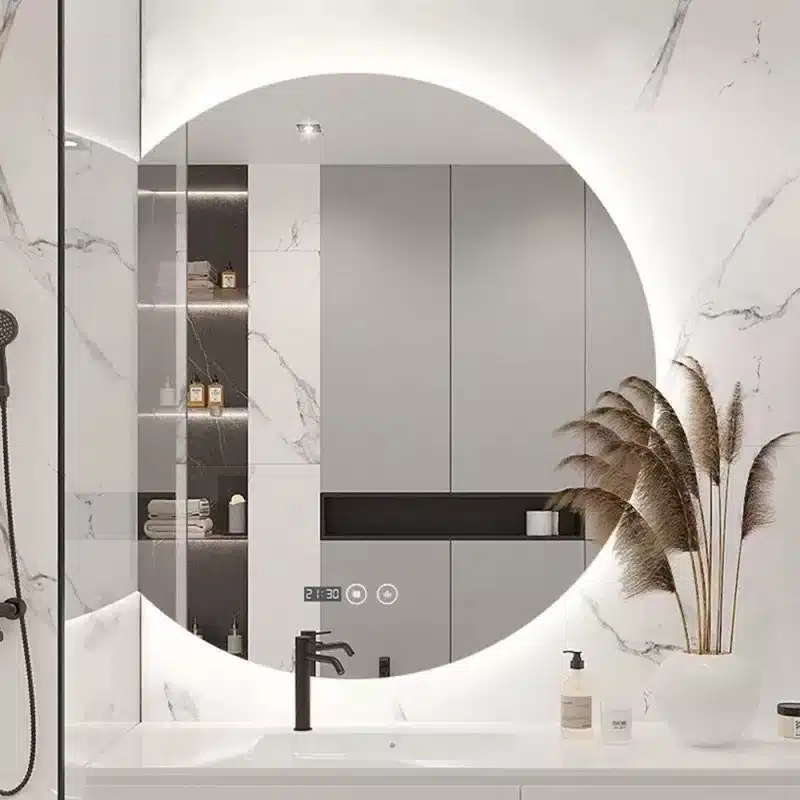
The defogger in MFBATH mirrors is a thin, electrically heated pad attached to the back of the mirror. It works just like the defogger on a car’s rear window, using printed resistive circuits that generate heat when an electrical current passes through them. This direct heating method provides instant-on activation, rapidly clearing steam after a hot shower. The heat is distributed evenly across a specific zone on the mirror, ensuring a clear reflection by preventing condensation before it starts.
Operating Temperature and Efficiency
The heating pads are engineered to maintain a consistent surface temperature that is effective for defogging without posing a safety risk or damaging the mirror’s silver backing. These systems operate at a stable temperature of around 70°C (158°F). This balances reliable performance with energy efficiency. The defogger is typically wired to the same switch as the LED lights, so it only consumes power when needed, minimizing operational costs for a hotel.
| Specification | Generic Market Standard | MFBATH System Specification |
|---|---|---|
| Heating Technology | Basic resistive heating film | High-efficiency printed resistive circuits |
| Activation Control | Separate switch or slow activation | Instant-on, integrated with primary light switch |
| Operating Temperature | Variable, may be inconsistent | Stable ~70°C (158°F) for safety and longevity |
| Energy Efficiency | Standard power draw | Low-wattage design for reduced operational cost |
Source Premium Smart Mirrors for Higher Profits
Touch Sensor vs. Hardwired Wall Switch?
The choice between touch sensors and hardwired switches is a classic trade-off: modern user experience and advanced features versus proven durability and cost-effectiveness.
Touch Sensor Controls: Modern Aesthetics and Smart Features
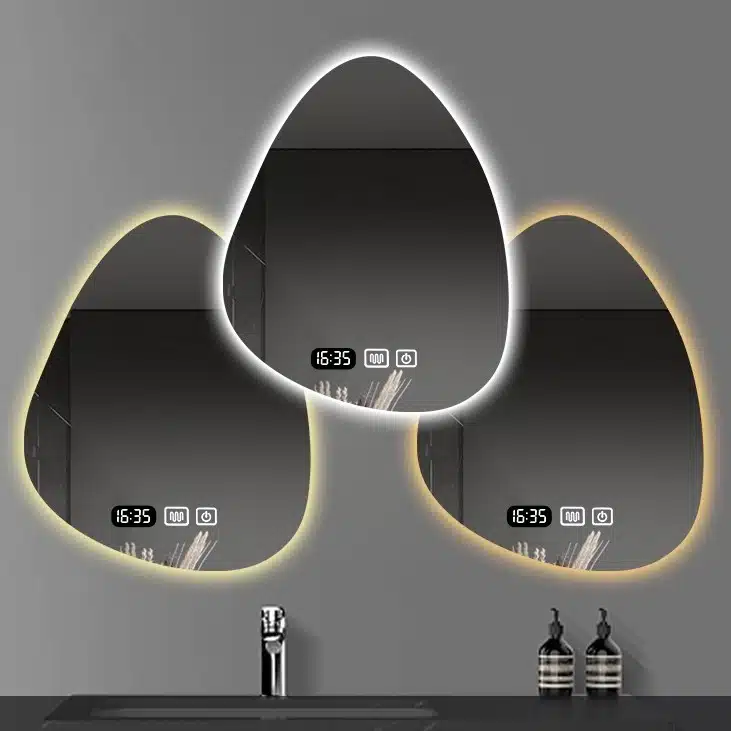
Touch sensor controls cater directly to the demand for contemporary design and an enhanced guest experience. By integrating controls directly onto the mirror surface, they create a sleek, minimalist look that aligns with modern, automated hospitality environments. This approach not only looks better but also offers functionalities like programmable dimming and color temperature adjustments, giving guests personalized control over their lighting.
- Delivers a clean, modern aesthetic with controls built directly into the mirror surface.
- Allows for advanced features such as adjustable brightness and color temperature.
- Simplifies installation by removing the need for separate wall switch wiring.
Hardwired Wall Switches: Reliability and Cost-Effectiveness
For projects where durability, budget, and operational simplicity are the primary drivers, the traditional hardwired wall switch remains the superior choice. This technology is recognized for its exceptional reliability and longevity, making it a practical and bulletproof solution for large-scale developments. Its straightforward operation is ideal for cost-sensitive markets or facilities that prioritize ease of use, such as senior-friendly accommodations or high-traffic public restrooms.
- Ensures long-term performance and durability with familiar, time-tested technology.
- Offers a cost-effective solution for large-scale developments and renovations.
- Provides simple, intuitive operation ideal for senior-friendly facilities and public spaces.
Lumen Output for Makeup (The Complaint #1)?
Insufficient or poor-quality light is the #1 reason for guest complaints about makeup application. A mirror must deliver both high lumen output for brightness and a high Color Rendering Index (CRI) for color accuracy to solve this problem.
The Standard for Task Lighting: Lumens and CRI
For clear, shadow-free makeup application, the accepted industry range is 1,200 to 1,800 lumens. This level of brightness is essential for detailed tasks. But lumens are only half the story. The Color Rendering Index (CRI) is just as critical. A CRI of 80 or higher ensures skin tones and makeup colors appear accurate and true to life, preventing the color distortion that happens under poor quality light. This combination provides enough light for precision without causing uncomfortable glare for the guest.
| Metric | Specification | Impact on Guest Experience |
|---|---|---|
| Lumen Output | 1,200 – 1,800 lm | Provides bright, shadow-free light for detailed makeup application. |
| Color Rendering Index (CRI) | 80+ | Ensures skin tones and makeup colors look natural and true-to-life. |
| Color Temperature (CCT) | 3000K – 6000K (Adjustable) | Allows guests to simulate different environments (e.g., office, outdoors). |
Adjustable Color Temperature for Different Environments
Lighting needs change throughout the day. A guest preparing for a business meeting needs different light than someone getting ready for an evening event. Our mirrors feature adjustable color temperatures, typically ranging from a warm 3000K to a cool 6000K. This allows users to check their appearance in lighting that simulates an office, an outdoor setting, or a restaurant. Dimmable controls also let them match the mirror’s brightness to the room’s ambient light, ensuring their makeup looks correct in any situation.
IP44 Rating for Bathroom Safety?
An IP44 rating isn’t a luxury feature; it’s the non-negotiable baseline for ensuring electrical safety and regulatory compliance in any commercial bathroom project.
What Does IP44 Protect Against?
An IP44 rating certifies that an electrical fixture is protected against solid objects larger than 1mm and water splashes from any direction. This makes it a baseline safety requirement for devices installed near sinks and vanities, typically categorized as bathroom Zones 1 and 2. It ensures the internal electronics are shielded from common bathroom hazards.
- The first digit ‘4’ indicates protection against solid objects over 1mm, such as wires, screws, or small tools during installation or maintenance.
- The second digit ‘4’ confirms resistance to water splashes, ensuring operational safety from common bathroom moisture events like hand washing.
- This rating is essential for fixtures like lighted mirrors positioned where they are likely to encounter splashes but not direct, high-pressure jets of water.
Meeting Global Electrical Codes
IP44 is not just a feature but a key requirement for complying with international safety standards. Regulations such as Europe’s DIN VDE 0100-701 and the U.S. National Electrical Code (NEC) mandate specific IP ratings for fixtures installed in wet locations to prevent electrical shock and fire hazards.
- Compliance ensures products are legally safe for installation in bathrooms across regulated markets, from North America to Europe.
- We integrate IP44-rated components as a standard to meet these global compliance demands, simplifying the specification process for our B2B clients.
- Using certified products simplifies building inspections and reduces liability for commercial projects like hotels and multi-family housing.
The Standard for Most Bathroom Zones
While higher ratings like IP65 are available for areas with direct water exposure, IP44 offers the optimal balance of safety and cost for most bathroom applications. It has become the dominant standard for lighting and mirrors installed outside of the direct shower or bath enclosure.
- IP44 is specified for bathroom Zones 1 and 2, which cover the area around the vanity, toilet, and the immediate exterior of showers or baths.
- Higher ratings are often unnecessary and more costly for typical vanity lighting, representing over-engineering for the application.
- The market has widely adopted IP44 as the go-to solution for providing reliable, code-compliant splash-proof protection without inflating project costs.
Easy-Hang Systems for Installers
A precision bracket and rail system is the standard for commercial mirror installation because it drastically cuts on-site labor costs and eliminates measurement errors across large-scale projects.
Bracket and Rail System Design
Our easy-hang systems are built around a precision-engineered bracket and rail configuration. This design provides exceptional stability and versatility, allowing installers to mount mirrors securely across different wall types, including drywall or tile, without needing on-site modifications. The entire system is pre-fabricated to eliminate guesswork and ensure a perfect fit for every unit, which is critical for maintaining consistency in multi-room hotel projects.
- Utilizes multi-point bracket configurations for enhanced stability and weight distribution.
- Features interchangeable mounting rails compatible with a wide range of mirror sizes and models.
- Engineered to remove the need for on-site cutting, drilling, or complex measurements.
Faster Installation with Fewer Steps
The primary benefit of the easy-hang system is a significant reduction in on-site labor and time. Pre-drilled alignment features and a simplified methodology ensure that each installation is both accurate and efficient. For large-scale projects, this means entire floors can be completed in a fraction of the time it would take with traditional mounting hardware. This efficiency directly translates to lower labor costs and faster project turnarounds for hotel construction or renovation schedules.
- Cuts typical installation times by nearly 50% compared to traditional mounting methods.
- Improves accuracy with pre-aligned mounting points for a consistently level finish.
- Reduces the requirement for specialized labor, allowing for faster project timelines.
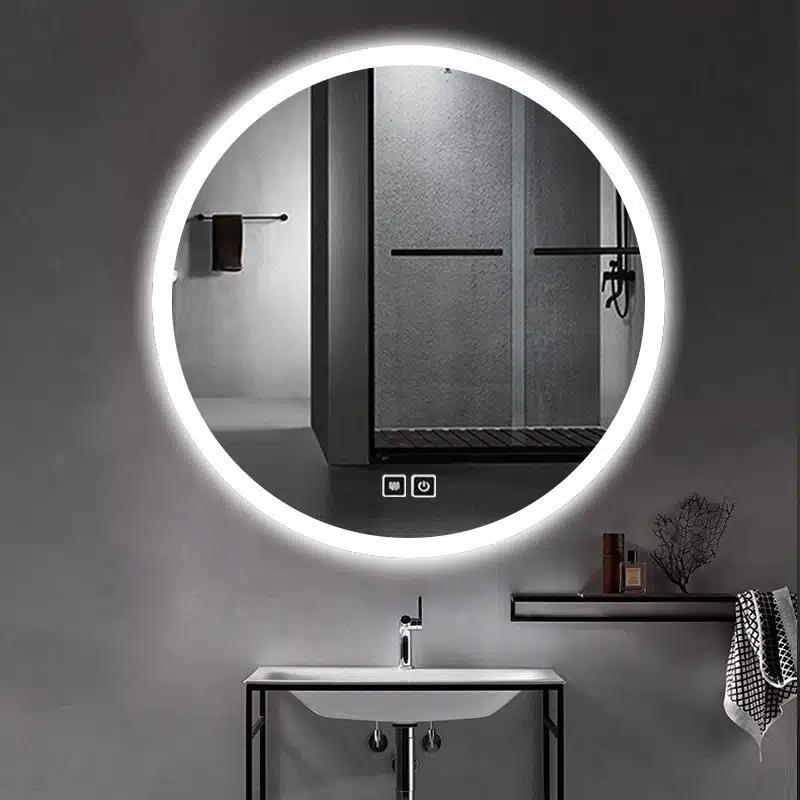
Replacing LED Drivers for Maintenance
Specifying mirrors with accessible, high-quality LED drivers is a critical long-term decision that directly impacts maintenance costs and minimizes room downtime.
While LED strips have an operational lifespan of 50,000 hours or more, the driver that powers them is often the first component to fail. A non-serviceable driver means replacing the entire mirror fixture, a costly and wasteful process. For hotel and commercial projects, ensuring the driver is a field-replaceable unit is non-negotiable for efficient facility management.
When Is LED Driver Replacement Necessary?
Identifying the warning signs of a failing LED driver is the first step in maintenance. The symptoms are usually obvious and directly affect the guest experience. Common indicators include flickering lights, inconsistent brightness levels between mirrors, audible buzzing sounds, or a complete failure of the mirror’s light. A driver may also fail after several years of continuous use as it reaches the end of its operational lifespan. Proactive inspections every six months can help maintenance teams detect these issues before a guest reports a complete failure.
| Failure Symptom | Likely Cause | Action Required |
|---|---|---|
| Flickering or Inconsistent Brightness | Unstable voltage output from a failing driver component. | Replace LED Driver. |
| Buzzing or Humming Noise | Internal transformer vibration; often a sign of component stress. | Replace LED Driver. |
| Total Lighting Failure | Complete driver failure or a tripped internal fuse. | Replace LED Driver. |
Key Steps for a Safe Replacement
Replacing an LED driver requires a methodical and safe approach. The process involves de-energizing the circuit, documenting the existing setup, and installing a new unit with identical specifications. While straightforward for a qualified technician, professional installation is always the correct choice to prevent electrical hazards and ensure compliance.
- Turn off power at the circuit breaker. Always confirm the circuit is dead with a voltage tester before touching any wires.
- Document the existing wiring connections with a photo to ensure the new driver is installed correctly.
- Remove the old driver and mount the new unit, ensuring its voltage, current, and wattage match the original specifications exactly.
- Secure all connections with terminal blocks or wire nuts. Use a multimeter to verify proper output voltage before closing up the mirror housing.
Proactive Maintenance to Extend Driver Life
You can extend the lifespan of an LED driver and reduce replacement frequency with simple, proactive maintenance. Heat is the primary enemy of electronic components, so ensuring proper heat dissipation is key. Regular inspections for damage, proper cleaning, and ensuring adequate airflow are the best practices for preventing premature failure.
- Inspect the driver periodically for any signs of physical damage or discoloration from overheating.
- Keep the area around the driver clean and free of dust, which acts as an insulator and traps heat.
- Make sure there is adequate airflow around the unit as designed by the manufacturer to prevent it from running too hot.
Conclusion
Selecting the right lighted mirror is a technical decision that impacts guest satisfaction, safety, and long-term maintenance costs. Key features like integrated defoggers, correct lumen output for makeup application, and IP44 ratings are essential for a modern hotel bathroom. Prioritizing models with easy-hang systems and replaceable LED drivers simplifies installation and protects your investment for years to come.
Reviewing your property’s current specifications is a practical first step. If you need detailed product data or a quality sample for evaluation, our team can provide a full catalog.
Frequently Asked Questions
Best lighted mirrors for hotels?
The best lighted mirrors for hotels combine guest-centric features with commercial-grade durability. Key features include front-lit and backlit designs for both task and ambient lighting, a high Color Rendering Index (CRI) of 90+ for accurate reflections, and adjustable color temperatures (CCT) to suit guest preferences. Essential amenities like integrated anti-fog technology and dimmable controls elevate the experience. For hotel operations, models with a 50,000-hour LED lifespan, robust construction, and proper safety certifications are crucial for ensuring long-term reliability and return on investment.
How do mirror defoggers work?
A mirror defogger, also known as a demister, functions via a thin heating pad that is bonded to the back of the mirror glass. When activated, this pad gently and safely warms the mirror’s surface. This raises the glass temperature just above the dew point of the humid air in the bathroom, preventing the water vapor from condensing and forming fog. The system is typically hardwired to the same switch as the mirror’s lights, providing a clear reflection for guests immediately after a hot shower.
Wiring requirements for led mirror?
LED mirrors require a standard 120V or 240V AC hardwired connection, depending on the region. The power source is typically a junction box installed on the wall behind the mirror’s mounting location. This circuit is usually controlled by a wall switch. For compliance and safety in a bathroom environment, the circuit must be protected by a Ground Fault Circuit Interrupter (GFCI). All electrical work must be performed by a qualified electrician to ensure it meets local building and safety codes.
Hotel mirror lumens standard?
While there is no single mandated standard, the hospitality industry best practice is for a lighted mirror to deliver approximately 700 to 1000 lumens of functional task lighting on the guest’s face. This level of brightness is ideal for grooming and makeup application without creating harsh shadows. The total lumen output of the mirror fixture itself will vary based on its size and design, but the key metric is the effective illumination provided at the vanity. Dimmable controls are also a critical feature to allow guests to adjust the light intensity to their comfort.
IP rating for bathroom mirrors?
The standard IP (Ingress Protection) rating for lighted mirrors in a typical hotel bathroom setting is IP44. The first digit ‘4’ indicates protection against solid objects larger than 1mm, while the second digit ‘4’ signifies protection against water splashes from any direction. This rating ensures the mirror’s electrical components are safely shielded from the moisture, steam, and condensation common in a bathroom environment, making it suitable for installation in Zone 2 (the area around the sink and outside the immediate bath/shower area).
Replaceable led driver for mirror?
Yes, in high-quality, commercial-grade lighted mirrors designed for hotels, the LED driver is a replaceable component. While the LED strips have a very long lifespan (50,000+ hours), the driver can be susceptible to power fluctuations and is the most common point of failure over time. Designing for a serviceable driver is a key requirement for the hospitality industry, as it allows for efficient maintenance and repair without the need to replace the entire mirror unit. This lowers the total cost of ownership and minimizes room downtime.




0 Comments