
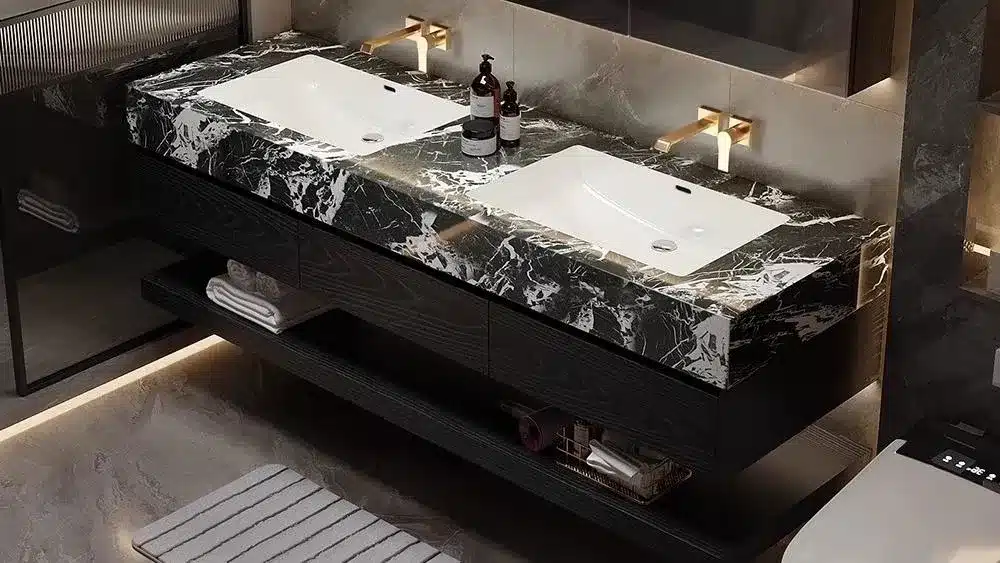
A Double Sink Bathroom Vanity sourced with incorrect plumbing or material specifications can trigger cascading change orders that blow project budgets and timelines. For commercial builds, ordering hundreds of units isn’t about style—it’s about logistical precision. A single dimensional error between a 60-inch and 72-inch model, or a failure to account for crate weight during transport, can halt work on an entire floor and lead to costly on-site modifications or product rejections.
This guide serves as a technical standard operating procedure for sourcing large-format vanities. We will analyze the critical differences in plumbing layouts for dual basins, compare the durability and transport requirements of quartz versus cultured marble tops, and examine the structural reinforcement needed to prevent freight damage. The goal is to equip procurement teams and project managers with the data to prevent sourcing errors before they become expensive on-site failures.
Why Double Sinks are the Commercial Standard
In commercial hospitality and multi-family projects, double sinks are no longer a luxury but a functional standard, designed to manage high-traffic flow and elevate a property’s market appeal.

Meeting High-Traffic Demands in Commercial Spaces
In hospitality and multi-family residential buildings, double sinks are a baseline requirement for accommodating simultaneous use during peak hours. This design prevents bottlenecks in shared bathrooms, which directly improves the user experience for guests and residents. A bathroom that can handle morning and evening rushes without creating queues is a significant operational asset.
- Allows multiple users to access facilities at once, reducing wait times in hotels, gyms, and shared living spaces.
- Provides a practical solution for families and couples, making properties more attractive and functional in the competitive real estate market.
Boosting Efficiency for Multiple Users
A dual-basin configuration enables two individuals to perform separate tasks simultaneously, streamlining morning and evening routines. Each person has a designated area, which leads to better organization and less countertop clutter. This separation is key to functionality in shared environments, from a master bathroom to a hotel suite.
- Creates distinct personal zones, allowing for organized storage of toiletries and personal items without overlap.
- Supports multitasking without interference, accommodating the needs of busy households and shared accommodations efficiently.
Elevating Perceived Value and Modern Aesthetics
Double vanities add a sense of luxury and sophistication that aligns with contemporary design trends emphasizing spacious, functional layouts. Their symmetrical appearance contributes to a balanced and high-end aesthetic that buyers and guests immediately recognize as a premium feature. This visual impact can directly influence a property’s perceived value.
- The visual appeal of a dual-sink setup creates a premium feel that can increase a property’s market value and rental appeal.
- They are often integrated with modern, space-saving designs like floating countertops and wall-mounted vanities to enhance visual space.
Optimal Widths: 60″ vs. 72″ Analysis
While the 60-inch vanity is the market’s efficient workhorse, the 72-inch model delivers on the modern expectation of a dedicated 36-inch personal zone per user, justifying its premium.
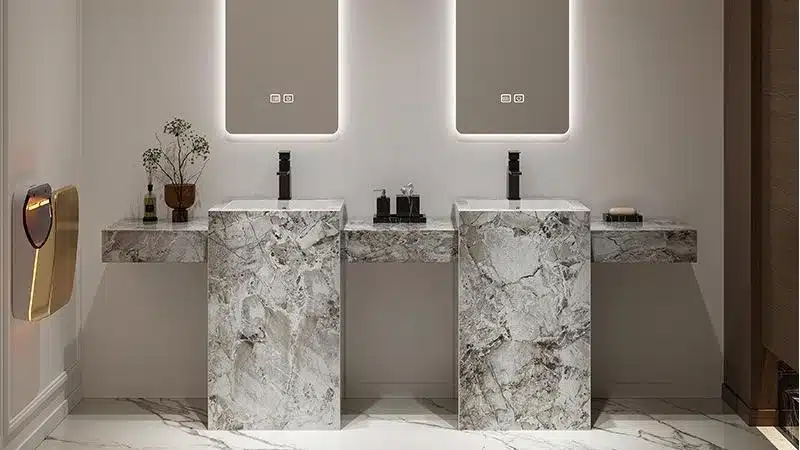
The 60-Inch Standard: Balancing Space and Functionality
The 60-inch (1524mm) vanity is the industry’s default solution for dual-basin functionality. It hits the sweet spot for most residential and hospitality projects, fitting comfortably into standard master bathroom layouts without dominating the room. This size offers two sinks and adequate counter space, meeting the practical needs of shared spaces while remaining spatially efficient and cost-effective for mass-market developments.
| Specification | 60-Inch (1524mm) | 72-Inch (1829mm) |
|---|---|---|
| Ideal Use Case | Standard master bathrooms, multi-unit projects | Large master suites, luxury market |
| Per-User Space (Centerline) | Approx. 30 inches (meets minimum standard) | Approx. 36 inches (meets comfort standard) |
| Market Positioning | Functional Workhorse | Premium Upgrade |
| FocusCabinet Production MOQ | 20 Sets Per Model | 20 Sets Per Model |
The 72-Inch Upgrade: Luxury and Expanded Storage
Moving up to a 72-inch (1829mm) vanity represents a clear step into the luxury segment. This width is designed for larger master bathrooms where space is not a primary constraint. The additional foot of length provides significantly more countertop area between and beside the sinks, reducing clutter and enhancing the user experience. It also allows for wider drawer banks and more substantial cabinet storage, commanding a premium price for its upscale appeal and superior functionality.
User-Centric Design: Maximizing Personal Space
The primary driver for choosing between these two sizes is the allocation of personal space, or “elbow room.” Modern design standards and consumer expectations call for 30 to 36 inches of dedicated space per user for a comfortable, non-conflicting daily routine. While a 60-inch model provides the bare minimum of 30 inches per person, the 72-inch model easily delivers a more generous 36 inches. This extra room is critical for simultaneous use, making the larger format the superior choice for high-end builds where user comfort is the top priority.
Boost Your Sales with Durable Vanities

Plumbing Configuration for Dual Basins
Properly configuring dual-basin plumbing requires joining two sink drains into a single, correctly sloped drainpipe using a double sanitary tee, ensuring each basin has its own p-trap to block sewer gases.
Drain and Water Line Configuration Techniques
A correct dual basin setup is straightforward but requires precision. Each sink needs dedicated hot and cold water supply lines, which are typically split from the main wall stubs with individual angled stop valves. The critical part is the drainage. Both sink drains are joined into a single main drain line using a specialized fitting called a double sanitary tee. This component ensures wastewater from both basins flows smoothly without creating backflow or siphoning effects. For the system to work reliably in 2026, all horizontal drain pipes must maintain a consistent downward slope of about 1/4 inch per foot. Finally, a p-trap is installed directly below each sink’s drain outlet; this is non-negotiable as it creates a water seal that blocks sewer gases from venting into the bathroom.
| Component | Standard Specification (2026) | Function & Key Consideration |
|---|---|---|
| Drain Pipe Diameter | 1.5-inch | Sufficient for dual bathroom sink flow without being oversized. |
| Drain Slope | 1/4 inch per foot | Ensures effective gravity-fed drainage and prevents clogs. |
| Connection Fitting | Double Sanitary Tee | Allows two horizontal lines to merge smoothly into one vertical drain. |
| Trap | Individual P-Trap per Sink | Blocks sewer gas; a separate trap for each fixture is required by code. |
Adapting a Single Drain for Dual Sinks
Converting an existing single-sink vanity to a double often means modifying the single drain stub-out in the wall. This is a common renovation task. One method connects the two sink drains horizontally with a continuous waste pipe that feeds into a single, centrally located p-trap. A more robust approach is to install two separate p-traps, one for each sink, and connect their outlets to a double sanitary tee that funnels wastewater into the original drainpipe. When performing this conversion, you must account for the increased water volume from two simultaneous users to prevent slow drainage. Always verify local plumbing codes, as regulations for combining drains can differ by jurisdiction.
Standard Sizing and Spacing
Adhering to standard dimensions for plumbing ensures a functional layout that is easy to install and service later. Bathroom basins are typically 18 to 20 inches wide, which dictates the minimum clearance needed between them on the countertop. The drain lines for these sinks almost universally use 1.5-inch diameter pipes, providing adequate flow for a dual configuration. During rough-in, space the water supply lines at least four inches away from the drain line to prevent interference. Most importantly, leave enough physical space around the p-traps and shutoff valves to allow hand and tool access for future repairs or replacements without having to deconstruct the vanity.
Countertop Durability: Quartz vs. Cultured Marble
The countertop market has a clear divide: Quartz offers superior, low-maintenance durability for long-term value, while Cultured Marble provides a cost-effective solution for projects where initial budget is the primary driver.
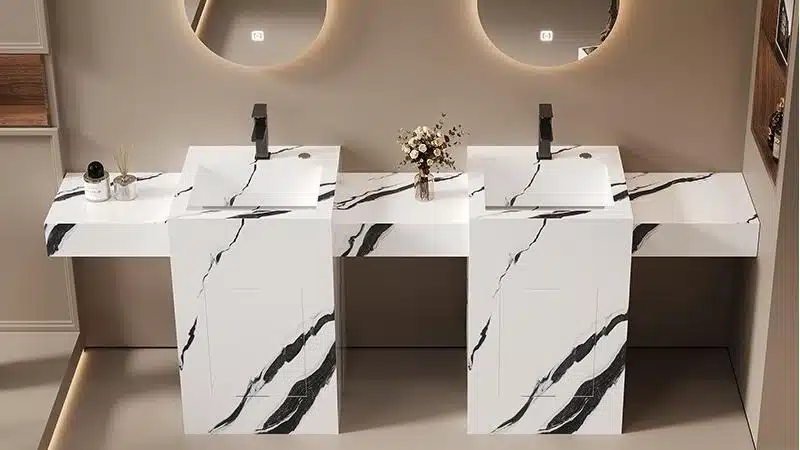
Selecting the right countertop material is a critical decision that balances cost, aesthetics, and long-term performance. In 2026, the two dominant engineered surfaces for bathroom vanities are quartz and cultured marble. Each material serves a distinct market segment, and understanding their technical differences is key to specifying the right product for a project’s goals, whether it’s a high-traffic commercial restroom or a budget-driven residential development.
Quartz: Low-Maintenance and High-Durability Standard
Quartz is the leading choice for high-use environments because of its superior scratch and stain resistance. As an engineered, non-porous surface, it completely eliminates the need for periodic sealing. This “set-and-forget” characteristic makes it a practical, long-term investment for commercial and residential projects where minimizing maintenance is a priority. Recent manufacturing advancements have expanded its aesthetic range and further improved its performance, solidifying its position as the industry benchmark for durability.
Cultured Marble: The Cost-Effective Alternative
Cultured marble remains a popular option for budget-conscious projects, offering consistent aesthetics at a lower price point. The material is composed of crushed marble dust and resins, finished with a protective gel coat. This top layer requires more careful handling to avoid scratches and needs periodic sealing to maintain its integrity. Its sustained appeal lies in its initial affordability and the fact that minor surface damage can often be repaired, making it a viable choice for specific residential applications.
| Specification | Quartz | Cultured Marble |
|---|---|---|
| Durability | Superior scratch, stain, and heat resistance. | Requires careful handling; gel coat is susceptible to scratches. |
| Maintenance | None. Non-porous surface requires no sealing. | Requires periodic sealing to protect the surface. |
| Primary Market Position | High-use environments; clients prioritizing longevity. | Cost-effective alternative for budget-driven projects. |
Comparing Long-Term Performance and Market Preference
The market trend leans heavily toward materials that promise longevity with minimal effort. Quartz directly meets this demand for low-maintenance durability, making it the preferred material for busy settings and buyers willing to invest in long-term performance. Cultured marble continues to serve consumers who prioritize initial cost savings over long-term upkeep. It holds a competitive niche in residential markets or rental properties where upfront budget dictates material selection.
“Master Bath” Appeal in Real Estate
A double vanity is a critical marketability feature that signals luxury and meets buyer expectations, though its direct financial return depends more on market conditions than a guaranteed price increase.
Influence on Buyer Perception and Marketability
In competitive real estate markets, a double sink vanity is no longer just an upgrade; it’s a signal of modern functionality and a standard expectation. This feature enhances a property’s appeal by improving the perceived space and convenience of the master bathroom, aligning with buyer demands in most urban and suburban areas. It moves a property from “acceptable” to “desirable” by showing that the design considers the practicalities of daily life for couples or families.
- Double sinks are a baseline expectation for buyers in many mid-to-high-end markets.
- The feature increases marketability by suggesting a more spacious and well-appointed living environment.
- It directly addresses the daily convenience needs of modern households, making it a powerful selling point during showings.
Return on Investment Analysis
Minor bathroom remodels that include adding a double vanity are among the most financially sound home improvements. Data shows these projects can yield a return on investment around 102%. This value is realized by making the property more competitive and desirable, leading to a quicker sale at a target price, not necessarily by adding a fixed dollar amount to the home’s appraised value. The investment helps a property stand out in online listings and justifies its price point against comparable homes that lack this feature.
Factors Affecting Resale Value
The impact of a double vanity on a home’s final sale price is not universal. The actual value added is tied to local market dynamics. In a seller’s market, where inventory is low, a double vanity can be a key differentiator that encourages better offers and accelerates a sale. In a buyer’s market, it helps a home meet the baseline standard but carries less influence on the final price.
Geographic location is also a major factor. In affluent urban and suburban neighborhoods, double sinks are expected in a master suite. Their absence can be a notable negative for potential buyers. In other markets, buyers might prioritize overall square footage over specific bathroom features. Ultimately, the perceived value depends on buyer priorities, but including a double vanity almost always broadens a property’s appeal.
Reinforcement Requirements for Transport
Modern logistics demand more than just basic crating; effective transport reinforcement for vanities combines multi-layer material strategies with certified drop-testing protocols to protect fragile components like stone tops and lacquer finishes.
Protection Against Environmental and Transit Damage
Standard packaging often fails to protect against the range of environmental stressors encountered during global shipping. High-gloss lacquer and delicate finishes are susceptible to abrasion and moisture damage. To counter this, a baseline reinforcement involves a 5-layer corrugated carton, which provides a necessary buffer against punctures and compression. More critically, dedicated corner protectors are essential, as these points bear the brunt of impacts during handling and transit, preventing chips and cracks that can render a unit unsellable.
Durability for Heavy-Duty Loads
Shipping a fully assembled vanity, especially one with a 72-inch stone top that can weigh over 150 lbs, creates significant dynamic stress on the packaging. The constant vibration and potential drops in a logistics chain require a system designed for survivability. For B2B clients, especially e-commerce sellers, this means adopting packaging engineered to pass rigorous standards. The ISTA 3A Drop Test has become the industry benchmark, simulating the shipping environment for a single parcel. Passing this test ensures the packaging can withstand the drops, shocks, and pressures common in courier networks, dramatically reducing return rates due to damage.
Advanced Multi-Material Reinforcement Strategies
A single material is insufficient for comprehensive protection. An advanced strategy blends different materials, each serving a specific function. The primary defense is a system of 6-sided molded foam, which creates a custom-fit cushion that absorbs shock from any direction. This is encased within the corrugated carton and supplemented with hard cardboard reinforcement. This multi-component approach creates a rigid yet cushioned structure that isolates the vanity from external forces, ensuring high performance against both physical impacts and environmental exposure during shipping.
Cost Analysis: Single vs. Double Mold
A meaningful cost analysis of single versus double mold production requires industrial data on tooling, cycle times, and material usage, not DIY construction guides.
Data Unavailable for Mold Cost Comparison
An accurate cost comparison between single and double mold manufacturing could not be completed. The provided research material was focused entirely on do-it-yourself (DIY) methods for building vanity cabinets, drawers, and doors, making it irrelevant to the economics of industrial production.
A proper analysis depends on specific manufacturing metrics that were absent from the source data. Key information needed includes:
- Tooling and mold creation expenses for both single and double basin designs.
- Raw material consumption and waste rates for each process.
- Production cycle times and labor efficiency metrics.
- Volume-based cost trade-offs between the two molding systems.
Conclusion
Choosing the right double sink vanity involves planning for plumbing layouts, countertop loads, and transport logistics, not just visual style. Addressing these technical details early prevents costly installation issues and ensures the final product meets commercial durability standards. This attention to detail directly impacts project timelines, budget adherence, and long-term asset value.
Our team can provide detailed specifications and material options to match your project requirements. Request a refundable sample to evaluate our build quality and finish firsthand.
Frequently Asked Questions
What is the minimum width for a comfortable double vanity?
The industry standard minimum width for a comfortable double vanity is 60 inches (5 feet). While custom solutions can sometimes fit into a slightly smaller space, 60 inches provides adequate room for two standard sinks and minimal shared counter space. For a more spacious and functional experience with ample elbow room, a 72-inch or wider vanity is highly recommended.
Do double sink vanities require two separate drain lines?
No, double sink vanities do not require two separate drain lines in the wall. Standard plumbing code allows the two sink P-traps to be joined together with a sanitary tee fitting, which then connects to a single, shared drain pipe. This is an efficient and common configuration that saves on materials and complexity while ensuring proper drainage for both basins.
How heavy is a 72-inch marble top crate?
A 72-inch marble vanity top, including its protective wooden shipping crate, typically weighs between 250 to 350 pounds (113 to 159 kg). The final weight varies based on the marble’s specific density, the top’s thickness (usually 2-3 cm), and the robustness of the crating materials used for transport. Always plan for a multi-person lift.
Can I buy base-only to source local tops?
Yes, purchasing a vanity base without a top is a very common and flexible option. Most major manufacturers and retailers offer their vanity cabinets as “base-only.” This allows you to partner with a local fabricator to select and customize a countertop from a wider range of materials, such as quartz, granite, or quartzite, ensuring a perfect fit and unique finish for your project.
What is the resale value impact of double sinks?
A double sink vanity has a significant positive impact on resale value, particularly in a primary or master bathroom. It is now a widely expected feature that buyers associate with modern convenience and perceived luxury. Adding a double vanity enhances the bathroom’s functionality and marketability, making the home more attractive to potential buyers and contributing to a stronger overall valuation.
Common plumbing conflicts with drawers?
The most common plumbing conflict is the sink’s P-trap and drain assembly physically obstructing the path of the top-row drawers. The U-shaped trap occupies the central space directly beneath the sink drain. To resolve this, vanities are often designed with specialized U-shaped drawers that have a cutout in the middle, false drawer fronts under the sinks, or more compact, offset drain systems.




0 Comments