


Selling a complete bathroom vanity and mirror set is a core strategy to combat margin compression and reduce costly freight damage. Many distributors treat mirrors as a simple accessory, forcing contractors to source components separately and leaving a significant 20% margin opportunity on the table. When vanities ship solo, the operational burden of managing fragile, low-margin mirror shipments separately erodes profitability and complicates the customer’s installation process.
This guide provides a standard operating procedure for integrating mirrors into your core vanity program. We’ll cover the tactical decisions, from SKU management and nested packaging logistics to marketing a “ready to install” solution. We explain the design rules for matching finishes, calculating the correct mirror size using the “2-inch gap” rule, and the data proving how this bundle strategy directly increases Average Order Value (AOV).
Does Bundling Increase AOV?
Product bundling is a proven B2B strategy that directly increases average order value by simplifying customer decisions and raising the perceived value of a complete solution.
Quantifiable Impact on Revenue
The data is conclusive: offering products like a bathroom vanity and mirror as a single package drives higher revenue. In 2026, this isn’t a theoretical advantage; it’s a core commercial tactic. Strategic bundles can lift Average Order Value (AOV) by 30% to 55%. More importantly, well-executed bundles have been shown to increase revenue per user by as much as 86% by encouraging a larger initial purchase instead of separate, smaller transactions over time.
| Performance Metric | Selling Items Separately | Bundling Vanity + Mirror |
|---|---|---|
| Average Order Value (AOV) | Baseline | Up to +55% Increase |
| Revenue Per User | Baseline | Up to +86% Increase |
| Customer Purchase Friction | High (Multiple sizing & style decisions) | Low (Pre-matched solution) |
The Psychology of Perceived Value
Bundling works because it aligns with customer psychology. When a buyer sees a vanity and mirror set priced 15-20% lower than the cost of buying both items individually, it creates a powerful sense of “consumer surplus”—getting more for their money. This strategy also reduces cognitive load. Instead of researching correct mirror proportions and matching finishes, the customer is presented with a curated, ready-to-install solution, which removes decision fatigue and accelerates the path to purchase.
Key Strategies for Effective Bundling
Successful bundles are not random; they are engineered based on data. The most profitable bundles pair products that are naturally complementary and solve a complete customer problem. For a B2B supplier, this means offering vanity and mirror combinations that are aesthetically cohesive and functionally practical.
- Analyze Purchase Data: Identify which vanity sizes and styles are most frequently purchased with specific mirror types. Use this data to create bundles that reflect actual customer behavior, not just assumed pairings.
- Offer Tiered Options: Create different bundle tiers. For example, a basic bundle might include a standard mirror, while a premium bundle features a dimmable, anti-fog LED mirror. This appeals to different budget and project requirements.
- Use Time-Based Incentives: Promote specific bundles with limited-time offers for project-based clients like contractors and hotel developers to create urgency and drive bulk orders.

Do You Need to Match Finishes?
The industry has moved past the outdated rule of matching every metal finish. Modern design prioritizes intentional contrast and coordinated undertones to create a layered, custom aesthetic that feels both cohesive and personalized.
The Shift from Uniformity to Coordination
By 2026, bathroom design no longer demands that all metal finishes be identical. The current standard favors thoughtful coordination, which allows for greater personalization and a more sophisticated, layered look. This trend reflects a broader shift in the market, where individual expression has replaced rigid uniformity as the mark of good design.
- Current design guidance favors coordinating undertones—pairing warm metals with other warm tones, for example—rather than insisting on exact finish matches for fixtures, lighting, and hardware.
- This flexibility enables unique and compelling combinations, such as pairing a warm, Brushed Gold mirror frame with cool-toned fixtures to create a deliberate and high-impact visual statement.
Principles for Mixing Finishes Effectively
Successfully mixing finishes is a strategic exercise in maintaining visual balance and cohesion. It’s not about random selection but a curated approach grounded in principles of tone, texture, and visual weight. Done correctly, the space feels thoughtfully designed rather than chaotic or mismatched.
- Establish a dominant metal for the primary fixtures, like the faucet and showerhead, then introduce a secondary finish as a deliberate accent on elements like cabinet pulls or the mirror frame.
- Maintain visual cohesion by choosing finishes with shared undertones or by repeating an accent element across the room to create a common thread.
- Combine different textures, such as a Matte Black faucet from one of our collections with a polished chrome mirror frame, to introduce depth and prevent the design from feeling flat.
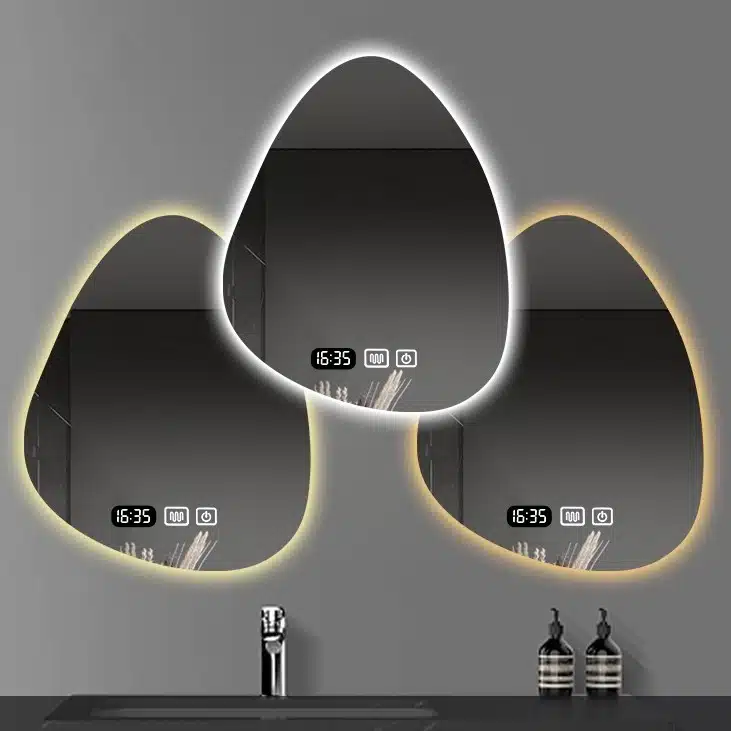
Boost Your Sales with Smart Mirrors
What Is the “2-Inch Gap” Rule?
The term “2-inch gap” actually highlights an impractical design choice; professional installers recommend a gap of at least 4 inches or installing the vanity flush to the wall to avoid maintenance issues.
The Problem with a Narrow 2-Inch Gap
The “2-inch gap” rule is a common point of discussion, but it points to a spacing that is too small for practical use. A gap this narrow makes it difficult to clean or retrieve items that fall between the vanity and the wall, creating a long-term maintenance problem.
- Dust, hair, and moisture accumulate in a narrow 2-inch gap, making it hard to keep the area hygienic.
- Retrieving dropped items like jewelry or bottle caps becomes nearly impossible without moving the entire vanity.
- Most professional installers recommend either a larger gap or no gap at all to prevent these issues.
Recommended Spacing Alternatives
Instead of a 2-inch gap, professional guidelines suggest two main approaches for installing a vanity next to a wall. The right choice balances easy cleaning with a seamless aesthetic.
- 4–6 Inch Gap: This is the recommended minimum spacing to allow enough room for a hand or cleaning tool, making it easy to wipe down the floor and wall.
- Flush to Wall: Installing the vanity directly against the wall eliminates the gap completely. This prevents anything from falling in between and creates a clean, built-in look.
- 3–4 Inch Gap: Some homeowners choose this as a compromise, offering slightly more cleaning access than 2 inches while keeping the vanity close to the wall.
Key Spacing for Double Vanities
Beyond the wall gap, proper spacing is critical for double sink vanities to ensure functionality for two users at once. These measurements are based on user comfort and accessibility.
- A minimum of 30–36 inches of open floor space in front of the vanity is necessary for comfortable movement and to fully open drawers or doors.
- The ideal distance between the centers of the two sinks is 18–24 inches, providing sufficient personal space for each person.
- These guidelines prevent crowding and ensure the double vanity is a practical, shared space.

Nest Mirrors or Ship Separate?
The decision to bundle (nest) or separate vanity and mirror shipments pivots on a key trade-off: bundled shipping streamlines purchasing and enhances value for builders, while separate distribution empowers design-focused buyers with customization.
The Case for Bundled Shipping
Shipping vanities and mirrors as a single, cohesive package boosts perceived value and simplifies the customer’s decision. This approach is the standard for cost-conscious homeowners and large-scale builders who require a unified aesthetic and straightforward installation. Bundling creates a solution-based sale, removing the friction of matching components and guaranteeing proportional fit.
- Bundled sets offer competitive pricing advantages and can directly improve a home’s resale value by presenting a professionally coordinated look.
- This strategy drives operational efficiency. It helps clear matched inventory and reduces design complexity for multi-unit projects.
| Shipping Method | Primary Target Audience | Logistical Focus |
|---|---|---|
| Bundled (Nested) Shipping | Builders, contractors, wholesale projects, cost-conscious homeowners | Maximize container space (Freight Saver), reduce cost per unit, simplify inventory management. |
| Separate (À la Carte) Shipping | Design-forward consumers, e-commerce retail, custom renovation projects | Maximum product protection (Drop Test Safe), enable design flexibility, higher shipping cost per unit. |
The Flexibility of Separate Distribution
Distributing mirrors and vanities separately caters directly to the design-forward market. This model provides modular flexibility, allowing buyers to mix materials, finishes, and styles to achieve a specific, personalized aesthetic. It avoids the constraints of a pre-packaged set and puts creative control back in the hands of the end-user or designer.
- Separate purchases give customers complete freedom to select custom sizes, advanced features like LED defoggers, and unique frame styles for each component.
- This à la carte approach appeals to buyers who prioritize unique, personalized bathroom designs over the convenience of a pre-packaged solution.
Bundle SKU or Separate?
Bundling a vanity and mirror under a single SKU simplifies procurement for trade professionals and boosts order value, while separate SKUs serve clients who prioritize custom design flexibility.
Boosting Sales with Cohesive Product Offerings
Creating bundled SKUs for vanities and mirrors directly addresses market demand for design cohesion and convenience. This strategy helps distributors increase average order value by offering a complete, aesthetically balanced solution. A single, competitively priced package simplifies the customer’s purchasing decision and can improve home resale value, making it an effective sales tool.
- Pre-matched sets eliminate the guesswork for consumers and contractors, ensuring a unified and professional look.
- Bundles offer perceived value and simplified pricing, which can drive higher conversion rates for distributors.
- MFBATH can leverage its customization capabilities to offer unique bundled packages tailored to specific regional tastes or project requirements.
Streamlining Procurement for Builders and Designers
For trade professionals managing large projects, bundled solutions streamline the specification and purchasing process. A single SKU for a vanity and mirror set reduces administrative work and guarantees that components are designed to work together. This approach is highly valued by builders and designers who prioritize efficiency and predictable outcomes.
- A single SKU simplifies inventory management and logistics for distributors handling large-scale orders.
- This strategy provides a turnkey solution for developers and contractors, ensuring proportional and aesthetic balance in every unit.
- Offering pre-configured bundles targets the cost-conscious professional market that values both quality and streamlined installation.

How to Market “Ready to Install”?
Effective “Ready to Install” marketing shifts the focus from individual products to complete, time-saving solutions, directly appealing to the core operational needs of builders, contractors, and project managers.
Emphasize Complete Solutions and Convenience
Position the vanity and mirror set as a cohesive design package that removes complexity from any renovation or new build. This approach is highly effective for both homeowners and professional builders who need to reduce decision-making time and guarantee a matched, professional look without extra sourcing effort. The key is to sell efficiency and certainty, not just a vanity and a mirror.
- Promote the functional and aesthetic value of a pre-matched set that eliminates design guesswork.
- Highlight the significant time savings achieved by removing the need to source and coordinate separate items from different suppliers.
| Customer Segment | Primary Pain Point | “Ready to Install” Marketing Angle |
|---|---|---|
| DIY Homeowners | Decision fatigue & design uncertainty | A cohesive, designer-curated look without the guesswork. Save time and ensure a perfect match. |
| Builders & Contractors | Project delays & labor inefficiency | Streamline procurement and installation. One SKU, one delivery, less on-site coordination. |
| Interior Designers | Sourcing complexity & budget control | A reliable, high-value turnkey solution that simplifies project budgeting and procurement for clients. |
Highlight Value with Bundled Pricing
Clearly communicate the direct cost savings of buying the bundle versus purchasing the vanity and mirror separately. This value proposition is a primary driver for budget-conscious homeowners and project managers responsible for financial oversight. The message isn’t just about saving money; it’s about making a smarter, more efficient investment that simplifies project accounting and procurement from the start.
Target Professional and B2B Channels
Concentrate marketing efforts on the professionals who benefit most from efficiency: builders, contractors, and interior designers. These groups value streamlined solutions that save labor, reduce project timelines, and minimize sourcing headaches. They are the ideal audience for ready-to-install products.
- Use targeted email campaigns and platforms like LinkedIn to deliver messaging that speaks directly to professional pain points.
- Develop technical spec sheets and installation guides that underscore the product’s ease of installation and positive impact on project timelines.

Conclusion
Creating a successful vanity and mirror bundle relies on mastering the details, from matching finishes to optimizing shipping logistics. This strategy simplifies the purchasing process for your customers and adds significant margin to each sale. A well-executed bundle transforms separate products into a cohesive, high-value solution.
Evaluate your current vanity offerings to identify opportunities for creating complete \\”full suite\\” packages. Contact our team to discuss your project needs or request a sample to experience our automotive-grade edge finishing and true-tone reflection firsthand.
Frequently Asked Questions
Should I buy vanity and mirror together?
From a value and convenience perspective, buying a vanity and mirror together is highly recommended. Bundling these complementary items is a proven strategy that allows retailers to offer a better overall price, often 15-20% lower than if purchased separately. This simplified approach reduces the cognitive load of matching items yourself and ensures a cohesive design, creating a win-win where you get a great value and an easier purchasing decision.
How to match mirror to vanity?
To match a mirror to a vanity, focus on three key elements: scale, style, and finish. The mirror’s width should typically be 2-4 inches narrower than the vanity’s width to create a balanced look. The style should be complementary—a modern, frameless mirror pairs well with a minimalist vanity, while an ornate, framed mirror suits a traditional one. Finally, coordinate the finishes. If the mirror is framed, its finish should align with the vanity hardware or faucet for a cohesive and professionally designed appearance.
Wholesale bathroom vanity sets?
Offering wholesale bathroom vanity sets is a highly effective business strategy. By bundling vanities with matching mirrors and sometimes faucets, wholesalers can significantly increase their average order value (AOV) and revenue per user. Data shows that strategic bundles can boost AOV by 30% to over 50%. These pre-selected sets simplify the purchasing process for contractors and retailers, providing them with a complete, value-driven solution that is easier to market and sell to end consumers.
Best size mirror for 30 inch vanity?
For a 30-inch vanity, the ideal mirror width is between 26 to 28 inches. This standard design guideline ensures the mirror is narrower than the vanity, creating a visually pleasing and balanced proportion. For height, the mirror should extend from a few inches above the faucet to a height that is comfortable for users, typically stopping below the ceiling or any overhead lighting fixtures. If using two smaller mirrors over a double vanity, apply the same width principle to each sink’s section.
Packaging mirrors with vanities?
Packaging mirrors with vanities requires a multi-layered approach to prevent damage during transit. The mirror is typically packaged separately from the vanity base in its own box, fortified with high-density expanded polystyrene (EPS) foam, custom-molded inserts, and reinforced corner protectors. Both the vanity and mirror boxes are then often placed within a larger master carton or secured together on a pallet. This “box-in-box” method, combined with clear “Fragile” and “This Side Up” labeling, is the industry standard for ensuring both items arrive intact.
Does bathroom mirror need to match faucet?
While it is not a strict requirement, the bathroom mirror frame should ideally match the faucet and other hardware finishes (like cabinet pulls and light fixtures) for a cohesive and intentionally designed space. Coordinating these metallic or colored elements—such as matching a matte black faucet with a matte black mirror frame—creates a polished, high-end look. If you opt for a frameless mirror, this rule does not apply, offering more flexibility to mix and match hardware finishes elsewhere in the bathroom.





0 Comments