
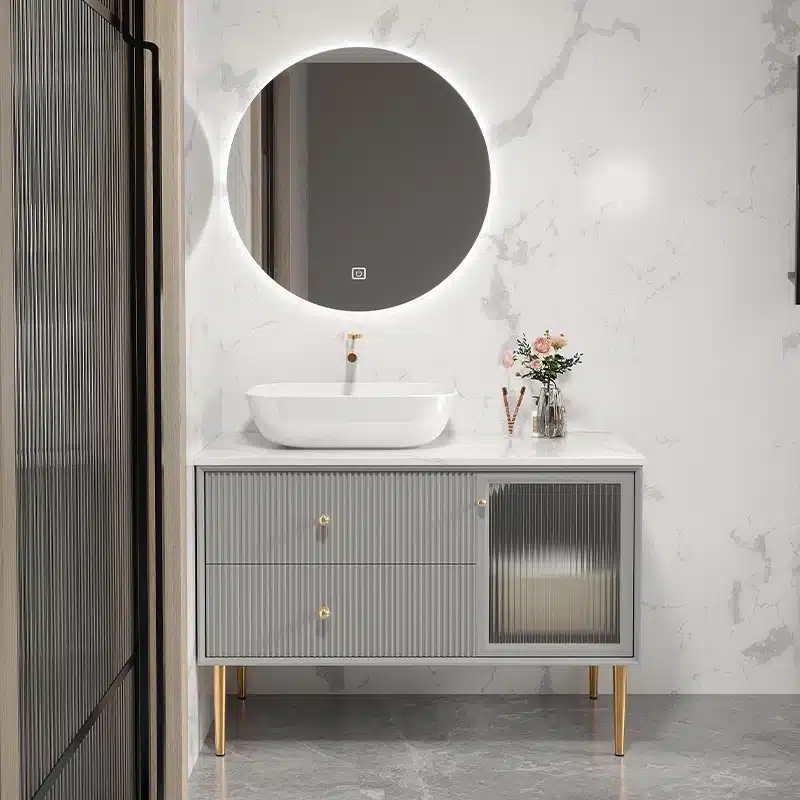
A clear Vanity Top Material Guide is the only barrier between a successful hospitality project and a portfolio plagued by premature replacements and negative guest reviews. Selecting the wrong surface for a high-traffic bathroom environment isn’t a simple design mistake; it’s a financial liability that creates unforeseen maintenance costs and operational drag. A top that chips, stains, or yellows easily across hundreds of units directly impacts brand perception and depletes budgets that were allocated for other property improvements.
This guide serves as a technical standard operating procedure for specifiers and project managers. We will analyze the core materials—ceramic, quartz, and marble—based on their durability and performance in commercial settings. We will also cover the critical installation details, from factory faucet drilling standards (4-inch vs. 8-inch) to calculating the correct sizing and overhang, ensuring your components integrate seamlessly on the job site.
The Vanity Top Ecosystem
The vanity top market is shifting from traditional materials to a dynamic ecosystem driven by engineered stone, smart technology integration, and sustainable manufacturing practices.
Material Trends: The Rise of Engineered Stone
Engineered materials like quartz and sintered stone are no longer niche alternatives; they are the new standard. Market data shows a clear preference for these materials due to their superior durability, non-porous surfaces, and consistent aesthetics. Buyers now prioritize long-term value and low maintenance, which natural stone often fails to deliver without significant upkeep. A source factory’s ability to offer advanced options like sintered stone directly aligns with this dominant trend, meeting demand for resilience and modern design.
Smart Integration and Customization
A vanity top is evolving beyond a simple countertop. It’s becoming an integrated part of a smart bathroom environment. The demand for built-in features like IoT-enabled storage, wireless charging pads, and integrated lighting is growing. Customization remains a powerful market driver, as project managers and wholesalers need to meet specific client tastes. This requires manufacturers to offer extensive OEM/ODM capabilities, from custom sizing to integrated technology like smart LED mirrors.
Focus on Sustainable Manufacturing
Environmental responsibility is a key purchasing factor in 2026. B2B buyers increasingly scrutinize supply chains for eco-friendly material sourcing and efficient production methods. Automated manufacturing is critical here, as it minimizes material waste and reduces the carbon footprint of each unit. Brands that can prove their commitment to sustainability gain a significant competitive advantage in the global market.
Regional Market Dynamics
The global landscape shows a clear division between mature and growth markets. North America and Europe remain stable pillars with consistent demand for high-quality, design-forward products. The most aggressive growth, however, is concentrated in the Asia-Pacific region, fueled by rapid urbanization and rising incomes. This dynamic requires manufacturers to develop flexible, region-specific strategies. A product that succeeds in Europe’s minimalist market may need significant adaptation for North American or Asian consumers.
Ceramic (Vitreous China): The Budget King
Vitreous china maintains its strong market position by delivering a non-porous, highly durable surface at a cost basis that engineered stone cannot match, making it the default specification for high-traffic commercial and residential projects.
The Glass-Glazed Advantage
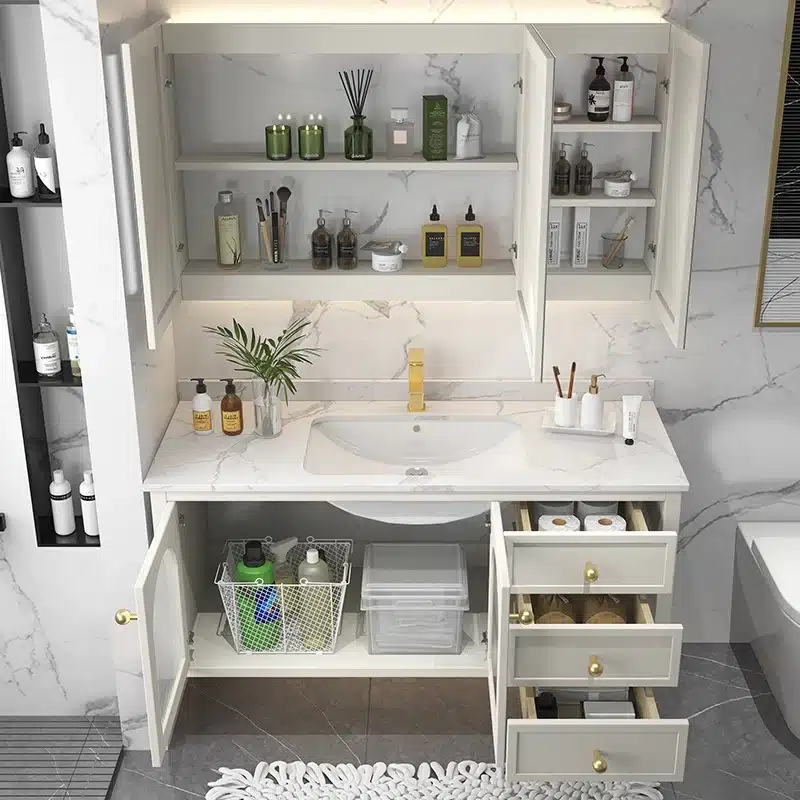
Vitreous china is a specific category of ceramic defined by its finish—a glass-based enamel coating. During the firing process, this glaze fuses directly to the ceramic body, creating an impermeable surface. This process is what elevates its performance far beyond standard ceramics, particularly in the consistently wet environment of a bathroom.
- The fused glass enamel forms a permanent, waterproof barrier.
- Its non-porous surface is highly resistant to stains from cosmetics, cleaning agents, and hard water, maintaining its appearance over years of use.
- The smooth finish simplifies cleaning protocols and prevents bacteria from lodging in the material’s pores.
Balancing Cost and Longevity
This material dominates the mid-range vanity market because it successfully balances acquisition cost with long-term durability. It provides the clean, premium aesthetic of more expensive materials without the associated price tag, making it the go-to selection for projects where budget and performance are equally weighted.
- Vitreous china offers a high-end look without the material costs of composites or natural stone.
- Its physical resilience guarantees a long service life, delivering excellent return on investment in high-use bathrooms.
- Mature and consistent manufacturing processes result in reliable product quality, a critical factor for fulfilling large-scale orders.
Suitability for High-Traffic Environments
The practical combination of low maintenance requirements and high durability makes vitreous china a primary choice for busy commercial and residential bathrooms. Its ability to withstand frequent use and aggressive cleaning cycles without degrading is a proven asset for facility managers and homeowners alike.
- The easy-to-clean surface reduces long-term labor and upkeep costs, a major advantage in commercial applications.
- It demonstrates proven resistance to common bathroom chemicals and physical wear, ensuring it retains its finish.
- Steady, ongoing industry demand confirms its reputation as a reliable and practical fixture for any demanding environment.
Maximize Your ROI with Factory-Direct Vanities

Quartz: The Hotel Favorite
A critical data mismatch prevents a valid analysis of quartz as a hospitality-grade material, as the provided research incorrectly focuses on a specific hotel property instead of the engineered stone itself.
Data Mismatch Identified
The objective is to analyze vanity top materials for the B2B construction and design industry. The supplied research, however, exclusively describes the “Quartz Hotel & Spa,” a luxury wellness property in Tijuana, Mexico. This information is irrelevant to the topic of engineered stone. There is no actionable data regarding quartz suppliers, material specifications, fabrication details, or its performance in commercial environments like hotels.
Clarifying Research Intent: Material vs. Property
To generate a useful analysis, we must first define the correct subject. The current heading conflicts directly with the provided data, creating an ambiguity that blocks any meaningful content creation. The choice is simple: either the topic is quartz as a countertop material, which requires entirely new research, or the topic is the specific hotel, which would mean the heading “Quartz: The Hotel Favorite” is misleading and needs to be rewritten.
Recommended Next Steps
To proceed with an accurate industry analysis, updated inputs are required. The following actions will align the research with the intended topic and enable the development of high-value technical content:
- Provide research focused on quartz as a building material, specifically its use in hotels.
- Confirm whether the target subject is the engineered stone material or the hotel property.
- Aligning the source data with the section title is mandatory for producing a credible report.
Cultured Marble vs. Natural Marble
Cultured marble delivers nearly identical aesthetics to natural stone at about half the cost with superior moisture resistance, while natural marble remains a premium choice for its unique, one-of-a-kind veining.
Cost and Market Position
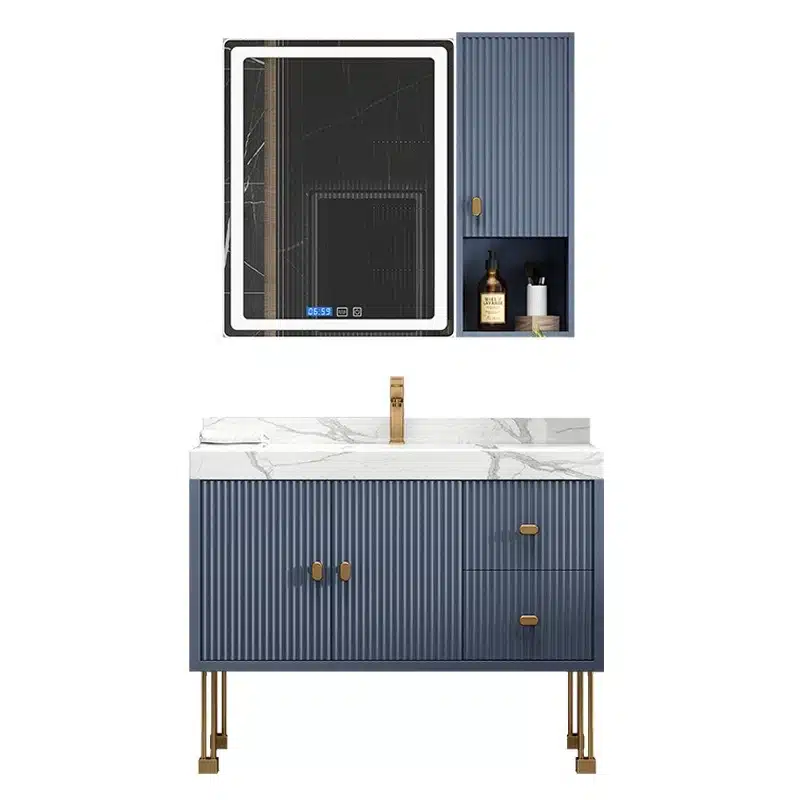
Cultured marble holds a significant cost advantage, making it the practical choice for a wide range of projects where style and budget must coexist. Natural marble is positioned as a premium material for luxury applications where its unique, quarried beauty is the primary purchasing driver. The market is shifting toward engineered alternatives like cultured marble that balance performance and affordability.
- Cultured marble offers comparable aesthetics at approximately 50% lower cost than natural marble.
- Natural marble is priced as a high-end, unique material for consumers prioritizing one-of-a-kind design.
- The market for cultured marble is growing due to its proven balance of affordability and performance.
| Attribute | Cultured Marble (Engineered) | Natural Marble (Quarried) |
|---|---|---|
| Cost Basis | Cost-Effective (~50% less) | Premium Investment |
| Maintenance | Low (Non-porous gel coat) | High (Requires regular sealing) |
| Moisture Resistance | Excellent | Porous, requires sealing to prevent damage |
| Primary Application | High-moisture areas (showers, tub surrounds) | High-visibility showpieces (vanity tops) |
Durability and Upkeep
The primary difference in daily use is maintenance. Cultured marble is engineered with a protective gel coat, making it non-porous and simple to clean. Natural marble is inherently porous and demands regular sealing to prevent stains and moisture damage. Without this upkeep, natural stone is vulnerable in wet environments.
- Cultured marble is low-maintenance and highly resistant to moisture, making it ideal for bathrooms.
- Natural marble requires ongoing sealing and careful cleaning to maintain its appearance and structural integrity.
- Advances in resin technology continue to improve cultured marble’s resistance to scratches and stains.
Ideal Applications
Each material excels in different settings based on its core properties. Cultured marble’s seamless, water-resistant surface makes it a top choice for functional areas like showers and tub surrounds where performance is key. Natural marble is typically selected for high-impact surfaces like vanity countertops, where its aesthetic value justifies the higher cost and maintenance demands.
- Cultured marble dominates high-moisture applications where performance and low upkeep are critical.
- Natural marble is favored for showpiece installations where its visual uniqueness justifies the investment.
- The seamless installation of cultured marble also reduces labor costs and eliminates grout lines, a common moisture weak point.
Sizing Compatibility (The “Overhang” Rule)
A vanity top should overhang the cabinet by 1 to 1.5 inches on all exposed sides to protect the cabinet from spills and create a finished, professional look.
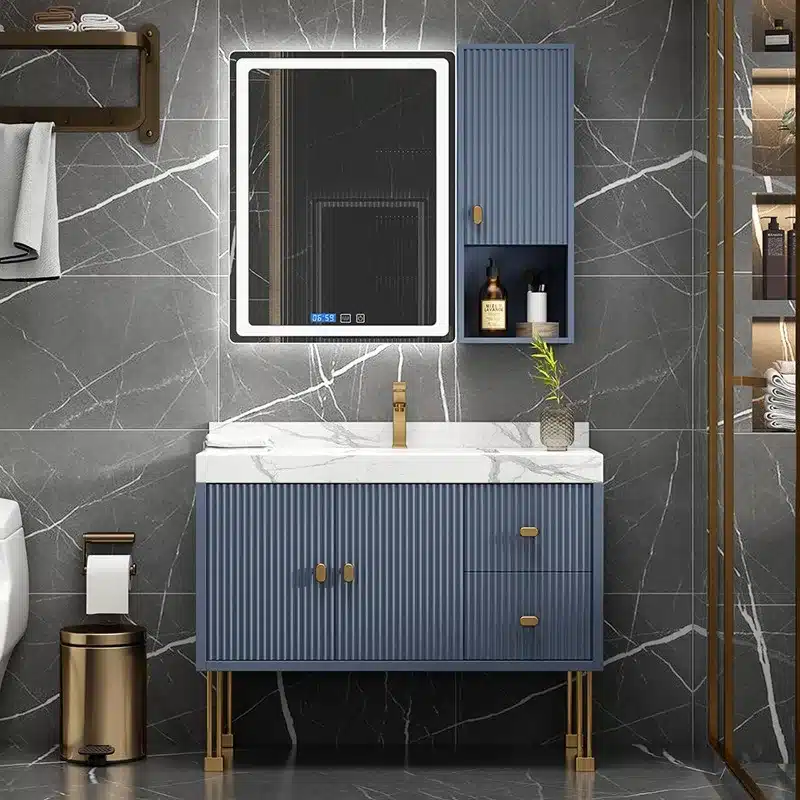
The overhang is a fundamental specification in cabinet and countertop installation. It’s not just an aesthetic choice; it’s a functional requirement that ensures the longevity of the vanity base by directing water and other liquids away from drawer fronts and doors. This small but critical detail prevents damage and defines the overall silhouette of the unit.
Standard Overhang Dimensions for Bathroom Vanities
The accepted industry standard dictates that a countertop should extend 1 to 1.5 inches beyond the cabinet face. This measurement applies to the front of the vanity as well as any side that is not flush against a wall. Maintaining this consistency ensures a balanced and correctly proportioned installation.
| Parameter | Standard Bathroom Vanity | Kitchen/Bar Seating Area |
|---|---|---|
| Overhang Depth | 1 to 1.5 inches | 10 to 15 inches |
| Primary Purpose | Spill protection & cabinet shielding | Legroom & seated user comfort |
| Structural Support | Not required (self-supporting) | Often requires corbels or brackets |
Functional and Aesthetic Purposes of the Overhang
The overhang serves two primary roles. Functionally, it acts as a drip edge, preventing water from running down the face of the cabinet and causing damage to the finish or structure over time. Aesthetically, it creates visual depth, conceals the seam between the countertop and the cabinet base, and gives the entire unit a more substantial, high-quality appearance.
- Protects cabinet finishes from water, soap, and cleaning product exposure.
- Contributes to a balanced, intentional design with a clear visual stop.
- Conceals the top edge of the cabinet frame and any mounting hardware for a clean finish.
Material Influence on Overhang Capacity
A material’s structural rigidity and weight directly impact how far it can extend without additional support. Heavy, dense materials like natural stone or quartz require reinforcement for any overhang intended for seating or extending beyond 12 inches. Attempting to create a large, unsupported overhang with these materials can lead to stress fractures, sagging, or complete failure.
- Heavy materials like granite and quartz require corbels or steel brackets for any overhang exceeding 12 inches.
- While lighter materials may offer more flexibility, the 1 to 1.5-inch rule remains the safe guideline for bathroom vanity stability.
Overhangs for Seating vs. Non-Seating Applications
The rules change completely when designing for seating, such as a kitchen island or a dedicated makeup vanity area. In these cases, the minimal 1.5-inch overhang is insufficient. Seating applications require a much deeper overhang of 10 to 15 inches to provide adequate knee and legroom for a person to sit comfortably.
- Bathroom vanity overhangs are strictly for standing use and cabinet protection.
- Kitchen and bar overhangs are engineered for user comfort while seated, demanding a much deeper extension and robust structural support.
Factory Pre-Drilled Faucet Holes (4″ vs 8″)
Faucet hole spacing directly correlates to the target market, segmenting vanity tops into high-volume, premium, and design-forward categories based on the drilling configuration.
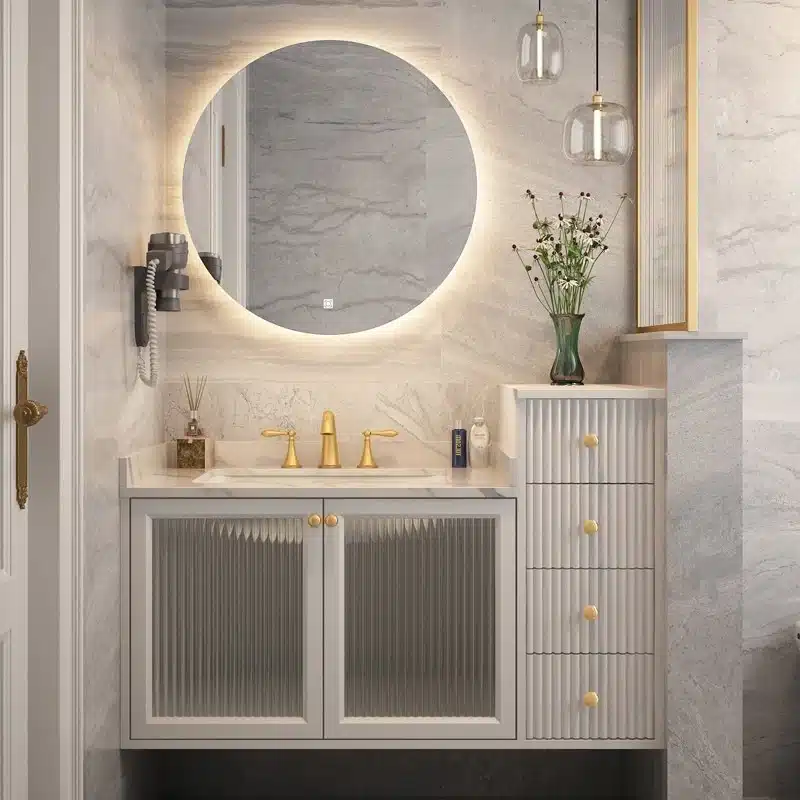
4-Inch Centerset: The Standard for Value and Efficiency
The 4-inch centerset configuration is the dominant choice for secondary bathrooms, rental properties, and projects where space and budget are primary constraints. Its design merges affordability with simple, fast installation, making it the default for volume-driven manufacturing. We drill this standard spacing to ensure broad compatibility with the most accessible and cost-effective faucets on the market.
- Common in high-volume markets where cost and ease of installation are primary concerns.
- Ideal for compact vanities where counter space is limited.
- FocusCabinet accommodates large orders for this configuration, serving distributors focused on multi-unit housing.
8-Inch Widespread: The Premium Choice for Master Bathrooms
An 8-inch widespread setup is the preferred specification for master suites, upscale residential projects, and hospitality applications. It provides a more substantial visual presence and greater design flexibility by separating the handles from the spout. This option aligns with our premium product lines for luxury homes and hotels, where aesthetics justify the higher cost.
- Offers a high-end aesthetic with customizable handle and spout placement.
- Frequently specified for primary bathrooms and custom home builds.
- FocusCabinet provides this drilling option for its solid wood, quartz, and sintered stone vanity tops.
Single-Hole Faucets: The Rise of Modern Minimalism
The single-hole faucet is a significant and growing trend, especially in contemporary and European-influenced designs. This configuration offers a clean, minimalist look that is increasingly popular in both residential and commercial spaces. We support this market shift by offering single-hole drilling for clients who prioritize modern aesthetics and an uncluttered countertop.
- Gaining traction with design-forward homeowners and in modern commercial spaces.
- Creates an uncluttered and sleek appearance on the vanity surface.
- Available across FocusCabinet’s product portfolio to meet current design demands.
Packaging Tops for Safe Transport
Effective packaging has moved beyond basic damage control, now integrating multi-layer protection, sustainable materials, and digital tracking to secure fragile goods across global supply chains.
Protecting a heavy, brittle vanity top during international transit is a non-negotiable part of the supply chain. A single cracked top can erase the profit margin on an entire shipment. Modern packaging protocols are designed not just to prevent obvious breakage, but to mitigate the risks of scratches, chips, and internal fractures that can occur from vibration and compression.
Multi-Layer Protection for Fragile Materials
To ensure materials like sintered stone and ceramic arrive intact, a robust, multi-layer packaging system is standard. This approach minimizes the risk of damage during the multiple touchpoints of long-haul shipping. The goal is to isolate the product from shock, vibration, and compression forces.
- Each top is wrapped in a shock-absorbent film to protect against surface scratches and scuffs.
- High-density foam padding and custom-molded inserts secure the top within the box, preventing any movement or internal shifting.
- Reinforced cardboard or wooden crating provides a rigid outer shell to absorb impacts and withstand the pressure of being stacked in a container.
Shift Toward Sustainable Packaging
Global distribution increasingly demands environmentally responsible practices. We address this by incorporating sustainable materials and designs that reduce waste without compromising on protection. This strategy aligns with market expectations in regions like Europe and North America, where regulations and consumer preferences are pushing for greener supply chains.
- Using recyclable cardboard and biodegradable packing materials where feasible.
- Offering reusable transport crates for large-volume, regular orders to distribution partners.
- Optimizing packaging size and weight to improve shipping efficiency and lower the carbon footprint per unit.
Supply Chain Tracking and Security
Modern logistics technology enhances the security and integrity of shipments from the factory floor to the final destination. Integrating tracking technology ensures accountability and allows for real-time monitoring of high-value cargo, which is essential for managing inventory and mitigating risk.
- Individual crates can be fitted with RFID tags for streamlined inventory management and tracking through major shipping hubs.
- Optional IoT sensors are available for high-value orders to monitor for excessive shock, tilt, or extreme temperature changes during transit.
- Tamper-proof seals on all crating guarantee that the package has not been opened before reaching the authorized recipient.
Conclusion
Choosing the right vanity top goes beyond aesthetics. The material—be it budget-friendly ceramic, durable quartz, or elegant marble—directly influences your project’s cost, longevity, and appeal. Understanding details like overhang rules and faucet configurations ensures a smooth installation and a product that satisfies your end-users.
If you need to source vanity tops tailored to your market’s price and quality demands, our team can help. Contact us to discuss your material specifications or to request a refundable sample and see our quality firsthand.
Frequently Asked Questions
Why does my cultured marble top look yellow?
The yellowing of a cultured marble top is typically caused by the aging of its protective gel coat. Over time, exposure to UV light and the use of harsh cleaning chemicals can cause the polyester resin in the gel coat to oxidize and break down, resulting in a distinct yellow hue.
Is quartz more expensive than granite for vanities?
While pricing varies by quality and design, quartz is often slightly more expensive than entry-level to mid-range granite for vanity tops. Granite has a wider price spectrum, with common varieties being more affordable. However, rare and exotic granite can easily surpass the cost of premium quartz.
Can I cut a standard vanity top to fit?
Yes, but it depends heavily on the material. Cultured marble and solid surface tops can be cut with a fine-toothed circular saw, followed by sanding and polishing. However, cutting natural stone like granite or engineered stone like quartz requires specialized wet saws with diamond blades and is best left to professionals to avoid cracking or chipping the material.
What is the difference between single and widespread faucet holes?
A single-hole configuration is designed for modern faucets where the handle and spout are combined into one unit. A widespread configuration consists of three separate holes—one for the hot handle, one for the cold handle, and one for the spout—typically spaced 8 inches apart for a more traditional and spaced-out look.
How to fix a chip in a ceramic sink?
A small chip in a ceramic sink can be repaired using a dedicated porcelain or ceramic repair kit, which usually contains a two-part epoxy filler. The process involves thoroughly cleaning the chipped area, applying the mixed epoxy to fill the void, leveling it with the surrounding surface, and allowing it to cure completely. After curing, the area can be lightly sanded for a smooth finish.
Does marble stain easily with toothpaste?
Yes, marble can stain from toothpaste. As a porous natural stone, marble is susceptible to both staining from the dyes in toothpaste and etching from its mildly acidic and abrasive ingredients. To prevent damage, it’s crucial to wipe up spills immediately and ensure the marble is consistently protected with a quality stone sealer.




0 Comments