

Specifying the wrong magnifying makeup mirror can quickly trigger negative guest reviews, directly impacting your property’s reputation for providing a premium experience. What appears to be a minor amenity is actually a critical functional touchpoint in vanity design, and a mirror with poor optics or improper placement causes immediate guest frustration. A distorted reflection or an inconvenient installation isn’t just a minor issue; it’s a detail that can undermine the entire perception of quality and care within the guest room.
This guide serves as a technical standard operating procedure for specifying and installing hospitality-grade makeup mirrors. We will break down the critical decisions, from selecting the correct magnification level (3x, 5x, or 10x) to avoid distortion risks, to determining the optimal installation height for accessibility. We will also analyze the operational trade-offs between hardwired and battery-operated lighting and examine the sourcing requirements for durable finishes and heavy-duty hinges built to withstand constant use.
Why Are “Makeup Mirrors” Considered a Necessity in Hospitality Vanity Design?
By 2026, makeup mirrors are a non-negotiable amenity, serving as a critical intersection of functional luxury, integrated design, and evolving guest expectations.
Elevating the Guest Experience with Functional Luxury
Makeup mirrors are a standard feature in any competitive hospitality property because they directly improve the guest experience. They offer a dedicated, properly lit space for detailed grooming, which sends a clear signal that the establishment prioritizes guest comfort and convenience over just providing the basics. This small touch addresses a real need that a standard, flat vanity mirror cannot.
- Gives guests the precision needed for tasks like makeup application, contact lens insertion, and shaving.
- Acts as a key differentiator, positioning a property as thoughtful and attentive to detail.
- Contributes directly to positive reviews and guest loyalty by adding a touch of practical luxury to the bathroom.
Integrating Aesthetics and Practicality in Modern Bathrooms
These mirrors are no longer just functional tools; they are integral design elements. Specifiers can select mirrors that align perfectly with a bathroom’s hardware and decor, reinforcing the overall aesthetic. The right mirror provides essential magnification and lighting without cluttering valuable vanity space, a critical consideration in compact room layouts.
- Available in a wide range of customizable finishes, including chrome, matte stainless, and brushed gold, to match faucets and other fixtures.
- LED-integrated designs offer sleek, contemporary profiles that complement modern interior design trends.
- Wall-mounted swing-arm models are especially effective at saving counter space while providing flexibility.
Meeting Evolving Hospitality Standards with Advanced Features
The hospitality market constantly raises its standards, and bathroom amenities are a key battleground for differentiation. Advanced makeup mirrors equipped with modern technology help properties meet and exceed guest expectations for a comfortable, state-of-the-art stay. Integrating these features shows that a property is keeping current with technology and is committed to a premium experience.
- Features like integrated defoggers, adjustable brightness, and switchable LED color temperatures (e.g., warm, neutral, cool) offer tangible functional upgrades.
- Energy-efficient LED lighting helps properties manage operational costs while delivering superior, shadow-free illumination.
- These tech-forward amenities prove that a property is investing in the quality of the guest’s stay.
How Do You Choose Magnification Levels (3x vs. 5x vs. 10x) to Avoid Distortion Risks?
Selecting the right magnification is a technical trade-off; 5x has become the industry benchmark because it delivers sufficient detail for most grooming tasks without introducing the significant distortion or narrow focal range common in higher-power optics.
The optimal magnification level is entirely dependent on the task. Choosing the wrong power introduces distortion and user frustration, undermining the mirror’s utility. Lower levels offer a broad, clear view for general applications, while higher magnifications are specialized tools for precision work, demanding a much closer working distance.
Matching Magnification to Specific Grooming Tasks
In hospitality and commercial projects, 5x magnification serves as the reliable standard, balancing detail with a comfortable, distortion-free field of view. 3x is best for a wider perspective, like hairstyling, while 10x is reserved for users who need extreme close-up detail for tasks like tweezing fine hairs or intricate eye makeup application. The key is to match the tool to the objective.
| Magnification Level | Optimal Use Case | Key Trade-Off |
|---|---|---|
| 3x Magnification | Full-face view, general hairstyling, applying foundation. | Lacks the detail required for precision tasks like fine tweezing. |
| 5x Magnification | The industry standard for daily makeup, shaving, and inserting contact lenses. | Offers a balanced, versatile view but may be insufficient for users with specific vision needs. |
| 10x Magnification | Highly detailed work like tweezing, eyeliner application, or skin inspection. | Requires a very short working distance; moving outside the focal point causes immediate blurring or image inversion. |
Understanding Working Distance and Distortion
Every magnification level has a specific focal range—a “sweet spot” where the reflection is perfectly clear. As magnification increases, this range shrinks dramatically. A 5x mirror provides a forgiving working distance, allowing the user to move slightly without losing focus. A 10x mirror, by contrast, forces the user to be extremely close. Any movement outside this narrow focal plane results in the blurring and image inversion that users perceive as distortion, making it impractical for general use.
The Impact of Lighting and Personal Vision
High-quality, shadow-free lighting is a powerful substitute for high magnification. A well-lit 5x mirror often provides more clarity than a 10x mirror in a poorly lit environment. When specifying mirrors, combining moderate magnification with superior illumination—especially from a mirror using an ultra-clear, low-iron glass substrate—delivers true-to-life color and detail. While users with vision correction needs may require higher power, the best practice for most applications is to select the lowest magnification that accomplishes the task. This ensures a comfortable, natural, and distortion-free experience for the widest range of guests.
Elevate Your Inventory with Factory-Direct Smart Mirrors
Should You Choose Lighted or Non-Lighted Arms for Wall-Mounted Makeup Mirrors?
The decision between lighted and non-lighted makeup mirrors balances the enhanced guest experience and production complexity of LED models against the cost-effectiveness and operational simplicity of non-lit units.
Lighted Mirrors: Enhanced Visibility and Guest Experience
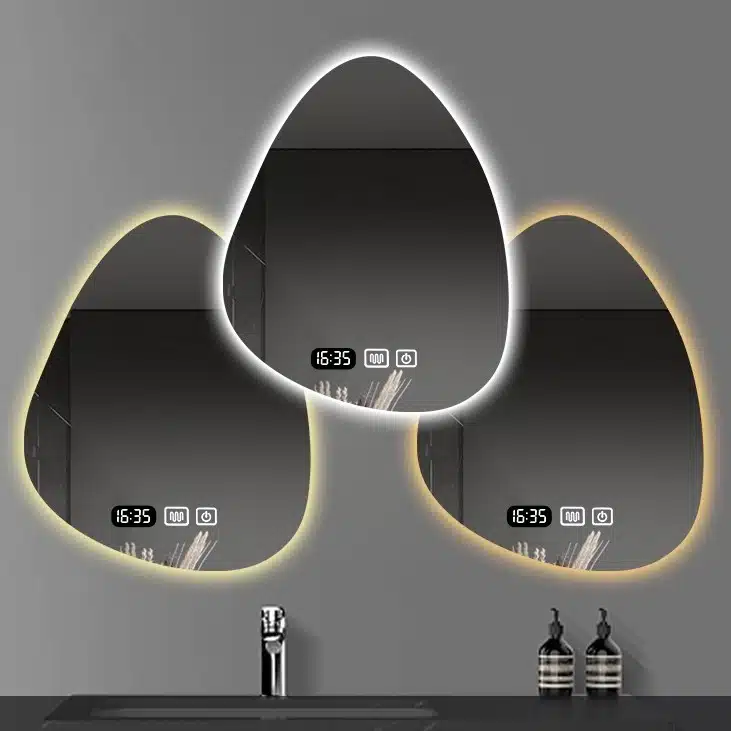
Lighted mirrors are driving market growth by providing superior, shadow-free illumination. Advances in LED technology deliver accurate color rendering and adjustable brightness, creating a premium experience for guests performing detailed grooming tasks. This functionality elevates the perceived value of the bathroom amenities, aligning with modern hospitality standards that prioritize guest comfort and sophistication.
- These units demand 30-50% longer assembly times and require stringent electrical certifications (UL, ETL, CE, RoHS) to meet international safety standards.
- Current design trends favor compact, wall-mountable LED mirrors with integrated touch controls and adjustable light temperatures to match different environments.
Non-Lighted Mirrors: Cost-Effectiveness and Simplicity
Non-lighted mirrors are a practical choice for budget-conscious projects. Their simpler manufacturing process and lower material costs make them an economical solution. They perform well in bathrooms that already have sufficient ambient or vanity lighting where supplemental, task-specific light is not a primary concern for the property owner.
- Production is straightforward, avoiding the supply chain complexity and costs associated with sourcing electrical components and securing necessary certifications.
- They provide a durable, long-lasting solution with almost no maintenance requirements, which reduces long-term operational costs for hotel staff.
What Is the Standard Installation Height for Accessible Makeup Mirrors?
For ADA compliance, the bottom of a mirror’s reflective surface must be mounted no higher than 40 inches from the finished floor, a critical standard for ensuring access for seated users.
ADA Height Requirement: The 40-Inch Rule
The primary ADA standard dictates that the bottom edge of an accessible mirror’s reflective surface must be mounted no higher than 40 inches from the finished floor. This regulation ensures that seated users, including those in wheelchairs, have a clear and functional line of sight. It’s a non-negotiable dimension for any public or commercial restroom designated as accessible.
- The measurement is taken from the floor to the bottom of the reflecting glass itself, not the surrounding frame or housing.
- To accommodate standing users, the top edge of the same mirror must be positioned at a minimum height of 74 inches from the floor.
- Full-length mirrors, like those in fitting rooms, have an even stricter requirement, with the bottom edge no more than 35 inches from the floor.
Clear Floor Space and Placement Considerations
Compliance extends beyond just the vertical placement. An accessible mirror is only functional if a user can approach it. Regulations require a clear, unobstructed floor space in front of the mirror to allow for a direct wheelchair approach, making the mirror truly usable.
- A minimum clear floor space of 30 inches by 48 inches must be maintained directly in front of the mirror.
- Vertically oriented mirrors are often a better choice in multi-user restrooms because they can serve both standing and seated individuals effectively.
- Tilted mirrors can sometimes help seated users, but they often create visual distortion and are less suitable for busy public spaces.
Standard vs. Accessible Installation Heights
It is critical to differentiate between ADA-mandated heights for public facilities and typical mounting guidelines for non-accessible residential settings. Standard installations are guided by aesthetics and fixture placement, not strict accessibility rules. In any commercial project, defaulting to ADA standards is the correct approach.
- In residential projects, mirrors are often mounted 5 to 10 inches above the faucet, which can be close to the 40-inch mark but is not a regulated maximum.
- Any public or commercial restroom designated as accessible must have at least one mirror that adheres strictly to the 40-inch maximum height standard.
Are Hardwired or Battery-Operated Lighted Makeup Mirrors Better for Hospitality?
For high-traffic hospitality venues, the operational reliability of hardwired mirrors consistently outweighs the installation flexibility of battery-powered models.
The decision between hardwired and battery-operated lighted makeup mirrors directly impacts guest experience and operational efficiency. While both have their place, the choice depends entirely on the facility’s scale, infrastructure, and maintenance capacity. Hardwired systems are the industry standard for large-scale hotels, whereas battery units offer a practical solution for smaller or more flexible accommodations.

Hardwired Models: The Case for Reliability and Low Maintenance
For any high-traffic hospitality environment, hardwired mirrors provide a set-it-and-forget-it power source. This eliminates the operational burden of checking and replacing batteries, which is a critical detail in maintaining hundreds of rooms. The uninterrupted power ensures every guest has a functional, well-lit mirror without exception. This reliability reduces long-term maintenance costs and prevents service disruptions. Although they require professional electrical installation, hardwired models integrate cleanly into permanent vanity designs, creating a seamless, high-end look expected in premier hotels and spas.
Battery-Operated Models: Advantages in Flexibility and Installation
Battery-powered mirrors offer unmatched installation flexibility. They can be placed anywhere in a guest room without needing a nearby electrical outlet or requiring invasive wall wiring. This makes them the ideal choice for properties with older infrastructure, historic buildings undergoing renovation, or operators that value adaptable room layouts. The installation is simpler and more cost-effective, which benefits smaller operations, boutique hotels, and vacation rentals where bathroom designs may evolve or lack extensive pre-existing wiring.
| Feature | Hardwired Models | Battery-Operated Models |
|---|---|---|
| Power Source | Direct connection to building’s electrical system. | Internal batteries (disposable or rechargeable). |
| Best Use Case | High-traffic luxury hotels, spas, and new construction projects. | Boutique hotels, vacation rentals, and building retrofits. |
| Maintenance Load | Virtually zero; no battery changes required. | Requires routine staff monitoring and battery replacement. |
| Installation | Requires a professional electrician and access behind the wall. | Simple, fast installation with basic tools; no wiring needed. |
Matching Mirror Type to Specific Hospitality Needs
The final decision hinges on the venue’s specific operational context. Permanent, high-end installations in new builds or major renovations should specify hardwired models for their durability and low maintenance profile. Facilities that require more adaptable designs, face wiring limitations, or operate on a smaller scale are better served by the flexibility of battery-operated mirrors. Some modern rechargeable or plug-in hybrid models can also offer a practical compromise, providing extended use between charges for mid-range operations seeking a balance of convenience and performance.
How Do You Ensure Finish Durability Against Swing Arm Wear in Makeup Mirrors?
Finish longevity in swing arm mirrors is a system-level issue, combining corrosion-resistant base metals like brass or titanium-coated steel with robust mechanical engineering to minimize friction at pivot points.
Selecting Corrosion-Resistant Base Materials and Finishes
The foundation of a durable finish lies in the base material. A high-quality finish cannot compensate for a weak substrate, especially in humid bathroom environments. Manufacturers prioritize metals that naturally resist corrosion and wear, such as solid brass or steel. These are then coated with protective finishes to withstand the constant friction of a swing arm mechanism over thousands of cycles.
- Solid brass with a polished chrome finish provides a classic, robust solution that resists tarnishing and wear in high-humidity environments.
- Titanium-coated steel offers a modern aesthetic combined with exceptional hardness, making it highly resistant to scratches from repeated movement.
- Choosing finishes designed to be easy to clean also helps prolong the mirror’s lifespan by preventing the buildup of corrosive agents from cleaning products.
Engineering High-Quality Pivoting Mechanisms
The design and construction of the arm are just as critical as the finish itself. A well-built pivoting mechanism operates smoothly, minimizing the friction and stress that degrade the finish at joints and connection points. The goal is to create a mechanism that feels solid and fluid, not loose or gritty, which is a direct indicator of impending wear.
- Sturdy construction and high-quality mounting hardware are essential to ensure the arm moves as intended without wobbling or scraping against other components.
- Products with UL listings often indicate that the mirror has passed rigorous testing standards that include mechanical durability and finish integrity.
- The overall build quality of the arm ensures that the finish maintains its appearance even after extensive use in a commercial or hospitality setting.
How Do You Source High-Quality Hinges for Heavy-Duty Makeup Mirrors?
Sourcing durable hinges for heavy-duty makeup mirrors depends on prioritizing corrosion-resistant materials like stainless steel and brass, verifying functional mechanics, and leveraging global B2B platforms for direct supplier access.
Prioritize Material Composition for Corrosion Resistance
When sourcing hinges for use in moisture-prone bathroom environments, the primary focus must be on materials that resist corrosion. Top-tier suppliers specialize in stainless steel and brass compositions because of their proven durability and longevity in high-humidity settings. These materials are essential for preventing rust and ensuring the smooth, reliable performance expected in commercial and hospitality applications.
- Select stainless steel or brass hinges to prevent rust and ensure reliable performance over time.
- Confirm that the material is engineered specifically for high-humidity settings to avoid premature wear.
Evaluate Functional Mechanisms and Design Features
Beyond material composition, the hinge’s functional design is critical for both performance and aesthetics. Advanced mechanisms can significantly improve the end-user experience and simplify installation. Features like soft-close capabilities prevent abrupt movements, reducing mechanical stress and noise. For a clean, modern look, concealed hinges hide the hardware from view, creating a more seamless integration with the mirror and vanity design.
- Look for soft-close capabilities to enhance the user experience and reduce mechanical stress.
- Consider concealed hinge designs for a seamless, modern appearance.
- Ensure the hinge is engineered with sufficient load-bearing capacity for heavy-duty mirror applications.
Use B2B Platforms for Direct Global Sourcing
The expansion of B2B e-commerce platforms has simplified direct access to international hinge suppliers. These online marketplaces provide a direct line to manufacturers, which allows for custom solutions and more competitive pricing by removing intermediaries. This direct communication channel is invaluable for specifying unique load-bearing requirements or custom design features tailored to a specific project.
- Leverage online B2B marketplaces to find specialized manufacturers and compare product specifications.
- Communicate directly with suppliers to request customizable features or specific load-bearing capacities.
Conclusion
Selecting the right magnification, finish, and power source is more than a design choice. Proper installation height and durable hardware ensure a safe, accessible, and lasting guest amenity. These technical decisions directly influence user experience and protect your investment against premature wear.
Assess your current mirror specifications to identify opportunities for an upgrade. For a detailed catalog of our certified, hotel-grade magnifying mirrors, contact our team to request a sample.
Frequently Asked Questions
Best magnification for makeup mirror?
The best and most versatile magnification for daily use is 5x to 7x. This level provides excellent detail for makeup application and grooming without the distortion or narrow focal range of higher powers. A 10x magnification is considered a specialist level, best suited for users with specific vision needs or for extremely precise tasks like detailed eyeliner work or tweezing very fine hairs.
Wall mounted lighted makeup mirror hardwired?
Yes, hardwiring is the standard for high-end and hotel-grade wall-mounted makeup mirrors. A hardwired installation connects the mirror’s electrical components directly to your home’s wiring, eliminating visible cords and plugs for a clean, integrated, and professional look. This method requires installation by a qualified electrician but provides a more permanent and aesthetically pleasing result than plug-in models.
Height to install magnifying mirror?
The ideal height for a magnifying mirror is to have its center aligned with the user’s eye level. A standard industry guideline is to mount the mirror’s center point between 63 to 67 inches (160 to 170 cm) from the floor. For models with an articulating arm, the mounting point should be positioned to allow the mirror to be easily adjusted to the eye level of all primary users, ensuring a comfortable, strain-free viewing angle.
5x vs 10x magnification mirror?
A 5x magnification mirror is the industry standard for general use, offering a detailed view of your entire face for flawless makeup application and grooming. A 10x magnification mirror is a tool for high-precision tasks, showing a small area of the face in extreme detail. It requires you to be very close to the mirror to get a clear focus and is best for tasks like tweezing or for users with vision impairment. For most people, 5x provides the perfect balance of magnification and usability.
Hotel style makeup mirror?
A hotel-style makeup mirror is a premium, wall-mounted fixture engineered for durability and a luxury guest experience. Key features include an extendable arm, integrated and energy-efficient LED lighting, hardwired installation for a clean look, and premium finishes like chrome or matte black. They are typically dual-sided, with 1x magnification on one side and a functional 5x or 7x on the other, combining sophisticated design with practical grooming precision.
Replace bulb in makeup mirror?
Modern lighted makeup mirrors feature integrated LED arrays that are not designed to be replaced by the user. These high-efficiency LEDs have a long lifespan, typically rated for 30,000-50,000 hours of use, lasting for the entire life of the mirror. Unlike older models with replaceable incandescent or fluorescent bulbs, if an integrated LED fails, the entire mirror unit or its core electrical component typically needs to be replaced.





0 Comments