
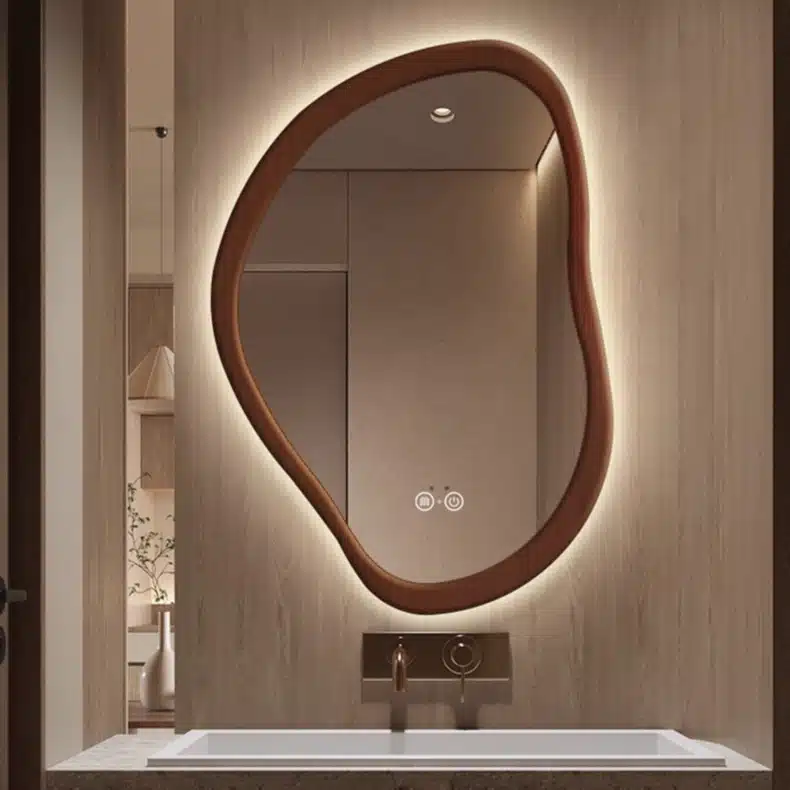
Sourcing the correct LED mirror tech for a lighted bathroom mirror is a critical decision that directly impacts project budgets, safety compliance, and client satisfaction. A mismatch in specifications isn’t a minor detail; it leads to costly product returns, failed electrical inspections, and a damaged professional reputation. Many specifiers get lost in the jargon of lumens, kelvins, and IP ratings, resulting in mirrors that are either unfit for purpose or a liability in wet environments.
This guide serves as a technical standard operating procedure for evaluating LED mirror components. We will dissect the three most critical specifications, compare front-lit and back-lit illumination for task-specific lighting, and clarify the real-world difference between IP44 and IP65 ratings. We will also explain the long-term maintenance benefits of a replaceable driver, the practical trade-offs between hardwiring and plug-in models, and why ETL/UL certification is non-negotiable for safety.
What Are the 3 Critical Specs?
A high-performance LED mirror’s value is defined by three core metrics: functional brightness for tasks, adjustable color temperature for accuracy and ambiance, and robust waterproofing for safety in humid environments.
LED Power and Brightness Output
The effectiveness of an LED mirror depends on its ability to provide functional task lighting. Brightness is measured in lumens, while power consumption is measured in watts. A well-designed mirror delivers ample light for grooming activities like makeup application or shaving without causing uncomfortable glare. This balance ensures the mirror is a practical tool, not just a decorative fixture.
- Most functional mirrors use 17.6–24W systems to deliver over 600 lumens.
- LED lifespan is standardized at 20,000–50,000 hours, ensuring long-term performance.
- Dimmability and memory functions allow users to customize and save their preferred brightness levels.
| Specification | Standard Industry Spec | MFBATH High-Performance Spec |
|---|---|---|
| Brightness Output | 600+ Lumens (Ambient) | 1200–1800 Lumens (Task-Focused) |
| Color Quality | 3-Color (3000/4000/6000K) | 3-Color Dimmable with CRI 95+ (Ultra-Clear Glass) |
| Waterproofing | IP44 Splash-Proof | IP54–IP65 Rated (High-Humidity Zones) |
Adjustable Color Temperature
Color temperature, measured in Kelvin (K), influences both the ambiance and functional quality of the light. The ability to switch between different color settings allows the mirror to adapt to various needs throughout the day. Warm light creates a relaxing atmosphere for the evening, while neutral and cool light provide the clarity needed for morning routines.
- Offers 3000K warm light for a relaxed, ambient feel.
- Provides 4000K neutral light, which mimics natural daylight for accurate color representation.
- Includes 6000K cool light for crisp, focused task illumination.
Waterproofing and Durability Ratings
Bathrooms are high-humidity environments, so a mirror’s electrical components must be protected from moisture. Ingress Protection (IP) ratings indicate the level of defense against water and solid particles. A proper IP rating is critical for ensuring electrical safety and product longevity in wet conditions.
- A rating of IP54–IP65 ensures the mirror can safely withstand splashes and humidity.
- Proper sealing of the housing is essential for maintaining anti-fog functionality and protecting internal electronics.
- Durable construction prevents moisture-related corrosion and protects integrated smart features.
Front-Lit vs. Back-Lit: Which is Better for Makeup?
For any task requiring color accuracy and clear visibility, like makeup application, a front-lit mirror is the only practical choice; backlit mirrors are engineered for ambient, decorative lighting, not functional grooming.
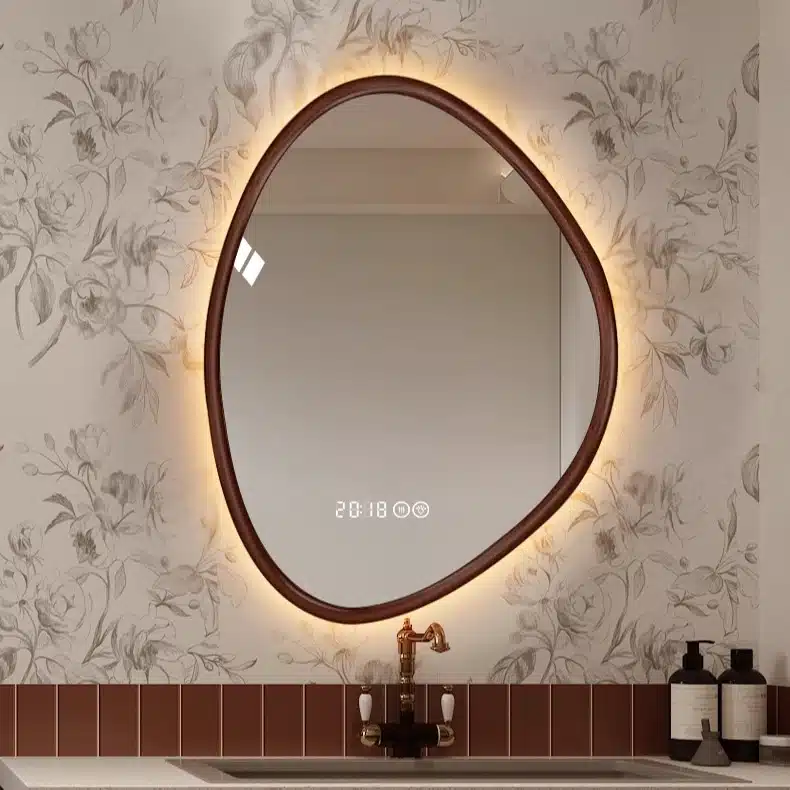
The difference between front-lit and back-lit mirrors comes down to the direction of light. A front-lit mirror projects light directly forward onto your face, providing the even, bright illumination required for detailed tasks. A back-lit mirror pushes light out from behind the glass, creating an atmospheric halo effect on the wall. This indirect glow is decorative and does not provide functional task lighting for your face.
Lighting Direction: The Key Difference
Front-lit designs integrate LEDs into the mirror’s frame or surface, casting light forward to erase shadows under the eyes, nose, and jawline. This creates an ideal canvas for grooming. In contrast, backlit LEDs are mounted behind the mirror, projecting light sideways and backward. While this creates a high-end, spa-like feel, it leaves your face in relative shadow, making it unsuitable for precision work.
| Specification | Front-Lit Mirror | Back-Lit Mirror |
|---|---|---|
| Primary Function | Task Lighting (Makeup, Shaving) | Ambient / Mood Lighting |
| Light Direction | Forward, directly onto the face | Sideways and backward, onto the wall |
| Shadow Control | Excellent; minimizes facial shadows | Poor; creates shadows on the face |
| Color Accuracy | High; improves accuracy by ~20% | Low; indirect light distorts color |
Why Front-Lit Excels for Makeup Application
For makeup application, front-lit mirrors deliver superior color rendering and shadow control. The direct light allows for an accurate assessment of skin texture and subtle color variations, which is why this configuration is the standard in professional beauty studios and hotel vanities. You cannot achieve this level of clarity with an ambient light source.
- The direct illumination can improve makeup color accuracy by around 20%, ensuring correct foundation blending and tone matching.
- It supplies the bright, focused light needed to evaluate skin texture and ensure a flawless application without any guesswork.
The Role of Backlit Mirrors
Backlit mirrors are an excellent choice for creating a sophisticated, spa-like atmosphere in a bathroom. Their soft glow serves as a powerful decorative feature or a gentle source of ambient light. They are not built for task-oriented work and almost always require supplementary lighting, like sconces or overhead lights, to be useful for makeup or shaving.
- The halo effect enhances room decor and contributes to a relaxing environment.
- Because the light projects away from the user, additional task lights are necessary to see clearly for any detailed grooming.
Boost Your Profits with Customizable Mirrors
IP44 vs. IP65: Which Is Better?
Selecting the right IP rating is not about which is superior overall, but which is correct for a specific bathroom zone; IP44 handles ambient humidity and splashes, while IP65 is engineered for areas exposed to direct water jets.
Ingress Protection (IP) ratings define an electrical enclosure’s resistance to solids and liquids. For LED mirrors, this rating is a critical indicator of durability and safety in a bathroom’s humid, high-moisture environment. A higher number doesn’t always mean it’s the right choice for every application, as over-specifying can lead to unnecessary costs without adding functional value.
What the IP Rating Numbers Mean
The two digits in an IP rating directly define its protective capabilities. The first number measures protection against solid objects, like dust or accidental contact with tools, while the second measures protection against liquids. IP44 is the established industry standard for most bathroom applications, offering solid protection against splashes. IP65 provides a higher level of defense, making it suitable for environments where direct water exposure is a factor.
| Feature | IP44 Rating (Standard) | IP65 Rating (High-Protection) |
|---|---|---|
| Solid Protection (1st Digit) | Protects against solid objects over 1mm (e.g., tools, wires). | Completely dust-tight. No ingress of dust is permitted. |
| Liquid Protection (2nd Digit) | Protects against water splashes from any direction. | Protects against low-pressure water jets from any direction. |
| Typical Bathroom Application | Zone 2: Areas near sinks, vanities, and outside the immediate shower area. | Zone 1: Areas closer to baths or showers where direct spray is possible. |
| MFBATH Recommendation | Our standard offering for global markets, providing safe and durable performance for 95% of residential and hotel projects. | Available for projects with specific wash-down requirements or installations in high-moisture commercial settings. |
Choosing the Right Rating for Bathroom Zones
The optimal IP rating depends entirely on the mirror’s installation location within the bathroom. Building codes divide bathrooms into zones based on their proximity to water sources. For mirrors installed in Zone 2—the area surrounding a sink or outside the immediate vicinity of a shower—an IP44 rating is sufficient to protect against condensation and accidental splashes. For installations in Zone 1, where direct water spray from a showerhead is possible, an IP65 rating provides the necessary seal to prevent water ingress and ensure electrical safety. At MFBATH, we guide distributors in selecting the correct IP rating based on regional codes and project needs, ensuring every installation is compliant, safe, and built to last.
Why Do You Need a Replaceable Driver?
A replaceable driver transforms a potential total-loss failure into a simple, low-cost component swap, protecting your long-term investment by making the mirror fully serviceable.
Simplified Maintenance and Long-Term Serviceability
The LED driver is the central power supply for a mirror’s lighting and smart functions. When this component fails in a mirror with an integrated design, the entire unit becomes inoperable e-waste. A replaceable driver architecture isolates this common point of failure, enabling a simple, targeted repair instead of a full and costly replacement.
- It isolates the electrical failure to a single, modular component.
- It enables quick repairs, a critical requirement for commercial properties like hotels where minimizing room downtime is essential.
- Technicians can swap the part without needing to uninstall the entire mirror from the wall.
Reduced Total Cost of Ownership
A mirror with an integrated, non-replaceable driver might have a lower initial purchase price, but this creates a significant long-term liability. A single component failure means replacing the whole unit. A replaceable driver makes the product far more economical over its entire lifespan.
- The cost of a new driver is a small fraction of the price of a brand-new smart mirror.
- It avoids the significant labor costs associated with removing an old mirror and installing a new one.
- This design protects the initial capital investment, especially in large-scale projects involving hundreds of units.
Hardwire vs. Plug-in: Which Is Better?
Hardwiring provides a permanent, integrated look for new construction and renovations, while plug-in models offer flexibility for renters and DIY-friendly upgrades.
Hardwired Installation: The Permanent Solution
A hardwired installation connects the mirror’s electrical system directly into a junction box within the wall, typically controlled by a wall switch. This method completely conceals all wiring, delivering a clean, built-in aesthetic that is standard in high-end renovations and new builds. By becoming a permanent fixture, a hardwired mirror can increase a property’s value.
- Achieves a sleek, professional finish with no visible cords.
- Considered a permanent upgrade that adds to the home’s value.
- The best option for homeowners seeking a custom, long-term bathroom design.
Plug-in Installation: Flexibility and Simplicity
A plug-in mirror connects to a standard GFCI wall outlet, making installation simple and fast without needing an electrician. This approach is ideal for renters who cannot make permanent changes to the wiring or for homeowners who want a quick, non-invasive bathroom update. The flexibility allows the mirror to be easily moved or replaced at any time.
- Allows for a straightforward setup in minutes without modifying wall wiring.
- An excellent choice for rental properties or temporary living situations.
- Offers the freedom to change or relocate the mirror as decor or needs evolve.
How to Choose Based on Your Needs
The decision comes down to your project scope and living situation. For a new build or a full bathroom remodel where you want a seamless, high-end finish, hardwiring is the clear choice. If you are looking for a cost-effective, easy-to-install upgrade in an apartment or an existing bathroom, a plug-in model provides unmatched convenience and portability.
- Select hardwiring to achieve a flawless, integrated look in a home you own.
- Choose a plug-in model for its simplicity and lower installation cost.
- MFBATH manufactures mirrors for both installation types and can customize plugs (US, EU, UK, AU) to meet specific project requirements.
How Does the Defogger Work?
A mirror defogger uses an integrated heating element to raise the glass surface temperature, preventing moisture from condensing and ensuring a clear reflection in high-humidity environments.
The Heating Pad Mechanism
A defogger functions with a thin heating pad attached to the back of the mirror glass. This element gently warms the surface to a temperature of about 104°F (40°C), which is just warm enough to stop cooler, moist air from forming condensation and creating fog. The system is engineered to work quickly and efficiently.
- A self-adhesive heating film, often made of PET, is applied directly to the rear of the mirror.
- When activated, it evenly raises the surface temperature to prevent fog from forming.
- This provides a clear, steam-free reflection immediately after a hot shower.
Energy Consumption and Integration
Modern defogging systems are designed for energy efficiency, consuming a small amount of power that typically ranges between 19 and 141 watts, depending on the pad size. They are seamlessly integrated into the mirror’s electrical design and are often linked to the main light switch or a dedicated touch sensor for user convenience.
- The system is low-wattage, minimizing its impact on electricity usage.
- Many designs connect directly to the internal wiring for a clean, professional installation without visible cables.
- By reducing constant moisture on the mirror’s backing, the defogger also helps protect the silver layer from long-term corrosion.
Why Are ETL/UL Important?
ETL and UL certifications are not just quality marks; they are essential market entry tickets and liability shields, confirming a product’s safety against fire and shock in high-humidity bathroom environments.
Ensuring Safety in Wet Environments
In any bathroom, the mix of water and electricity creates a significant risk. ETL and UL certifications provide third-party verification that a mirror has passed rigorous testing for electrical safety. These standards are specifically designed to evaluate performance in damp locations, ensuring that the fixture’s insulation, wiring, and construction prevent electrical shock and fire hazards. For project specifiers and distributors, this is a non-negotiable layer of assurance.
- Tests for protection against electrical shock and potential fire risks.
- Validates that materials and construction can withstand prolonged bathroom humidity.
- Confirms the product is safe for its intended use in both residential and commercial projects.
Meeting Regulatory and Market Demands
Beyond the immediate safety benefits, these certifications are a critical business requirement. In North America, ETL or UL listing is mandatory to comply with regional building codes and import regulations. Attempting to enter the market without them leads to rejected shipments and legal liabilities. For B2B clients, seeing these marks builds immediate trust, signaling that the manufacturer adheres to the highest safety and quality protocols. It’s a clear differentiator that separates reliable products from uncertified, high-risk alternatives.
- Fulfills legal requirements for market access in North America.
- Increases end-user confidence and strengthens brand reputation.
- Provides a clear quality advantage over uncertified competitors.
Conclusion
Choosing the right LED mirror specifications is fundamental to project success. Details like light temperature, waterproofing, and driver type directly impact user experience and product lifespan. Proper installation and certified components are essential for meeting safety standards and ensuring long-term reliability.
Review your project requirements against these technical benchmarks. For a look at our fully certified LED mirror collection, reach out to our team to request a catalog or a sample for evaluation.
Frequently Asked Questions
What is the best kelvin for bathroom mirror?
The ideal color temperature is 4000K (Neutral White). It provides a clear, natural light that renders skin tones accurately, making it perfect for tasks like applying makeup or shaving. For a more relaxing, spa-like ambiance, 3000K (Warm White) is suitable. For high-detail grooming, 6000K (Cool White) mimics daylight. The best mirrors offer adjustable color temperatures, allowing you to switch between 3000K, 4000K, and 6000K to match the time of day or task.
Do LED mirrors provide enough light?
Yes, modern LED mirrors are specifically engineered to provide ample task lighting. Quality mirrors deliver over 600 lumens, which is more than sufficient for illuminating your face clearly and without shadows for grooming tasks. While they excel as a primary light source for the vanity area, they are not intended to light up the entire bathroom. They should be paired with general ambient ceiling lights for complete room illumination.
Front lit vs backlit mirror?
The choice depends on the primary function. Front-lit mirrors cast light forward, directly onto your face, which is superior for task-oriented activities like makeup and shaving because it eliminates shadows. Backlit mirrors cast light backward against the wall, creating a decorative ambient glow or halo effect. For functional use in a primary bathroom, a front-lit mirror is the recommended choice. Premium models often incorporate both front and back lighting for maximum versatility.
IP44 rating for bathroom mirror?
An IP44 rating is a standard and sufficient level of protection for most bathroom mirrors. The ‘IP’ stands for Ingress Protection, the first ‘4’ protects against solid objects larger than 1mm, and the second ‘4’ protects against water splashes from any direction. This makes it safe for installation in Zone 2 of a bathroom, such as directly above a sink. While IP44 is adequate, higher-end models may feature IP54 or IP65 ratings for even greater durability and resistance to dust and moisture.
Replaceable LED driver for mirror?
A replaceable LED driver is a critical feature for long-term reliability. While the LEDs themselves have a lifespan of 20,000-50,000 hours, the driver (which converts power for the LEDs) is often the first component to fail. High-quality mirrors are designed with easily accessible, plug-and-play drivers, allowing for simple replacement without needing to replace the entire mirror. This serviceability is a key differentiator in premium and commercial-grade products, ensuring a much longer operational life.
Wiring led mirror to wall switch?
Yes, the standard and recommended installation method is to hardwire the LED mirror to a junction box that is controlled by a wall switch. This provides a master power control for the unit. Most modern mirrors feature a memory function, which recalls the last-used settings (e.g., on/off state, brightness, color temperature) when power is restored from the wall switch. Installation should always be performed by a qualified electrician to ensure safety and code compliance.

0 Comments