


After Brexit, a UK bathroom cabinet buyer faces a compliance question that did not exist in 2019: do you mark your stock with UKCA (UK Conformity Assessed), CE, or nothing at all? The honest answer is that it depends on where the cabinet sells and what is inside it. Great Britain currently recognizes the CE marking alongside or in place of UKCA, Northern Ireland follows CE rules, and most plain bathroom cabinets sit outside the mandatory marking lists entirely. This guide maps which mark applies in GB versus NI, which product types actually trigger a marking duty, and what documentation you should collect from your factory before you pay a 30% deposit and book freight from Qingdao. For most bathroom cabinets, the UKCA vs CE marking decision is a destination and documentation exercise, not a redesign.
Key Takeaways
- In Great Britain, CE and UKCA are both accepted today: the government “continues to recognise the CE marking, alongside or in place of the UKCA marking,” so a CE-marked line needs no conversion for GB.
- The UKCA label may go on the product or on accompanying documents until 31 December 2027, which gives importers flexibility on packaging and label placement.
- Northern Ireland accepts CE; CE+UKNI appears only in the limited cases where third-party conformity assessment is required and a UK body performed it.
- A plain bathroom cabinet without electrical parts is generally not in the mandatory CE/UKCA product lists, so no mark is required; the duty shifts to smart LED mirrors and other powered components.
- Even with no mark, product safety rules (EU GPSR / UK 2005 GPSR), E1 formaldehyde at or below 0.1ppm, timber legality paperwork, and importer labeling still apply to every shipment.
- Collect from your factory: ISO 9001 and ISO 14001 certificates (MFBATH obtained both in 2017 and confirmed them valid in 2025), an E1 test report, CE declaration documents, English manuals, and importer label data.
- Plan the timeline: samples in 10 working days, production in 20–30 days, FOB (Free On Board) Qingdao, a 30% deposit, and the balance within a week of the draft BL (draft bill of lading).
In This Guide
- GB vs NI: Where Each Mark Applies
- Which Products Actually Need a Mark
- CE vs UKCA: Documentation You Should Collect
- What Your Supplier Must Provide
- A Compliance Checklist for UK Imports
- Frequently Asked Questions
GB vs NI: Where Each Mark Applies
The United Kingdom operates as two regulatory zones for product conformity. Great Britain — England, Scotland, and Wales — runs its own UKCA regime but still accepts CE. Northern Ireland, under the arrangements that keep it aligned with EU product rules, treats CE as the working mark, with UKNI added only in narrow circumstances. A distributor that plans one compliance strategy for the whole “UK” will trip on the line that runs through the Irish Sea, usually at the moment the first shipment splits between a London warehouse and a Belfast customer. Sort every SKU into GB-destination and NI-destination lines, then apply the UKCA, CE, or CE-plus-UKNI route each one needs.

For GB, the current position is deliberately low-drama. The government states that it “continues to recognise the CE marking, alongside or in place of the UKCA marking,” and the Product Safety and Metrology (Amendment) Regulations 2024 locked in that parallel recognition. If your existing EU line already carries CE, you can sell it in England, Scotland, and Wales without re-marking. UKCA remains available for manufacturers who prefer one mark for both markets, and until 31 December 2027 you may affix the UKCA label to the product itself or to the accompanying documents. That documentation route matters when you want to avoid reprinting packaging mid-contract, or when a compact cabinet leaves no clean surface for an extra label.
Northern Ireland is the stricter puzzle. Products placed on the NI market carry CE, and in the specific case where third-party conformity assessment is required and a UK body carried it out, the CE+UKNI combination applies. For bathroom cabinets that third-party trigger is rare — most plain furniture never reaches a notified-body step — so CE alone usually covers Northern Irish buyers. Before you quote a customer in Belfast, confirm whether the product contains electrical components, because that is what decides the assessment route. Check the gov.uk UKCA guidance before each shipping season, since the marking window and product scope are government decisions, not industry habits.
Label strategy follows market split, not habit. If a SKU sells into the EU and GB from the same stock, CE-only is the simplest route because GB accepts it. If a line is GB-only and you want UKCA, plan the label placement in the artwork stage — product sticker, packaging, or accompanying document — and use the 31 December 2027 documentation flexibility so you do not reprint twice. Mark the responsible operator on every unit: manufacturer, importer, or authorized representative, with name and address. That single line of text costs nothing to print, and it is the first thing a buyer audit checks.
Which Products Actually Need a Mark
The first correction most importers need: CE and UKCA are not quality marks and they are not universal. They are required only when a product falls inside specific legislation — the low-voltage, electromagnetic compatibility (EMC), and radio equipment directives for electrical goods, for example. Furniture is largely absent from those lists. A plain PVC (polyvinyl chloride), plywood, or solid-wood vanity with a passive mirror triggers no CE or UKCA duty by itself. The table below is the decision sheet we hand to buyers before they commit to a container.
| Product type | CE/UKCA required? | Basis |
|---|---|---|
| Plain bathroom cabinet, no electrical parts | No mark required | Not in the mandatory CE/UKCA product lists; product safety and E1 rules still apply |
| Cabinet with a classic passive mirror | No mark required | A passive mirror adds no electrical scope |
| Smart LED mirror or cabinet with integrated lighting, anti-fog heating, touch controls | CE/UKCA apply | Low-voltage and EMC directives; radio equipment directive if voice or Bluetooth options are fitted |
| Cabinet with powered add-ons (sockets, built-in lighting, heated mirror) | CE/UKCA apply | Electrical parts bring the unit into scope even when the shell alone would not be |
| Any product imported under your own brand | Depends on components; labeling duties always apply | You own the conformity file and the importer label as the economic operator |
The pattern to remember: the shell rarely creates the marking duty, the electronics do. Smart LED mirrors — with adjustable brightness and color temperature, anti-fog heating, touch control, and optional voice or Bluetooth modules — map each feature to a directive category, and the declaration of conformity lists them one by one. The gov.uk CE marking guidance sets out which product categories fall inside the rules, and it is worth re-reading every time you add a feature to a mirror or vanity. For the plain-cabinet case, our CE marking for bathroom cabinets explainer goes through the no-mark scenario in more detail.
The marks, however, are only part of the compliance stack. A cabinet that needs no CE still must meet general product safety duties — under the EU General Product Safety Regulation for Northern Ireland and the UK General Product Safety Regulations 2005 for GB — cover formaldehyde emission limits (E1 at 0.1ppm or below in board), and satisfy timber legality checks on plywood and solid wood. These are the requirements that actually hold up containers, and they apply to every SKU regardless of marking. Our CE vs UKCA compliance overview walks through the same decisions for buyers who serve EU markets from the same production line.
Formaldehyde is where the paperwork gets specific. E1 boards measure at or below 0.1ppm, and the test report should name the board supplier, the batch, and the test method — a generic “E1 compliant” line in a quotation is not a document. If the same factory also serves North America, its lines are checked against CARB Phase 2 and TSCA Title VI limits, which means one board spec can cover multiple markets from a single order. Timber legality follows the same logic: keep the mill-level paperwork for plywood and solid wood so a buyer audit never depends on a forwarding agent’s memory.
Private-label programs change the paperwork owner. When you import under your own brand, you step into the manufacturer’s shoes for labeling and safety duties under the general product safety rules, even though the factory still holds production quality. MFBATH supports white-label and private-brand programs with logo printing or laser engraving and custom packaging, so the label surface is designed during development instead of patched on after the first audit. Whatever the brand, keep the risk assessment on file: what could fail, who gets informed, how a recall would run. Buyers rarely ask for it on day one; they ask for it the day a complaint lands.
CE vs UKCA: Documentation You Should Collect
Once you know which mark applies — or that none does — the work shifts to paperwork. Customs officers and your buyers rarely ask to see a sticker; they ask for the file behind it. For CE, that file is an EU declaration of conformity plus the technical documentation that supports it. For UKCA, the same structure with a UK declaration. The two documents look nearly identical, and the difference sits in who signs, which standards are cited, and which market they cover — so keep separate files per zone instead of one combined folder.
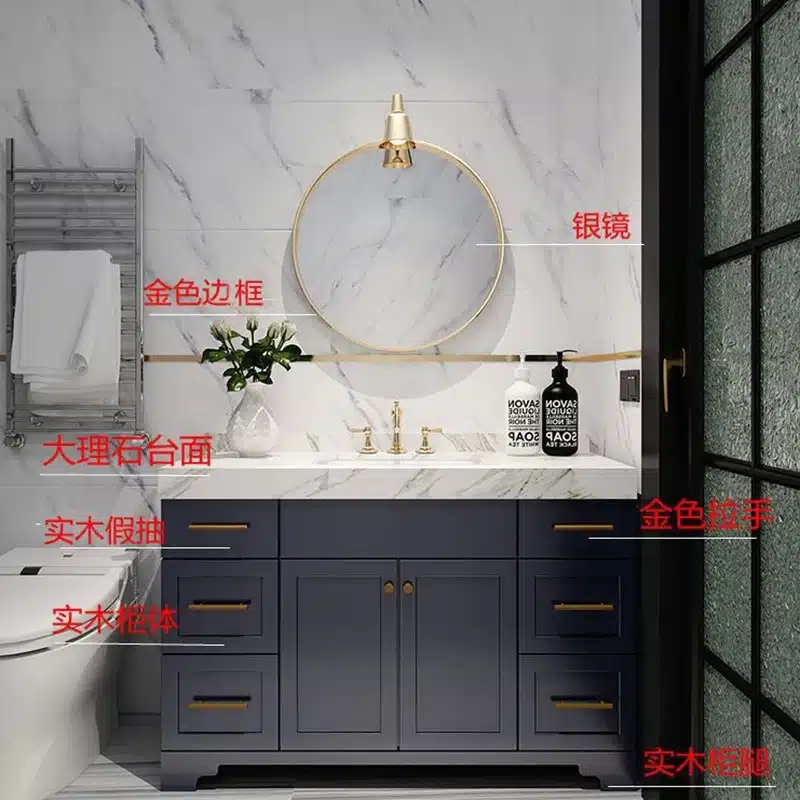
A declaration of conformity is a short document with a long list of required elements: product identification, the directives and harmonized standards applied, the manufacturer’s or authorized representative’s name and address, and a dated signature. For a smart LED mirror, expect the file to cite low-voltage, EMC, and — if wireless — radio equipment directive assessments. Keep the instruction manual and warning labels in English for both GB and NI; a Chinese-language manual with an English cover does not survive a buyer audit. The European Commission CE marking page describes the declaration requirements for the EU side, which remains the baseline for NI.
Under product safety rules, the responsible operator’s name and address must be traceable on the product or its packaging, which is where the importer labeling duty lands on you, not the factory. Retain the technical file for the life of the product and several years beyond — a buyer or authority can ask at any point, and reconstructing a file after a shipment has sold through is expensive. What you should not collect is a “UKCA certificate” from the factory: Chinese factories do not certify you for the UK market. They hand over evidence, and you sign the declaration as the economic operator placing the product on the market. If that boundary is new to your team, the vanity import compliance mistakes article lists the failure points we see in purchase orders, from missing English manuals to labels that name nobody.
Build the file in the same order you build the product. Start with product identification: model name, SKU, and a technical description that matches the commercial invoice. Then the directive list, then the standards applied, then the test reports, then the signed declaration. For an electrical vanity, the low-voltage and EMC reports should name the exact model, not a product family; a report that references a cousin model fails the first detailed audit. Add the importer’s or authorized representative’s contact block last, and re-issue the declaration whenever a component changes — a new LED driver or power supply can invalidate the existing file before the container leaves the port.
Compliance-Ready Bathroom Cabinets for GB and NI
Browse this product, solution, or service page to explore relevant offerings.

What Your Supplier Must Provide
Your factory file should answer three questions: is the factory real, does the material meet the limits, and is the product built to the declared specification? The table below maps each document to the question it answers and to the GB/NI requirement behind it.
| Document to request | What it proves | Why it matters for GB/NI |
|---|---|---|
| ISO 9001 certificate with current validity | Quality management system is audited and maintained | Baseline for factory reliability; MFBATH obtained it in 2017 and confirmed validity in 2025 |
| ISO 14001 certificate with current validity | Environmental management system is in place | Supports E1 and low-VOC claims and buyer sustainability screening |
| E1 formaldehyde test report | Board emissions at or below 0.1ppm | Covers the E1 limit GB and NI buyers cite in specifications |
| CE declaration of conformity and technical file (electrical items) | Low-voltage, EMC, and radio compliance evidence | Required to affix CE on smart LED mirrors sold in GB or NI |
| English instruction manual and warning labels | User safety and information duties are covered | Product safety information duties apply in both GB and NI |
| Importer label data (manufacturer, importer, or authorized representative name and address) | Traceability of the responsible operator | Your labeling duty as the economic operator |
| Timber legality documentation (FSC chain-of-custody optional) | Legal and sustainable sourcing of plywood and solid wood | Feeds timber due-diligence checks on every wooden SKU |
| Third-party inspection report (SGS, TÜV, or similar) | Batch-level QC evidence from an independent body | Buyer assurance; book in advance — MFBATH supports third-party inspection with prior arrangement |
Ask the factory to state the current validity of each certificate rather than accepting a scan. ISO 9001 and ISO 14001 are re-audited on cycles; MFBATH obtained both in 2017 and confirmed them still valid in 2025, and the same verification question belongs in every factory audit you run. On the product side, the factory should declare CE and UL certification where the design requires it — certificate numbers are often not published, but declaration documents are. For a step-by-step way to check a factory’s claims yourself, see verifying ISO 9001 factory claims.

Quality claims deserve the same scrutiny as certificates. MFBATH runs five inspection points on every cabinet, supports SGS or TÜV third-party inspection with advance arrangement, and tests hardware to 100,000 cycles in a humidity environment — one hinge rated for 100,000 cycles failed at 45,000 in that setup, which is why the factory rejects hardware on data rather than on the box. That level of specificity separates a factory file you can defend from a folder of scans. Environmental claims matter too: E1 at or below 0.1ppm, low-VOC finishes, and FSC-optional sourcing are the items GB and NI buyers actually check, and our ISO 14001 and EU compliance piece explains how the environmental side feeds into EU-facing orders.
A factory’s production reality should match its certificates. MFBATH operates a 10,000 sqm plant with 95 employees and monthly capacity of 5,000 sets, has served 1,000+ dealers across 20+ countries since 2015, and builds PVC cabinets that are 100% waterproof alongside plywood, solid wood, and sintered stone lines. The stone basins test at Mohs hardness 7–8 with 300°C heat resistance and non-porous surfaces; cabinet widths run 24–60 inches with 18–24 inch depths. None of that replaces a certificate, but it tells you whether the factory can hold a compliance file for years of repeat orders — which is what your GB and NI buyers are really buying when they sign a framework agreement.
A Compliance Checklist for UK Imports
Run this checklist twice: once before you send a quote, and again before the container loads. The first pass decides the mark; the second pass decides whether the documentation matches the shipment.
- Split your destination list into GB and NI SKUs and confirm the mark regime for each: CE, UKCA, both, or none.
- Audit the bill of materials for electrical parts — lighting, anti-fog heating, touch panels, wireless modules. Anything powered moves the unit into directive scope.
- Decide UKCA label placement while the packaging is still in design: on the product or in the accompanying documents, both legal until 31 December 2027.
- Collect the factory file: ISO 9001 and ISO 14001 certificates with current validity, an E1 test report at or below 0.1ppm, CE declaration documents, English manuals and warnings, and importer label data.
- Check timber and board paperwork for legality evidence on plywood and solid-wood lines.
- Confirm the product or packaging names a responsible operator — manufacturer, importer, or authorized representative.
- Book quality control: five inspection points per piece at the factory, plus third-party inspection (SGS, TÜV) if your buyer requires it, arranged ahead of production.
- Lock the logistics timeline: samples in 10 working days, production in 20–30 days, FOB (Free On Board) Qingdao, a 30% deposit with the order, and the balance within a week of draft BL.
Two commercial points belong in the checklist too. First, MOQ (Minimum Order Quantity) and customization: MFBATH quotes 15 sets per model, color, and size with mixed-container loading, and custom colors start at the same 15-set level, so a first GB/NI order can combine SKUs instead of committing to a single line. Second, warranty language: a 2-year cabinet warranty with a return rate under 1% gives your buyers a defensible resale claim — but only if the warranty document sits in the file before the PO is signed. If the same line also sells into North America, the CARB and FSC certification for vanities page covers the E1, CARB Phase 2, and TSCA Title VI picture in one place.
One more reason to run the list before loading: the cost of skipping it is rarely a customs fine, it is a delisting. A GB retailer that finds a missing E1 report or an unlabeled importer will hold the whole container until the file arrives, and a second offense ends the relationship. Sending the checklist with the purchase order puts the documentation burden on the factory’s schedule instead of yours — samples take 10 working days, production runs 20–30 days, and the balance falls due within a week of draft BL, so the file should be complete before the first payment, not after the last.
Frequently Asked Questions
Do bathroom cabinets need UKCA or CE marking to sell in Great Britain?
Only if the product falls inside the mandatory CE/UKCA lists. A plain cabinet without electrical parts generally does not, so no mark is required. A smart LED mirror with lighting, anti-fog heating, or touch controls falls within electrical directives, and there CE applies — GB continues to recognise CE alongside or in place of UKCA. Either way, product safety rules (UK General Product Safety Regulations 2005), E1 formaldehyde at or below 0.1ppm, and importer labeling duties still apply.
What is the difference between CE and UKCA for Northern Ireland?
Northern Ireland follows EU product rules, so CE is the working mark. CE+UKNI appears only in the limited case where third-party conformity assessment is required and a UK body performed the assessment — rare for bathroom cabinets. In GB, both CE and UKCA are accepted, and the UKCA label may be placed on the product or its accompanying documents until 31 December 2027.
What documents should a UK buyer request from a Chinese bathroom cabinet factory?
Request ISO 9001 and ISO 14001 certificates with current validity (MFBATH obtained both in 2017 and confirmed them valid in 2025), an E1 formaldehyde test report at or below 0.1ppm, a CE declaration of conformity and technical file for electrical products, English instruction manuals and warning labels, importer label data, and timber legality documentation. For batch assurance, add third-party inspection (SGS or TÜV) with advance arrangement; MFBATH runs five inspection points per cabinet and supports it.
The Bottom Line
Great Britain accepts CE and UKCA in parallel today, Northern Ireland runs on CE, and most bathroom cabinets need neither mark — the real compliance load sits in product safety duties, E1 at 0.1ppm or below, timber paperwork, and importer labels. The 31 December 2027 flexibility on UKCA label placement is a packaging convenience, not a reason to defer documentation. Build the supplier file before you quote: ISO 9001 and ISO 14001 validity, an E1 test report, CE declaration documents, English manuals, and importer label data — then send the checklist to your factory with the purchase order.




0 Comments