
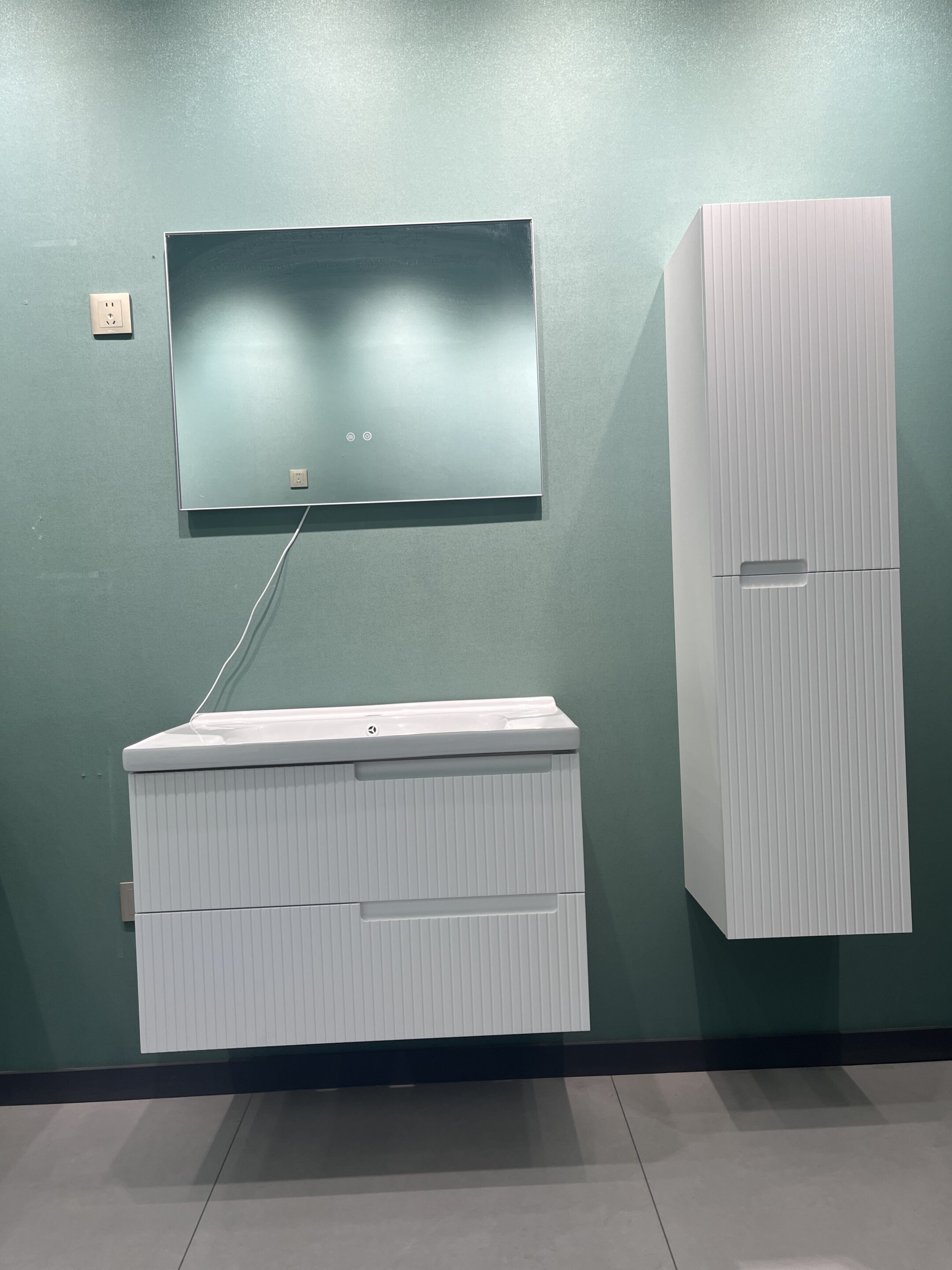
An ISO 14001 bathroom vanity is cheap insurance against customs delays on a European project. MFBATH builds its Europe-Ready range around that certificate. The factory configures every shipment to clear customs cleanly and meet REACH requirements without back-and-forth. That alone makes the certification cost-effective.customs delays

The real value lives in the production process itself. Factories running an environmental management system keep tighter control on glue application rates and waste handling. That discipline shows up in your cabinets: fewer surface defects, better finish consistency, and durability that holds up in damp bathrooms. On top of that, you get a compliance story you can defend.production process
ISO 14001 Bathroom Compliance Explained
ISO 14001 is a process standard, not a product label.
ISO 14001 audits the whole manufacturing chain, not just the finished product. In bathroom production, that means strict checks on water use, chemical handling, and wood binder content. Process-level control is your best defense against customs holds. Those holds eat time and cost you money.global standard for Environmental Management Systems

The 2026 ISO 14001 revision pushes toward lifecycle impact and climate alignment. Any supplier can hang a generic certificate on the wall. A genuinely 2026-ready factory needs verifiable data: raw material origins, energy consumption numbers, waste handling records. That transparency is becoming a hard requirement in EU public tenders and large commercial builds. Nobody wants reputational damage traced back to a skipped environmental audit.
In bathroom manufacturing, ISO 14001 and quality control are the same operation. Precise chemical and adhesive application, done to meet environmental limits, also cuts VOC emissions and reduces material defects. Facilities running both ISO 9001 and ISO 14001 tend to hold more consistent quality across bulk runs. Every unit gets low-emission E1-grade materials, applied identically.E1-grade materials
- EU CE Marking: ISO 14001 is a practical stepping stone toward CE marking. The certificate confirms the manufacturing environment follows strict REACH rules on chemical handling, preventing customs seizures of non-compliant cabinets outright. E1 Grade Formaldehyde: The standard enforces tight controls on adhesives and wood composites. Your vanities hit E1 grade requirements for low formaldehyde emissions, protecting building occupants and clearing European compliance without last-minute lab re-runs.EU CE MarkingREACH regulationsE1 grade requirement
- ISO 14001 audits run across the entire production cycle, not just the finished product. That is what stops a factory shutdown over an environmental violation. For large hotel or residential builds, delivery stays on schedule with no regulatory delays, and quality stays consistent from the first batch to the last.

Real Cost of Non-Compliant Cabinetry
Non-compliant cabinetry triggers REACH fines, customs holds, and reputational damage that erase project margins.
EU REACH enforcement is tightening faster than many suppliers update their materials lists. A manufacturer caught using a banned substance faces product bans and steep fines. Non-compliant goods get held at customs. The delays that follow eat up any savings from cheaper materials. Cost-effective sourcing starts with compliance, not bargain prices.product bans
- Rejected materials trigger recalls, fines, and lost margins. Customs risk means border holds, project delays, and urgent freight for replacements. High VOC emissions and poor waste handling create hidden costs: health liabilities and higher disposal fees. Traceability gaps slow batch identification when something fails. That complicates warranty claims and damages brand reputation.warranty claims
- Specify certified low-emission materials, E1 grade or above. Enforce strict waste handling procedures. Do both, and the shipment clears EU customs with your margin intact.
| Risk Factor | Cause | Financial Impact | MFBATH Mitigation | Benefit |
|---|---|---|---|---|
| Customs Seizure & Delays | Non-CE Compliant Materials | Project Stalls, Storage Fees, Re-export Costs | ISO 14001 Certified E1 Grade Materials | Guaranteed EU Market Entry |
| Material Failure | High Formaldehyde/VOC Emissions | Health Liabilities, Brand Reputation Damage | Strict Chemical Usage Protocols | Safe Indoor Air Quality Compliance |
| Supply Chain Disruption | Inconsistent Manufacturing Quality | Rework Costs, Delayed Handovers | 5-Stage Rigorous QC Process | Consistent Product Reliability |
| Regulatory Non-Compliance | Lack of Lifecycle Data | Failed Audits, Lost Tenders | ISO 14001:2026 Ready Documentation | Competitive Edge in EU Tenders |

ISO 14001:2015 vs 2026 Updates
ISO 14001:2026 shifts compliance from paperwork to verifiable lifecycle carbon data.
ISO 14001:2015 is gone. ISO 14001:2026 replaces it, and this is not a paperwork change. The new standard rewrites how European buyers evaluate vanity suppliers. It targets climate action and circular economy accountability. Suppliers now have to demonstrate their environmental footprint and prove it holds over time. A claim is not evidence.
The real gap in the 2026 rules is supply chain transparency. A generic ISO certificate will not pass. You need specific data: material origin, energy use per unit, waste management records. Suppliers who can deliver per-vanity carbon data are already ahead. That is how you skip customs delays and meet EU sustainability targets.
Five elements shape the 2026 updates: environmental policy, planning, implementation, checking, and management review. At MFBATH, those operate as connected workflows, not separate boxes on a compliance chart. MFBATH has held ISO 9001 and ISO 14001 since 2017, so the 2026-ready protocols are already routine. Quality checks run at every stage. Durability tests are part of daily production.
- The 2026 update moves beyond factory waste control and tracks environmental impact across the full product lifecycle, from raw log extraction to end-of-life disposal. Buyers should expect suppliers to provide verifiable low-VOC data (E1 grade) and documented sustainable wood sourcing. Long-term project safety relies on documented evidence, not trust. Cost-effective sourcing means asking for those certificates up front, not after the shipment.
- Merging the 2026 updates into the existing ISO 9001 quality system isn’t extra paperwork. It directly lowers defect rates and improves material consistency. When environmental compliance runs through the same workflow as the quality checks, durability gets better and rework drops. That is cost-effectiveness in practice.
Sourcing Vanities with Verified Eco-Materials
ISO 14001:2026 compliance requires verifiable lifecycle data, not just final product CE marks.
For European projects, sourcing vanities with verified eco-materials is risk mitigation, not an aesthetic choice. The 2026 ISO 14001 framework requires a functioning environmental management system (EMS), which forces manufacturers to prove traceability from raw log to finished cabinet. Contractors have to stop accepting generic sustainability claims and start demanding documented E1-grade formaldehyde emissions plus FSC or PEFC certified wood sourcing. Quality and durability live in that documentation. Cost-effectiveness follows when the supplier has already locked in those certifications.E1 grade formaldehyde emissionsFSC/PEFC certified wood sourcingSourcing vanities with verified eco-materialsenvironmental management systemsenvironmental management systems
ISO 9001 and ISO 14001 are not independent checkboxes. In a bathroom cabinet factory, the environmental controls that pass an ISO 14001 audit, such as regulated glue application and VOC waste handling, are the same controls that deliver consistent product quality. If a factory fails its environmental audit, do not trust its quality assurance paperwork. Those defect rates will show up in your shipment.quality assurance paperwork
- **E1 Grade Verification** is non-negotiable for EU CE compliance. It caps formaldehyde emissions at a safe level and prevents the material failures and health liabilities that cheap MDF boards create. **FSC or PEFC certification** on solid wood sourcing protects your project from reputational risk and customs blocks tied to illegal logging. **100% waterproof PVC** is the right call for humid climates. Standard plywood swells and molds in tropical environments; PVC eliminates both problems. For **premium oak or walnut**, moisture treatment is mandatory. Insist on E1-grade binders to keep VOC emissions low without undermining the wood’s natural performance.100% waterproof PVCSustainable Wood SourcingMoisture-Resistant PVC
- ISO 9001 and ISO 14001 together set the floor for any serious commercial project. Don’t let a supplier sell the pair as a badge of honor. When both certifications run in parallel, the environmental protocols keeping your supply chain clean are the same ones holding product quality steady. There are no separate systems, and no shortcuts.
The gap that matters now is how far ahead a supplier sits on the 2026 regulations. Plenty still wave a generic ISO 14001 certificate. The updated standard demands lifecycle impact data instead. Suppliers already logging carbon footprint per unit are pulling ahead, and for EU tenders that data determines whether your bid wins. It also reveals which partner holds your supply chain stable over the long run.
| Feature | Specification | Advantage |
|---|---|---|
| Environmental Certification | ISO 14001 & ISO 9001 Certified | Ensures strict waste management and consistent quality control for EU compliance |
| Material Emissions | E1 Grade Formaldehyde | Meets REACH standards, preventing customs delays and health risks |
| Production Capacity | 5,000 Units Monthly | Guarantees reliable on-time delivery for large-scale commercial projects |
| Order Flexibility | Low MOQ (10-20 Units) | Enables low-risk market testing and customized branding without high inventory costs |
| Quality Assurance | 5-Stage Inspection Process | Mitigates material failure risks and ensures aesthetic perfection upon arrival |
Conclusion
Stable supply chains in Europe run on more than price. You need a manufacturer whose environmental management system actually enforces CE and E1 compliance. ISO 14001 does real work here: fewer customs delays, consistent material specs, and protection from formaldehyde liability. That reliability saves real money over the project lifecycle.formaldehyde liability
Frequently Asked Questions
Is ISO 14001 being updated in 2026?
Yes, the 2026 revision shifts focus from administrative paperwork to verifiable lifecycle carbon data. This requires manufacturers to provide transparent data on material sourcing and energy consumption rather than just final output metrics. Verify current certification status with your supplier before procurement.
What are the 5 steps of ISO 14001?
The standard follows the Plan-Do-Check-Act cycle: establishing policy, planning actions, implementing operations, monitoring performance, and conducting management reviews. This continuous improvement loop ensures ongoing environmental compliance. Audit suppliers to confirm their EMS follows this continuous cycle.
Is ISO 14001 an internationally agreed standard?
Yes, it is the globally recognized benchmark for Environmental Management Systems (EMS) published by the International Organization for Standardization. It provides a universal framework for organizations to manage their environmental responsibilities. Use this global standard to validate supplier environmental claims.
What is the Clause 7.2 of ISO 14001?
Clause 7.2 mandates competence, requiring personnel performing work affecting environmental performance to be educated, trained, or experienced. Organizations must retain documented information as evidence of this competence. Request training records for key manufacturing staff during audits.
What are the 5 elements of ISO 14001?
The core elements include leadership commitment, planning, support, operation, and performance evaluation. These components work together to establish a robust framework for managing environmental impacts effectively. Ensure your supplier demonstrates maturity across all five elements.



0 Comments