

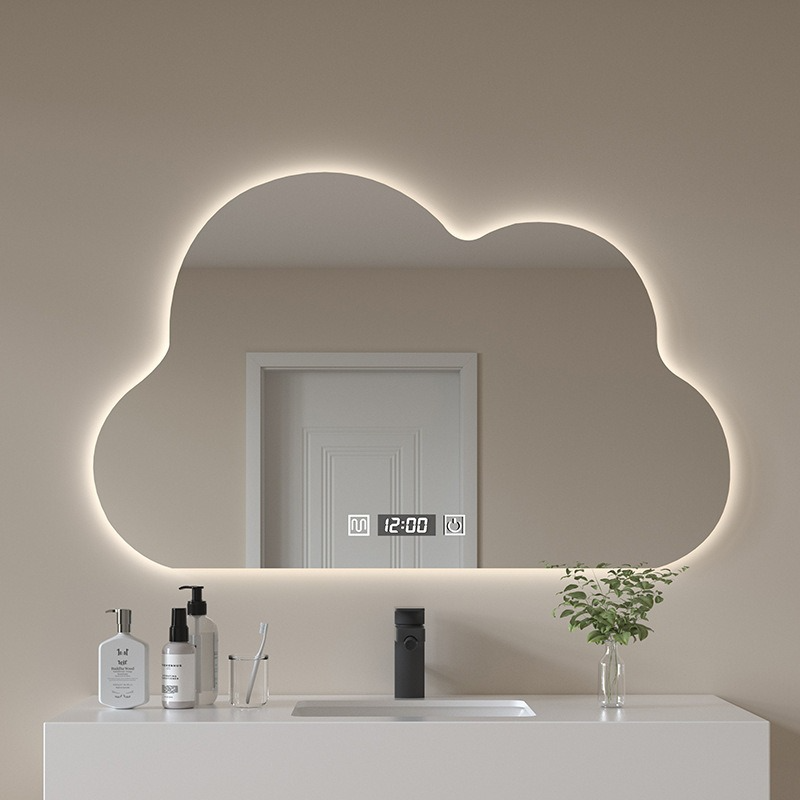
Specifying smart mirror IP ratings for a commercial bathroom is a direct calculation of liability and long-term maintenance costs. MFBATH has spent over a decade manufacturing bathroom solutions for distributors in more than 20 countries, learning that the difference between a compliant hotel project and a callback nightmare often comes down to a single digit in an IP rating. Most architects and designers focus heavily on the aesthetic finish of a vanity, but the electrical safety of the integrated mirror is what protects your reputation when a guest steps out of a hot shower.
A commercial smart mirror must have a minimum IP44 rating to resist splashing water, but for zones directly over a bathtub or in steam rooms, IP65 is mandatory. Specifying the wrong rating is a code violation that can void insurance claims. Beyond water resistance, the real risk of low-end ‘smart mirrors’ is not just fog, but “dry burning” heating films that pose a fire hazard. Premium units use dew-point sensors to cut power automatically, ensuring the heating element never runs without moisture.
IP Ratings vs Zones: What Safe Spec?
Zone 1 mandates IP65; Zone 2 requires IP44.
Architects and project specifiers must map IP ratings to specific bathroom zones to avoid severe liability and safety code violations. Zone 1, defined as the space directly inside a bathtub or shower, requires an IP65 rating to withstand direct water jets without compromising electrical safety. Zone 2, extending 60cm outward from the water source, requires a minimum IP44 rating to resist splashing water. Specifying an IP44 unit in a Zone 1 area is a direct violation of building codes and creates an unacceptable fire and electrocution hazard.
-
- Zone 1 (Bathtub/Shower): Mandatory IP65 rating. Protects against low-pressure water jets from any direction. Low-cost imports often lack the necessary gasket sealing, leading to immediate failure.
- Zone 2 (60cm Radius): Mandatory IP44 rating. Protects against splashing water from all directions. Suitable for standard commercial washbasin areas.
- Dry Burn Hazard: Budget mirrors use manual on/off heating pads that risk fire if left on without moisture. Premium units utilize dew-point sensors to cut power automatically, preventing dry burning.
- Compliance Verification: Do not rely on marketing claims. Demand third-party test reports (e.g., TUV or SGS) and valid UL (North America) or CE (Europe) listings for the exact model specified.
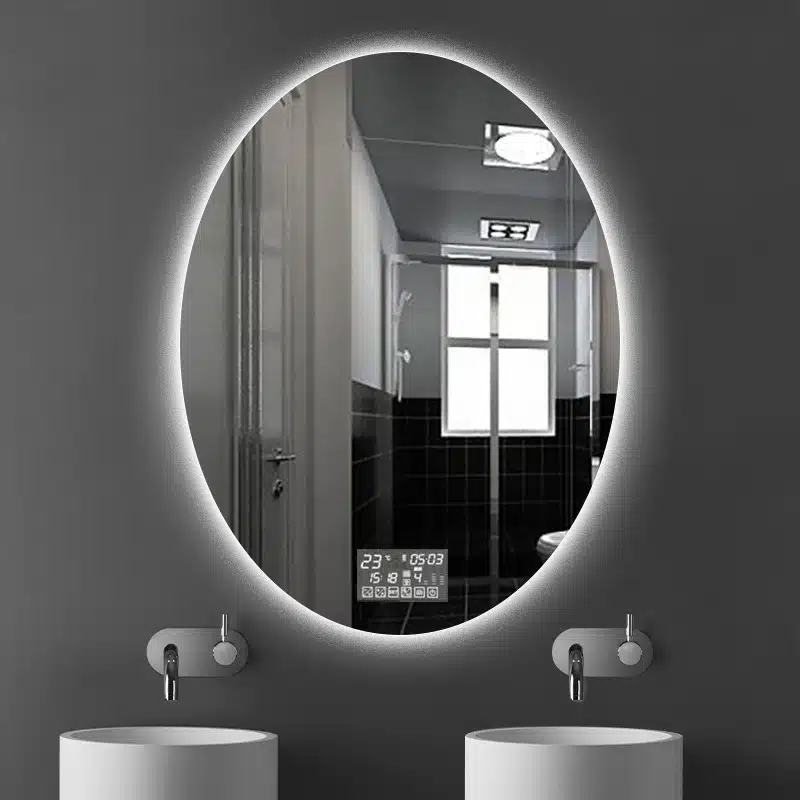
Anti-Fog: Power Kill vs Smart Sensor
Manual resistive heating wastes energy and risks fire; sensor-based dew-point detection prevents dry burning.
Low-cost retail mirrors rely on manual resistive heating pads that run continuously when left on. This approach wastes electricity and poses a significant fire hazard known as ‘dry burning,’ where the heating film degrades without moisture to dissipate the heat.
Premium commercial units utilize high-precision humidity sensors to detect the dew point. The system calculates when steam is about to form and activates the anti-fog feature only when necessary, automatically shutting off once the environment clears.
Implementing sensor-based activation reduces power consumption by 30% to 50% per cycle compared to standard manual switches. This efficiency directly lowers operational costs for large-scale projects, such as 100-room hotels, while eliminating the risk of unattended heating.
-
- Energy Efficiency: Sensor-based activation reduces energy consumption by 30-50% per cycle by eliminating continuous runtime.
- Fire Safety: Automatic shut-off prevents the ‘dry burn’ effect, protecting the mirror and reducing fire liability.
- Dew Point Logic: Advanced sensors calculate the dew point to pre-heat the glass before fog appears, rather than reacting to it.

LED Power & Proximity: The Spec Sheet
Commercial smart mirrors require 24V DC external drivers and infrared proximity sensors to prevent steam-triggered errors.
The electrical architecture of a commercial smart mirror is defined by the separation of high-voltage AC and low-voltage DC. While residential units often integrate 110V-240V AC directly into the frame, commercial and hospitality installations mandate 24V DC external drivers. This externalization isolates the user from lethal voltage and allows for centralized power management across multiple vanities in a hotel setting.
The control interface must utilize infrared (IR) proximity sensors rather than standard capacitive touch screens. In a high-humidity bathroom environment, standard capacitive touch screens suffer from ‘ghost touches’ triggered by steam condensation or wet fingers. An IR sensor detects the presence of a user through a non-conductive glass surface, waking the LED and anti-fog systems without physical contact.
-
- Driver Type: 24V DC external power supply (UL/CE certified) to isolate user from mains voltage.
- Activation Method: Infrared proximity sensor (wake-on-approach) to prevent steam-induced ghost touches.
- Input Voltage: 110V-240V AC for the external driver; 24V DC for the internal LED and sensor circuitry.
- Touch Interface: Capacitive touch controls for brightness/color adjustment, located on the dry, lower bezel to avoid steam interference.

Custom CRI 90+: Why Specs Matter for Finish
CRI 90+ is non-negotiable for accurate color rendering in high-end hospitality and residential projects.
Luxury hotel specifiers and interior architects often confuse raw brightness with color accuracy. A mirror can emit 1000 lumens, but if the Color Rendering Index (CRI) is below 80, the light spectrum is distorted. This results in unnatural skin tones and inaccurate material representation, leading to costly design callbacks and client dissatisfaction during final walkthroughs.
The industry standard for professional-grade grooming and high-end vanity applications is a minimum CRI of 90+. At this threshold, the LED spectrum closely mimics natural daylight, ensuring that makeup application, fabric selection, and tile finishes appear exactly as intended under standard illumination. Anything less compromises the integrity of the interior design specification.
Budget smart mirrors frequently utilize low-cost LED strips with a CRI of 70-80. While these units may appear bright in a showroom, they fail to render reds and yellows accurately. For a commercial developer, specifying a mirror with a CRI of 90+ ensures that the lighting environment remains consistent and flattering, regardless of the ambient light conditions in the bathroom.
-
- CRI Threshold: Mandatory CRI 90+ for all luxury and commercial vanity applications to ensure accurate color fidelity.
- Color Temperature: Adjustable range of 2700K (warm) to 6500K (cool) allows specifiers to match existing architectural lighting schemes.
- Light Quality: High CRI eliminates the green/magenta cast common in cheap LEDs, ensuring true-to-life skin tones and material colors.
- Project Impact: Prevents aesthetic failures where finishes look different under mirror light versus ambient light, protecting the architect’s reputation.
How to Verify a Manufacturer’s IP Claim
Never accept a supplier’s internal datasheet for IP claims; demand independent third-party validation.
Architects and project specifiers face severe liability if a smart mirror fails a safety inspection due to falsified IP ratings. A common industry deception involves suppliers claiming ‘waterproof’ status based on internal visual tests rather than standardized engineering protocols. To protect your project from callback risks and code violations, you must demand verifiable evidence from accredited international laboratories.
-
- Lab Reports: Request the original test report from an accredited third-party lab, such as TUV Rheinland or SGS. These reports provide the definitive proof of IP44 or IP65 compliance, detailing the exact water volume and pressure (e.g., 10 liters/min for IP65) used during testing. Internal factory certificates are legally insufficient for commercial building permits.
- Regional Listings: Verify that the unit holds a legitimate UL listing for North America or CE certification for Europe. This confirms the electrical components—specifically the LED driver and anti-fog heating circuits—meet strict regional safety codes. A UL mark ensures the mirror is safe for use in wet environments and satisfies commercial insurance requirements.
- Technical Documentation: Reputable manufacturers provide detailed wiring diagrams and container loading plans. These documents are essential for your electrical engineer to calculate load requirements and for your logistics team to optimize shipping. Without these technical specs, you risk installation delays and improper electrical integration on-site.
- Warranty Terms: The warranty must explicitly cover the LED driver and the anti-fog heating element for a minimum of 2 years. Many budget suppliers exclude these components, leaving the developer liable for early replacements. A comprehensive warranty indicates the manufacturer stands behind the durability of their electronic sealing and internal components.
Conclusion
Specifying a smart mirror requires more than aesthetic selection. It demands strict adherence to IP ratings and anti-fog engineering to eliminate liability. Premium units with dew-point sensors and UL/CE certification prevent dry-burn hazards and ensure code compliance across all bathroom zones.
Frequently Asked Questions
Is IP44 good enough for a commercial bathroom?
IP44 is sufficient only for Zone 2 areas, such as mirrors mounted outside the immediate splash zone of showers or tubs. For Zone 1 locations directly over bathtubs or in. Verify the mirror’s placement against local bathroom zoning codes to ensure compliance.
Can I get a smart mirror with a UL listing?
Yes, MFBATH offers smart mirrors that are UL/CSA compliant, specifically engineered for the North American market. These units meet strict safety standards for electrical components and accessibility requirements. Request the specific UL certification documents for your project’s compliance review.
What is the MOQ for custom sizes with a specific IP rating?
The minimum order quantity for custom sizes and specific IP ratings is typically 10 to 20 units. This low threshold allows distributors to test market demand without committing to large-scale production runs. Confirm exact MOQ requirements based on the final technical specifications.
How does the anti-fog feature affect the mirror’s warranty?
Premium anti-fog systems using dew-point sensors generally carry standard warranties because they prevent the dry-burning risks associated with manual resistive heating. Using manual switches that leave the film on continuously may. Ensure the anti-fog system is properly calibrated to maintain warranty validity.
What is the typical lead time for a smart mirror with a custom IP rating?
Lead times depend on factory capacity and the complexity of the custom IP rating certification. For standard custom orders, production typically aligns with the facility’s monthly output of up to 5,000. Request a precise timeline quote after submitting your detailed technical specifications.


0 Comments