
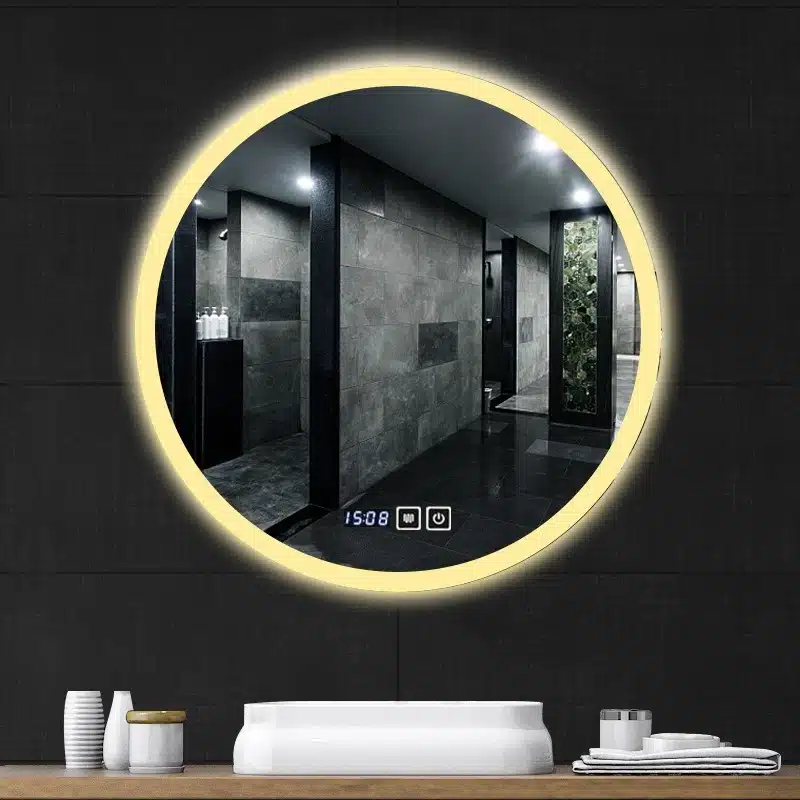
Sourcing a quality **copper free mirror** is the most critical step in preventing costly warranty claims and reputational damage from premature glass failure. Standard mirrors frequently corrode in humid environments like hotel and multi-family bathrooms, developing an unsightly “black edge” that forces expensive, project-wide replacements and undermines client trust.
This technical guide provides the specifications for procuring durable, long-lasting mirror glass. We’ll analyze how the manufacturing process prevents silvering corrosion and how glass thickness affects optical distortion. We’ll also cover the role of vinyl safety backing in meeting building codes, the cost differences in edge finishing, and how to use salt spray test data to validate supplier durability claims.
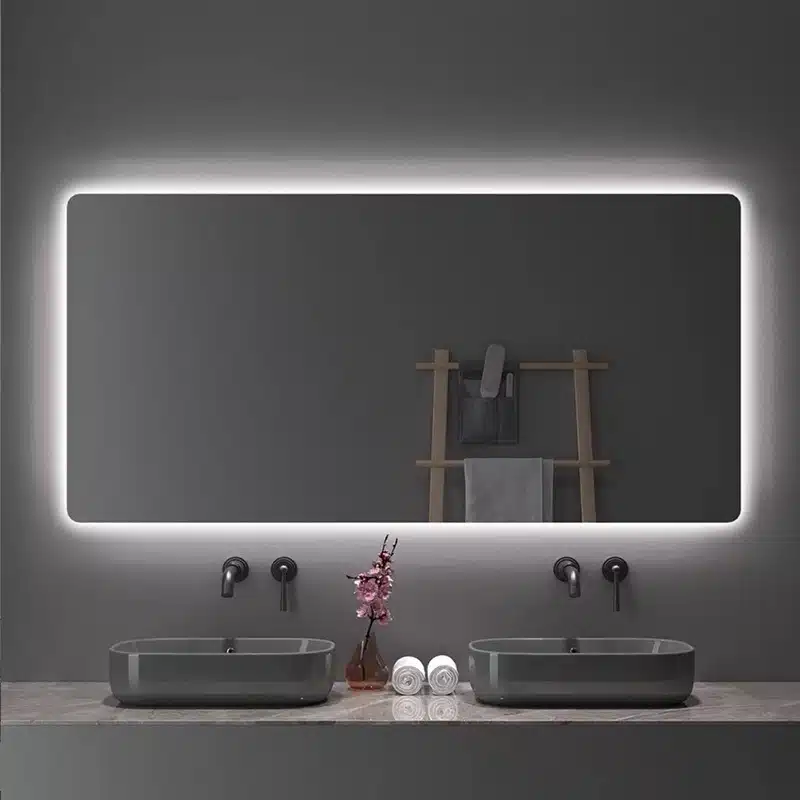
What Causes “Black Edge” Mirror Corrosion in Humid Bathrooms?
The “black edge” on bathroom mirrors, known as desilvering, is not a stain but permanent chemical damage caused when moisture bypasses the edge sealant and reacts with the mirror’s silver backing.
The Role of Humidity and Moisture Intrusion
High humidity is the primary driver, allowing moisture to seep behind a mirror’s protective edge sealant. This trapped water acts as a catalyst, powering the chemical reaction that degrades the silver backing. The process almost always starts at the edges, which are the most vulnerable points of entry for moisture.
- When bathroom humidity consistently exceeds 60%, water vapor condenses on the cool mirror surface and can penetrate compromised edge seals.
- This moisture functions as an electrolyte, dramatically accelerating the chemical breakdown of the reflective silver layer.
- Gravity pulls this condensation downward, concentrating moisture at the bottom corners and edges. This pooling effect is why corrosion often appears there first.
Chemical Reactions and Environmental Accelerants
The blackening effect is the formation of silver sulfide, a compound created when the mirror’s silver reacts with airborne hydrogen sulfide gas. While this gas is present in small amounts in the air, several environmental factors in a bathroom can turn a slow process into rapid, visible damage.
- Inadequate Ventilation: Poor airflow traps steam and airborne chemicals from aerosols or cleaning products. This increases the duration and intensity of the mirror’s exposure to corrosive agents.
- Harsh Cleaning Products: Abrasive or ammonia-based cleaners can damage the mirror’s protective backing and edge sealant. If the cleaning liquid seeps over the edge, it can directly attack the silver layer, leaving it vulnerable.
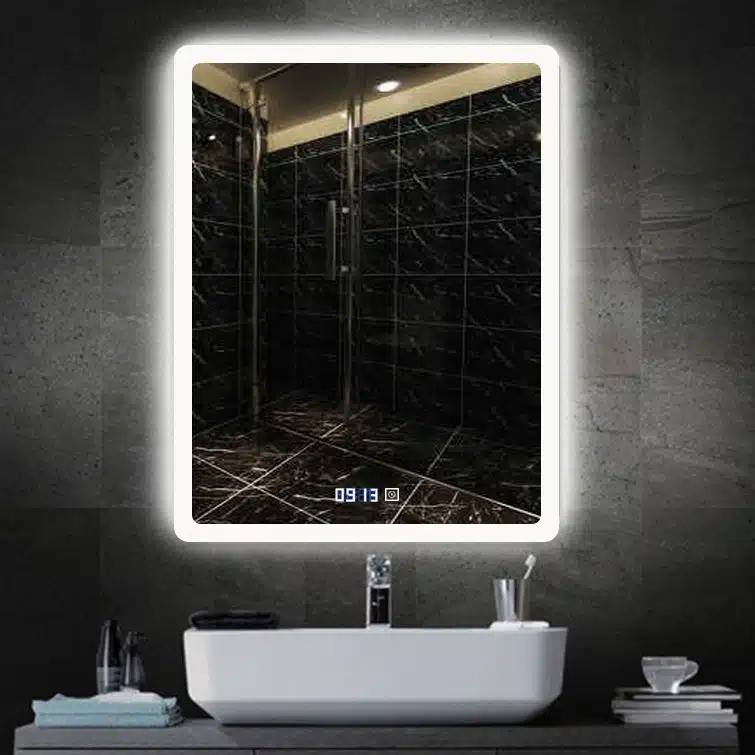
What Is a “Copper-Free” Silver Mirror and Why Does It Last Longer?
Eliminating the traditional copper backing—the primary failure point for oxidation—is the key technological shift that gives modern mirrors a service life 3-5 times longer in high-humidity environments.
The Role of Copper in Traditional Mirror Manufacturing
In older manufacturing processes, a layer of copper was applied directly over the silver coating. This layer was intended to shield the delicate silver from scratches and chemical exposure. Yet, copper itself is highly susceptible to oxidation when it comes into contact with moisture and air. This chemical reaction is the direct cause of “black edge” corrosion, where moisture penetrates the mirror’s edge seals and attacks the copper, leading to visible tarnishing and degradation over time.
| Feature | Traditional Copper-Backed Mirror | Modern Copper-Free Mirror (MFBATH Standard) |
|---|---|---|
| Protective Layer | Copper (prone to oxidation) | Palladium-based metal coating (chemically inert) |
| Corrosion Resistance | Low; highly susceptible to humidity and cleaning chemicals | High; engineered to prevent “black edge” oxidation |
| Expected Lifespan (Humid Area) | 1-2 years before showing degradation | 5+ years without silvering defects |
How Modern Coatings Prevent Corrosion
Copper-free mirrors solve the oxidation problem by replacing the vulnerable copper layer with advanced, chemically inert materials. We use a palladium-based metal coating system that creates a more durable and non-reactive barrier. This modern process provides significantly better protection against humidity, ammonia-based cleaning products, and other atmospheric chemicals. By removing the primary weak link—the copper layer—the mirror’s silvering is effectively sealed, preserving a clear reflection and preventing degradation at the edges for years. This also makes the manufacturing process more environmentally friendly by eliminating hazardous copper and lead compounds.
Boost Profits with Factory-Direct Smart Mirrors
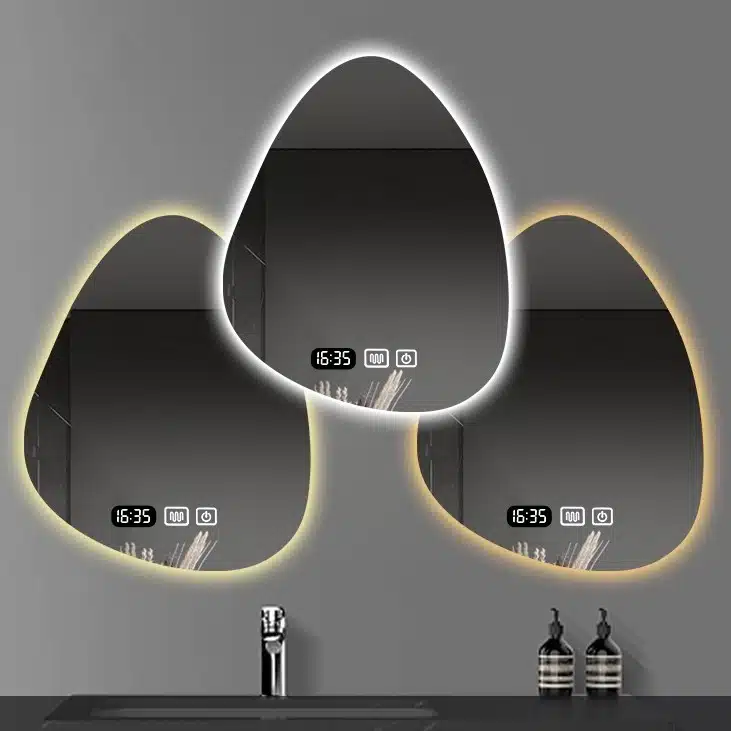
How Does Mirror Thickness Affect Distortion (4mm vs. 5mm Standards)?
Mirror thickness directly controls structural rigidity; 5mm is the 2026 industry standard for preventing visual distortion in frameless bathroom mirrors, while thinner 4mm glass is relegated to framed applications and 6mm+ is specified for large-scale commercial walls.
4mm Thickness: Cost-Effective for Smaller, Framed Mirrors
While less common for primary bathroom mirrors by 2026, 4mm glass is a viable, budget-friendly option for smaller or fully framed mirrors where the frame provides most of the structural support. Its main advantage is lower material cost, making it suitable for price-sensitive projects or decorative accent pieces. In larger, frameless applications, 4mm glass is highly susceptible to flexing, which creates a distorted, “funhouse” effect in the reflection.
5mm Thickness: The 2026 Industry Standard for Distortion-Free Clarity
By 2026, 5mm thickness is the established international benchmark for high-quality bathroom and vanity mirrors. It offers the ideal balance of structural integrity, clear reflection, and cost for most residential and commercial projects. This thickness provides superior rigidity that prevents warping and ensures optimal flatness, even in large frameless formats. Its durability also offers enhanced resistance to stress from environmental factors like temperature fluctuations in a bathroom.
| Thickness | Primary Application | Key Performance Characteristic |
|---|---|---|
| 4mm | Small, fully framed mirrors; budget-sensitive projects. | Prone to flexing and visual distortion in larger sizes. |
| 5mm (Standard) | Frameless residential and commercial bathroom mirrors. | Superior rigidity ensures zero distortion and optimal flatness. |
| 6mm+ | Large commercial installations (gyms, hotel lobbies). | Maximum structural stability and impact resistance. |
6mm+ Thickness: Specified for Large-Scale and High-Humidity Installations
For oversized installations or commercial projects with stringent safety requirements, 6mm or thicker glass is specified. This includes large mirror walls in gyms, dance studios, and hotel lobbies, where any risk of flexing must be eliminated. The increased weight and strength of 6mm glass help it meet stricter building codes for public spaces. It also offers the highest level of resistance to moisture and physical impact, ensuring long-term performance in the most demanding conditions.
Why Is Vinyl Film Safety Backing Crucial for Mirror Breakage Protection?
Vinyl safety backing is no longer just an optional feature; it’s a non-negotiable component for meeting global safety standards, containing glass shards upon impact to prevent severe injury in commercial and public spaces.
The primary role of a vinyl safety film is to adhere to the back of the mirror glass. If the mirror shatters from an impact, the film holds the dangerous fragments together, preventing them from scattering and causing injury. As of 2026, this has become a critical and expected safety feature for any mirror installed in public or high-traffic areas where liability is a concern.
How Safety Backing Film Contains Glass Fragments During Impact
The mechanism is simple and effective. A strong, pressure-sensitive adhesive on a durable PET or vinyl film creates a secure bond with the mirror’s back surface. When an impact is strong enough to break the glass, the energy is distributed across the film, which holds the sharp, broken pieces in place. This containment is what prevents a catastrophic failure from turning into a major safety hazard.
- The adhesive bond keeps sharp glass shards stuck to the film instead of allowing them to fall or fly outwards.
- This action significantly reduces the risk of cuts and lacerations, making it an essential specification for gyms, hospitals, hotels, and public bathrooms.
- At MFBATH, we include shatter-proof film as a standard feature on all our mirrors to ensure this base level of protection.
Meeting Safety Standards in Commercial and Residential Spaces
Many regional building codes and international safety regulations now mandate the use of safety glass in certain applications. Safety-backed mirrors allow manufacturers and project specifiers to meet these legal requirements, such as the European BS EN 12600 standard, which classifies glazing materials based on their performance under impact. For B2B projects, this is not just about safety, but about compliance and risk mitigation.
- Using backed mirrors ensures compliance for commercial projects where safety is non-negotiable.
- It simplifies the specification process for architects and designers who must adhere to strict regional codes.
- The film provides clear documentation that the mirror product meets established safety benchmarks, streamlining approvals.
Secondary Benefits: Moisture Resistance and Edge Protection
Beyond impact protection, the vinyl film serves as a functional barrier against humidity and moisture. This secondary benefit is especially valuable in bathrooms, where constant steam can attack the mirror’s reflective silver layer and cause “black edge” corrosion. The film effectively seals the back of the mirror, extending its functional lifespan and preserving its aesthetic quality.
- The film shields the mirror’s silver backing from direct contact with ambient moisture and steam.
- This protection is vital for preventing edge creep and desilvering, the most common failure points in damp environments.
- By preserving the mirror’s silvering integrity, the backing improves its long-term durability and appearance.
What Are the Cost Differences Between Polished Edge and Beveled Edge Mirrors?
The 10-30% price premium for a beveled edge mirror is a direct result of a more complex manufacturing process that requires skilled labor, specialized machinery, and results in greater material waste compared to a standard polished edge.
Manufacturing Process and Labor Costs
The primary driver of the cost difference is manufacturing complexity. A polished edge is a simple, smooth finish, but creating a beveled edge requires a multi-step grinding and polishing process to cut the mirror’s border at a specific angle. This operation is more time-consuming and demands more specialized machinery and skilled labor.
- The beveling process is inherently slower than creating a standard flat polish, increasing machine time and labor costs per unit.
- Grinding the glass to create the angled border generates material waste, which is factored into the final price.
- This complexity results in a typical cost premium for beveled mirrors between 10% and 30% over polished edge mirrors of the same size and quality.
Factors That Influence the Price Premium
Beyond the basic manufacturing process, several factors can widen the cost gap between the two edge types. The mirror’s size, the width of the bevel, and any custom design features all contribute to the final price calculation.
- For larger mirrors, the absolute cost difference becomes more significant, even if the percentage premium remains consistent.
- A wider or more intricate bevel design demands more precise work and material removal, which increases the price.
- Customizations, such as integrating LED lighting or cutting unique shapes, add complexity and cost, particularly for beveled edge designs that require more careful integration.
How Does the Salt Spray Test (CASS) Prove Mirror Durability?
The Copper-Accelerated Acetic Acid Salt Spray (CASS) test provides objective, empirical proof of a mirror’s long-term durability by simulating years of harsh bathroom humidity in a controlled, accelerated lab environment.
For procurement teams and project managers, specifying mirror quality requires more than just visual inspection. You need a standardized method to verify that a mirror’s backing and silvering will not fail prematurely. The CASS test is that method. It cuts through marketing claims by subjecting mirrors to conditions that aggressively promote corrosion, providing a clear pass/fail outcome on durability.
How CASS Testing Works
The CASS test is a controlled process designed to replicate and accelerate the galvanic corrosion that causes black edges on bathroom mirrors. A sample piece of the mirror is placed inside a sealed chamber and exposed to a continuous, heated salt spray. This isn’t just simple salt water; the solution contains sodium chloride and copper chloride, is kept at a constant 49°C (120°F), and maintained at an acidic pH level. This aggressive chemical and thermal environment mimics the worst-case scenario for a mirror in a poorly ventilated, high-humidity bathroom, turning years of potential degradation into a test that runs for hundreds of hours.
| Mirror Specification | Protective System | Typical CASS Test Outcome |
|---|---|---|
| Standard Commercial Mirror | Basic copper layer with a single layer of standard paint. | Shows significant edge creep, blackening, and silvering spots in under 150 hours. Fails to meet durability standards for humid environments. |
| MFBATH Copper-Free Silver Mirror | Multi-layer system: sealed silver, lead-free corrosion-resistant primer, and a waterproof epoxy or Valspar-grade topcoat. | Withstands 300+ hours of exposure with no clouding, no edge blackening, and minimal to zero silver impairment. Passes standards for luxury hotels and commercial projects. |
Validation Criteria for Mirror Durability
For a mirror to officially pass the CASS test, it must meet strict performance criteria that confirm its protective backing is effective against moisture intrusion. The absence of visible degradation after hundreds of hours proves the mirror will withstand long-term use in its intended environment. A passing grade isn’t subjective; it’s based on measurable outcomes.
- The reflective surface must show absolutely no clouding or darkening.
- The mirror edges cannot show any signs of undercutting, blackening, or discoloration.
- Any silvering damage or tarnish spots must be minimal, typically not exceeding 9 total spots or 3mm in cumulative size.
- Achieving these results depends entirely on a robust, multi-layer protective system, typically a sealed silver layer, a corrosion-resistant primer, and a final waterproof topcoat.
 How Should You Structure Warranty Clauses for Mirror Silvering?
A well-structured warranty clause protects both the manufacturer and the customer by clearly defining coverage duration, specific silvering defects, liability limits, and a formal claims process.
A properly drafted warranty for mirror silvering sets clear expectations and minimizes disputes. It needs to be specific about what constitutes a defect, how long coverage lasts, and the precise steps for making a claim. This creates a transparent agreement that protects the investment for the buyer and manages risk for the manufacturer.
Defining the Scope and Duration of Coverage
The foundation of any warranty is a clear statement of its duration and what it covers. This clause should specify the exact period of protection against manufacturing flaws, which protects the original customer without creating indefinite liability. A five-year period is the common industry standard for silvering defects, though terms can range from one to ten years depending on the product grade.
- Specify that coverage applies exclusively to silvering defects originating from the production process, such as clouding, discoloration, or the formation of black spots.
- Establish that the warranty is for the original purchaser only and is non-transferable.
- Clarify that any replacement product provided does not reset or extend the original warranty period.
Establishing Liability Limitations and Exclusions
It’s critical to limit the manufacturer’s liability and list conditions that void the warranty. The clause should state that the sole remedy is either a direct product replacement or a refund of the original purchase price. This prevents open-ended financial exposure from ancillary costs. The warranty must also list specific actions or conditions that nullify the coverage.
- Explicitly exclude responsibility for any labor costs associated with the removal of the defective mirror or the installation of a new one.
- List common exclusions, including damage from improper installation, physical breakage, scratches, or contact with incompatible adhesives or harsh cleaning chemicals.
- State that defects caused by prolonged exposure to excessive moisture or failure to provide adequate ventilation in a bathroom are not covered.
Outlining the Claims and Enforcement Process
A warranty must detail the exact procedure for filing a claim. This creates a verifiable and consistent process that protects against invalid or fraudulent requests. The steps should be simple but firm, ensuring that the manufacturer has the opportunity to validate the claim before committing to a remedy.
- Require the customer to provide written notification of the defect to the manufacturer before the warranty period officially expires.
- Stipulate that the manufacturer retains the right to inspect the mirror in its installed location to verify the defect is a result of a manufacturing flaw.
- This procedure ensures that reported issues are legitimate and can be attributed to production rather than post-installation factors like environmental damage or improper handling.
Conclusion
Choosing the right bathroom mirror goes beyond aesthetics. Specifications like copper-free silvering directly prevent edge corrosion in humid environments, while glass thickness ensures a distortion-free reflection. These technical details, along with safety backing and quality edge work, are what truly define a mirror’s long-term performance and value.
Evaluate the mirror specifications in your current project plans to align with modern durability standards. To see the difference in clarity and build quality yourself, contact our team to arrange for a sample.
Frequently Asked Questions
What is a copper free mirror?
A copper-free mirror is a modern, high-quality mirror that eliminates the traditional copper layer used to protect the silver backing. Instead, it uses a more advanced, eco-friendly chemical adhesion process. This design provides significantly higher resistance to corrosion and “black edge” (desilvering), especially in high-humidity environments like bathrooms, making it far more durable than older copper-backed mirrors.
Why do bathroom mirrors turn black on edges?
Mirrors turn black on the edges, a process called desilvering or corrosion, due to a chemical reaction. High humidity in bathrooms allows moisture to seep behind the mirror’s edge seals. This moisture, combined with atmospheric gases, reacts with the mirror’s silver backing, causing it to oxidize and darken. The process is concentrated at the edges and bottom where water condensation naturally collects.
4mm vs 5mm mirror thickness?
The primary difference is in rigidity and optical quality. A 5mm mirror is the industry standard for high-quality vanity and full-length mirrors. Its greater thickness provides superior structural integrity, which prevents bending and distortion (the “funhouse” effect), especially in larger sizes. A 4mm mirror is a more economical option suitable for smaller, framed, or decorative mirrors where rigidity is less critical. For a primary bathroom mirror, 5mm offers a more premium, distortion-free reflection.
How to prevent mirror corrosion?
Preventing mirror corrosion involves controlling moisture and protecting the mirror’s edges. Ensure proper bathroom ventilation with an exhaust fan to keep humidity below 60%. When cleaning, use a soft, lint-free cloth and an ammonia-free cleaner, being careful not to spray cleaner directly on the edges where it can seep behind the glass. Additionally, choosing a mirror with high-quality sealed edges or a protective frame can significantly reduce moisture ingress.
Best quality bathroom mirror glass?
The best quality bathroom mirror is a copper-free model made with low-iron glass. The copper-free construction offers maximum durability against corrosion and desilvering in humid conditions. Low-iron glass provides superior clarity and a brighter, more accurate color reflection without the slight green tint found in standard glass. For optimal quality and image stability, this glass should have a thickness of at least 5mm.
Safety backed mirror meaning?
A safety-backed mirror has a protective film applied to the back of the glass. In the event of breakage, this backing holds the sharp glass fragments together, preventing them from shattering and falling. This is a crucial safety feature that significantly reduces the risk of injury, making it a standard requirement for large mirrors, commercial installations, and high-traffic household areas.




0 Comments