

Two countertop architectures dominate bathroom vanity sourcing. The integrated basin forms the bowl into the top as one piece. The separate countertop pairs a flat top with an undermount or vessel sink. The core difference fits in one sentence. Integrated means one part; separate means two replaceable parts.
That single choice changes cleaning routines, leak risk, repair cost, customization range, and order math. This article works through the integrated basin vs separate vanity top decision dimension by dimension, using sintered stone (natural minerals pressed and fired at high temperature) and minimum order quantity (MOQ) terms. You will finish with a clear pick for your customer base.
Key Takeaways
- An integrated basin forms the bowl and the countertop from one sintered stone panel, so no seam runs between them.
- Sintered stone is pressed and fired from natural minerals with no resin, rating 7–8 on the Mohs hardness scale.
- The surface resists heat up to 300°C, blocks stains because it is non-porous, and does not fade under UV light.
- A separate countertop lets you swap a ceramic basin alone, which cuts per-part repair cost.
- Minimum order quantity (MOQ) is 15 sets per model, color, and size across the full product line.
- Every piece passes five quality checks, backed by a 2-year whole-cabinet warranty.
- Production lead time is 20–30 days; samples ship in 10 working days.
Table of Contents
- Integrated Basin vs Separate Countertop: Side-by-Side
- Integrated Basins: Sintered Stone One-Piece Construction
- Separate Countertops: Top Plus Undermount or Vessel Sink
- Cleaning, Leak Prevention, and Repair
- Cost Structure and MOQ Reality
- Customization: What Each Design Lets You Change
- Which One Fits Your Line
- Frequently Asked Questions
- The Bottom Line
Integrated Basin vs Separate Countertop: Side-by-Side
Read this table as a sourcing checklist, not a verdict. Each row is a decision point your customer hits within the first year of ownership. Structure and leak prevention matter at installation. Cleaning and repair cost matter every week after. Cost structure and customization matter at order time.
Seven Dimensions Compared at a Glance
| Dimension | Integrated Basin | Separate Countertop |
|---|---|---|
| Structure | One-piece top and bowl in a single sintered stone panel | Two parts: flat top plus undermount or vessel sink |
| Cleaning | Smooth surface with no seam; wipe across the whole top | Caulk line around the basin needs periodic re-sealing |
| Leak prevention | Fewer joints; the drain is the main seal point | Basin-to-top seal depends on installer care |
| Cost structure | Higher material cost per unit, fewer installation parts | Lower base top cost, plus sink, sealant, and hardware |
| Customization | Sintered stone textures; single or double basin | Ceramic basin shapes; broad top material range |
| Repair | Replace the entire top assembly | Replace the sink alone and keep the top |
| Installation | One heavy panel, fewer assembly steps | More components, separate mounting steps |
Two patterns stand out. The integrated basin removes joints, so it wins on cleaning and leak prevention. The separate countertop separates parts, so it wins on repair economics and material mixing. Every other row flows from those two facts. The sections below explain the material science behind each pattern.
Integrated Basins: Sintered Stone One-Piece Construction
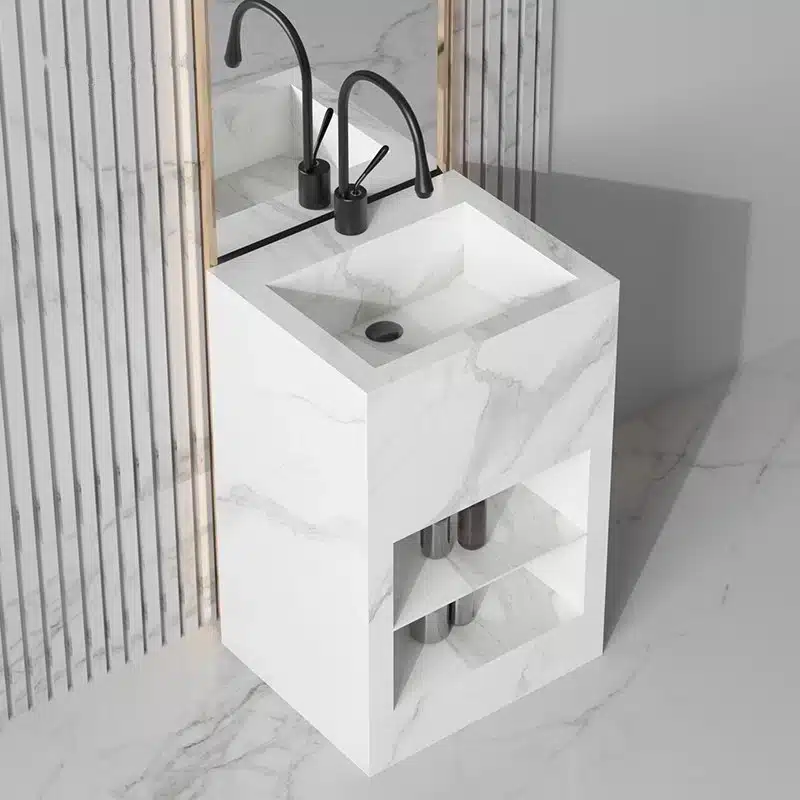
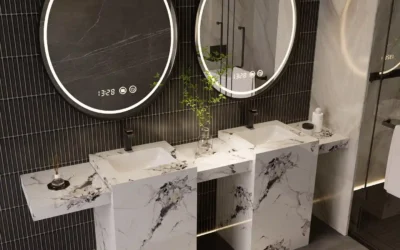
An integrated basin starts as a single mineral panel. Quartz, feldspar, and silica are pressed under high pressure and fired at high temperature. The basin shape forms into the same surface as the top, so bowl and countertop are one body. No resin binder holds the structure together. No seam exists from drain to edge.
How Sintering Removes the Resin Problem
The name sintered stone describes the process, not just the look. Natural minerals are compacted and heated until they densify into a uniform slab. That firing step replaces the resin binders used in many engineered surfaces. The payoff is homogeneity. The surface layer matches the core, so years of scrubbing do not expose a different material.
Density changes how the basin behaves in daily use. The non-porous surface gives liquids nowhere to soak in, so spills stay on top until wiped. Hard water and soap residue do not bond into the finish. This is why sintered stone integrated basins hold their appearance in rental and hotel bathrooms.
Performance Specs You Can Quote
The material data for our sintered stone line is fixed, so quote it directly. The surface rates 7–8 on the Mohs hardness scale, which means keys, rings, and dropped bottles rarely leave marks. Heat resistance reaches 300°C, so styling tools and hot water do no damage. UV-stable pigments keep the color true in sunlit rooms. The surface also carries antibacterial properties, a real benefit in shared bathrooms.
Full sintered stone vanity specifications cover the material sheet in one place. Keep that page in your quoting folder. When a hotel architect asks for proof, you have the numbers without a second email.
One-piece construction also simplifies the parts list. There is no separate basin, mounting ring, or sealant kit to order and store. The vanity arrives with the basin built into the top, so installers handle one panel instead of two. Fewer SKUs mean fewer stockouts for distributors. That simplification shows up in every reorder.
Sizes and Configurations
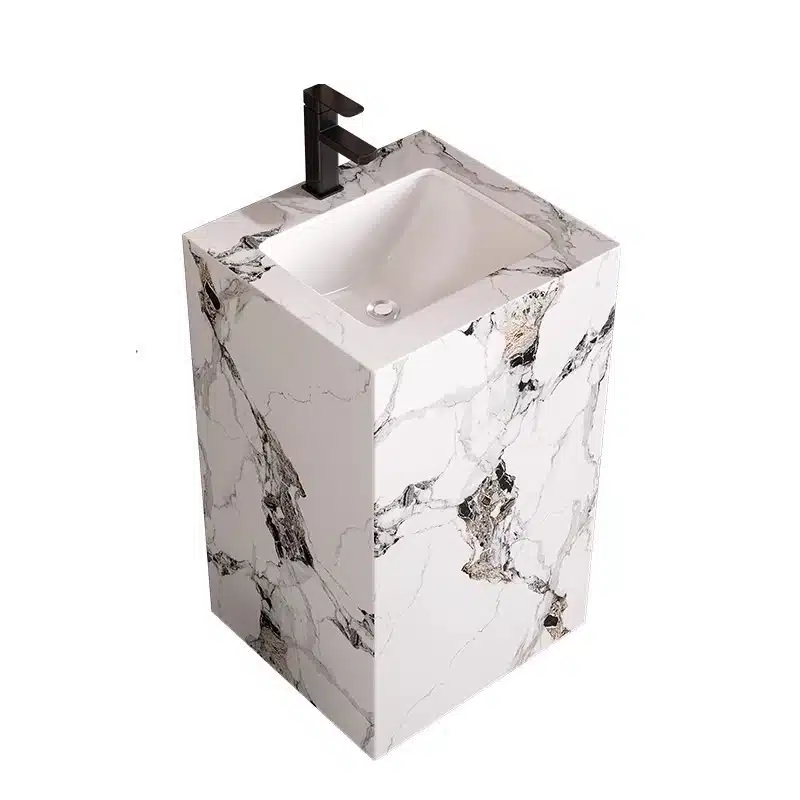
Sintered stone basins run from 600 mm to 2000 mm wide, in single and double basin layouts. The same material covers floating vanities from 600–1800 mm and floor-standing units from 800–2000 mm. Finishes mimic marble, granite, and cement, in matte, satin, or polished surfaces. That range spans a one-basin powder room to a double-basin master suite. Width, finish, and basin count all accept custom orders.
Single basins serve powder rooms and compact hotel bathrooms. Double basins carry master suites and family bathrooms. Floating vanities free floor space for cleaning, while floor-standing units hide plumbing behind closed panels. Drain positions follow the plumbing layouts your market uses. Both mount styles keep the same 15-set minimum.
Verdict: Choose Integrated for High-Traffic Bathrooms
Integrated basins earn their cost where cleaning happens daily and callbacks are expensive. Hotels, serviced apartments, and public washrooms fit that profile. The one-piece body removes the caulk line that fails in high-use rooms. If your channel sells durability and low maintenance, this is your architecture.
Separate Countertops: Top Plus Undermount or Vessel Sink
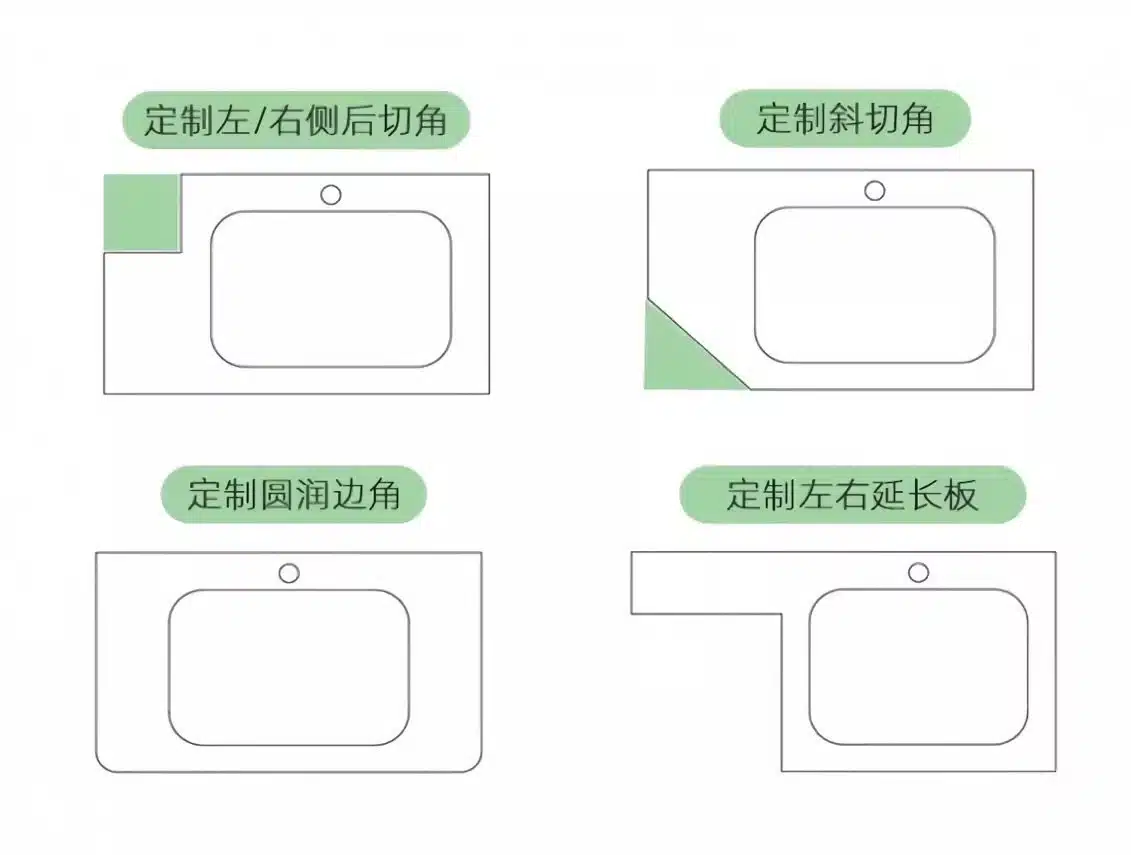
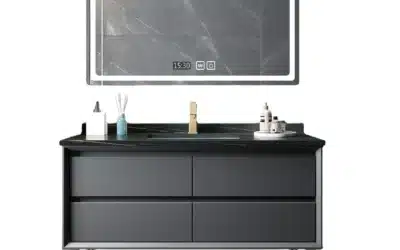
A separate countertop keeps the top and the bowl as two independent parts. The sink mounts below the top as an undermount basin, or sits above it as a vessel sink. Ceramic remains the most common basin material. The top can be ceramic, quartz, marble, or sintered stone. Two-piece construction adds material choices and lowers the base cost per unit, while adding joints, sealants, and mounting steps.
The Two-Piece Structure
An undermount basin attaches beneath the countertop, so its rim stays hidden. A vessel sink rests on top, with the rim fully visible. Both designs use a sealant bead where basin meets top, plus a drain assembly through the slab. That sealant is the part that ages first in real bathrooms. Installer skill decides how long the seal holds.
Above-counter mounting changes the silhouette of the whole vanity. Some markets prefer the sculptural look of a vessel sink. Others want the clean line of an undermount bowl. Review vessel sink specifications before committing to above-counter mounting.
Ceramic Basin Customization
Ceramic basins accept the widest shape range in the separate design. Round, oval, square, and rectangular bowls are standard options. Our factory also makes resin and sintered stone basins for above- and below-counter mounting. Glaze colors match the cabinet finish or stay classic white. Compare commercial vanity top materials in the same sourcing sheet as the basin.
Glazed ceramic handles the daily abuse of a bathroom well. The glaze layer seals the body, so water and cleaners stay on the surface. Scratches appear slowly, and a white glaze hides water marks. When a glaze chip does appear, the basin still swaps out on its own. That replacement speed matters in rental portfolios.
Repair and Replacement Flexibility
Two-piece logic pays off when one part fails. A cracked ceramic basin swaps out without touching the countertop. A damaged top can be replaced while the basin is reused. Distributors can stock basins as spare parts instead of whole tops. That inventory logic frees cash from replacement stock.
Verdict: Choose Separate for Parts Flexibility
Separate countertops suit channels that sell replacement parts or mix materials freely. Price-driven programs benefit from the lower base cost. The trade is visible: sealant maintenance and more installation steps. If your market treats the basin as a consumable, this design fits.
Cleaning, Leak Prevention, and Repair
The table compressed three maintenance rows into one line each. Cleaning, leak prevention, and repair drive long-run cost more than the invoice does. Most buyers compare purchase price. Experienced buyers compare the third year of ownership.
Cleaning an integrated basin means wiping one continuous surface. There is no lip, groove, or sealant bead to catch residue. A separate countertop carries a caulk line around the basin plus the basin rim. That line needs periodic re-sealing to stay white and watertight. Housekeeping teams notice the difference in the first month.
Leak risk follows joint count. The integrated basin has one main seal point: the drain. The separate design adds a basin-to-top seal and, with some vessels, a second seal at the overflow. Each seal is a place where failure starts. Factory inspection catches defects before shipping, but field installation decides the rest.
Repair cost splits along the same line. A failed integrated basin means replacing the entire top assembly. A failed separate basin means replacing one bowl and re-sealing the mount. The integrated path costs more per incident but fails less often. The separate path fails more often but costs less per incident.
Put both designs in your spec sheet so your sales team answers this question in one call. List the cleaning routine for each: one-surface wiping for integrated, caulk inspection for separate. Quote the material data for sintered stone and the replacement logic for ceramic. The buyer who understands the trade decides faster. The buyer who is left guessing shops another supplier.
Sintered Stone Vanities and Basins in One Source
Browse this product, solution, or service page to explore relevant offerings.
Cost Structure and MOQ Reality
Cost structures differ in shape, not just total. The integrated basin concentrates cost in one high-quality panel. The separate design spreads cost across top, basin, sealant, and hardware. The integrated panel costs more to produce; the separate package costs more to assemble. Neither price is fixed, because width, finish, and basin count move both.
Where the Cost Structure Splits
Quote both architectures against your target retail band, not against each other. An integrated sintered stone basin supports a premium price point because the material justifies it. A separate ceramic basin supports a volume price point because the parts are simple and proven. Labor enters the math, since integrated installs in fewer steps. Sell the installed cost, not the unit cost, when you sell through installers.
Sample both designs before you set your buy plan. One sample request covers the 10-working-day window, and the cost of two samples is small against a container of the wrong design. Measure the installed cost with an actual installer, not a spreadsheet. Then lock the order quantity against the design that survives the test. This sequence removes most of the guesswork from the decision.
MOQ: 15 Sets Across the Line
Our minimum order quantity (MOQ) is 15 sets per model, color, and size for the entire product line. Custom dimensions and colors start from the same 15-set threshold. Mixed containers are supported: different models and sizes share one shipment when the total reaches MOQ. That structure lets you test both architectures in one container. You are never locked into a single design to hit a minimum.
Quality Checks, Warranty, and Lead Time
Every piece passes five quality checks before packing. Third-party inspectors such as SGS and TÜV can audit the goods when arranged in advance. Samples ship within 10 working days. Full production runs take 20–30 days. Total delivery to the United States, Canada, and Mexico runs 4–6 weeks, with tracking included.
The whole cabinet carries a 2-year warranty, and the return rate sits below 1%. Trade terms are free on board (FOB) from Qingdao Port. Payment runs 30% deposit at order placement, with the balance due within one week after the draft bill of lading (BL) is issued. The factory holds ISO 9001 standard quality certification and ISO 14001 standard environmental certification, both obtained in 2017 and confirmed current in 2025. Certifications matter when your customer requests documentation.
Customization: What Each Design Lets You Change
Both architectures accept custom orders, and the range is wide on both sides. The factory supports over 40,000 custom combinations across materials, colors, and hardware. Integrated basins vary by width, finish, texture, and basin count. Separate designs vary by basin shape, material, and top surface. White label and private brand programs cover logo printing, laser engraving, and custom packaging.
Integrated sintered stone basins come in marble, granite, and cement textures with matte, satin, or polished surfaces. Sizes run from 600 mm to 2000 mm with single or double basins. Separate designs use ceramic basins in multiple shapes, plus resin and sintered stone basin options. Pantone-matched colors apply to cabinet and frame. Document every dimension in the custom vanity top specifications sheet before sampling.
Custom orders start at 15 sets, the same threshold as standard production. The 2025 product catalog, over 100 pages, is free. Samples ship in 10 working days, so a custom design is verified before the container loads. Customization does not require a second supplier. One factory delivers both architectures.
Which One Fits Your Line
The right architecture follows your channel, not your taste. Hotel buyers pay for cleaning speed and fewer maintenance callbacks. Distributors buy what their region resells. E-commerce brands live and die by returns and freight cost. Match the design to the decision your customer makes at the countertop.
Hotel and Commercial Projects
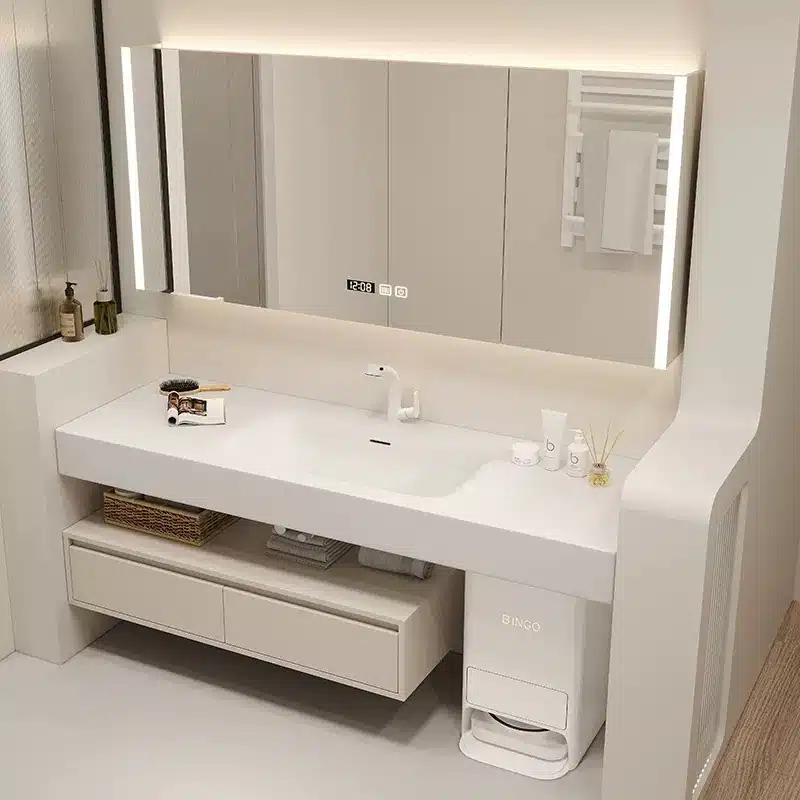
Hotel specifications should lean integrated. The sintered stone surface cleans fast, carries antibacterial properties, and resists 300°C heat from styling tools. The one-piece body removes the caulk-line failures that generate guest complaints. A 2-year whole-cabinet warranty covers units in service. For a phased property rollout, order in batches of 15 sets per model.
A failed caulk line in a hotel bathroom costs more than the repair. The room leaves the inventory, the guest moves, and housekeeping reschedules. Integrated basins remove that failure mode at the design stage. For a 200-room property, that math repeats across every bathroom. This is why project buyers specify integrated tops first.
Wholesale Distribution
Wholesale programs can carry both architectures without extra cost. Mixed containers combine integrated vanities and separate-top models in one shipment. The 15-set MOQ per model, color, and size keeps each SKU small enough to test. Run integrated for premium accounts and separate for parts-driven accounts. Work with a sintered stone vanity manufacturer whose quality system covers both lines.
E-commerce Brands
E-commerce brands should start with separate countertop models. Ceramic basins travel well, and replacement parts ship cheaply when a bowl arrives cracked. Integrated sintered stone panels are heavier and need sturdier packaging. Reserve integrated models for a premium SKU with clear freight math. Browse the product line to see which models match your carrier limits.
Frequently Asked Questions
Does an integrated basin leak less than a separate sink?
Yes, by structure. The integrated basin has one main seal point, the drain, while a separate design adds a basin-to-top seal. Fewer joints mean fewer places for failure to start. The factory runs five inspection checks per piece before packing.
What is the MOQ for custom sintered stone basins?
The minimum order quantity is 15 sets per model, color, and size across the product line. Custom dimensions and finishes start at the same 15-set threshold. Different models and sizes can mix in one container.
Can I replace a ceramic basin without replacing the countertop?
Yes. An undermount or vessel basin mounts independently, so a cracked bowl swaps out while the top stays in place. The installer removes the old sealant, mounts the new basin, and re-seals. Spare-part stock stays smaller and cheaper.
What sizes do integrated sintered stone basins come in?
Widths run from 600 mm to 2000 mm, in single and double basin layouts. Finishes include marble, granite, and cement textures with matte, satin, or polished surfaces. Custom sizes start at 15 sets.
The Bottom Line
The integrated basin wins on cleaning, leak points, and long-run maintenance. The separate countertop wins on parts flexibility and lower base cost. Hotels and premium wholesale lines should run integrated; price-driven programs and e-commerce ranges should run separate. Confirm the pick with a sample order, since MOQ starts at 15 sets per model, color, and size.



0 Comments