
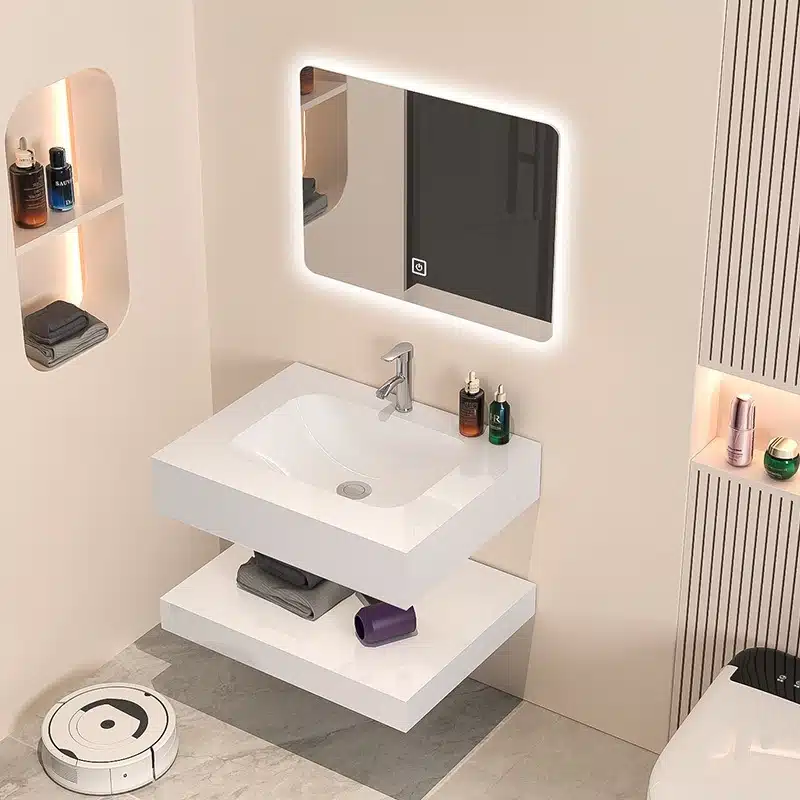
Choosing the right China sintered stone basin supplier is the one decision that prevents a container of cracked, poorly fabricated vanities from ruining your project budget and client relationships. As sintered stone gains popularity in luxury bathrooms, the market is flooded with factories claiming expertise. Yet, many lack the specialized machinery and skill to execute the perfect 45-degree mitered edge, a non-negotiable detail for a high-end seamless look. A bad partnership results in costly freight returns, unsellable inventory, and delays that damage your reputation.
This guide provides a technical sourcing framework, not just a simple list. We analyze the fabrication process that separates premium products from failures and identify the top manufacturers with proven capabilities. We also break down the critical “mismatch risk” of sourcing stone tops and wood cabinets from different suppliers and detail the specific packaging methods required to ship this brittle material across oceans without damage. Use this as your standard operating procedure for vetting and securing a reliable manufacturing partner.
Why Is Sintered Stone Taking Over Luxury Bathrooms?
Sintered stone dominates high-end bathroom specifications because its manufacturing process delivers a non-porous, highly durable surface that mimics premium natural stone without the associated maintenance costs.
Engineered Durability Meets High-End Aesthetics
Sintered stone successfully merges the resilience of an engineered product with the visual appeal of premium natural stone. The material is created by fusing natural minerals under intense heat and pressure, which produces an exceptionally robust surface built for demanding luxury environments. This process yields a slab with consistent quality and appearance, unlike the unpredictable variations found in quarried stone.
- The manufacturing process creates a non-porous, waterproof material ideal for wet bathroom conditions.
- It achieves the look of high-end stone but offers greater consistency and customization in design.
- The availability of large-format slabs allows for seamless installations that minimize grout lines for a clean, modern finish.
Superior Resistance to Stains and Scratches
Its dense, non-porous surface makes sintered stone exceptionally resistant to common bathroom hazards. It stands up to daily wear and tear far better than porous traditional materials like marble or granite, which can easily etch or stain. This inherent durability protects the owner’s investment and preserves the original look of the installation for years.
- Resists stains from cosmetics, cleaning agents, and other common bathroom products.
- Offers high scratch and abrasion resistance, maintaining its original appearance over time.
- The material is also heat-resistant, so it won’t be damaged by hot styling tools left on the surface.
Low Maintenance and Long-Term Value
Natural stone requires regular sealing and careful maintenance, creating ongoing costs and labor. Sintered stone eliminates this requirement. Its non-porous surface does not need any special treatments or sealants to protect it from moisture or stains. This ease of care, combined with its exceptional durability, provides excellent long-term value and lowers the total cost of ownership.
- Cleaning requires only basic, non-abrasive household products.
- It does not need periodic sealing or special treatments to protect its surface.
- Its physical longevity and timeless look contribute to lower lifecycle costs and sustained property value.
Why Does Fabrication (45-Degree Miter) Make or Break the Product?
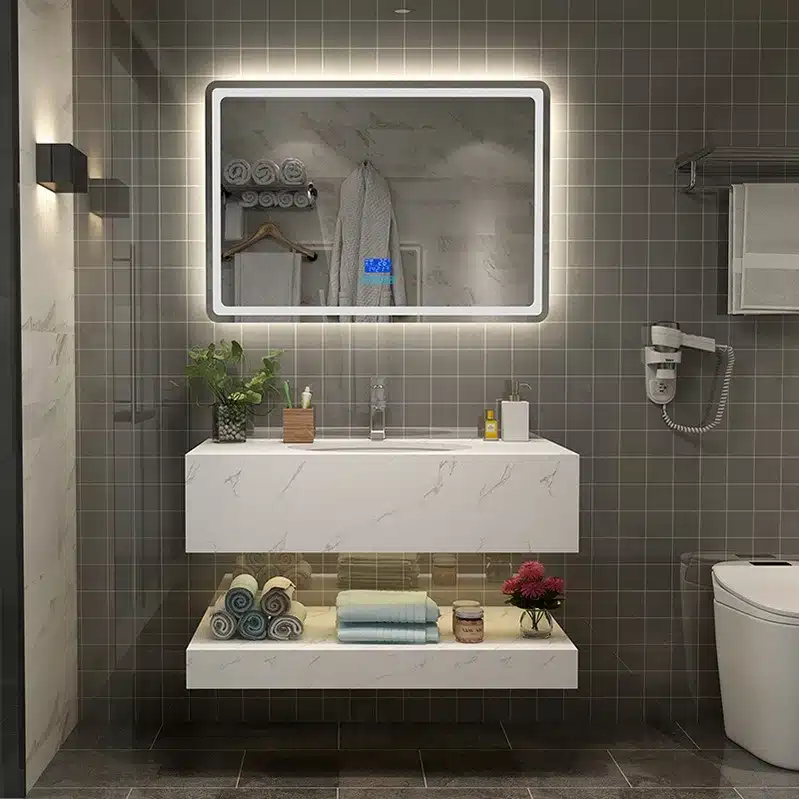
The precision of a 45-degree mitered joint directly determines whether a sintered stone piece is perceived as a premium, solid block or a low-quality assembly.
Seamless Joints vs. Visible Gaps
The quality of a mitered edge is the primary visual cue for value. A flawlessly executed 45-degree joint makes sintered stone appear as a single, solid piece, which is critical for premium applications like waterfall countertops or integrated basins. Any imperfection in this joint immediately devalues the final product, turning a luxury material into a visibly assembled, lower-grade item.
- A perfect miter creates a continuous, seamless look that elevates the aesthetic and justifies a higher price point.
- Visible gaps or misalignments from poor fabrication expose the joint, signaling lower quality and compromising the intended design.
| Fabrication Method | Visual Outcome | Commercial Impact |
|---|---|---|
| Poor (Manual / Inexperienced) | Visible gaps, uneven lines, chipped edges. Looks cheap. | Devalues the material; results in client rejection and lost margin. |
| Professional (CNC Automation) | Seamless, continuous “waterfall” effect. Looks monolithic. | Commands a premium price; enables high-margin architectural projects. |
From Manual Error to Automated Precision
The fabrication industry has shifted from inconsistent manual cutting to precise CNC automation for creating mitered edges. This move was necessary because manual methods are too prone to human error, resulting in the waviness and angle inconsistencies that ruin high-end projects. Modern automation ensures uniform angles and perfectly straight lines across entire slabs, turning a difficult specialty task into a reliable, repeatable process.
- Manual techniques depend entirely on operator skill and often produce inconsistent angles and wavy edges.
- CNC automation provides exact angle control, making precision fabrication a scalable and dependable process for any high-value project.
Elevate Your Inventory with Ultra-Durable Sintered Stone
Who Are the Top 10 Sintered Stone Vanity Manufacturers?
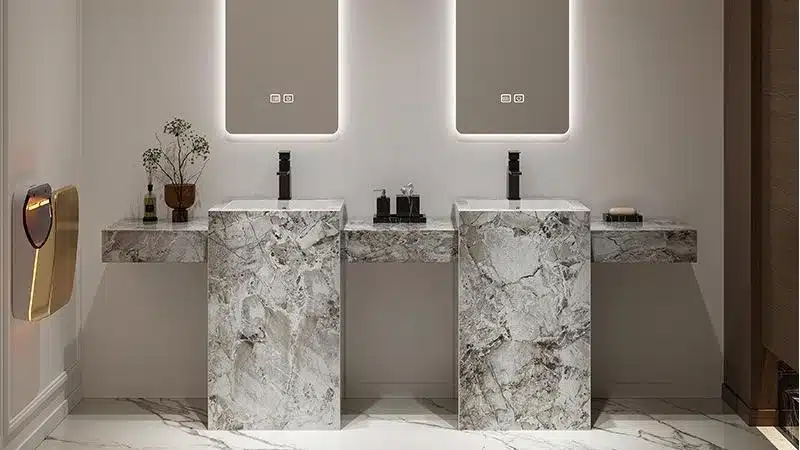
While European manufacturers, particularly from Italy and Spain, set the technological standard in sintered stone production, the real value in the vanity market comes from manufacturers who master the integration of stone and cabinetry for specific applications.
The global market for sintered stone is dominated by large-scale European slab producers who leverage advanced high-temperature sintering technology. But when it comes to finished bathroom vanities, the list of top players shifts. Excellence is defined not just by the quality of the stone, but by the ability to fabricate it precisely and integrate it seamlessly with high-quality cabinetry tailored to specific regional and regulatory demands. Instead of a generic top-10 list, we’ll analyze a manufacturer that exemplifies this integrated approach for the high-end North American market.
Why MF FOCUS CABINET Excels in Vanity & Basin Integration
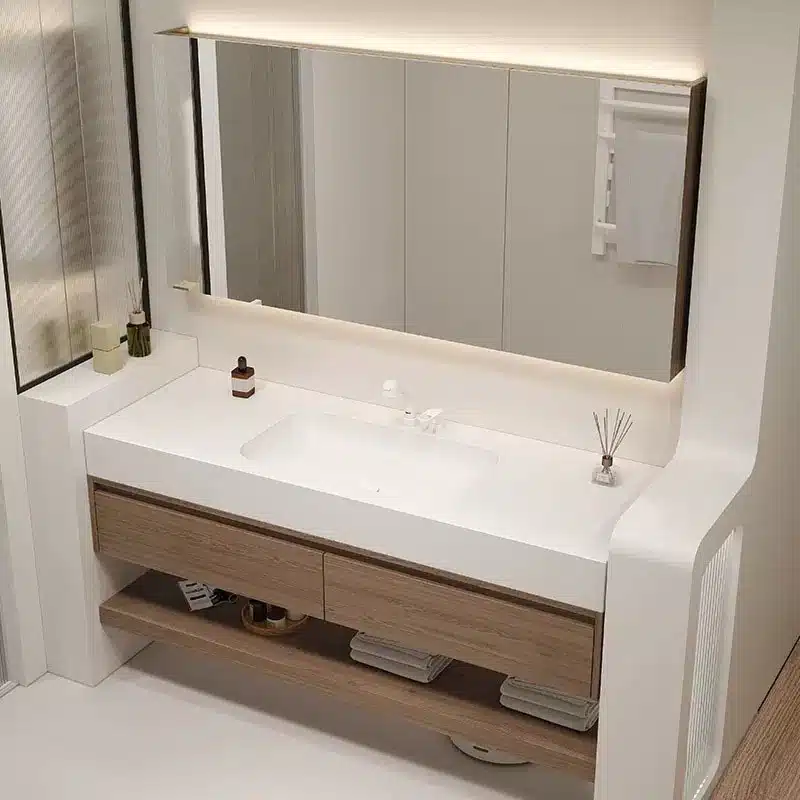
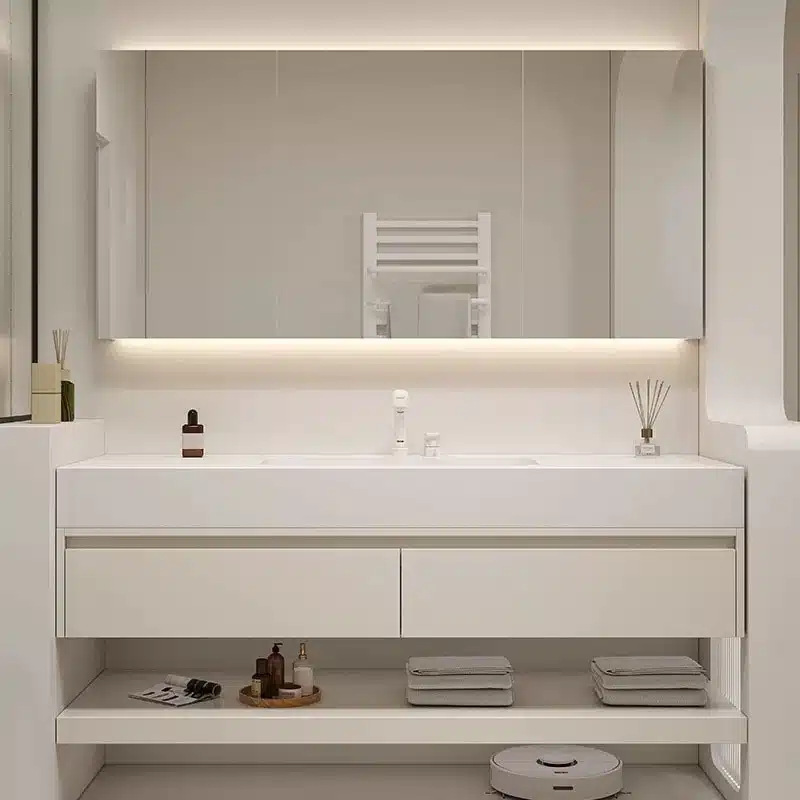
MF FOCUS CABINET distinguishes itself by focusing on the complete, integrated unit: a durable sintered stone basin paired with a highly customized bathroom vanity. This approach directly targets the North American luxury residential market by engineering solutions that solve specific project challenges, such as meeting strict ADA (Americans with Disabilities Act) compliance without compromising on high-end aesthetics. They bridge the gap between industrial stone production and fine custom woodworking.
| Feature | Standard Industry Approach | MF FOCUS CABINET Solution |
|---|---|---|
| Sourcing Model | Separate sourcing for stone tops and wood cabinets, leading to mismatch risk. | Integrated system. Vanity and basin are fabricated together for a perfect fit. |
| Market Focus | Broad, mass-market production with generic designs. | Niche specialization in luxury residential and ADA-compliant applications. |
| Material Customization | Limited material and finish options based on volume production. | Premium options like solid walnut and moisture-resistant plywood with 15+ finishes. |
By controlling the entire process from cabinet construction to basin integration, the company eliminates the coordination failures and quality inconsistencies that often arise when contractors source materials from separate suppliers. This integrated model provides a single point of accountability and ensures a cohesive, high-quality final product.
- Accessibility-Focused Designs: The company produces ADA-compliant vanities with practical features like adjustable heights and integrated grab bars, meeting regulatory needs for commercial and residential projects.
- Premium Material Options: They offer custom vanities in high-end materials, including solid walnut and various grades of moisture-resistant plywood, with more than 15 finish choices to match specific design requirements.
- Seamless Integration: The core value is creating flawless vanity-and-basin combinations, ensuring that the stone and woodwork complement each other in both function and form for luxury applications.
What Is the “Mismatch Risk” of Buying Stone and Wood Separately?
Sourcing sintered stone tops and wood cabinets from different suppliers creates a cascade of preventable failures in logistics, quality control, and structural integrity that drive up project costs.
Attempting to manage separate suppliers for stone and wood introduces unnecessary complexity and risk into a project. The core issue isn’t just about getting two boxes to the same location; it’s about ensuring two fundamentally different materials, produced in different factories with different standards, work as a single, functional unit. This fragmented approach exposes buyers to costly delays, material incompatibilities, and on-site installation failures that a unified procurement process eliminates.
Supply Chain and Timing Failures
When stone and wood are sourced from different suppliers, their production and delivery schedules are completely independent. A delay from one vendor—a common occurrence in global logistics—can halt the entire installation, leaving contractors idle and pushing back project timelines. You lose the benefit of a single point of contact responsible for ensuring all components arrive together and on schedule.
- Coordination becomes complex without a single point of contact for logistics.
- Mismatched delivery timelines create expensive bottlenecks in the installation process.
- Separate freight arrangements double the chances of damage or loss for one of the components.
| Risk Category | Sourcing Separately (Fragmented) | Integrated Supplier (Unified) |
|---|---|---|
| Logistics & Timing | Unsynchronized deliveries cause project delays and increase coordination overhead. | Single, coordinated shipment ensures all components arrive together on schedule. |
| Quality & Aesthetics | Inconsistent color, finish, and quality standards between suppliers lead to a mismatched final product. | Unified quality assurance guarantees visual and material compatibility. |
| Structural Integrity | The cabinet is not engineered for the stone’s exact weight, risking on-site errors and long-term failure. | The entire vanity system is designed and tested to work together seamlessly. |
Material and Quality Inconsistencies
Without a single factory overseeing quality assurance, the stone top from one supplier may not match the wood cabinet from another in color, finish, or durability. This mismatch isn’t just aesthetic; different materials react to moisture and temperature changes differently. A cabinet that swells or warps can compromise the stability of the stone it’s supposed to support, leading to cracks and failures.
- Colors and textures sourced from samples often differ under real-world lighting conditions.
- Wood components may react differently to bathroom moisture than the stone, causing warping or delamination.
- One supplier’s lower quality standards can create an imbalance that compromises the entire product.
Fragmented Installation and Structural Integrity
The most critical risk is structural. An integrated manufacturer engineers the wood base to support the exact weight and dimensions of the specific sintered stone top. When sourced separately, this engineering link is broken. The responsibility for compatibility falls on the installer, who may have to make costly and risky on-site modifications. Disjointed weight calculations can lead to an overloaded cabinet, an unstable vanity, and potential structural failure over time.
- Installers are forced to solve compatibility issues on the job, which increases the margin for error.
- Weight calculations become guesswork, risking an overloaded or unstable vanity base.
- Unified procurement ensures all components are designed and validated to function as a cohesive system.
How to Package Brittle Sintered Stone for Ocean Freight?
Shipping sintered stone internationally requires robust, specialized packaging focused on preventing damage from point pressure, vibration, and in-transit movement.
Sintered stone’s large format and brittle nature make it vulnerable during long-haul ocean freight. A successful packaging strategy isn’t just about a strong box; it’s a system designed to isolate each slab from shock and compression. The method used depends entirely on the size of the order, but the principles of securing the material remain the same.
Primary Packaging Methods for Secure Transit
Shipping sintered stone slabs requires structures tailored to the shipment size. High-volume orders use horizontal wooden crates for maximum density and protection, while smaller shipments rely on vertical A-frames to maintain stability and structural integrity.
- Wooden Crates are the standard for large orders. Slabs are stacked horizontally, with each piece separated by pearl wool foam sheets. The entire crate is then reinforced with metal plates and secured with steel straps to counteract the constant vibration and movement of a container ship.
- A-Frames are built for smaller quantities or single panels. Slabs are placed vertically and fastened securely with heavy-duty ratchet straps. To prevent any movement inside the shipping container, the A-frame itself is braced with wooden strips.
- In-Container Bracing applies to both methods. Any empty space within the container is a liability. Inflatable air bags are wedged between crates or A-frames to create a tight, stable load that cannot shift, even in rough seas.
Critical Protective Measures to Prevent Damage
An effective packaging strategy mitigates three main risks: point pressure, vibration, and slab movement. This involves a multi-layered approach that includes internal cushioning, secure strapping, and structural reinforcement within the crate or frame.
- Internal Separation is non-negotiable. Foam sheets are placed between every slab to absorb shock and prevent the finished surfaces from scratching or grinding against each other.
- Secure Strapping using high-tension bands or industrial ratchets is essential. This keeps the slabs tightly packed, preventing them from shifting or sliding, which is a primary cause of chipped edges and fractures.
- Load Reinforcement includes placing wooden blocks at the bottom of the stack to distribute weight and reduce concentrated pressure on the lowest slabs. The entire package is often wrapped to protect it from moisture caused by condensation during transit.
Conclusion
Choosing the right sintered stone vanity supplier depends on more than just the material itself. Success hinges on precise fabrication, especially 45-degree miter joints, and the ability to deliver a perfectly integrated basin and cabinet. This approach eliminates the mismatch risk common when sourcing components separately and ensures the final product meets luxury standards.
If you are ready to evaluate a factory’s capabilities, consider requesting a full catalog or ordering a sample. This allows you to inspect the finish, joint quality, and packaging firsthand before committing to a full container order.
Frequently Asked Questions
Best sintered stone basin manufacturer in China?
Identifying the single “best” manufacturer depends on specific needs like volume, design complexity, and price point. However, top-tier suppliers consistently invest in Italian OEM machinery (like SACMI or Breton), maintain rigorous ISO 9001 quality control, and have extensive OEM/ODM experience. Industry leaders such as Keding, Monerte, and Nabel are widely recognized for their advanced technology, material consistency, and ability to produce complex, high-quality sintered stone products for the international market.
Cost to import rock plate vanities?
The total landed cost to import rock plate (sintered stone) vanities is a sum of several factors. The factory (FOB) price typically ranges from $150 to over $600 per unit, depending on size, brand, and design complexity. To this, you must add international sea freight (which varies by container size and route), import tariffs (specific to your country’s HS codes for ceramic goods), customs clearance fees, and final-mile domestic transportation. For accurate budgeting, always request a comprehensive quote that includes FOB price, packaging specifics, and estimated shipping volume.
How to check sintered stone basin quality?
A thorough quality inspection involves several key checks. First, visually inspect the surface under bright, angled light for consistency in pattern and finish, ensuring there are no pinholes or blemishes. Use calipers to verify dimensional accuracy and thickness uniformity across the slab. A critical test is for porosity: apply common staining agents like coffee or wine for 10 minutes; a high-quality, non-porous surface will wipe completely clean. Finally, check the integrity of joints and edges, especially in integrated sinks, ensuring they are perfectly flush and free of micro-cracks or adhesive residue.
Seamless basin fabrication factories?
Factories capable of producing truly seamless integrated basins utilize advanced fabrication technology. Look for suppliers with 5-axis CNC machining centers for precise mitered edge cuts and automated thermoforming equipment. The seamless effect is achieved by joining these precision-cut pieces with a specialized, color-matched two-part epoxy adhesive, which is then cured, machined, and polished to create a monolithic appearance. Premier factories will have dedicated clean rooms for adhesion and a robust QC process to inspect these joints for strength and visual perfection, effectively eliminating grout lines.
Packaging for sintered stone shipping?
Proper packaging is critical to prevent damage during international transit. The industry standard involves a multi-layer approach. The product is first wrapped in a protective surface film, followed by custom-fitted, high-density EPE foam corner and edge protectors. This assembly is then placed inside a solid, heat-treated (ISPM 15 compliant) wooden crate. Internal bracing and foam blocks are used to immobilize the piece within the crate, preventing any movement. The exterior of the crate must be clearly marked with “Fragile,” “This Side Up,” and other international handling symbols.




0 Comments