


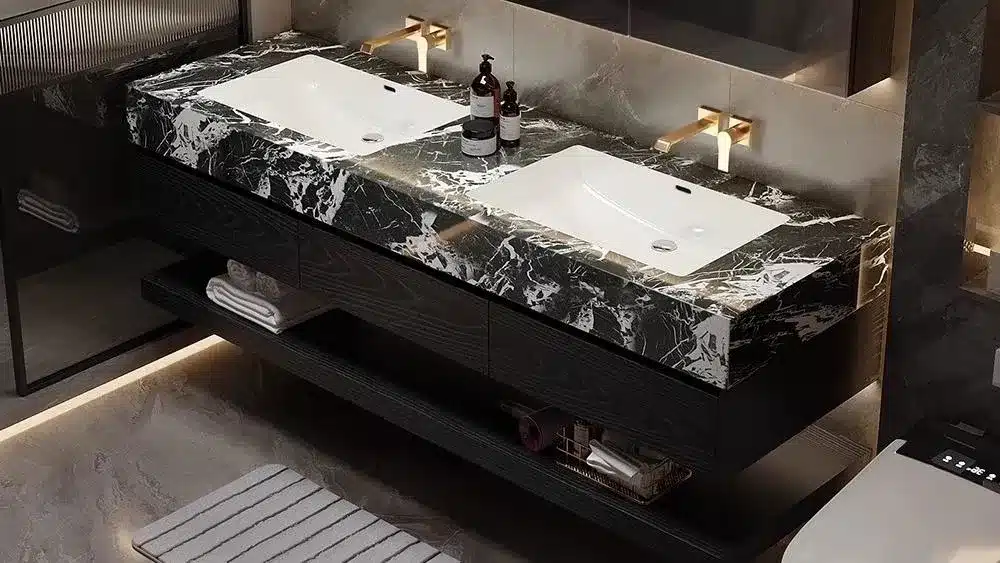
A proper Vanity Top Material Guide is the only thing standing between a profitable multi-unit project and one derailed by costly material failures and warranty claims. Specifying the wrong surface for a hotel or apartment complex can lead to premature yellowing, chipping, and staining, triggering a cascade of negative guest reviews and expensive replacements. What looks good on a spec sheet often fails under the demands of high-traffic commercial use, impacting both the budget and the property’s reputation.
This guide serves as a technical standard operating procedure for vanity top selection. We analyze the core differences between ceramic, quartz, and both cultured and natural marble, focusing on durability and lifecycle cost. We also cover critical logistical details, including sizing compatibility based on the “overhang rule,” factory-drilled faucet configurations, and packaging requirements to prevent job site damage during transport.
The Vanity Top Ecosystem
The vanity top market has evolved from a simple commodity space into a dynamic ecosystem, where growth is now dictated by material science, consumer ethics, and integrated technology.
Material Innovation as a Primary Growth Driver
The industry is seeing a significant and sustained shift toward engineered materials. Options like quartz and sintered stone are fueling market expansion by offering enhanced durability and modern design possibilities that are simply unavailable in traditional materials. This move away from basic ceramic and laminate meets a clear demand for surfaces that perform better and last longer in high-use bathroom environments.
- The market is projected to grow at a compound annual rate of 5–8.2% through 2030, a figure largely attributed to the adoption of these new materials.
- Engineered stones provide superior, measurable resistance to scratches, stains, and heat, directly addressing consumer demands for low-maintenance surfaces.
Increasing Consumer Demand for Sustainability
A growing environmental consciousness directly influences purchasing decisions. A substantial portion of the market now actively seeks out eco-friendly products, compelling manufacturers to rethink sourcing and production. This isn’t a niche trend; it’s becoming a core expectation for a large and growing segment of buyers who want to see transparent and responsible practices behind the products they purchase.
- Data from 2026 shows that nearly 40% of consumers prefer vanity tops made from recycled or sustainably sourced materials.
- This shift drives the adoption of certified materials and pressures the industry to build more transparent and environmentally responsible supply chains.
Integration of Smart Technology
Vanity tops are no longer just static surfaces. They are evolving into interactive, functional components of the modern bathroom. Built-in technology adds real convenience and elevates the user experience, creating significant separation between standard and premium product lines. These features are quickly moving from novelties to expected functionalities in higher-end residential and hospitality projects.
- Features like integrated LED lighting, wireless or USB charging stations, and IoT connectivity are becoming key selling points.
- This technological convergence adds tangible value and helps manufacturers differentiate their products in a crowded marketplace.
Evolving Global Markets and Supply Chains
The global landscape of production and consumption is changing. While established markets in North America and Europe remain strongholds for premium products, new regions are rapidly gaining prominence. At the same time, digital platforms are transforming sales channels, forcing manufacturers to become more agile and responsive to customized, on-demand orders.
- Asia-Pacific markets are quickly expanding as both critical production hubs and powerful consumer bases.
- The rise of online customization tools and direct-to-consumer channels makes flexible, nearshore partnerships essential for meeting demand efficiently.
Ceramic (Vitreous China): The Budget King
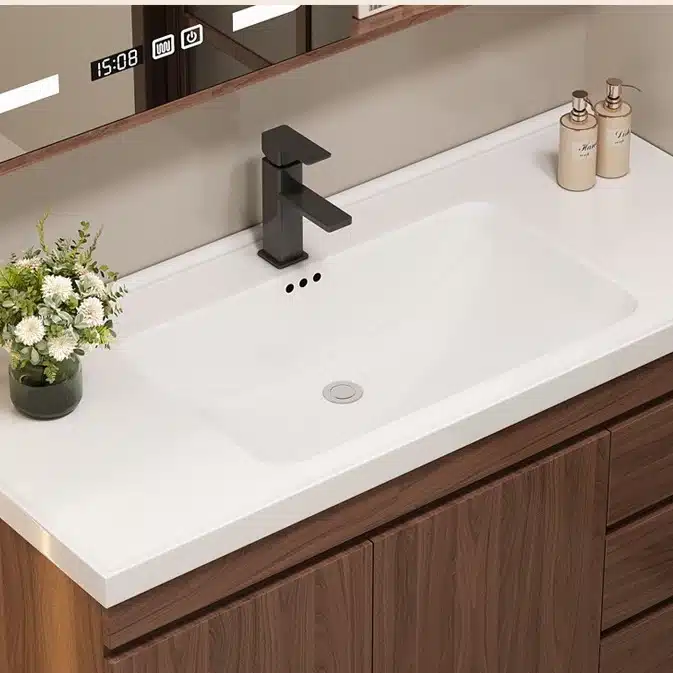
Vitreous china dominates the high-volume vanity market by bonding a glass-like enamel coating to a ceramic base, delivering a non-porous, durable, and cost-effective surface ideal for both residential and commercial projects.
Non-Porous Surface for Hygiene and Stain Resistance
The primary benefit of vitreous china is its glass-like, non-porous surface created by a special enamel coating. This barrier prevents liquids, soap, and bacteria from penetrating the material. This makes it exceptionally easy to clean and highly resistant to stains from common bathroom products.
- Its smooth, sealed surface ensures germs and grime have nowhere to hide.
- Resists discoloration from common bathroom products like makeup and toothpaste.
- Maintains high hygiene standards, which is ideal for both homes and commercial settings.
Exceptional Durability and Scratch Resistance
Firing vitreous china at high temperatures fuses the enamel coating to the ceramic base, creating an incredibly hard and durable finish. This process makes it tough enough to handle the daily demands of a busy bathroom without showing significant wear. The resulting surface is resistant to fading and minor impacts.
- The hard surface resists scratches from jewelry, belt buckles, and cleaning tools.
- It is less prone to chipping or cracking from minor impacts.
- The glossy finish is fade-resistant, retaining its bright appearance for years.
Affordable Quality for Any Project
Vitreous china provides a classic, clean aesthetic and proven longevity at a very accessible price point. Its balance of performance and cost makes it the default choice for projects where budget and reliability are key concerns, from single-family homes to large-scale hotel developments.
- Offers a premium look without the high cost of materials like natural stone or quartz.
- Manufacturing consistency ensures reliable quality across large orders for hotels or developments.
- Provides long-term value by minimizing the need for repairs or replacements.
Boost Your Sales with Durable Vanities

Quartz: The Hotel Favorite
Engineered quartz dominates hospitality projects because its non-porous, highly durable, and consistent surface meets the intense operational demands of high-traffic commercial use.

Engineered for High-Traffic Durability
Hotel bathrooms handle constant use from guests and frequent, aggressive cleaning by staff. Engineered quartz countertops are built to withstand this heavy traffic without showing wear, making them a reliable long-term investment for hospitality projects. The material is designed from the ground up to resist the daily abuse common in a commercial setting, reducing long-term maintenance costs and replacement cycles.
- Composed of natural quartz crystals and polymer resins, the material resists scratches from luggage, toiletries, and cleaning tools.
- Its hard surface stands up to chips and impacts better than many natural stones, reducing the need for costly repairs or replacements.
- The manufacturing process ensures a consistent density and strength across every slab, a key factor for outfitting hundreds of identical rooms.
Non-Porous Surface for Superior Hygiene
Cleanliness is a top priority in hotels. Quartz’s non-porous surface prevents liquids, bacteria, and mold from penetrating, ensuring a sanitary environment for guests. This property also simplifies the cleaning process for housekeeping staff, allowing for faster room turnover without compromising hygiene standards.
- Unlike natural marble, quartz does not require periodic sealing to maintain its hygienic properties, lowering maintenance overhead.
- Spills from makeup, toothpaste, or cleaning agents can be wiped away easily without leaving stains or permanent marks.
- The smooth, seamless surface eliminates grout lines where germs and grime typically accumulate.
Consistent Appearance for Brand Uniformity
Large hotel chains must maintain a consistent brand aesthetic across all their properties. Engineered quartz delivers predictable patterns and colors, ensuring that the vanity top in room 101 looks identical to the one in room 801. This level of uniformity is nearly impossible to achieve with natural stone, where every piece is unique.
- Manufacturers can produce large batches of quartz with minimal variation in color, veining, and pattern.
- This consistency simplifies both the initial specification process and any future repairs or additions.
- It allows for easy replacement of a damaged section with a matching piece, even years after the initial installation in 2026.
Cultured Marble vs. Natural Marble
The choice between natural and cultured marble is a direct trade-off between the unique, high-maintenance luxury of quarried stone and the durable, cost-effective performance of an engineered composite.
Natural Marble: The Luxury Choice
Natural marble holds its ground as a premium material, specified for its one-of-a-kind veining and established heritage. It remains the standard for high-end architectural and commercial projects where visual impact is the primary driver, justifying its higher sourcing costs and demanding maintenance schedule. Each slab is unique, ensuring a distinct aesthetic that cannot be replicated, which is why it dominates luxury commercial spaces and prestigious buildings where budget is a secondary concern to brand image.
Cultured Marble: The Practical Alternative
Cultured marble has become the go-to choice for projects prioritizing durability and cost-efficiency, especially in residential and hospitality settings. This engineered material consists of crushed marble dust mixed with resins and pigments, finished with a tough gel coat. The result is a non-porous surface that excels in high-moisture bathroom environments, offering strong resistance to stains and mildew with minimal upkeep. It provides a clean, polished look that reliably performs without the vulnerabilities of porous natural stone.
| Attribute | Cultured Marble | Natural Marble |
|---|---|---|
| Composition | Engineered composite (marble dust, resins, gel coat) | Natural quarried stone (calcium carbonate) |
| Surface Porosity | Non-porous due to gel coat | Porous; susceptible to stains and etching |
| Maintenance | Low; no sealing required, easy to clean | High; requires regular sealing to prevent damage |
| Aesthetic | Consistent and uniform appearance | Unique, one-of-a-kind natural veining |
| Primary Application | Residential, hospitality, high-traffic bathrooms | Luxury commercial, high-end architectural projects |
Market Application and Consumer Trends
The market is clearly segmented by project requirements. Natural marble is specified where aesthetic distinction is paramount. Cultured marble, on the other hand, continues to gain market share in residential new builds, renovations, and hotel projects where predictable costs, durability, and long-term performance are the deciding factors. The final decision for buyers almost always comes down to balancing the desire for unique looks with the practical need for resilience and a manageable budget.
- Residential buyers favor cultured marble for its value and toughness in daily use.
- High-end commercial developers continue to specify natural marble to project an image of prestige.
- The choice between the two materials reflects a clear market split between practical performance and aesthetic uniqueness.
Sizing Compatibility (The “Overhang” Rule)
The standard 1 to 1.5-inch countertop overhang is a non-negotiable specification for protecting cabinetry from water damage, while extended 10 to 15-inch overhangs are required for functional seating areas.
Standard Overhang for Cabinets
The established industry consensus for countertop overhang on bathroom vanities and kitchen cabinets is between 1 and 1.5 inches. This dimension serves as a crucial guideline for installers working with both wall-mounted and freestanding vanities. Its primary function is to direct water and spills away from the face of cabinet doors and drawers, preventing moisture damage and preserving the finish of the cabinetry below.
| Overhang Type | Standard Dimension | Primary Function |
|---|---|---|
| Standard Cabinet Overhang | 1 to 1.5 inches (2.5 to 3.8 cm) | Protects cabinet faces from spills and improves user ergonomics. |
| Seating Area Overhang | 10 to 15 inches (25 to 38 cm) | Provides adequate legroom for comfortable seating at islands or bars. |
Extended Overhang for Seating Areas
When a countertop surface needs to accommodate seating, like a kitchen island or bar top, the standard overhang increases to between 10 and 15 inches. This larger dimension is essential for user comfort, providing adequate legroom so people can sit without their knees hitting the cabinet structure. This effectively converts a standard work surface into a functional dining or social area.
Dual Purpose of Overhangs
Countertop overhangs combine practicality with ergonomics. Functionally, the overhang creates a drip edge that safeguards the cabinetry finish from liquids. Ergonomically, the small extension allows a user to stand closer to the counter, improving posture and reducing strain during tasks like washing hands or brushing teeth. This design detail improves the daily interaction with the workspace.
Safety and Material Considerations
Overhang depth is also dictated by safety and the physical properties of the material used. An excessively long overhang made from heavy natural stone or quartz can create a serious tipping hazard if it lacks proper support brackets or structural reinforcement. Modern design practices balance the desired aesthetic with the weight and structural limits of the material, shifting from a one-size-fits-all rule to a more consultative approach that ensures long-term stability.
Factory Pre-Drilled Faucet Holes (4″ vs 8″)
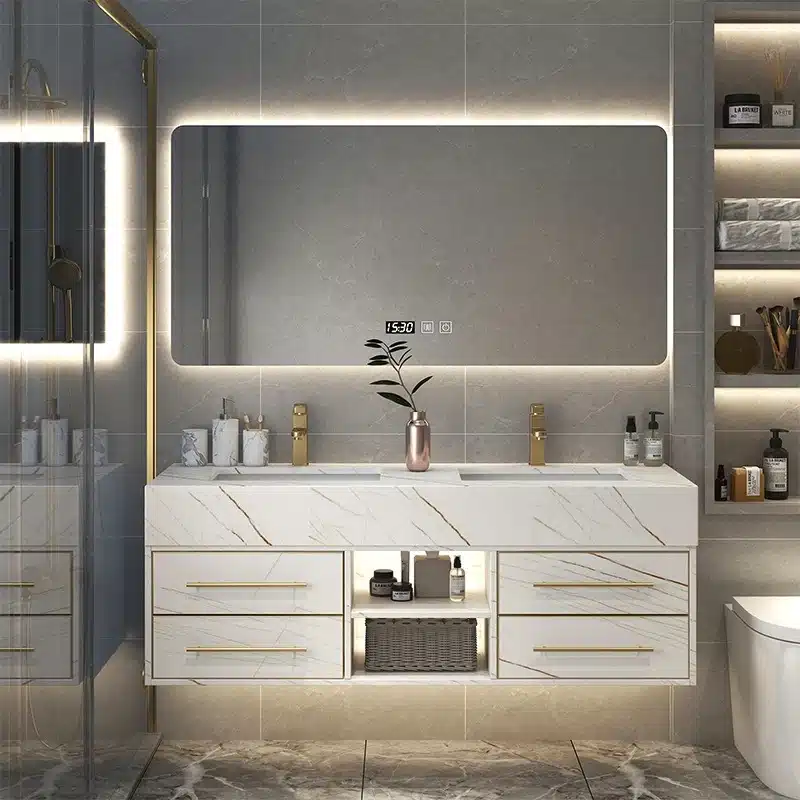
The choice between 4-inch centerset, 8-inch widespread, and single-hole faucet configurations directly reflects the project’s budget, aesthetic goals, and available vanity space.
4-Inch Centerset: The Standard for Compact Spaces
The 4-inch centerset is the default configuration for space-constrained installations. We see it specified most often for secondary bathrooms, rental properties, and commercial projects where maximizing counter space is a priority. This design combines the spout and handles on a single base plate, which simplifies the manufacturing and installation process.
- Ideal for narrower vanities and powder rooms.
- A cost-effective solution for large-scale developments and multifamily housing.
- Streamlines installation since all components are integrated.
8-Inch Widespread: The Choice for Premium Installations
The 8-inch widespread configuration is the established standard for primary bathrooms and high-end applications. With separate hot and cold handles, it allows for greater design flexibility and a more substantial, luxurious appearance. This setup requires three individual holes drilled into the countertop, a specification common in luxury homes, hotels, and custom renovations.
- Offers a cleaner, more spaced-out aesthetic suitable for larger vanities.
- Easier to clean around the base of the faucet and handles.
- Commonly featured in luxury homes, hotels, and custom bathroom renovations.
Single-Hole Faucets: The Modern, Minimalist Trend
A growing number of projects now specify single-hole faucets, reflecting a shift toward minimalist and European-influenced design. This configuration uses one hole for a single-lever or joystick-style handle, creating a clean, uncluttered look that works well with modern basins. The simplified design also makes countertop cleaning much more efficient by eliminating extra hardware bases.
- Provides a streamlined appearance that complements contemporary decor.
- Simplifies countertop cleaning by eliminating extra holes.
- Many models include optional deck plates to cover existing 4-inch holes for retrofits.
Packaging Tops for Safe Transport
Effective packaging in 2026 combines proven materials like corrugated cardboard and plastic with advanced tracking, tamper-evident seals, and sustainable systems to protect fragile vanity tops through complex supply chains.
Dominant Materials in Protective Packaging
The foundation for safely transporting heavy, fragile vanity tops still relies on two workhorse materials: corrugated boxes and engineered plastics. Their effectiveness and cost keep them at the forefront of the industry. By 2026, these materials continue to lead the market because they provide a reliable balance of structural integrity and impact absorption.
- Plastic packaging solutions, including molded foam and protective films, command nearly 40% of the market due to their versatility and cushioning properties.
- Corrugated boxes are not far behind, making up about 31% of packaging solutions by providing the essential outer structure and rigidity.
Advanced Security and Tracking Methods
For high-value or project-critical shipments, basic cardboard and foam are not enough. The industry now integrates tracking and security technologies to provide full visibility and protect against tampering or theft during transit. This is especially critical for ensuring entire container loads of custom orders arrive intact.
- Tamper-evident seals are now a common requirement for valuable goods, offering a clear visual sign if a package has been opened without authorization.
- RFID tracking gives real-time location data, allowing logistics managers to monitor shipments from the factory floor to the final destination warehouse.
The Shift Toward Reusable Packaging
Sustainability goals and stricter regulations are pushing the industry away from single-use packaging. Reusable crates, pallets, and internal dunnage reduce waste and can significantly lower long-term costs for businesses with predictable, high-volume shipping loops. This move reflects a broader adoption of circular economy principles within manufacturing and distribution.
- A growing focus on environmental impact is compelling manufacturers and their wholesale partners to find alternatives to disposable materials.
- Reusable systems are becoming a key strategy for brands to demonstrate environmental responsibility while improving operational efficiency.
Specialized Packaging for Sensitive Goods
Vanity tops are heavy, brittle, and have vulnerable corners, classifying them as sensitive goods that require engineered packaging. Standard boxes are insufficient, especially for the rigorous demands of e-commerce fulfillment where packages are handled multiple times. A robust system is needed to protect against impacts, vibration, and environmental factors.
- Impact-resistant designs are crucial. A best-practice “E-commerce Ready” solution involves 6-sided molded foam inside a reinforced cardboard carton, designed to pass stringent ISTA 3A drop tests.
- Contamination and moisture protection ensures the product arrives clean and undamaged, preventing issues with dust or water that could compromise the finish during a long transit.
Conclusion
Choosing the right vanity top involves balancing aesthetics, budget, and long-term durability. Understanding the key differences between ceramic, quartz, and marble allows you to source products that meet specific project requirements. This knowledge ensures you can confidently cater to different market segments, from budget-conscious builds to premium installations.
Our team can help you select or customize materials to fit your target price point and market needs. Contact us to discuss your project specifications or request a refundable sample to evaluate the quality firsthand.
Frequently Asked Questions
Why does my cultured marble top look yellow?
Yellowing in cultured marble is primarily caused by the natural aging of the polyester resin and gel coat used in its construction. This process is often accelerated by prolonged exposure to UV light from sunlight or certain fluorescent bulbs. Using harsh, abrasive, or bleach-based chemical cleaners can also degrade the protective gel coat, making it more susceptible to discoloration over time.
Is quartz more expensive than granite for vanities?
While pricing can vary by region and specific slab, quartz and granite are now very competitively priced for vanity tops. In the current market, many mid-range quartz options are often comparable to, or even slightly less expensive than, mid-range granite. However, rare, high-end exotic granite slabs will typically cost more than premium quartz. For most common designs, the price difference is minimal.
Can I cut a standard vanity top to fit?
It depends entirely on the material. Laminate or solid surface tops can be cut with care using a circular saw with a fine-toothed blade. However, you should never attempt to cut quartz, granite, or marble tops yourself. These materials are extremely hard and brittle, requiring specialized diamond wet saws and professional expertise to avoid catastrophic cracking and ensure a clean finish.
What is the difference between single and widespread faucet holes?
The difference lies in the number and spacing of the holes drilled into the vanity top. A single-hole configuration has one central hole for a faucet where the spout and handle(s) are combined in a single unit. A widespread configuration has three separate holes: one for the hot handle, one for the cold handle, and one for the spout, typically spaced 8 inches apart center-to-center.
How to fix a chip in a ceramic sink?
A small chip in a ceramic sink can be repaired using a dedicated porcelain and ceramic repair kit. The process involves thoroughly cleaning the damaged area, applying a two-part epoxy filler, and leveling it with the surrounding surface. After the filler cures completely (usually 24 hours), it must be carefully sanded with fine-grit sandpaper until smooth and flush, then polished to restore the original sheen.
Does marble stain easily with toothpaste?
Yes, marble can be damaged by toothpaste. Because marble is a soft, porous stone, it is susceptible to two issues: etching and staining. The mild abrasives and acidic ingredients in many toothpastes can etch the polished surface, creating a dull spot. Additionally, the strong dyes in some toothpastes can penetrate unsealed or poorly sealed marble, causing a true color stain. Always wipe up spills immediately.





0 Comments