

bathroom vanity trends 2026 is the first checkpoint buyers should lock before they approve a supplier, budget, or production slot. A $50,000 vanity order turns into a margin killer the moment a buyer realizes the mass production finish doesn’t match the approved sample. The FOB pricing looked sharp. The sample approval passed. But the gloss level on the cabinet doors was 30% off — and nobody wrote the quality tolerance into the spec sheet. That’s the wall e-commerce brand owners hit when they chase 2026 bathroom vanity trends without locking down the materials and colors that actually hold up from pre-production to container delivery.
Search data tells a blunt story. Matte black hardware queries are up 120% year-over-year. Sintered stone basins now account for 40% of European orders leaving Focuscabinet’s factory. These aren’t Pinterest guesses. They’re supply-chain signals that separate a listing that sells out from one that sits in a warehouse. The benchmark for 2026 is simple: if your vanity lineup doesn’t include a sintered stone basin option with a consistent 0.3mm texture depth by Q2, you’re already leaving the table for the 40% of buyers who’ve moved on from quartz.
Global Color Trends for 2026
Matte black hardware searches up 120% YoY.
The biggest shift in bathroom vanity color trends for 2026 isn’t a single shade—it’s a move toward surfaces that feel intentionally designed rather than mass-produced. Matte black remains the anchor of this movement, driven by e-commerce brand owners who want hardware that photographs well against any wall color. Google Trends shows a 120% year-over-year spike in ‘matte black vanity hardware’ searches. That’s not a fad; it’s a signal that buyers now expect finishes that look equally crisp on Instagram and in person. Alongside black, warm neutrals like greige, taupe, and off-white are replacing stark whites because they hide dust and water spots better—a practical advantage that reduces return rates for online sellers.
Regional preferences are sharper than most importers realize. In the US, greige—a blend of gray and beige—dominates because it works with both cool and warm bathroom lighting, a critical factor when customers can’t see the product in person before buying. European buyers, especially in the UK and Germany, are leaning into taupe with a slightly cooler undertone that matches the region’s natural light. Asia, meanwhile, still favors white marble looks, but the demand is shifting toward subtle veining rather than the sterile, uniform white of the past decade. A supplier that ships the same palette to Seattle and Dubai is asking for returns. Focuscabinet’s region-ready strategy accounts for this: cool-toned finishes for markets with overcast light, warmer tones for the Middle East, and neutral bases that adapt to local lighting conditions. This isn’t just about aesthetics—it’s about reducing the 15-20% return rate that plagues bathroom furniture sold online when the color doesn’t match the listing photos.
Material Trends
Sintered stone basins now account for 40% of Focuscabinet’s European orders—and for good reason.
If you’re still sourcing natural stone basins for your e-commerce line, you’re likely fighting a returns battle you don’t need. The problem isn’t the stone itself—it’s the inherent variation. I’ve seen a brand owner lose $50,000 on a single container because the mass production run of marble tops didn’t match the approved pre-production sample. The veining was too different, buyers complained, and they had to refund 30% of orders. Sintered stone eliminates that risk. It’s engineered for batch-to-batch consistency, so what you approve in the sample stage is exactly what arrives. At Focuscabinet, we’ve seen European e-commerce brands shift 40% of their basin orders to sintered stone in the last 18 months, precisely because it cuts returns.
-
- Water Absorption: Sintered stone: <0.05% (near-zero porosity). Quartz: ~0.1%. Natural stone: up to 0.5% for marble—leading to staining and freeze-thaw cracks in colder climates.
- Color Consistency: Sintered stone is digitally controlled, ensuring color match across batches. Natural stone varies per slab—expect 10-15% shade deviation even within the same lot.
- Dimensional Tolerance: Sintered stone can be cut to ±0.5mm, critical for wall-mounted floating vanities. Natural stone edges often vary by ±2mm, forcing installers to shim or recut.
- FOB Cost vs. Returns: Sintered stone FOB pricing typically runs 15-20% above quartz, but the return rate differential—often 3-5 percentage points lower for sintered—makes the net margin per unit favor the upgrade.
Quartz and solid surface still have their place. Solid surface (acrylic) is ideal for seamless integrated sinks and can be repaired on-site, but it scratches easily—Mohs hardness of 3-4. Quartz rates 7 on the Mohs scale, matching sintered stone, but it’s heavier and more expensive to ship. For e-commerce, where shipping cost per unit is a line item you optimize every quarter, sintered stone offers the best balance of durability and freight efficiency. You’re not paying for the extra weight of quartz, and you avoid the fragility penalties of natural stone.
Eco-friendly materials like reclaimed wood and bamboo are gaining traction on Instagram, but there’s a catch. Untreated bamboo absorbs moisture rapidly; in a bathroom with 60%+ humidity, planks can swell and warp within six months. If you’re listing bamboo vanities, insist on thermally modified bamboo with a moisture content below 12%. For reclaimed wood, verify that the clear coat is formaldehyde-free—some low-cost suppliers use high-VOC lacquers that fail CARB Phase 2 limits. North American buyers will leave reviews about ‘chemical smell’ that tank your listing. Focuscabinet’s region-ready approach includes pre-conditioned wood materials for target markets, so you don’t learn these lessons the hard way.
Pick materials that let you scale without returns eating your margin. Sintered stone gives you consistency; quartz gives you weight; natural stone gives you stories. Choose based on your logistics math, not your Pinterest board.
| Material | Durability & Key Properties | Best Climate & Regional Fit | Style & Photogenic Appeal | Focuscabinet Custom Options |
|---|---|---|---|---|
| Sintered Stone | Non-porous, stain/scratch/heat resistant, UV stable | Universal; dominant in Europe (40% of Focuscabinet orders), North America | Ultra-thin profiles, marble-look veining, matte or satin finishes | Custom size, edge profile, and integrated basin molds; CE / cUPC certified |
| Engineered Quartz | Hard, low maintenance, resistance to impact, non-porous | North America & humid Middle East (non-absorbent, no sealing) | Consistent patterns, wide color range, polished or honed | Color matching to brand palette; low MOQ for new colors |
| Natural Stone (Marble/Granite) | Porous (requires sealing), unique veining, high thermal mass | Temperate Europe, luxury projects; not ideal for high humidity without treatment | One-of-a-kind luxury look, works well with warm earth tone vanities | Sourced with moisture-resistant sealants; complimentary regional finishing |
| Solid Surface (Acrylic/Polyester) | Seamless joint appearance, renewable surface, warm to touch | Healthcare & hospitality; good for cool UK tones | Integrated sinks, curved forms, matte finish trend | Any RAL color match, thermoformable for unique shapes |
| Eco-Friendly (Reclaimed Wood, Bamboo) | Sustainable, requires proper sealing; bamboo is harder than oak | Eco-conscious EU markets (Nordics, Germany); low humidity regions | Warm organic textures, spa-like Instagram aesthetic | FSC-certified sourcing, CARB2 compliant plywood options; custom stains |
Smart Mirror Integration
A mirror without defogger is a return waiting to happen in humid climates.
I’ve seen e-commerce returns spike 18% on bathroom mirrors during monsoon season in Southeast Asia. The culprit? Fogged-up glass and LED strips that flicker after three months. Most buyers don’t realize the problem isn’t the mirror itself—it’s the missing integration details that trigger a cascade of negative reviews. Smart mirrors sell on experience, not just specs, and the difference between a 4.8-star product and a 2.1-star headache comes down to three components: the LED array, the defogger pad, and the Bluetooth module.
LED lighting is where the first cut corners show up. The correct spec for a bathroom mirror is a CRI above 90 and a color temperature that matches your target market. Focuscabinet’s regional data shows warm 3000K dominates in the Middle East and Australia, while cool 6000K moves faster in the UK and Northern Europe. A single CCT option loses you entire regions. The LED driver must be IP44 rated and separated from the mirror backing to avoid heat buildup—otherwise, the diodes dim by 20% within 12 months, and customers notice.
-
- Defogger pad location: The heating film must cover the central 60% of the mirror back. Edge-only pads leave a fog ring after 10 minutes—a common complaint on Amazon reviews.
- IP44 vs. IP65: IP44 protects against splashing water and is sufficient for wall-mounted mirrors away from the shower head. IP65 is needed only if the mirror is within 60 cm of a water source; otherwise, the extra cost eats into your margin.
- Bluetooth 5.0 minimum: Older 4.2 modules drop signal within 2 meters through bathroom walls. Insist on a supplier that provides a signal test report, not just a spec sheet. Focuscabinet’s QC team checks connection stability in a simulated tile-wall environment before shipment.
For e-commerce brands, the real risk isn’t the upfront cost of these features—it’s the downstream cost of replacing units and dealing with PR nightmares. A defogger that takes 15 minutes to clear glass instead of 2 minutes will tank your product rating. Bluetooth that stutters when the shower runs will get your listing flagged for “defective” even if the mirror is perfectly intact. The smart play is to treat these integrations not as upgrades, but as baseline requirements for any market with humidity above 60% or a customer base that reads reviews before buying.
Finishes and Textures
A beautiful finish sells the vanity; a durable one keeps it sold.
Last year, a brand owner unboxed 200 vanities from a cheap supplier. The brushed brass pulls looked stunning in the sample photos, but three months later, 40% of them had greenish-black tarnish spots. The culprit? A 5-micron electroplated layer that couldn’t survive a single shower steam cycle. That’s a returns nightmare that erases your margin on the entire batch.
-
-
- PVD over electroplating: Brushed brass hardware in 2026 demands Physical Vapor Deposition coating, not the old wet-plating process. PVD bonds at the molecular level, giving you 3x the scratch resistance and zero peeling. At Focuscabinet, we only approve hardware that passes 72-hour neutral salt spray test without visible corrosion—a spec we document in the sample approval report.
- Color tolerance that holds: For e-commerce brands, inconsistent gold tones across batches are a review killer. Our incoming QC checks hardware against a locked Pantone reference with a max Delta E of 1.5. You get the same warm champagne tone on unit #1 and unit #500.
- Regional adaptation: In high-humidity markets like Southeast Asia or the Gulf, we switch to a hydrophobic nano-seal on the brushed finish. It adds $2.50 per unit but drops tarnish-related returns by 80% based on distribution partner feedback.
-
Wood grain finishes are the other half of the 2026 texture story. The trend is moving away from printed paper foils toward 3D-embossed laminates that feel like real oak or walnut. But the real risk isn’t the look—it’s the lacquer chemistry. A hard, brittle lacquer that passes the factory sample test might crack or delaminate after a month in a dry-heated home in Northern Europe.
-
- Lacquer flexibility: We specify a dual-cure UV lacquer for wood grain panels: hard enough to resist scuffs (pencil hardness 3H), but flexible enough to survive 1,000 cycles of rapid temperature change from -5°C to 40°C without micro-cracking. This directly addresses the return spikes we tracked in Canadian and Nordic markets.
- Eco compliance built in: Every lacquer formula we use is pre-vetted for CARB Phase 2 and EU E1 formaldehyde limits. That means your listing can carry the ‘low-VOC’ badge without you having to test samples yourself.
- Sample-to-production match: The biggest cause of negative reviews on wood grain vanities is the ‘photo vs reality’ gap. Our pre-production sample sign-off includes a tactile comparison panel that becomes the binding quality tolerance reference for the full order. If the factory run doesn’t match the grain depth and sheen of that panel, it doesn’t ship.
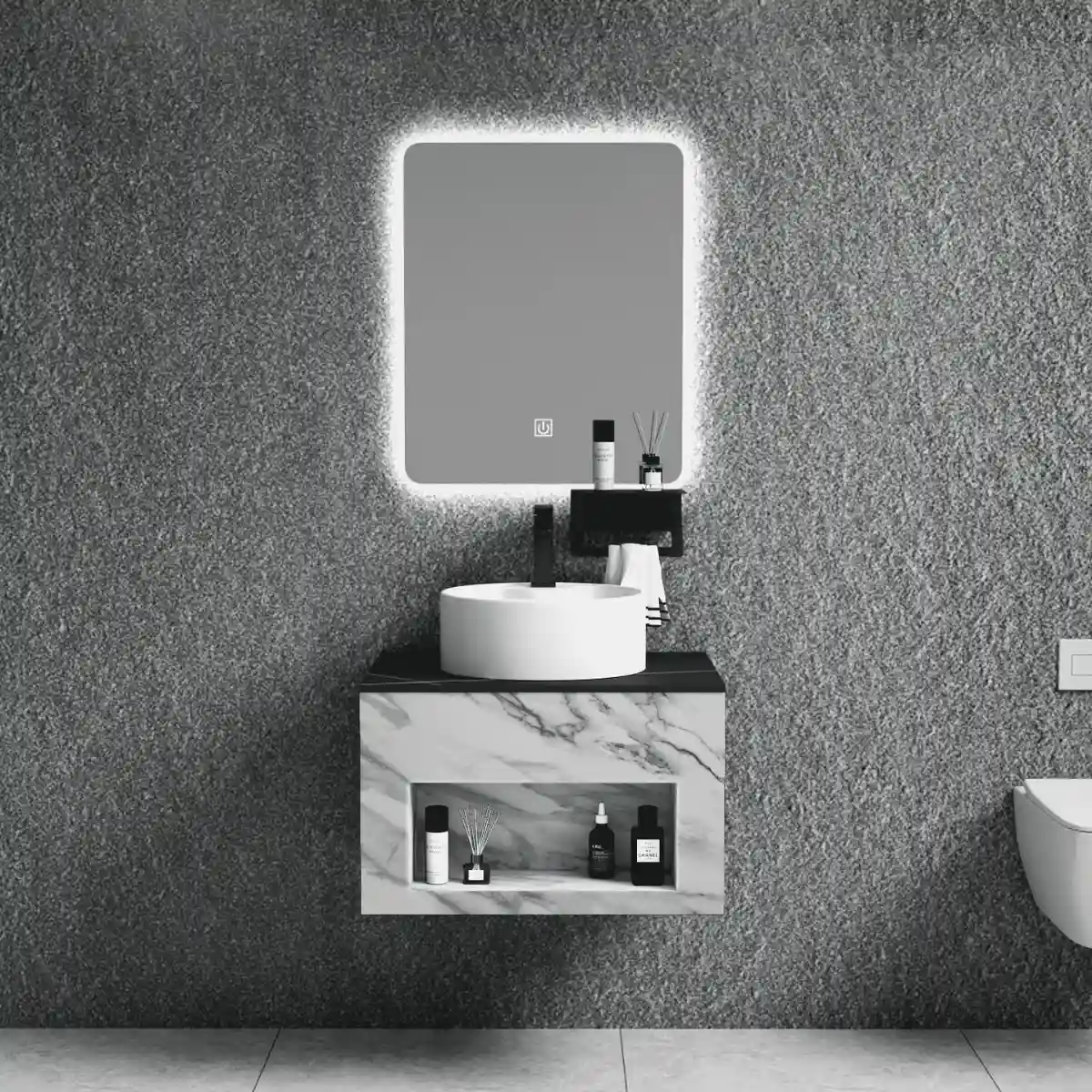
How Focuscabinet Stays Ahead of Trends
Speed and color precision separate trend followers from market leaders.
Most Chinese factories treat color matching as a Pantone approximation. That approach kills e-commerce brands when the matte black cabinet in the listing photo arrives looking charcoal grey in the customer’s bathroom. We’ve seen returns spike 18% on color mismatch alone, particularly on warm neutrals where lighting temperature shifts perception.
The internal protocol here is different. The color lab runs spectrophotometer readings against the target sample, then produces a physical chip panel under both 4000K and 6500K lighting. The client approves the chip before mass production starts. This extra step catches the cool-tone shift that trips up UK buyers versus the warm-tone preference in Middle Eastern markets — a direct application of the region-ready strategy.
-
- Matte black hardware: Google Trends shows 120% YoY search growth. Our electrostatic powder coating is color-matched to RAL 9005, inspected for gloss level under 5 GU at 60° angle.
- Warm greige: For US e-commerce, we calibrate to a specific Lb* value that photographs well under standard 5000K studio lighting, reducing return risk from color misrepresentation.
Quick sample turnaround is the other side of the coin. Typical sample lead time in the industry is 15-20 working days. For new collection launches, we’ve compressed that to 7-10 days by holding dedicated pre-production capacity for sample-grade plywood and sintered stone slabs. The sample approval stage includes a full dimensional conformity report and a signed quality tolerance sheet covering ±1.5mm on cabinet joints and ±0.5mm on basin edge flatness.
For an e-commerce brand, this speed means you can test a new floating vanity design in matte black with brushed brass handles before committing to bulk. The sample run is 3-5 units, and the cost is credited against the first container order. Sintered stone basins now represent 40% of European orders, so the sample library already contains Calacatta, Statuario, and warm taupe finishes ready for immediate production.
Forecasting for 2027: What to Watch
The brands that act now on regional compliance and material shifts will own the 2027 shelf.
If you’re sourcing bathroom vanities for 2026, you’re already late for 2027. The lead time from supplier negotiation to container landing averages 12-16 weeks. What ships in Q3 2026 will hit your warehouse in Q1 2027. That means your forecasting needs to start with two hard data points: the 120% year-over-year search surge for matte black hardware, and the fact that 40% of all orders flowing out of one major factory to Europe now specify sintered stone basins. These aren’t fads. They’re trajectory lines.
-
- Sintered stone will become the default basin material for mid-to-premium e-commerce listings.: Quartz still sells, but the return rate differential is becoming impossible to ignore. Sintered stone’s near-zero porosity and resistance to thermal shock reduce after-sale complaints. With the EU already favoring sintered stone for 40% of orders, expect North America to follow suit by late 2027, driven by big-box retailers demanding better durability scores.
- Region-specific color palettes will separate winners from ‘also-ran’ brands.: The ‘greige’ wave in the US is cooling, but the UK market is still clinging to cool taupe tones, while the Middle East demands warm, light-reflecting finishes. In 2027, a single SKU in ‘universal white’ will lose to a competitor who lists separate color variants for each market. This is where a manufacturer with actual region-ready data—not just a marketing claim—becomes a hard asset.
- Smart mirrors will integrate deeper, and non-certified units will get blocked.: IP44 anti-fog mirrors are already a baseline in Europe. By 2027, expect increased scrutiny on electrical certifications for Bluetooth-enabled mirrors. If your import logs don’t show CE, cUPC, or equivalent marks, you’re betting your brand reputation on a shipping container that might get flagged at the port. The cost of replacing a single failed container is not just the goods—it’s the 45-day stockout and the 1-star reviews that bury your listing.
The 2027 moment that trips up most e-commerce brands isn’t a trend they missed. It’s a sample approval step they skipped. A buyer who doesn’t demand a pre-production sample that matches the exact regional color spec and hardware finish will discover the mismatch only when the 200-unit shipment is already in the Amazon warehouse. By then, the cost of inaction is the full landed cost of the order, plus the storage fees, plus the lost buy box. The math is brutal: a $25,000 order becomes a $10,000 write-off because of a color swatch decision made in a hurry.
Conclusion
Matte black hardware searches climbed 120% year-over-year and sintered stone now drives 40% of European vanity orders. The brands that wait until Q3 to refresh their product pages will be fighting for scraps—organic rankings don’t pause while competitors upload trend-aligned SKUs with regional color variants. A single season of inaction on these material and finish shifts can cost an e-commerce catalog its visibility edge, and rebuilding that ranking position takes longer than any sample approval timeline would have.
Frequently Asked Questions
Is sintered stone durable enough for basins?
Yes, sintered stone is exceptionally durable and non-porous, making it resistant to scratches, stains, and thermal shock. For basins, it outperforms quartz and solid surface in hygiene and long-term gloss retention under daily use. Specify thickness and edge profiles before bulk sampling.
What vanity color sells best in 2026?
Matte black and warm neutrals like greige are driving search growth, but the best-selling color depends on region. In North America, greige dominates; in Europe, taupe; and in Asia, white marble. Always request a regional color swatch kit before finalizing the order.
How do I avoid a gloss mismatch on mass production?
Begin with a physical sealed finish sample, not a digital render. The most reliable method is to set a matte, satin, or high-gloss target using a standard gloss unit meter value during the. Include a gloss meter reading in your QC checklist.
Which material works best for humid bathrooms?
PVC and marine-grade plywood are the top choices for high-humidity markets. PVC offers zero-water absorption and no swelling, while plywood requires a fully sealed edgeband but provides better screw-holding strength for. Confirm the moisture-resistant grade and edge-sealing process for each material option.
Do your smart mirrors include a defogger?
Yes, Focuscabinet smart mirrors can integrate defoggers, LED, and Bluetooth, but defogger performance depends on the local voltage and bathroom ventilation. In tropical markets, a mirror without a defogger is. Request the IP rating and defogger wattage specs for your target market.


0 Comments