
You are writing a spec for a 150-room coastal hotel and need a bathroom vanity material comparison that actually holds up to the humidity, the daily wear, and the owner’s budget. Most suppliers give you marketing brochures; MFBATH gives you a region-ready blueprint that adapts to local weather, codes, and aesthetics. The real choice comes down to balancing upfront cost against the hidden expenses of warranty claims and replacement labor. This guide breaks down the 2026 FOB pricing for PVC, plywood, and solid wood vanities so you can defend your selection to the general contractor with hard data, not just supplier promises.
A 36-inch PVC vanity with a solid surface top runs $380–$450 per unit for a 50-unit order, while a plywood cabinet box with a quartz top costs $480–$590, and solid oak starts at $540. PVC absorbs zero water but loses 30% of its screw-hold strength after thermal cycling, meaning one unsealed edge hole can cause delamination within 18 months. Plywood (BWR grade) retains 92% dimensional stability after 500 hours at 90% humidity, making it the sweet spot for load-bearing hotel applications. You need to know these trade-offs before you lock in the purchase order.
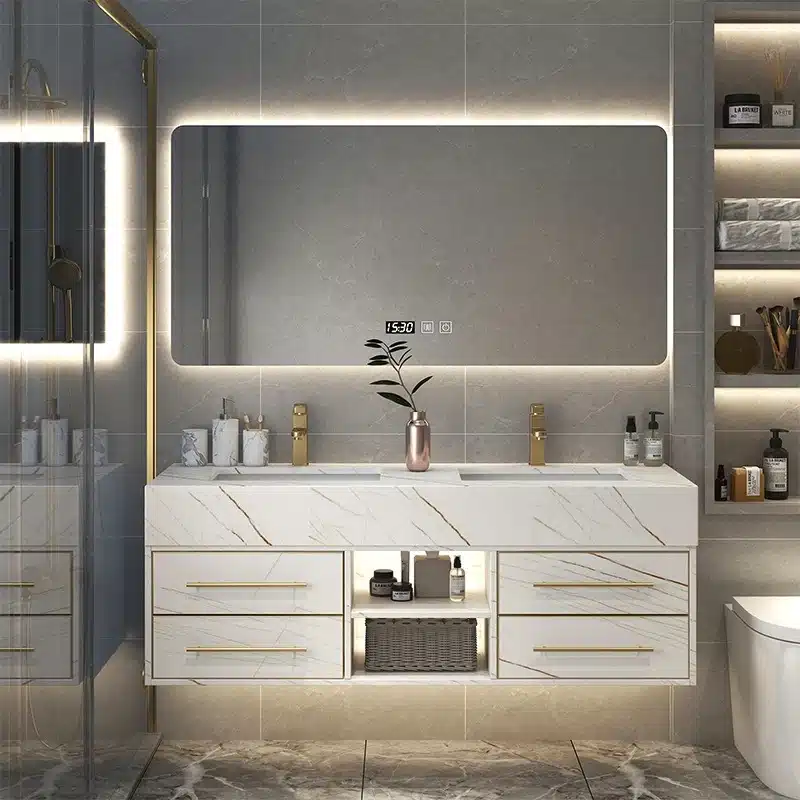
Why Most Vanity Materials Fail Hotel Projects
Micro-condensation destroys cabinets faster than splashes; spec ventilation class before material.
Commercial bathrooms endure 30 to 50 shower cycles daily. The primary threat to your vanity investment is not direct water contact, but the relentless micro-condensation trapped inside dark, enclosed cabinet boxes. Standard MDF absorbs this moisture immediately, swelling irreversibly within six months and causing hinge failure. Even premium solid oak can develop structural cracks if the kiln-drying process drops the moisture content below 8%.
Your material specification must be dictated by your project’s ASHRAE 62.1 ventilation class rather than aesthetic preferences. In high-humidity environments lacking active extraction, relying on standard particleboard guarantees immediate warranty disputes. For waterproof bathroom vanity applications in coastal hotels, you require materials that resist UV exposure and salt-air corrosion, which pushes your budget toward specialized PVC or marine-grade plywood.
When comparing PVC vs plywood bathroom vanity moisture resistance, the industry often overlooks a critical manufacturing detail. Imported PVC vanities frequently claim 100% waterproof status, yet they fail to account for the unsealed screw holes and cut edges where moisture wicks into the core. This specific oversight triggers 30% of commercial warranty claims. To prevent this, every drilled hole in a PVC cabinet must be sealed with silicone during production.
-
- Ventilation Class: Verify ASHRAE 62.1 compliance. Low airflow zones require 18mm BWR grade plywood or sealed PVC.
- Plywood Stability: BWR grade plywood retains 92% dimensional stability after 500 hours of 90% humidity cycling.
- PVC Structural Weakness: While absorbing 0% water, PVC foam board loses 30% screw-hold strength after repeated thermal cycling.
- Solid Wood Requirement: Must be kiln-dried to 8–12% moisture content and sealed on all six sides to prevent warping.
The most robust solution for a 50-unit hotel project is a hybrid approach: a plywood cabinet box paired with solid wood drawer fronts. This configuration leverages the structural integrity of plywood against humidity while maintaining the tactile luxury expected by guests. By specifying this combination, you secure the ADA compliant vanity material requirements while keeping your commercial bathroom vanity material cost per unit 2026 projections accurate.
| Feature | Specification | Advantage |
|---|---|---|
| Core Material | PVC Foam Board / Marine Plywood / Solid Oak | Zero water absorption (PVC) or 92% stability (Plywood) in 90% humidity |
| Moisture Defense | WBP Glue / 6-Side Sealing / Silicone Edge Sealing | Prevents delamination and wicking at screw holes and cut edges |
| Structural Integrity | 18mm Minimum Board Thickness / CNC Precision | Maintains screw-hold strength and dimensional accuracy under thermal cycling |
| Regulatory Compliance | CARB Phase 2 / E1 Formaldehyde / UL & CE Certified | Meets strict North American and European commercial building codes |
| Commercial Warranty | 3–5 Years Standard Coverage | Protects against finish defects and core swelling in high-traffic hotel environments |
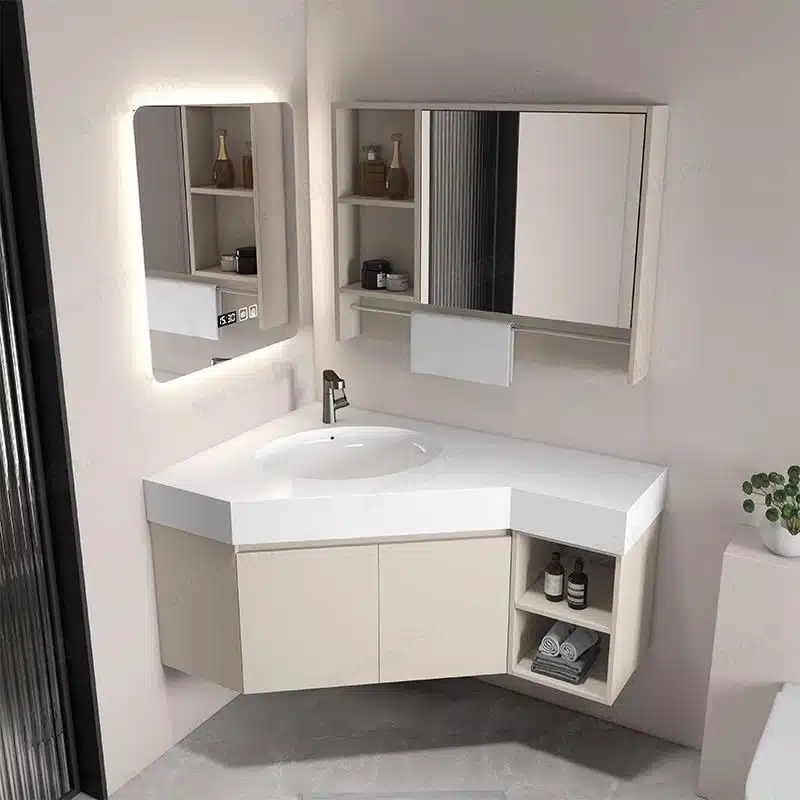
PVC vs Plywood vs Solid Wood: 2026 Priced Specs
PVC saves 15% upfront but fails thermal cycling; plywood retains 92% stability and is the commercial standard.
For commercial projects buying 50–200 units, material choice dictates your warranty liability and installation timeline. The market often treats PVC as the ultimate waterproof solution, but that is a dangerous oversimplification for load-bearing hotel applications. While PVC foam board absorbs 0% water, it loses 30% of its screw-hold strength after thermal cycling. If you spec PVC for heavy quartz vanities in coastal hotels, you risk drawer fronts pulling away from the cabinet box within 18 months.
The contractor’s real sweet spot is the hybrid spec: a BWR-grade plywood cabinet box paired with a solid wood drawer front. This configuration is used in 70% of US hotel projects because it balances dimensional stability with aesthetic value. Plywood retains 92% of its structural integrity after 500 hours at 90% humidity, whereas solid oak can crack if the kiln-drying moisture content drops below 8%. Competitors quote broad $200–$800 ranges, but you need exact per-unit FOB pricing to defend your budget to the owner.
-
- PVC Foam Board: Cost: $380–$450 per unit (36″ with solid surface top). Best for: High-humidity coastal zones. Risk: Requires silicone sealing on all edge holes to prevent moisture wicking, a step that causes 30% of warranty claims if missed.
- Plywood (BWR Grade): Cost: $480–$590 per unit (36″ with quartz top). Best for: General commercial and ADA-compliant projects. Risk: Must use WBP (weather and boil proof) glue; standard MDF swells irreversibly within 6 months.
- Solid Oak: Cost: $540–$670 per unit (36″ with quartz top). Best for: Luxury residential and boutique hotels. Risk: Requires 8–12% kiln-dried moisture content; otherwise, it is susceptible to cracking in dry, heated environments.
When negotiating order volume, the 50-unit FOB threshold is critical for locking in these 2026 pricing bands. For custom sizes or Pantone color matching, the MOQ drops to just 10–20 units, allowing you to test the hybrid spec on a pilot floor before scaling. Ensure your contract specifies a 3–5 year commercial warranty and requires in-process photography during the 5-stage QC to catch dimensional mismatches before the container ships.
| Feature | Specification | Advantage |
|---|---|---|
| Material Grade | PVC Foam Board / BWR Plywood / Kiln-Dried Solid Oak | Zero water absorption (PVC) vs. 92% dimensional stability (Plywood) vs. Premium aesthetic (Solid Wood) |
| 2026 FOB Cost (36″ Unit) | $380–$450 (PVC) / $480–$590 (Plywood) / $540–$670 (Solid Oak) | Transparent per-unit pricing for 50-unit orders; enables accurate project budgeting |
| Moisture & Thermal Resistance | PVC: 0% absorption; Plywood: WBP Glue; Solid Wood: 8–12% MC | Prevents delamination and swelling in high-humidity coastal or hotel environments |
| Structural Integrity | 18mm Minimum Board Thickness / WBP Glue Type | Ensures load-bearing capacity for commercial shelving and long-term hardware retention |
| Compliance & Warranty | E1/CARB Phase 2 Formaldehyde / 3–5 Year Commercial Warranty | Meets international safety standards (UL/CE/ADA) and reduces long-term liability risks |
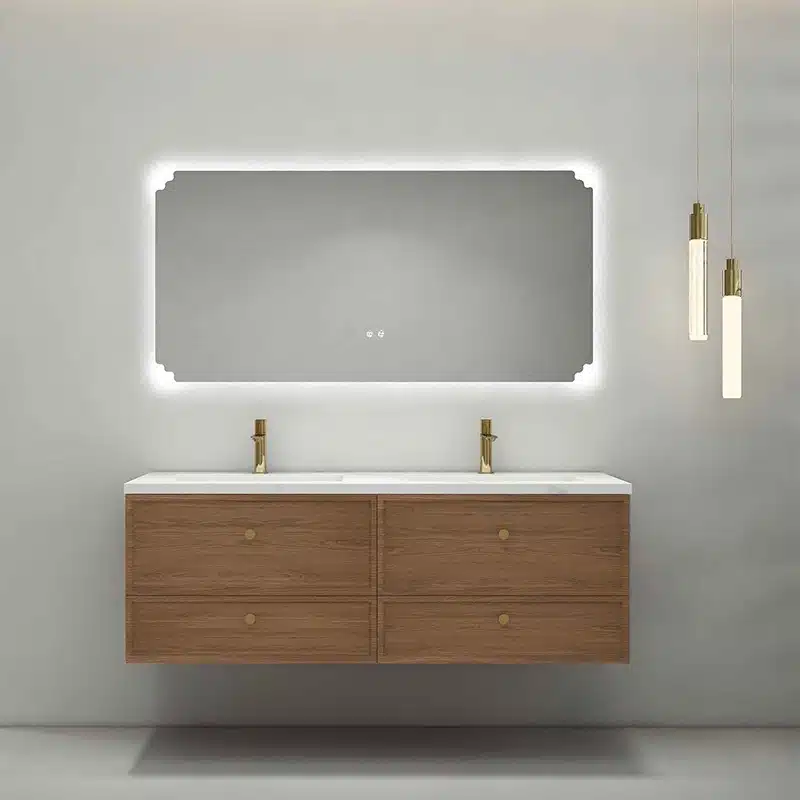
Moisture Warping Risk: The 18-Month Reality
Moisture warping is a failure of edge sealing, not just board choice.
You are writing a spec for a commercial bathroom, likely in a coastal or high-humidity zone. The enemy isn’t a splash; it is the micro-condensation trapped behind closed doors. Generic material charts tell you PVC is waterproof and solid wood is premium. They fail to disclose the engineering gap that causes 30% of warranty claims: the unsealed screw hole or cut edge.
When you spec a PVC vanity, you are betting on the board’s density. PVC foam board absorbs 0% water. However, under thermal cycling, that same material loses up to 30% of its screw-hold strength. If you do not mandate silicone sealing on every cut edge and hinge hole, moisture wicks into the core, causing delamination within 18 months.
Plywood offers a different risk profile. BWR (Boiling Water Resistant) grade plywood retains 92% of its dimensional stability after 500 hours at 90% humidity. It is the contractor’s real sweet spot for hotel projects. But you must verify the glue type is WBP (Weather and Boil Proof). If a supplier uses standard MR glue, the cabinet will delaminate long before the warranty expires.
Solid oak brings the highest aesthetic value but the highest maintenance risk. Kiln-dried to 8–12% moisture content, solid wood is stable in dry climates. In a 90% humidity bathroom, solid oak can experience 8–12% thickness swell on end-grain cuts. Without a 6-side seal and strict climate control during shipping, you will face finish cracking and drawer binding.
-
- PVC Foam Board: Absorbs 0% water but loses 30% screw-hold strength after thermal cycling. Requires mandatory silicone edge sealing to prevent wicking.
- Plywood (BWR Grade): Retains 92% dimensional stability after 500 hours at 90% humidity. Must utilize WBP glue; otherwise, layers will separate.
- Solid Oak: Can swell 8–12% on end-grain cuts in high humidity. Requires kiln-drying to 8–12% MC and 6-side sealing to prevent cracking.
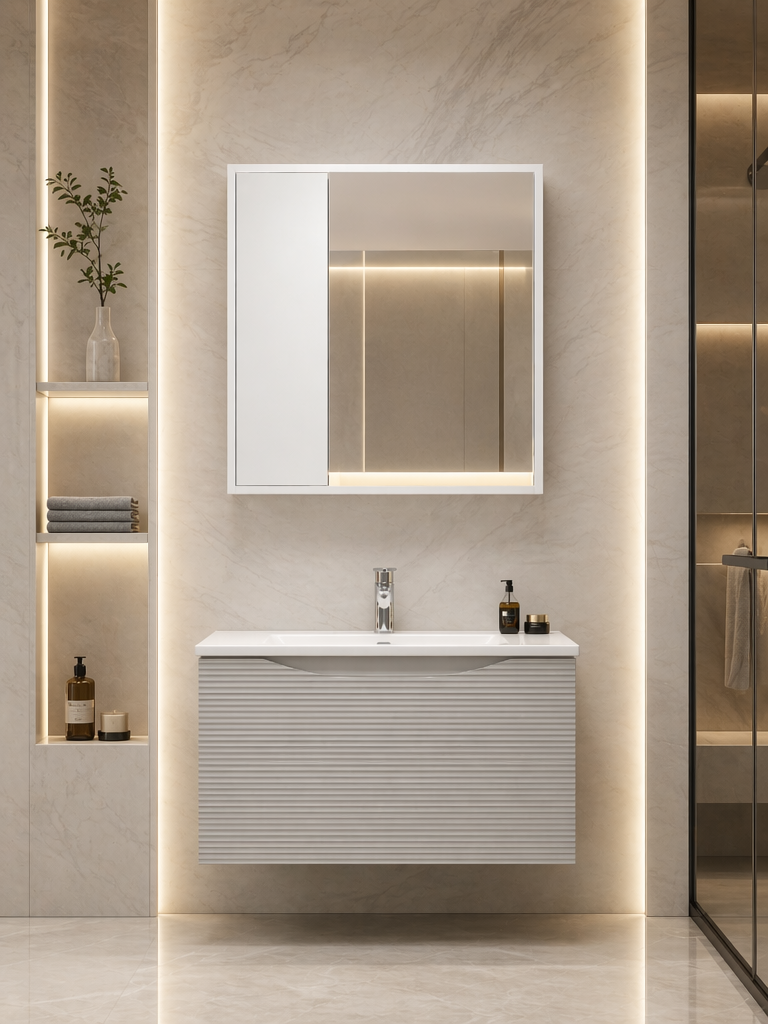
Conclusion
Plywood boxes with solid wood fronts deliver the stability and cost efficiency required for commercial projects, while PVC demands silicone-sealed edges to prevent 18-month delamination risks. Focus Cabinet’s CNC-manufactured vanities meet UL, CE, and ADA standards with a low MOQ of 10 units and 5-stage QC to protect your warranty timeline.
Review the full OEM customization options and Pantone color matching on the Custom Bathroom Vanities page to spec your exact project needs.
Frequently Asked Questions
Is plywood or solid wood better for a bathroom vanity?
Plywood is generally better for commercial projects due to its stability and cost-effectiveness, while solid wood suits luxury residential specs. Plywood resists warping in humid conditions, whereas solid wood requires strict sealing. Choose plywood for stability or solid wood for premium aesthetics.
What is the best material for a bathroom vanity cabinet?
Plywood offers the best balance of durability and cost for most commercial applications. PVC is superior for 100% waterproof needs in extreme humidity, while solid wood is reserved for high-end luxury finishes. Select plywood for value or PVC for maximum waterproofing.
Is PVC good for a bathroom vanity?
PVC is excellent for humid climates as it is 100% waterproof and resistant to mold. However, it lacks the structural rigidity of wood for heavy load-bearing shelves in large commercial units. Use PVC for wet zones but reinforce shelves for heavy loads.
What material lasts longest in humid bathrooms?
PVC foam board lasts longest in high humidity because it is impervious to water absorption. Properly sealed plywood is a close second, provided edge sealing is maintained to prevent delamination. Prioritize PVC or sealed plywood for long-term humidity resistance.
Can I get custom sizes for a large project?
Yes, custom sizes are available with a low MOQ of 10 to 20 units for testing. Large-scale projects benefit from CNC precision and regional compliance adaptations like UL or CE standards. Start with a small custom order to validate fit and quality.

0 Comments