

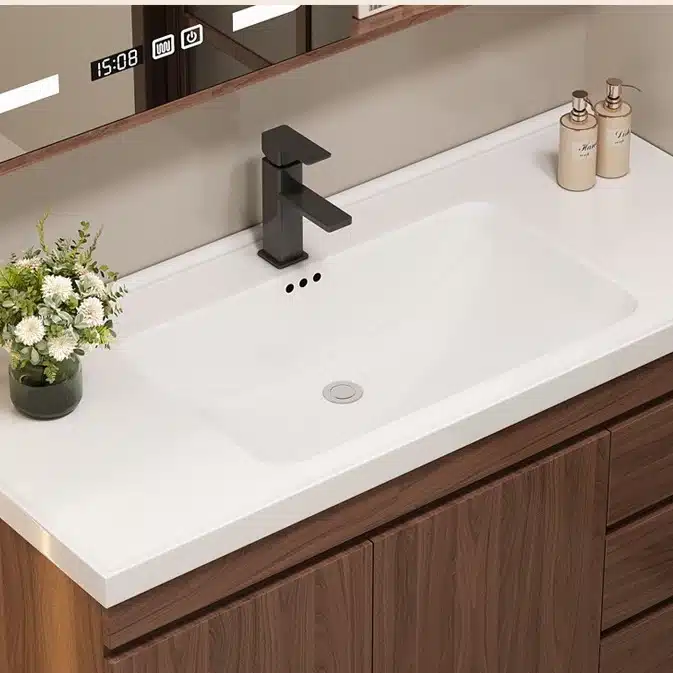
Sourcing a cUPC certified bathroom sink is the critical step that separates a smooth import process from a logistical nightmare of seized containers and project-halting compliance failures. For importers, the plumbing fixture market is a minefield of regional standards, vague supplier claims, and fraudulent certification stamps. A single misstep doesn’t just risk a customs delay; it exposes your business to product liability, forced recalls, and irreparable damage to your brand’s reputation with contractors and distributors.
This guide serves as a technical SOP for navigating global plumbing certifications. We will compare the core requirements of North America’s cUPC standard against Australia’s WaterMark, detail the non-negotiable specifications for drain hole sizes and overflows, and examine the material pros and cons of undermount ceramic versus integrated resin basins. You’ll get a clear, step-by-step process for verifying a factory’s certification claims directly at the source, ensuring every shipment meets legal and safety mandates.
The Risk of Uncertified Plumbing Fixtures
Sourcing uncertified plumbing fixtures exposes projects to severe public health risks from lead contamination and creates massive financial liability through code violations, failed inspections, and voided insurance claims.
Lead Contamination and Health Hazards
Uncertified plumbing fixtures pose a direct public health threat. A 2025 study found that an alarming 90% of off-brand faucets fail U.S. safe drinking water standards, primarily from lead contamination due to non-compliant materials. These counterfeit products bypass safety regulations, threatening the integrity of community water supplies.
- Fixtures lacking proper certification often leach lead and other dangerous toxins into the water.
- Millions of non-compliant units have entered the market in recent years, increasing public exposure risks.
- Counterfeit products directly sidestep the safety protocols designed to protect public health infrastructure.
Code Violations and Legal Penalties
Installing uncertified fixtures is a direct violation of plumbing codes and federal law. Regulatory bodies like the EPA enforce strict standards, with civil penalties reaching nearly $70,000 for each noncompliant product sold. These are not minor infractions; they are costly compliance failures.
Projects that use uncertified products will fail mandatory building inspections. This forces expensive rework and causes significant project delays, impacting both budgets and deadlines. As the market for unsafe counterfeit goods expands, regulatory enforcement continues to intensify.
Voided Warranties and Insurance Exclusions
Beyond legal penalties, uncertified fixtures introduce major financial risks. If a non-compliant faucet leaks and causes water damage, it can void the warranties on surrounding products like cabinets, vanities, and flooring. Other manufacturers will not cover damage caused by an illegal component.
Insurance companies routinely deny claims for water damage when an uncertified plumbing component is the source of the failure. This leaves the property owner personally liable for all repair and replacement costs, with no financial recourse. The initial savings from a cheap, uncertified part are quickly erased by the cost of a single incident.
North America: cUPC and CSA Standards
Sourcing plumbing fixtures without cUPC and CSA certification is a direct route to project failure, as these standards are the primary legal and safety benchmarks for market access in the U.S. and Canada.
The Role of cUPC Certification
The Certified Uniform Plumbing Code (cUPC) is the dominant certification for plumbing products sold in North America. Managed by the International Association of Plumbing and Mechanical Officials (IAPMO), this mark validates that a product—whether a sink, faucet, or toilet—meets strict safety and quality benchmarks. It serves as a clear indicator to inspectors, contractors, and consumers that the fixture complies with established codes.
To earn cUPC certification, products undergo intensive third-party testing covering material composition, pressure tolerance, flow rate efficiency, and long-term durability. Factories don’t just get a one-time pass; they must submit to annual audits to prove they maintain consistent quality control and production standards. This ongoing verification ensures that every product bearing the cUPC stamp continues to meet the required specifications.
| Parameter Tested | cUPC/CSA Requirement | Impact on Business |
|---|---|---|
| Material Quality & Safety | Meets IAPMO/CSA guidelines for safe, lead-free materials. | Avoids health risks, severe EPA fines, and legal liability. |
| Mechanical Performance | Passes tests for pressure tolerance, flow rate, and long-term durability. | Ensures product reliability, reduces warranty claims, and builds contractor trust. |
| Factory Compliance | Requires annual audits to verify consistent production standards. | Guarantees ongoing market access and prevents certification loss. |
CSA Standards and Dual-Market Compliance
The Canadian Standards Association (CSA) provides the primary certification framework for the Canadian market. Because the U.S. and Canadian markets are so integrated, many products are designed for dual-market compliance. You can identify these products by looking for markings like “C” and “US” or “NRTL/C” alongside the certification logo. This indicates the fixture meets the requirements for both countries.
A Mutual Recognition Agreement (MRA) between the two countries allows testing bodies like UL and CSA to certify products to each other’s standards. This streamlined system is a major benefit for manufacturers. It eliminates the need for redundant, costly testing and significantly accelerates the process of bringing a compliant product to the entire North American market.
Ensuring Market Access and Consumer Trust
For any business operating in residential or commercial construction, holding cUPC and CSA certifications is non-negotiable. In most jurisdictions, compliance is a legal requirement for plumbing fixtures used in new builds and renovations. An installation with uncertified products will fail inspection, causing costly delays and rework.
Beyond legal mandates, these certifications are powerful tools for building trust. Contractors and wholesalers recognize these marks as a guarantee of quality, safety, and reliability. For manufacturers, adherence to these standards is the key factor in achieving widespread distribution and establishing a credible presence in the North American market.
Increase Profits with High-Demand Bathroom Vanities

Australia/EU: WaterMark and CE
WaterMark governs the legal installation of plumbing products in Australia, while the CE mark is a broader declaration of conformity required for market access across the European Union.
WaterMark Certification in Australia
In Australia, the WaterMark scheme is the mandatory certification for many plumbing and drainage products. It’s managed by the Australian Building Codes Board (ABCB) and is critical for any professional project. While a non-certified product can technically be sold, a licensed plumber is legally forbidden from installing it. This creates a clear distinction between retail availability and professional-grade compliance.
- Products must comply with the National Construction Code to qualify for the mark.
- The scheme covers taps, pipes, valves, sanitary fixtures, and other water-related hardware.
- Certification requires rigorous testing in accredited labs to verify material quality, safety, and adherence to standards like low-lead limits for drinking water fixtures.
CE Marking in the European Union
The CE mark (Conformité Européenne) is a manufacturer’s self-declaration that a product meets the European Union’s health, safety, and environmental protection standards. It isn’t a quality mark but a prerequisite for placing many products on the market within the European Economic Area (EEA). Without it, market entry is blocked.
- The mark signals that a product complies with all applicable EU regulations.
- It facilitates the legal sale and free movement of goods within the entire EEA bloc.
- FocusCabinet ensures relevant products, such as bathroom vanities with electrical components, meet all CE requirements for our European partners.
Key Differences: Installation vs. Market Access
The primary difference between these two systems is their function. WaterMark is a specialized, country-specific scheme that directly governs the legal installation of plumbing products. In contrast, CE marking is a broad declaration that enables market access across a multi-nation economic area. One controls what can be installed, while the other controls what can be sold.
- WaterMark is a specific certification focused on plumbing product installation legality.
- CE is a general declaration of conformity required to sell products within the EU market.
- For global distributors, understanding both is essential for regional compliance and preventing costly project delays.

Standard Drain Hole Sizes (1.75″) & Overflow Rules
Standardized drain hole diameters, integrated overflow systems, and corrosion-resistant materials are not design choices—they are critical industry agreements that ensure fixtures from different manufacturers work together reliably, preventing leaks and water damage.
Standardized Drain Diameters for Global Compatibility
The bathroom fixture industry relies on standardized drain hole sizes to ensure sinks and drain assemblies from different manufacturers fit together seamlessly. This compatibility is a fundamental requirement for a global supply chain. While several sizes exist, they follow established benchmarks that simplify installation for distributors and contractors worldwide, eliminating guesswork and custom modifications on the job site.
- The primary standard for bathroom sink drain holes is 1.75 inches (44.45 mm), but other common sizes include 1.25, 1.5, and 1.625 inches to accommodate various basin designs.
- This intentional standardization allows factories to produce basins and vanities that are compatible with plumbing fixtures across North America, Europe, and Oceania.
- The goal is to provide universal fitting compatibility, reducing the need for special parts or on-site modifications during installation.
The Function of Sink Overflows in Preventing Water Damage
An overflow is a critical safety feature built into most bathroom sinks, not an aesthetic choice. It is a small hole located high in the basin that directs rising water back into the drain pipe before it can spill over the edge. This simple mechanism is a primary defense against water damage from a forgotten running tap or a slow drain.
- The system works by channeling water through a hidden passage within the sink’s structure to a corresponding opening in the drain fixture, safely redirecting the flow.
- Drain components must be specifically designed to work with overflow-equipped sinks; a non-overflow drain installed in a sink with an overflow is a mismatch that will fail.
- This feature is often a mandatory requirement in regional building codes, especially for projects like hotels or multi-family housing where flood risk mitigation is paramount.
Material Choices for Drain Assemblies
The materials used for drain fixtures directly impact their service life and reliability. The industry standardizes around metals known for corrosion resistance and durability to ensure a long, leak-free performance. This focus on material quality protects the end user and the installer from premature failures and costly callbacks.
- Brass and stainless steel are the primary materials for drain construction due to their proven resistance to rust and corrosion in wet environments.
- These robust materials provide structural integrity and can be finished in chrome, matte black, brushed nickel, or other styles to match faucets and surrounding hardware.
- Using high-quality metals prevents the leaks and degradation common with cheaper plastic or pot metal alternatives, ensuring the fixture maintains its function and appearance for years.

Undermount Ceramic vs. Resin Integrated Basins
The decision between ceramic and resin basins is no longer about longevity; it’s a strategic choice between ceramic’s classic scratch resistance and resin’s superior design flexibility and impact durability.
Ceramic Basins: Traditional Durability and Aesthetics
Ceramic remains a dominant material in the basin market, especially for traditional and budget-focused projects. Its primary advantages are proven durability, high scratch resistance, and a classic, clean aesthetic that has been a standard for decades. This material is fired at high temperatures, creating a hard, vitrified surface that stands up well to daily use and cleaning chemicals.
- Offers superior scratch resistance compared to many other materials.
- Known for its long-term durability and resistance to stains and chemicals.
- Favored in conventional designs for its timeless and widely accepted appearance.
Resin Integrated Basins: Design Flexibility and Impact Resistance
Resin integrated basins are gaining popularity in premium and contemporary designs. Their key strength lies in superior design flexibility, allowing for seamless, one-piece vanity tops and basins with sharp lines and modern shapes. They also offer better impact resistance than traditional ceramic, making them less prone to chipping or cracking from dropped objects.
- Enables greater customization through advanced moulding capabilities.
- Provides enhanced durability against chipping and cracking from impacts.
- Features a non-porous surface that is easy to clean and maintain.
| Feature | Ceramic Basin | Resin Integrated Basin |
|---|---|---|
| Scratch Resistance | High | Good |
| Impact Resistance | Moderate (Can chip or crack) | High (More resistant to chipping) |
| Design Flexibility | Limited to traditional shapes | Very High (Seamless, custom shapes) |
| Ideal Application | Conventional or budget-focused projects | Premium, contemporary, and custom designs |
Decision Factors: Longevity, Maintenance, and Environmental Profile
The choice between ceramic and resin is driven more by design preferences and maintenance tolerance than a major difference in performance. Both materials offer excellent longevity, though they have different environmental and upkeep profiles. A project focused on sharp, modern aesthetics will benefit from resin, while one prioritizing a classic look and maximum scratch resistance may favor ceramic.
- Both materials demonstrate a comparable lifespan of 15-20 years or more.
- Resin production often requires less energy, resulting in a lower environmental impact.
- Final selection typically depends on the project’s aesthetic goals and tolerance for specific maintenance needs.
Verifying the Factory’s Certification Stamps
Relying on a physical certification stamp without digital verification is a direct route to project failure; standards evolve, and counterfeit marks are common.
Identifying Key Certification Bodies and Marks
Verification starts with knowing which marks matter for your market. Each stamp confirms compliance with specific standards, from safety to efficiency. For example, fixtures destined for North America typically require cUPC marks from IAPMO to prove they meet regional plumbing codes. The NSF/ANSI 61 mark ensures product materials won’t contaminate drinking water, while the EPA’s WaterSense label identifies fixtures meeting federal water efficiency targets—a critical requirement for many modern projects.
| Certification Mark | Governing Body | Primary Function & Market |
|---|---|---|
| cUPC | IAPMO / CSA Group | Confirms compliance with North American plumbing and safety codes. |
| NSF/ANSI 61 | NSF International | Ensures materials are safe for direct contact with drinking water. |
| WaterSense | U.S. Environmental Protection Agency (EPA) | Identifies products meeting federal water efficiency standards. |
Using Digital Databases for Cross-Verification
A physical stamp alone is not sufficient proof of compliance. The only way to protect a project from counterfeit marks or lapsed certifications is to cross-reference the product in an official online database. Buyers can use centralized registries, like the California Energy Commission’s MAEDBS database, to look up a model number and confirm its status. This digital check validates that the certification is current and applies to the exact model being purchased. Skipping this step introduces a major risk of installing a non-compliant fixture that will fail inspection.
The Impact of Evolving Standards and Code Cycles
Plumbing standards are not static. Codes are updated on a roughly three-year cycle, meaning a certification from a few years ago might not be valid today. Sourcing from a factory that doesn’t actively track and renew its certifications is a liability. Using a fixture with an outdated or missing certificate can trigger inspection failures, force costly replacements, and cause significant project delays. To ensure compliance in 2026, you must work with a manufacturer that manages these updates as a core part of their quality control process.

Conclusion
Sourcing vanities without correct plumbing certifications like cUPC or WaterMark introduces serious project risks. Local plumbers may refuse to install non-compliant fixtures, causing costly delays and violating building codes. Verifying your factory’s certifications and confirming standard drain hole sizes are critical steps for a smooth import process.
Review your current supplier’s documentation to prevent these issues on your next project. If you need a manufacturing partner with certified options, our team can provide a full catalog and a refundable sample to verify our quality firsthand.
Frequently Asked Questions
Does a bathroom sink need cUPC?
Yes, a bathroom sink requires cUPC (Uniform Plumbing Code) certification to be legally installed in the United States and Canada. This certification ensures the product complies with all safety and performance standards, including lead-free requirements mandated by the EPA. Using non-certified fixtures can lead to code violations, voided insurance, and significant health risks from material contamination.
Standard vanity drain hole size?
The standard drain hole opening in a bathroom vanity sink is 1.75 inches (44.45mm) in diameter. This universal size is designed to accommodate standard drain assemblies, which typically have a diameter of 1.25 inches or 1.5 inches, ensuring compatibility across a wide range of fixture brands.
What is an overflow hole?
An overflow hole is a small opening near the top rim of a sink that serves two key functions. Primarily, it acts as a safety feature to prevent the sink from overflowing if the faucet is left on while the main drain is closed. Water enters the hole and is safely redirected into the drain pipe below. Secondarily, it allows air to enter the drain system, which helps water flow out more quickly and smoothly.





0 Comments