

Following a technical Import/Wholesale Guide is the only reliable barrier between a profitable vanity program and having to liquidate an entire shipping container at a loss. The difference between a supplier’s perfect sample and the bulk production that arrives at your warehouse can be staggering, often revealing warped doors, cracked joints, or peeling finishes. These defects aren’t just cosmetic issues; they lead directly to customer complaints, costly chargebacks, and permanent damage to your brand’s reputation for quality.
This quality control checklist is a standard operating procedure for anyone sourcing bathroom cabinets globally. We will move beyond generic advice and detail the critical inspection points for manufacturing and logistics. We cover specific moisture content tolerances to prevent warping, the right way to inspect mitre joints and paint adhesion, and how to verify packaging meets ISTA standards. You’ll also learn how to analyze A-grade versus B-grade quotes and enforce proper container loading to protect your investment from the factory floor to your distribution center.
The Risks of Global Vanity Sourcing
Focusing solely on a low unit price is a flawed procurement strategy that consistently fails to account for the total cost of ownership, exposing importers to quality failures, logistical penalties, and supply chain shocks.
Hidden Costs Beyond the Unit Price
Pursuing an artificially low unit price often conceals significant downstream expenses. Many procurement strategies fail because they overlook critical factors like quality control failures, complex logistics, and regulatory non-compliance. These oversights result in costs that far exceed any initial savings. Unexpected expenses tied to supplier verification, failed product inspections, and logistical penalties are common. A myopic focus on the initial quote ignores the total cost of ownership, leading to poor financial and operational outcomes.
Supply Chain Vulnerabilities in 2026
The current market environment magnifies the dangers of simplistic, cost-cutting sourcing strategies. Geopolitical instability, volatile tariffs, and fragmented supply chains create conditions where seemingly small risks can cause substantial damage. Single-region sourcing is now a high-risk approach. Relying on unvetted, low-cost suppliers makes a business extremely vulnerable to market shocks, as these suppliers are often the first to fail under pressure. This can lead to production halts and severe reputational harm.
The Shift to Value-Driven Procurement
Effective sourcing teams have moved away from purely price-driven decisions. The new standard emphasizes supplier reliability, comprehensive risk assessment, and a clear understanding of total cost. Best-practice procurement prioritizes building resilient and dependable supply partnerships. This involves proactive risk diversification to mitigate dependency on any single region or supplier. The goal is to ensure long-term value and operational stability, not just to secure the lowest possible bid on a spreadsheet.
Critical QC Points: Finish, Joints, & Flatness
Beyond aesthetics, inspecting surface finish, joint integrity, and panel flatness is non-negotiable for preventing structural failures and warranty claims down the line.
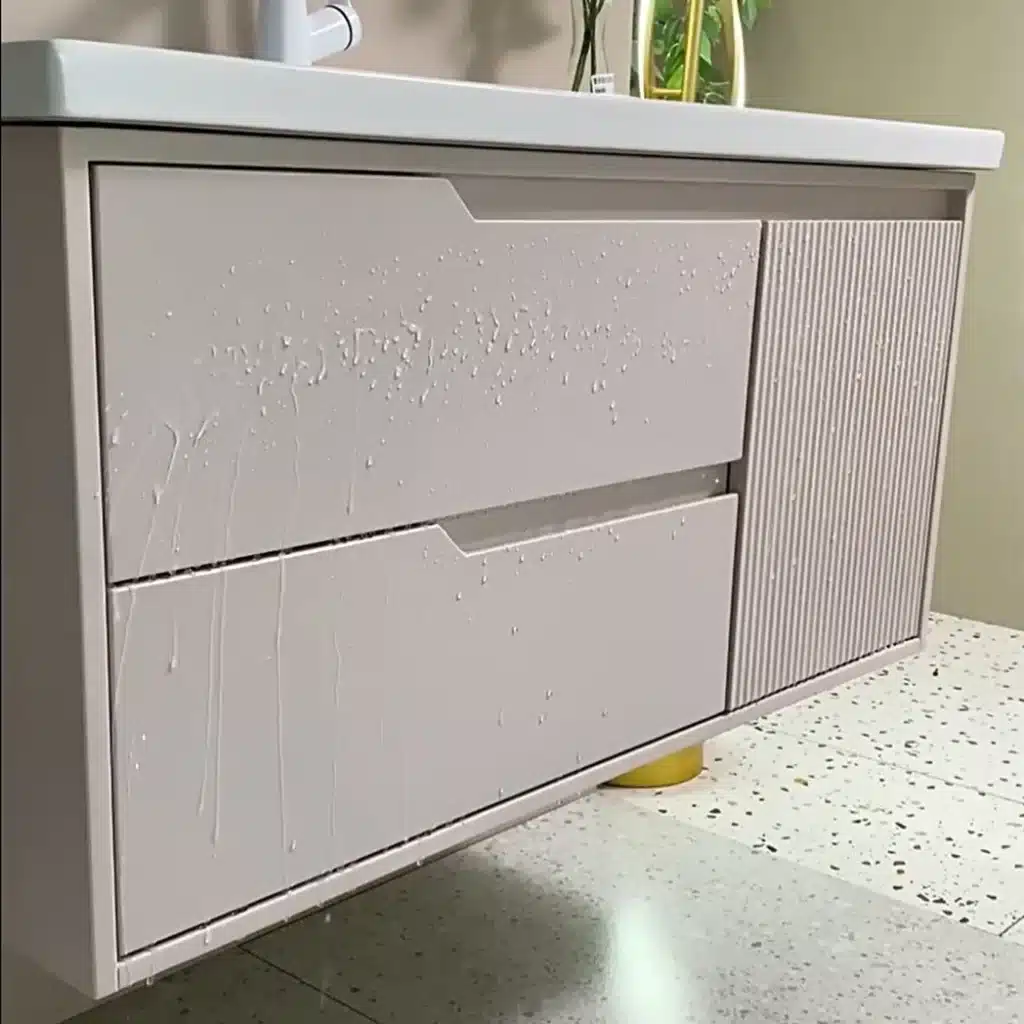
Surface Finish Inspection
A durable and visually flawless surface is the first indicator of quality. A proper multi-stage finishing process ensures both aesthetic consistency and resilience against bathroom humidity. We perform checks under controlled lighting to catch subtle defects like inconsistent gloss or color variations that are easily missed, ensuring every cabinet meets the approved master sample before the 2026 assembly phase begins.
- Technicians inspect for consistent gloss and color across all components against approved master samples.
- Paint and lacquer layer thickness is measured to confirm it meets durability specifications.
- Surfaces are examined for defects like orange peel, pinholes, or scratches.
| Finish Type | Key Characteristics | Primary Application |
|---|---|---|
| High-Gloss Lacquer | Multi-layer spray painting provides a seamless, premium, and ultra-smooth surface. Requires a stable substrate like HMR MDF. | Premium and minimalist designs, especially popular in European markets for its clean aesthetic. |
| PVC Skin (Membrane) | A paint-free, factory-applied film that is highly durable, waterproof, and consistent in color and texture. | Ideal for high-moisture environments like the Middle East or for budget-focused projects requiring maximum durability. |
| Laminate / Melamine | Applied to plywood cores, this finish offers superior scratch resistance and a wide range of textures, including realistic timber-look grains. | Popular in markets like Australia for coastal or Hamptons-style vanities that require a wood appearance with high durability. |
Structural Joint Integrity
A cabinet’s long-term strength depends entirely on its joints. We use precision CNC machinery to produce components with tight tolerances, but physical verification is still essential. The quality control process confirms every connection is secure, square, and free of gaps. This step is critical for preventing structural issues that can develop months or years after installation.
- Digital calipers verify joinery, ensuring connections are flush and perfectly square.
- Load-bearing joints, especially on wall-mounted vanities, undergo stress tests to confirm they exceed design specifications.
- Adhesive application is monitored for proper coverage and curing to guarantee maximum bond strength.
Panel and Surface Flatness
Large components like doors, side walls, and countertops must be perfectly flat. Any deviation can lead to warping, poor alignment, and installation problems. We use precision tools to check every major surface, which guarantees that doors will close flush and countertops can be installed without creating stress points that could lead to cracking.
- A precision straightedge is used across large surfaces like doors and side panels to detect any bowing or twisting.
- The flatness of sintered stone countertops is verified to ensure they sit level on the cabinet base without stress.
- Final assembly checks confirm all doors hang flat and maintain consistent, even gaps with adjacent components.
Increase Profits with Factory-Direct Bathroom Vanities.

Moisture Content Checks (Crucial!)
Failing to match wood moisture content to the destination climate is a leading cause of post-installation warping, cracking, and joint failure in bathroom vanities.
Defining Acceptable Moisture Levels by Region
The ideal moisture content (MC) in wood or plywood isn’t a single number; it’s a calculated target based on the product’s final destination. Materials destined for a dry climate in the Middle East require different conditioning than those headed for the humidity of coastal Australia. Setting the wrong moisture level leads directly to dimensional instability. We establish specific MC targets for materials like solid wood and plywood based on the destination market’s climate zone. This proactive step ensures the vanity remains stable and avoids expansion or contraction issues after installation. For example, wood prepared for North American winters is tested to withstand dry indoor heating, while materials for tropical zones are conditioned for high humidity.
| Target Climate | Environmental Conditions | Required Moisture Content (MC) |
|---|---|---|
| Dry / Arid (e.g., Middle East, US Southwest) | Low Ambient Humidity (<40%) | 6-8% |
| Temperate (e.g., Europe, North America) | Moderate / Seasonal Humidity (40-60%) | 8-10% |
| Humid / Tropical (e.g., Southeast Asia, Coastal Australia) | High Ambient Humidity (>60%) | 10-13% |
Modern vs. Traditional Testing Methods
Outdated quality control relies on slow, often destructive, oven-drying methods to test moisture. We utilize modern, non-destructive techniques like spectroscopic analysis and near-infrared (NIR) tools. This allows for real-time checks directly on the production line without damaging the materials, providing instant, precise readings. Non-destructive testing means more components can be checked without generating waste, increasing overall quality assurance. This technology preserves sample integrity and speeds up the entire QC process, allowing us to identify and reject non-compliant materials immediately.
Compliance with International Standards
Adhering to recognized international standards provides a clear framework for quality and safety. Our moisture analysis protocols align with benchmarks like ASTM D4442, which are essential for manufacturing products for regulated markets. Following these standards ensures a scientific and repeatable approach to moisture control. We use NIST-traceable calibrated equipment to guarantee that measurements are accurate and defendable. This level of compliance is critical for meeting the regulatory and quality expectations of distributors in Europe and North America.
Packaging Drop Tests (ISTA Standards)
Properly engineered packaging, validated against ISTA standards, is not a cost but a direct defense against the high return rates and reputational damage common in e-commerce and parcel shipping.

Shipping damage is a direct hit to your profit margin. The International Safe Transit Association (ISTA) provides a framework to test and validate packaging performance before your products ever leave the factory. These tests simulate the drops, vibrations, and impacts that a package will endure during handling and transit, allowing you to identify and correct design flaws proactively.
ISTA 1A as the Global Standard
By 2026, ISTA 1A has become the accepted global benchmark for pre-shipment integrity testing. It’s a non-simulation test, meaning it serves as a screening tool to verify that a package can withstand basic hazards. For importers and wholesalers, it’s the minimum due diligence needed to confirm that items like bathroom vanities and mirrors are robustly protected for mass distribution.
- It establishes a baseline for fundamental drop, shock, and vibration integrity.
- The tests quickly reveal obvious weak points in carton strength, corner protection, or internal cushioning.
- Passing this test provides an initial layer of confidence before committing to a full production run.
The Role of Third-Party Lab Validation
While in-house testing is useful, validation from an accredited third-party laboratory provides unbiased, defensible proof of compliance. This documentation is critical for businesses operating in demanding channels like e-commerce or retail distribution, where logistics partners and marketplaces have strict packaging requirements. A certified lab report is your evidence that you took the necessary steps to protect your product.
- It ensures compliance with requirements from major retailers like Amazon or Wayfair.
- Certified reports provide essential documentation for freight insurance claims and liability disputes.
- Labs use calibrated equipment and standardized procedures, ensuring the results are reliable and repeatable.
Expanded Protocols for Different Channels
A pallet of vanities shipped to a warehouse faces different risks than a single vanity sent to a customer’s home. The ISTA framework accounts for this with a range of protocols. While ISTA 1A is a good start, more complex supply chains demand more rigorous testing. For example, our e-commerce packaging upgrade is engineered to pass the ISTA 3A test, which specifically simulates the harsh environment of small parcel delivery systems.
- Series 3 tests are designed for the multiple touchpoints and automated sorting common in parcel systems like FedEx or UPS.
- Series 6 protocols are often mandated by specific retailers (e.g., Amazon’s “SIOC” tests) to align with their unique logistics networks.
- This flexibility lets us match the packaging investment to the actual risk profile of your sales channel, preventing both over-engineering and costly transit damage.
Analyzing “B-Grade” vs. “A-Grade” Quotes
Understanding the difference between A-Grade and B-Grade vanities is less about “good” vs. “bad” and more about a strategic trade-off between cosmetic perfection and unit cost for specific market segments.
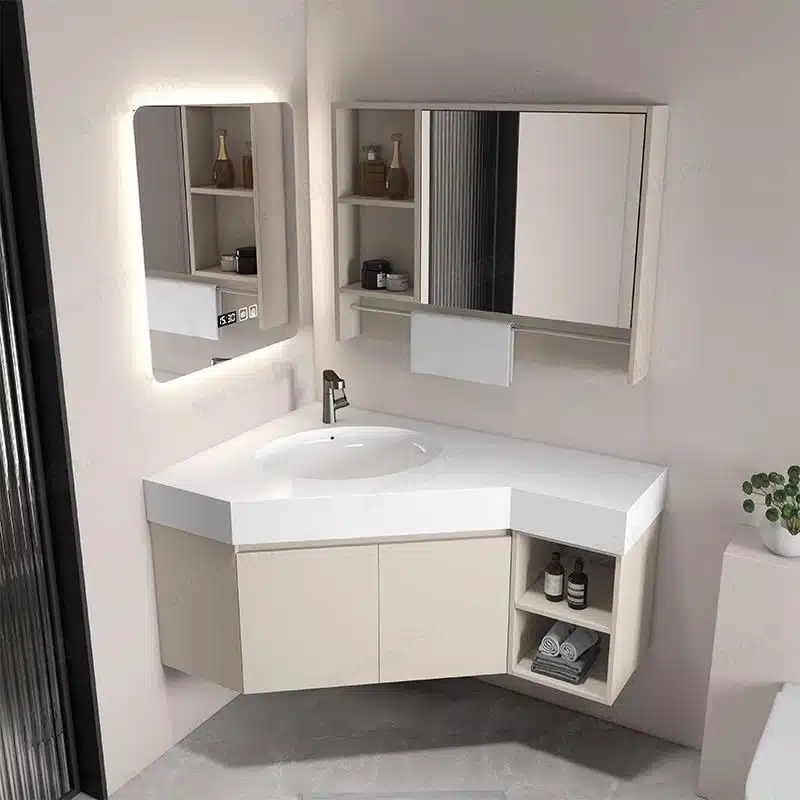
Defining “A-Grade”: The Standard for Perfection
A-Grade products represent the highest quality standard available from a factory. These units undergo close-scrutiny inspections to ensure they are free of visible defects. Surfaces are flawless, color matching is uniform across all components, and material integrity is perfect. This grade is specified for luxury residential projects, hotel developments, and retail showrooms where every detail contributes to the final aesthetic and client perception. The premium price reflects its defect-free condition and superior material selection.
Understanding “B-Grade”: Functional with Minor Flaws
B-Grade items are fully functional but contain minor, non-structural cosmetic flaws. These imperfections do not impact the product’s performance or durability. Common examples include small scratches, slight discoloration in a non-visible area, or minor scuffs from handling during production. B-Grade vanities offer a cost-effective alternative for projects where slight imperfections are acceptable, such as in high-traffic commercial spaces or budget-constrained rental properties where utility is prioritized over a flawless finish.
| Attribute | A-Grade (Premium) | B-Grade (Cost-Effective) |
|---|---|---|
| Visual Standard | Flawless finish and uniform color. No visible defects under close inspection. | Minor cosmetic flaws. May include small scratches, slight discoloration, or minor scuffs. |
| Functionality | Perfect structural and functional integrity. | Fully functional. Flaws are non-structural and do not impact performance or durability. |
| Ideal Application | High-end residential, luxury hotels, and showrooms requiring visual perfection. | Rental properties, commercial spaces, and large-scale projects where budget is the primary driver. |
| Pricing Impact | Premium price point reflecting defect-free quality and materials. | Significant cost savings, prioritizing function over flawless aesthetics. |
The Price-to-Quality Calculation in Quotes
A quote featuring B-Grade options will be significantly lower, reflecting the defined cosmetic compromises. Analyzing these quotes requires weighing the direct cost savings against the project’s aesthetic requirements and the end client’s expectations. Distributors must assess if the price reduction justifies the presence of minor visual defects for their target market. At FocusCabinet, we provide transparent grading and clear definitions of what constitutes each grade. This allows our partners to make informed purchasing decisions based on their specific inventory and project needs.
How Grade Affects Project Suitability
The choice between A-Grade and B-Grade directly maps to the end-use application. A-Grade is the only viable option for projects demanding visual perfection, such as premium residential developments or hotel vanity programs where the finish is a key selling point. B-Grade provides a practical, durable solution for large-scale commercial contracts or multi-family housing where budget adherence is the primary driver and minor cosmetic issues are acceptable. A flexible sourcing partner should offer both grades to provide tailored solutions for different market segments, aligning production with your business goals.
Container Loading Logic (Top vs. Base)
The choice between top-loading with open-top containers and side-loading with flat-racks is a strategic decision driven by cargo dimensions, weight, and equipment availability at the ports.
Selecting the right container loading method directly impacts operational efficiency and cargo safety. The days of simply filling a standard box are over. Today, logistics teams analyze the specific characteristics of the freight to determine whether a top-down or side-on approach is more effective. This decision dictates the type of container used—typically an open-top for vertical loading or a flat-rack for multi-directional access.
Top Loading with Open-Top Containers
This method is purpose-built for oversized or irregularly shaped cargo that cannot be loaded through standard container doors. Using cranes, logistics teams lower items vertically into the container, which is an ideal solution for bulky goods that are too tall or wide for conventional loading. For bathroom fixtures, this applies directly to large, pre-assembled vanity units or custom-crated stone basins that must be handled with precision.
- It streamlines operations for freight that is too tall or wide for conventional side-loading.
- This approach requires specialized crane equipment at both the origin and destination ports.
Base and Side Loading with Flat-Racks
Flat-rack platforms provide multi-directional access, allowing heavy or dense palletized goods to be loaded from the top or sides with forklifts. This flexibility is key for cargo that requires unique securing or cannot be easily stacked, like crates of hardware or stacks of sintered stone slabs. The open design gives loading equipment much easier access compared to the tight constraints of an enclosed container.
- The choice between top and side loading on a flat-rack depends on the equipment available and the cargo’s nature.
- This method is especially useful for dense, heavy materials that benefit from direct forklift placement.
Matching Loading Strategy to Cargo Type
Modern logistics prioritizes a customized loading strategy based on the cargo’s specific profile to optimize cost and safety. Digital freight platforms now help match cargo requirements with the most efficient container and loading solution available. A tailored strategy minimizes the risk of damage during transit, reduces handling time, and improves overall supply chain predictability.
- Key factors influencing the choice include cargo weight, dimensions, fragility, and destination handling capabilities.
- This data-driven approach moves beyond standardized containers to find the best fit for project-specific cargo.
Inspecting Hardware (Hinges/Slides)
Functional hardware is more than just a component; it defines the vanity’s long-term user experience and durability, with cycle-life and corrosion resistance being the primary failure points.

Cycle-Life and Load-Bearing Tests
Hardware durability isn’t a guess—it’s confirmed through mechanical stress tests that simulate years of use. These evaluations ensure hinges and slides can handle daily operation without failure, aligning with established ANSI/BHMA standards. The two primary tests are straightforward and effective.
- Automated rigs open and close cabinet doors and drawers for tens of thousands of cycles to identify material fatigue and wear.
- Static load tests involve placing weights on fully extended drawers to check for sagging, bending, or catastrophic component failure.
Corrosion and Moisture Resistance
Bathroom hardware operates in a constant state of high humidity, making corrosion resistance a critical inspection point. These tests focus on how well the hardware’s finish protects the base metal from rust and degradation. The industry-standard method is a salt spray test, which is conducted in a controlled chamber to accelerate corrosion and assess the quality of the plating or coating. Following the test, a visual inspection looks for any signs of rust, pitting, or blistering on the hardware surface. Any failure here points to a short service life.
Smoothness and Damping Functionality
Modern hardware is judged heavily on its user experience. Smooth motion and quiet operation are signs of quality manufacturing. Inspections must verify that soft-close mechanisms and slide systems perform as specified without noise or friction. Technicians manually check that soft-close hinges engage properly to prevent doors from slamming. Drawer slides are pulled and pushed repeatedly to test for a consistent, smooth glide path, ensuring there is no sticking, grinding, or excessive noise during operation.
Conclusion
A low FOB price can often hide expensive quality issues that emerge after delivery. Focusing on technical details like moisture content, finish integrity, and packaging standards protects your investment. This checklist provides a framework to help you separate reliable A-grade vanities from problematic B-grade stock.
Use these points to evaluate your current suppliers or to structure your next import order. If you need a manufacturing partner who understands these details, our team can prepare a refundable sample based on your exact specifications.
Frequently Asked Questions
What is the ideal moisture content for wood vanities?
The ideal moisture content (MC) for wood vanities is between 6% and 8%. This range is critical for ensuring the wood is in equilibrium with the relative humidity of most indoor environments in North America and Europe. Maintaining this MC minimizes the risk of warping, cracking, or joint separation after installation.
How to check for paint quality on cabinets?
A thorough paint quality check involves both visual inspection and physical testing. Visually, inspect for consistent color, uniform sheen, and the absence of defects like drips, “orange peel” texture, or dust particles. Physically, a cross-hatch adhesion test (per ASTM D3359) is the industry standard. This involves scoring the paint, applying specialized tape, and pulling it off to check for flaking. A high-quality finish will show no or minimal paint removal.
What is the ISTA 3A packaging standard?
ISTA 3A is a general simulation performance test standard for individual packaged products weighing up to 150 lbs (70 kg) that are shipped through a parcel delivery system like UPS or FedEx. The procedure subjects the package to a sequence of tests that simulate real-world shipping hazards, including vibration, shocks, and drops from various heights and orientations. Passing ISTA 3A demonstrates that the packaging is robust enough to protect its contents during transit.
How to prevent mold inside shipping containers?
Mold prevention hinges on controlling moisture. First, ensure all products, especially wood vanities, have the correct low moisture content before packing. Second, inspect the container before loading to confirm it is clean, dry, and structurally sound. Finally, deploy high-capacity desiccant bags (e.g., calcium chloride) inside the container. These bags absorb ambient moisture and prevent “container sweat”—condensation caused by temperature fluctuations during ocean transit—which is the primary cause of mold growth.
Should I import tops and cabinets separately?
Yes, importing tops and cabinets separately is the industry best practice for mitigating risk. Shipping them pre-assembled creates a high potential for damage, as the heavy stone top can stress, crack, or break the cabinet base during transit. Separate shipments allow for more secure, specialized packaging for each component, drastically reducing damage rates. This approach also provides greater flexibility for quality control and allows for mixing and matching tops and bases from different suppliers if needed.
Common defects in Chinese vanity imports?
Common defects often stem from insufficient quality control. For woodwork, these include incorrect moisture content causing warping, poor joinery, and finish imperfections like uneven sheen, drips, or paint adhesion failure. For stone tops, issues include inconsistent thickness, color variation beyond acceptable limits, and un-repaired fissures or pits. Functional defects are also frequent, such as misaligned doors, faulty soft-close hardware, and drawers that do not operate smoothly.




0 Comments