
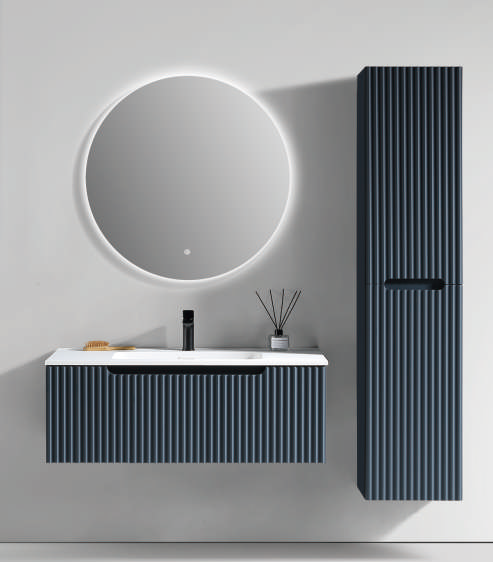
A stainless steel bathroom vanity is the primary defense against the costly cycle of water damage and mold liability that plagues wood-based fixtures in hospitality and multi-family properties. Traditional MDF or particleboard vanities inevitably fail in high-humidity environments, leading to delamination, swelling, and unsafe mold growth. For property managers and developers, this means unexpected replacement costs, unit downtime, and negative tenant reviews stemming from poor material choices.
This guide provides the technical specifications needed to make a sound procurement decision. We’ll compare the critical differences between Grade 304 and 201 steel to prevent rust spotting. We will also analyze construction methods like fully welded frames versus riveted assembly, which directly impacts long-term durability. We’ll cover sound-deadening techniques, finishing options like PVD, and a direct cost breakdown against solid wood vanities.
Why Stainless Steel? (Zero Formaldehyde, Zero Mold)
Stainless steel offers a fundamentally superior material for humid environments because its non-porous surface eliminates mold growth and its composition is free of the harmful formaldehyde found in engineered woods.
Hygienic and Health-Safe Properties
Stainless steel provides a non-porous surface that naturally prevents the growth of bacteria, mold, and mildew. This is a critical advantage in bathrooms, where hygiene is a constant concern. Unlike MDF or particle board, stainless steel contains zero formaldehyde or other volatile organic compounds (VOCs), which protects indoor air quality and makes it a safe choice for any residential or commercial project.
- The non-porous surface leaves no room for germs or grime to accumulate.
- Its composition is free of formaldehyde and VOCs.
- It is simple to clean and sanitize, supporting a healthier living space.
Unmatched Durability in Humid Environments
Wood-based vanities swell, warp, and degrade when exposed to constant moisture. Stainless steel fixtures are completely waterproof and maintain their structural integrity indefinitely. High-quality Grade 304 stainless steel delivers excellent corrosion resistance, giving the vanity a lifespan that often exceeds 20 years, even in the steamiest bathrooms. This durability translates directly to a lower total cost of ownership.
- The material is inherently resistant to rust and corrosion.
- It provides structural stability that wood cabinets cannot offer in wet conditions.
- Its extreme durability reduces the frequency and cost of replacements over time.
Sustainable and Eco-Friendly Choice
As a fully recyclable material, stainless steel meets modern demands for sustainable building practices. Its exceptional longevity means fewer resources are consumed for replacements, making it a responsible choice for eco-conscious projects. By specifying a material that fits into a circular economy, you minimize long-term landfill waste.
- Stainless steel is one of the most recycled materials globally.
- Choosing long-lasting fixtures minimizes the environmental impact of frequent replacements.
- Its production and recyclability contribute to a more sustainable building model.
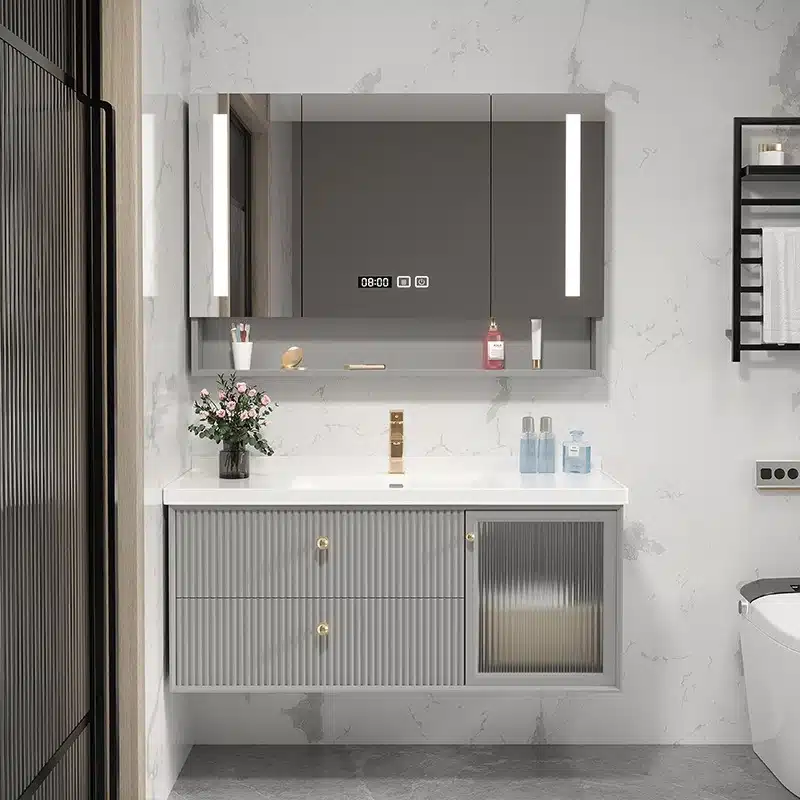
Grade 304 vs. 201: Avoiding Rust Spots
The choice between Grade 304 and 201 stainless steel is a direct trade-off between long-term corrosion resistance for humid environments and lower upfront material cost.
Grade 304: The Standard for Humid Environments
Grade 304 stainless steel is the established standard for high-moisture applications like bathrooms. Its higher nickel content (typically around 8%) provides superior corrosion resistance, which is critical for preventing rust spots and ensuring durability in fixtures constantly exposed to water and steam. This chemical makeup is why it dominates hygiene-critical products where rust prevention is non-negotiable. Premium manufacturers specify Grade 304 for bathroom fixtures to guarantee longevity and a pristine finish that lasts for decades.
| Attribute | Grade 304 (Recommended) | Grade 201 (Not Recommended) |
|---|---|---|
| Corrosion Resistance | High, due to significant nickel content. Forms a protective passive layer. | Low, as nickel is substituted with manganese, reducing rust defense. |
| Primary Use Case | Humid environments like bathrooms, kitchens, and coastal areas. | Dry, low-corrosion applications and budget-focused manufacturing. |
| Long-Term Outcome | Maintains finish and structural integrity for 20+ years. | Prone to developing rust spots and staining when exposed to moisture. |
Grade 201: A Cost-Driven Compromise
Grade 201 was developed as a budget-friendly alternative, substituting a significant portion of its nickel content with manganese to reduce material costs. While this makes it attractive for price-sensitive manufacturing, it severely compromises its defense against corrosion. This material simply lacks the necessary rust resistance for prolonged exposure to humidity, making it a poor choice for bathroom environments. The trade-off is clear: a lower upfront cost at the direct expense of durability and aesthetic longevity, often leading to premature rust spotting and customer complaints.
Create Standout Bathroom Cabinets for Your Market

Finishing Options: PVD Gold, Matte Black, Brushed
While brushed stainless steel remains the market standard for its practicality, Physical Vapor Deposition (PVD) technology provides a molecularly bonded color finish that offers superior scratch and chemical resistance for high-end applications.
Brushed Finishes: The Practical Standard
Brushed finishes are the dominant choice in the stainless steel vanity market, selected for their functional and aesthetic advantages. This finish is excellent at hiding water spots, smudges, and fingerprints, which makes it a low-maintenance solution for both residential and commercial high-traffic bathrooms. Its soft, non-reflective surface diffuses light, contributing to a clean, contemporary look that designers value for its versatility.
- Effectively conceals minor smudges and water marks, reducing visible upkeep.
- Offers a contemporary, non-reflective look that complements minimalist to industrial design styles.
- Specified by designers for its timeless appeal and ability to soften light reflection.
PVD Technology: For Superior Durability
Physical Vapor Deposition (PVD) represents the peak of finish durability and is the go-to process for premium colored stainless steel. Unlike a simple coating or paint that sits on top of the steel, PVD embeds color particles directly into the metal’s surface at a molecular level. This creates a finish that is exceptionally hard and highly resistant to scratching, tarnishing, and fading from cleaning agents or UV exposure.
- Creates a finish that is molecularly bonded to the stainless steel, so it will not chip or peel.
- Provides exceptional resistance to abrasion and damage from cleaning agents.
- Maintains its original look for years, even in demanding commercial environments.
Matte Black and PVD Gold: Niche Aesthetic Options
Matte black and PVD gold are emerging as specialized finishes for designers and property owners looking to create a distinct aesthetic. While less common than standard brushed steel, these options provide a bold statement for custom bathroom projects and high-end product lines. They cater to specific design trends, offering strong visual contrast or a touch of warmth and luxury that standard finishes cannot match.
- Matte black offers a modern, high-contrast aesthetic that pairs well with other materials.
- PVD gold provides a touch of luxury and warmth without the risk of tarnishing associated with traditional brass.
- These finishes are typically found in higher-end or custom product lines.
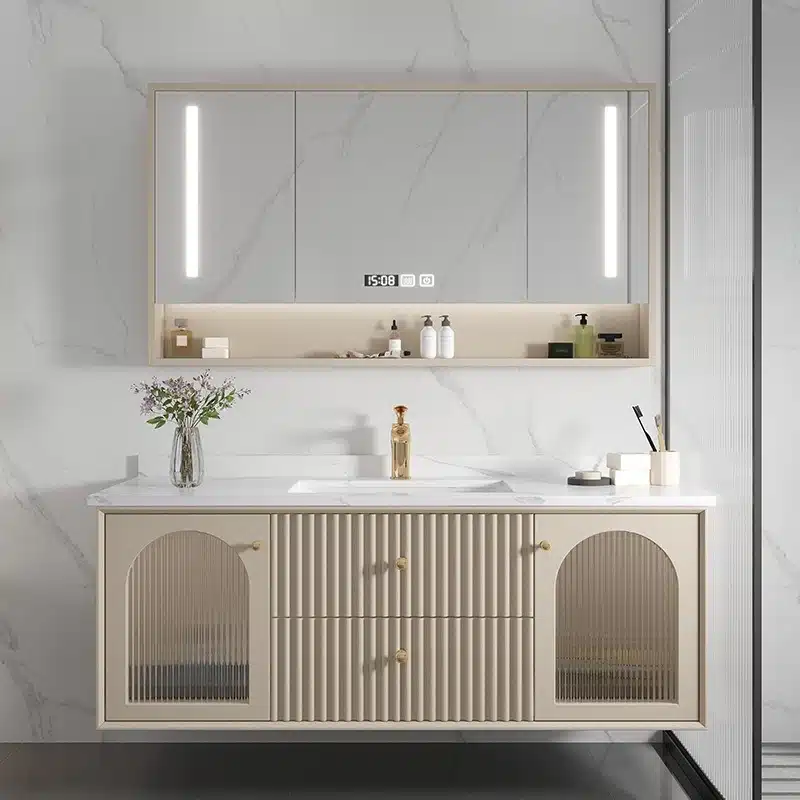
Sound Deadening: Preventing the “Tin Can” Sound
A cheap stainless steel vanity sounds hollow and metallic, but proper sound deadening uses multi-layered, self-adhesive materials to eliminate vibrations and create a solid, premium-feeling product.
The perceived quality of a metal cabinet is often determined by sound. An untreated stainless steel door closing creates a high-frequency, hollow “clang” that customers associate with low-cost manufacturing. Effective sound deadening, once a feature of high-end commercial kitchens, is now standard for premium bathroom vanities. It transforms the user experience from noisy and industrial to quiet and substantial.
Multi-Layered Dampening Materials
By 2026, sound deadening relies on a multi-layered strategy. This approach combines different materials to absorb a wide spectrum of sound frequencies, killing the unwanted noise. Effective solutions pair dense material pads, like mass-loaded vinyl, applied directly to the large, flat steel panels to stop vibrations. This is then supplemented with softer acoustic foam insulation inside the main cabinet structure to absorb any remaining ambient sound.
These materials are engineered for high performance in humid bathroom environments. They must be durable and completely resistant to moisture to prevent degradation or mold growth over the product’s lifespan, which is a significant upgrade from generic foam or rubber pads.
User-Friendly Installation
The industry has moved toward user-friendly, self-adhesive sound deadening materials. This change simplifies the manufacturing process by removing the need for complex surface preparation, specialized glues, or mechanical fasteners. The result is a direct reduction in factory labor costs and production time.
A peel-and-stick application allows for quick, consistent placement of the dampening pads every time. This improved consistency ensures that every vanity unit leaving the factory performs to the same acoustic standard, eliminating quality control issues and guaranteeing a quiet, solid product for the end customer.
Construction: Welding vs. RTA Rivets
Welded construction creates a permanent, seamless unibody for premium aesthetics, while riveted RTA designs prioritize lower shipping costs and assembly speed for volume-driven markets.
Welding: For Seamless and Permanent Joints
Welding is the preferred method for permanent structural and aesthetic applications in stainless steel vanities. It produces seamless, corrosion-resistant joints without visible fasteners, meeting modern design expectations for a clean, premium finish. The process fuses metal into a single, continuous piece, which eliminates gaps and crevices where water or grime could collect. This unibody construction is not only stronger but also more hygienic, making it the standard for luxury fixtures where a flawless appearance is a key selling point.
| Attribute | Welded Construction | RTA (Rivet) Construction |
|---|---|---|
| Joint Type | Permanent, seamless unibody | Mechanical, fastened with rivets |
| Aesthetics | Flawless, no visible fasteners | Visible rivet heads and panel lines |
| Logistics | Ships fully assembled (higher freight cost) | Flat-pack shipping (lower freight cost) |
| Ideal Market | Premium residential & hospitality projects | E-commerce, high-volume builders, budget projects |
RTA Rivets: For Assembly Speed and Cost-Effectiveness
Riveting remains a dominant method for high-volume, ready-to-assemble (RTA) products. This approach is valuable for cost-sensitive manufacturing and applications requiring tolerance for vibration during transport. Because it allows for flat-pack shipping, it can dramatically reduce logistics costs for wholesalers and e-commerce sellers. On-site assembly is simple and requires no specialized labor or equipment. While the final product has visible fasteners and seams, the lower manufacturing entry cost and shipping efficiency make riveting a practical choice for large-scale projects and price-sensitive product lines.
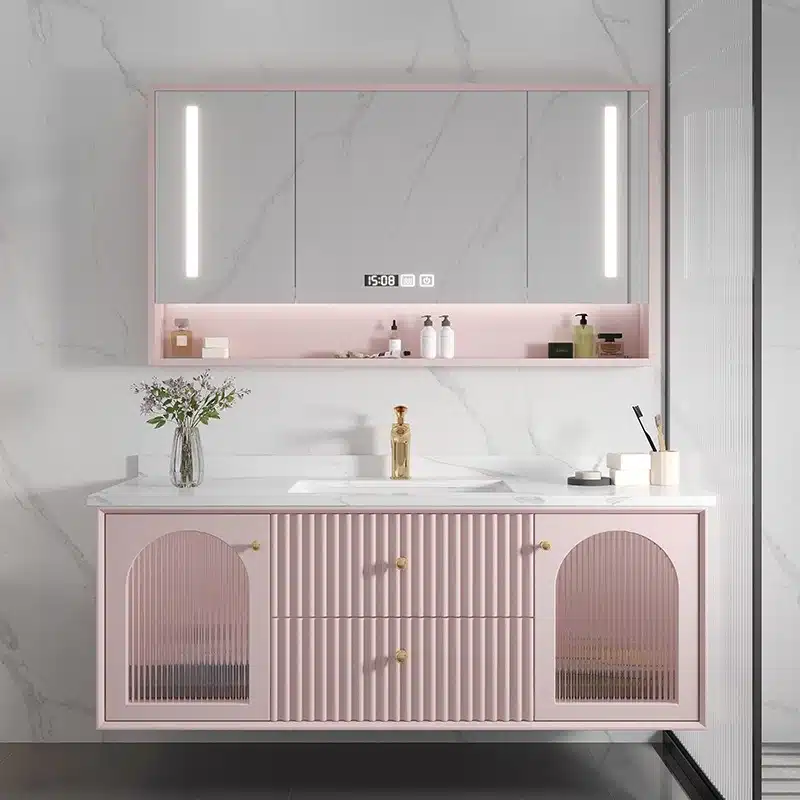
Cost Comparison vs. Solid Wood
Stainless steel offers a lower initial cost and superior moisture resistance, while solid wood commands a premium for its aesthetic warmth and long-term asset value in well-maintained bathrooms.
Stainless Steel: Upfront Affordability
Metal vanities consistently price lower than their solid wood counterparts. For projects where budget and moisture resilience are the primary drivers, stainless steel is the logical choice. In 2026, it remains a cost-effective material that delivers high performance against the constant humidity and water exposure found in bathrooms, preventing issues like rot or warping that affect wood-based products.
Solid Wood: A Premium Investment
Solid wood vanities occupy the mid-to-high end of the market, valued for their natural aesthetic and proven longevity. The final cost depends heavily on the wood species, with oak and walnut sitting at the premium end. A standard 36-inch solid wood vanity typically costs between $600 and $1,200. With proper maintenance in a well-ventilated space, it’s an asset that can last over 15 years, providing strong return on investment for owner-occupied properties.
| Feature | Stainless Steel | Solid Wood |
|---|---|---|
| Upfront Cost | Lower (Budget-to-Mid Range) | Higher (Mid-to-Premium Range) |
| Moisture Resistance | Excellent (inherently resistant) | Vulnerable (requires regular sealing) |
| Typical Lifespan | 20+ Years (Grade 304) | 15+ Years (with proper care) |
| Maintenance | Low (wipes clean, no sealing) | High (requires periodic resealing) |
Cleaning & Maintenance Selling Points
The real value of a stainless steel vanity isn’t just its look; it’s the minimal effort required to maintain that look over decades of use, a direct result of modern material science in finishes and coatings.
Fingerprint and Mark Resistance
A primary selling point for any stainless steel fixture is the industry’s shift away from polished surfaces toward brushed or satin finishes. These textured surfaces are specifically engineered to minimize the visibility of fingerprints, water spots, and smudges. This allows the vanity to maintain a clean, high-end appearance with significantly less daily wiping, a crucial benefit in both commercial and residential settings.
- Modern finishes like brushed steel diffuse light across the surface, making smudges and water marks far less obvious than on a reflective, polished finish.
- This feature directly reduces daily cleaning demands, a strong value proposition for busy households and high-traffic commercial properties.
- The vanity maintains its intended aesthetic without constant attention, looking new for longer.
Hygienic and Stain-Proof Surfaces
Stainless steel’s non-porous nature is fundamental to its hygienic properties, naturally resisting the growth of bacteria, mold, and mildew. In 2026, many premium vanities also feature advanced nano-particle coatings. These transparent layers create an impermeable barrier against common bathroom chemicals and cosmetics, preventing stains and making the surface exceptionally easy to sanitize.
- Seamless construction, often achieved through welding, leaves no grout lines or crevices where germs and mold can accumulate.
- Protective coatings ensure that spills from products like toothpaste, makeup, or cleaning agents don’t leave permanent marks.
- You can wipe the surface clean and disinfect it with simple solutions, avoiding the harsh chemicals that can damage wood or laminate.
Long-Term Value and Sustainability
The durability of stainless steel creates a powerful cost-benefit argument over the product’s lifecycle. With a lifespan that often exceeds 20 years, these vanities consistently outlast traditional wood or MDF alternatives that are vulnerable to moisture damage. This longevity, combined with the material’s recyclability, also resonates with environmentally conscious buyers and specifiers for green building projects.
- Properly specified Grade 304 steel resists rust, corrosion, and warping from humidity, ensuring it performs for years.
- This extreme longevity eliminates the material and labor costs of future replacements common with less durable materials.
- As a fully recyclable material, stainless steel supports sustainable building practices and contributes to a circular economy.
Conclusion
Stainless steel vanities offer a practical solution where wood and MDF often fail, providing complete immunity to water damage and mold. By choosing Grade 304 steel, welded construction, and proper sound deadening, you get a durable, quiet fixture that avoids rust and feels solid. With modern finishes like PVD gold or matte black, these cabinets fit high-end residential and commercial projects, not just industrial spaces.
If you are looking for a reliable, waterproof vanity for your product line or next project, we can customize stainless steel models to meet your specific design and budget requirements. Contact our team to discuss your project needs or order a sample to evaluate the material quality and construction firsthand.
Frequently Asked Questions
Do stainless steel vanities rust?
High-quality stainless steel, particularly grade 304, offers superior corrosion resistance and is not prone to rusting in a normal bathroom environment. Its composition includes chromium, which creates a passive, self-healing protective layer. While extremely harsh chemicals (like bleach or chlorides) or deep scratches can compromise this layer, for all practical purposes, a well-maintained stainless steel vanity will remain rust-free for its entire lifespan, which often exceeds 20 years.
Is metal vanity better than wood?
In a high-humidity environment like a bathroom, a stainless steel vanity is functionally superior to a wood vanity. Metal is non-porous, meaning it does not absorb moisture, which prevents the warping, swelling, and mold growth common with wood. Stainless steel is also more hygienic, easier to clean, and has a significantly longer lifespan. While wood offers a traditional aesthetic, stainless steel provides unmatched durability, health benefits (zero formaldehyde), and lower maintenance over the long term.
Cost of stainless steel bathroom cabinet?
Stainless steel bathroom cabinets are considered a premium product, and their initial cost is typically higher than standard MDF or particleboard vanities. Their price point is often comparable to or slightly above high-quality solid wood cabinets. However, the higher upfront investment is justified by their exceptional durability, resistance to water damage, and minimal maintenance needs, which translates to a lower total cost of ownership over their extended lifecycle.
How to clean stainless steel vanity?
Cleaning a stainless steel vanity is straightforward. For daily cleaning, use a soft microfiber cloth with warm water and a small amount of mild dish soap. Always wipe in the direction of the metal’s grain to avoid streaks and preserve its finish. For fingerprints or water spots, a specialized stainless steel cleaner can be used. Crucially, avoid abrasive materials like scouring pads, steel wool, or harsh chemicals like bleach, as they can permanently scratch the surface and damage its protective layer.
Modern industrial vanity ideas?
For a modern industrial look, focus on minimalist forms and mixed materials. Consider a wall-mounted stainless steel vanity with an integrated trough sink for a sleek, floating appearance. Pair the metal cabinet with a thick concrete or matte quartz countertop to create textural contrast. Complete the aesthetic with matte black faucets, exposed-bulb pendant lighting or integrated smart backlighting, and an open-shelf design below the countertop for a utilitarian, yet sophisticated, feel.
Are metal cabinets noisy?
Modern, high-quality stainless steel cabinets are engineered to be exceptionally quiet. Unlike lower-grade metal products, they are built with features to eliminate noise. These include integrated sound-dampening pads on interior surfaces, premium soft-close hinges and drawer slides, and a rigid, often double-walled construction. This combination ensures that doors and drawers close smoothly and silently, without the “tinny” or hollow sound you might expect from metal.
SEO
Title:
Description: .
URL: stainless-steel-bathroom-vanity
Keywords:




0 Comments