
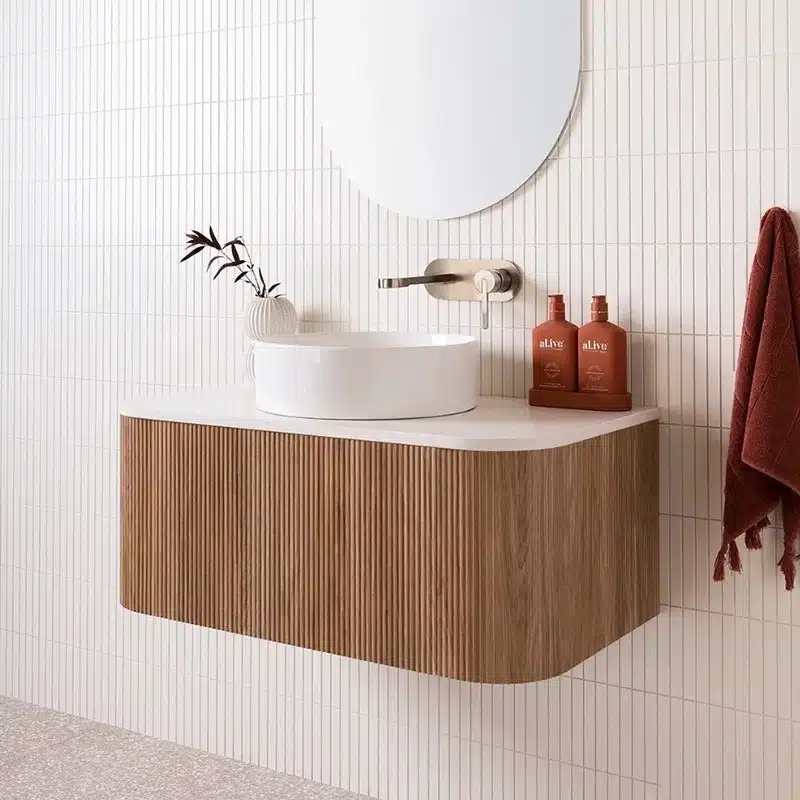
The wood vs. MDF bathroom vanity discussion is a core factor in managing container-load return rates and costly warranty claims. Sourcing the wrong material for a specific climate zone or finish type results in unsellable inventory, with customer complaints ranging from cracked paint at the joints to swollen door panels. This isn’t just a logistics problem; it’s a direct hit to your profit margins and your brand’s reputation among retailers and contractors.
This article serves as a technical procurement guide, moving past the marketing myths of “solid wood” to focus on material engineering. We’ll analyze MDF’s performance in high-humidity shower areas, establish why plywood is often the better choice for the vanity carcass, and explain the structural reasons MDF is superior for painted finishes while solid wood is mandatory for stains. Consider this your standard operating procedure for specifying vanities that last, minimizing warping risks and protecting your bottom line.
The “Solid Wood” Myth in Bathrooms
The traditional belief that solid wood is the premium choice for all furniture fails in high-humidity bathrooms, where engineered materials offer superior dimensional stability and moisture resistance.
Why Engineered Materials Outperform Wood in High Humidity
The long-held belief that solid wood is the ultimate material for furniture simply doesn’t apply to the unique environment of a bathroom. Constant moisture, steam, and temperature swings demand materials built for the job. High-quality engineered materials like well-sealed HMR MDF and water-resistant plywood are specifically designed to handle these conditions, offering superior performance where solid wood is weakest.
- Solid wood is naturally porous. It absorbs airborne moisture, which leads directly to swelling, warping, and potential microbial growth inside the cabinet over time.
- Engineered materials, including our PVC and moisture-resistant plywood, are manufactured to resist water penetration and maintain their structural integrity for years.
- A factory finish is critical. The consistent, durable barrier applied to engineered products provides a level of sealing that is nearly impossible to replicate with raw wood on a project site.
Dimensional Stability: The Unseen Advantage
Beyond direct water contact, daily temperature changes from hot showers cause solid wood to expand and contract. This constant movement puts stress on joints and finishes. Over time, this natural process leads to cracks in the paint and can compromise the vanity’s structural lifespan. Engineered wood is far more stable against these environmental shifts.
- Engineered wood is made using binders and cross-laminated layers that actively minimize the natural expansion and contraction cycle found in solid wood.
- This inherent stability prevents the joint separation and hairline finish cracks that commonly appear on solid wood vanities installed in bathrooms.
- The result is a cabinet that lasts longer and maintains its original look without needing frequent repairs or costly refinishing.
Shifting Market Perception: Performance Over Tradition
While solid wood provides a classic look, its performance limits in humid settings are driving a clear market shift. Distributors, contractors, and property developers now prioritize materials based on proven durability and long-term value. The traditional perception of wood’s automatic superiority is being replaced by evidence-based decision-making.
- Industry data shows a growing adoption of engineered alternatives, particularly for high-traffic commercial projects and hospitality applications where reliability is non-negotiable.
- Cost-effectiveness is a key factor. Engineered options consistently deliver better long-term performance and reliability at a more accessible price point.
- This evolution is a practical move toward selecting the right material for the specific application, challenging the outdated idea that “solid wood” is always the best answer.
MDF Performance in High Humidity (Shower Areas)
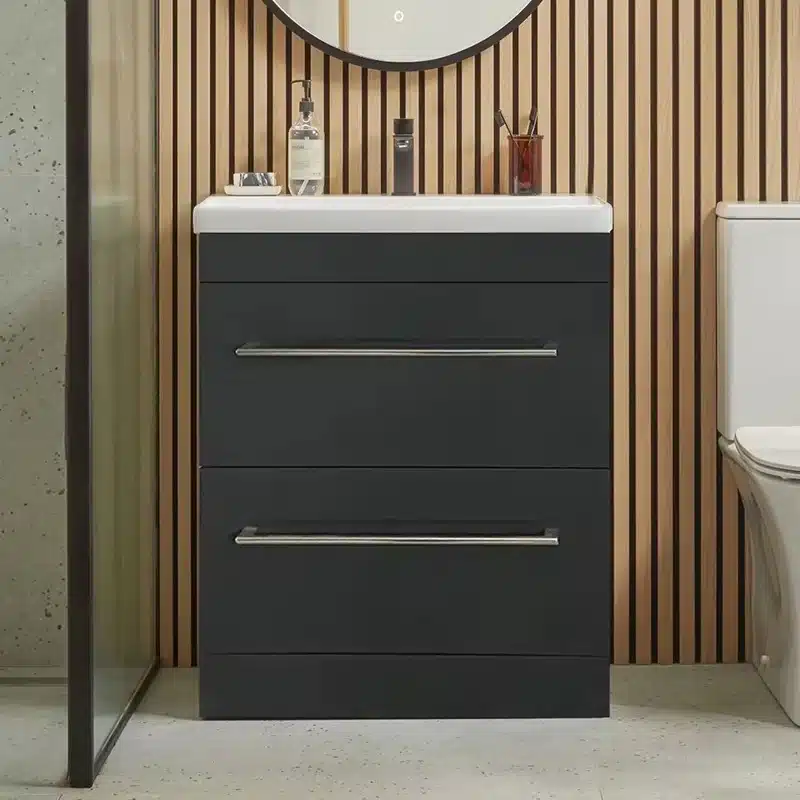
Modern moisture-resistant MDF (HMR) leverages integrated waterproof resins and optimized density to achieve a thickness swell rate below 8%, making it a reliable substrate for humid environments when properly sealed.
Advances in Material Composition
The performance of modern MDF in damp spaces is a direct result of advances in material science. Manufacturers now integrate waterproof resins directly with the wood fibers during production, creating a core that inherently blocks moisture penetration at a microscopic level. This is fundamentally different from simply applying a topical sealant. Additionally, panel density is carefully controlled within an optimal range of 700-750 kg/m³. This specific density provides structural integrity while minimizing the microscopic voids that can absorb airborne moisture and lead to swelling.
Key Performance Metric: Reduced Thickness Swell
The primary measure of an MDF panel’s fitness for bathroom use is its resistance to swelling. Standard MDF can expand by 15% or more when exposed to moisture, causing irreversible damage to finishes and joints. High Moisture Resistant (HMR) MDF is specifically engineered to keep this thickness expansion below 8%. This low swell rate is critical for long-term stability, ensuring cabinet doors remain flat and structural joints maintain their integrity even with regular exposure to steam from a shower.
| Performance Metric | Standard MDF | High Moisture Resistant (HMR) MDF |
|---|---|---|
| Thickness Swell Rate | > 15% | < 8% |
| Optimized Core Density | Approx. 600-680 kg/m³ | 700-750 kg/m³ |
| Primary Binder | Standard Resin | Integrated Waterproof Resin |
Market Positioning and Identification Standards
Moisture-resistant MDF provides a practical, cost-effective alternative to marine plywood for indoor applications with high ambient humidity. It is not intended for applications with direct, prolonged water contact, but it excels in bathroom cabinetry. For commercial projects or applications requiring a highly durable and hygienic surface, melamine-faced HMR panels are a common specification. To ensure quality control and easy identification, the industry widely uses a green dye in the core of the board. This visual cue confirms the panel is a moisture-resistant grade, preventing mix-ups on the factory floor or job site.
Boost Sales with Durable, Customizable Vanities

Plywood: The Gold Standard for Carcass?
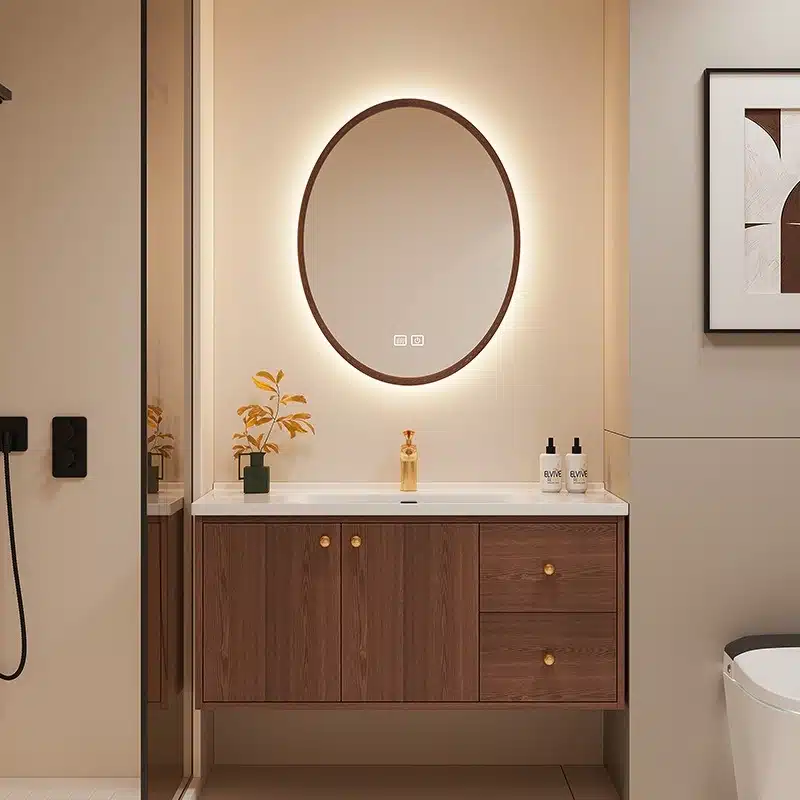
Plywood’s cross-grained structure offers superior dimensional stability and moisture resistance compared to solid wood and MDF, making it the professional’s choice for durable vanity carcasses in humid environments.
Dimensional Stability in Humid Environments
Plywood’s primary advantage is its structural resistance to humidity. The cross-grained construction, where thin layers of wood are bonded at alternating 90-degree angles, physically restricts the material’s ability to expand and contract. Unlike a solid wood board that moves freely with moisture changes, each layer in plywood counteracts the movement of the one next to it. This built-in tension prevents the warping and cracking cycles that compromise cabinet integrity in a bathroom setting.
- Maintains its shape and size despite fluctuations in moisture and temperature.
- Ensures cabinet doors and drawers remain aligned and functional over time.
Moisture Resistance Compared to MDF
While High Moisture Resistant (HMR) MDF performs well, it remains vulnerable if its protective finish is compromised. A deep scratch or unsealed edge can allow water to penetrate the core, causing it to swell and delaminate like a sponge. Plywood offers a higher degree of water tolerance. Its layered wood veneer and waterproof adhesive construction slow down water absorption significantly. In the event of a minor leak or surface damage, plywood is far less likely to swell and disintegrate, providing a more resilient and repairable foundation for the entire vanity.
- Plywood does not easily swell or disintegrate upon prolonged exposure to dampness.
- It provides a more durable foundation in areas prone to splashes or leaks.
A Balance of Durability and Cost
For commercial buyers and project specifiers, plywood represents the optimal balance of performance and value. It delivers the moisture-resistant durability required for bathroom furniture without the premium cost and climate instability associated with solid wood. This makes it the industry standard for building reliable vanity carcasses. Choosing plywood results in a product with a longer service life and fewer warranty claims related to moisture damage, securing a better return on investment for any project.
- Offers long-term performance and repairability at a reasonable price point.
- Provides a strong, reliable material for constructing vanity carcasses that are built to last.
Painted Finishes: Why MDF Wins
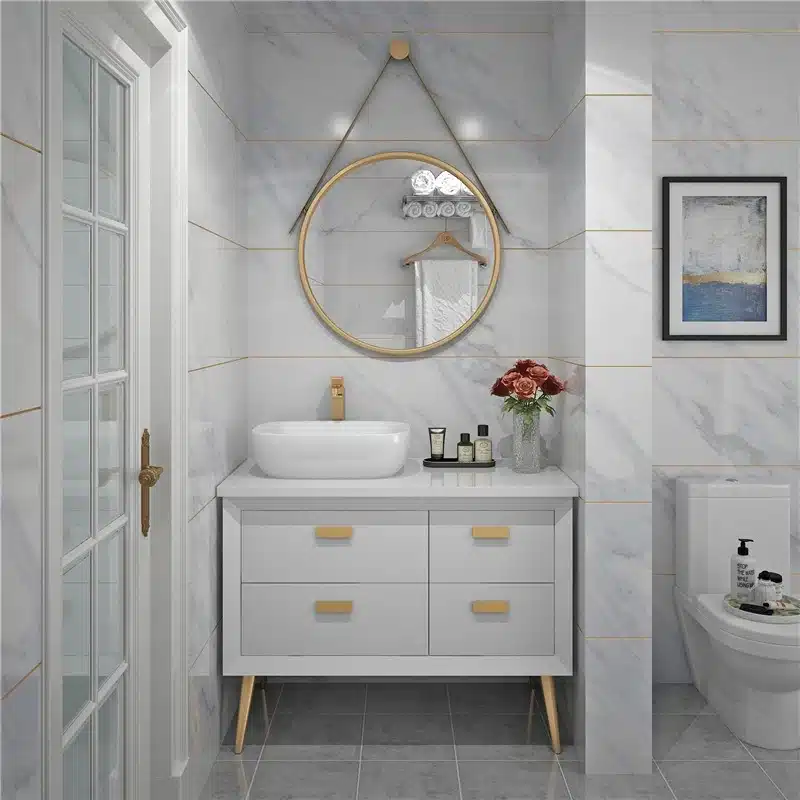
MDF is the preferred substrate for painted vanities because its perfectly uniform, grain-free surface guarantees a flawless finish that solid wood’s natural movement cannot consistently achieve.
Superior Surface for Paint Application
The primary advantage of Medium-Density Fiberboard (MDF) is its engineered composition. It provides a completely smooth, non-porous surface that is free from the grain, knots, and imperfections inherent in solid wood. This uniformity creates an ideal canvas for paint, allowing for an even application that results in a flawless, monolithic finish without extensive surface preparation. Solid wood, by contrast, requires significant priming and sanding to mask its natural grain, which can still telegraph through the paint over time.
- Eliminates natural wood grain variations that can show through paint.
- Requires less primer and fewer finishing coats to achieve a uniform appearance.
| Characteristic | HMR MDF Substrate | Solid Wood Substrate |
|---|---|---|
| Surface Finish | Perfectly smooth and consistent, no grain. | Natural grain texture can show through the finish. |
| Joint Stability | Single-panel construction eliminates joints and cracking risk. | Joints expand and contract, causing hairline paint cracks. |
| Preparation Workload | Minimal priming needed for a flawless, uniform coat. | Requires heavy grain filler and primer to achieve smoothness. |
| Ideal Application | High-gloss, satin, and matte solid-color finishes. | Stained finishes designed to highlight natural wood grain. |
Consistency for Modern and Minimalist Designs
The flawless surface of MDF is critical for achieving the clean lines and solid colors that define modern and minimalist aesthetics. It ensures that the final product looks precisely as designed, with absolute color consistency across all components. This predictability is something solid wood cannot offer. The very nature of wood means grain patterns and tones will vary from one door to the next, disrupting the clean, uniform appearance required by contemporary design languages.
- Perfect for high-gloss, satin, or matte painted finishes popular in contemporary bathrooms.
- Guarantees that doors, drawers, and panels match perfectly in color and texture.
Dimensional Stability and Affordability
High Moisture-Resistant (HMR) MDF is more dimensionally stable than solid wood in environments with fluctuating humidity. Solid wood naturally expands and contracts as it absorbs and releases moisture. In a cabinet door made of multiple wood pieces, this movement occurs in different directions, creating stress at the joints. Since paint is inflexible, it can’t stretch with the wood, leading to hairline cracks along the joint lines. Because MDF is a single, stable panel, it has no joints to fail, protecting the integrity of the painted finish. This stability, combined with its lower cost, makes MDF a more reliable and affordable choice for achieving a premium painted look.
- Provides a premium painted look at a more accessible price point.
- Resists minor fluctuations in temperature and humidity, protecting the integrity of the painted finish.
Stained Finishes: Where Wood is Mandatory
For finishes that enhance natural beauty rather than conceal it, solid wood is the only viable material; engineered substrates like MDF lack the organic grain required for a true stained effect.
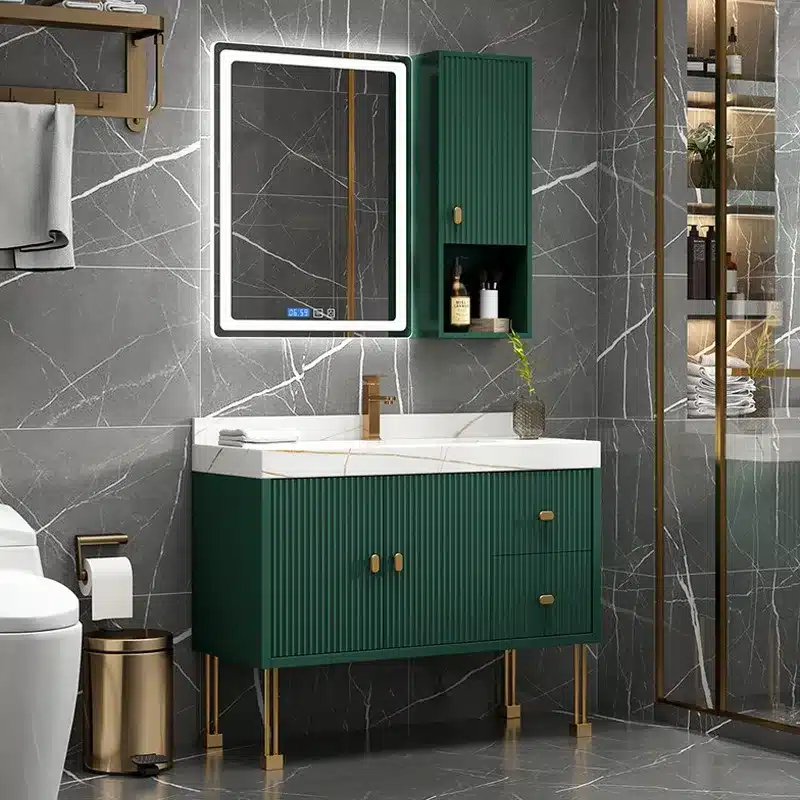
Preserving Natural Wood Grain
The primary function of a stain is to celebrate, not cover, the material it’s applied to. It penetrates the wood to highlight the unique, organic patterns inherent in each piece. This process creates a visual depth and character that an opaque paint finish can never replicate, adding a sense of warmth and authenticity to bathroom furniture. Because materials like MDF and HDF are engineered from wood fibers, they have no natural grain structure, making them fundamentally incompatible with traditional staining techniques. Attempting to stain them results in a flat, blotchy appearance that fails to mimic genuine wood.
Tonal Flexibility and Appearance
Solid wood offers extensive customization through a wide spectrum of stain colors, from light, natural tones to deep, rich shades. Unlike paint, which forms a solid film on the surface, stain is absorbed directly into the wood fibers. This colors the wood from within while allowing its natural texture and grain to remain prominent. This characteristic gives designers the flexibility to match specific aesthetic goals for a project without sacrificing the authentic look and feel of real wood.
Durability and Sealing
A common misconception is that stained wood is unsuitable for humid bathroom environments. Performance isn’t determined by the stain itself, but by the protective topcoat applied over it. A high-quality polyurethane or lacquer sealant creates an impermeable barrier that blocks moisture absorption, preventing the wood from warping, swelling, or degrading. This layered finishing system effectively protects the wood from humidity and splashes while preserving its natural aesthetic for years of reliable service.
Repair and Maintenance
Stained wood surfaces provide a significant long-term maintenance advantage. Minor damage, such as small scratches or scuffs, can often be repaired locally. The affected area can be lightly sanded and new stain blended in, followed by a new layer of topcoat. This is far more practical than repairing a painted finish, where achieving a perfect color and sheen match for a spot repair is extremely difficult. This superior repairability makes stained wood a more resilient and cost-effective choice over the full lifecycle of the vanity.
Warping & Cracking Risks by Climate
The long-term stability of any bathroom cabinet, whether solid wood or MDF, is less about the core material and more about the quality of the protective finish shielding it from humidity.
Solid Wood: Expansion and Contraction in Humid Zones
By 2026, the primary challenge for solid wood in bathrooms remains its natural tendency to expand and contract with humidity fluctuations. This movement can stress joints, leading to cracks and warping, especially in regions with pronounced wet and dry seasons. Solid wood constantly absorbs and releases atmospheric moisture, causing it to change size. If the protective sealing is insufficient, moisture can penetrate the wood and accelerate the risk of structural failure.
MDF: Swelling Risks When Surface Protection Fails
MDF offers excellent dimensional stability, meaning it doesn’t warp from humidity changes like solid wood. Its main vulnerability is swelling if the protective paint or laminate layer is scratched or chipped, allowing moisture to reach the absorbent core. The integrity of the surface finish is the single most critical factor in protecting the MDF. Once swollen, MDF does not return to its original shape, and the damage is often permanent.
| Material | Primary Climate-Related Risk | Failure Mechanism |
|---|---|---|
| Solid Wood | Warping & Cracking | Natural expansion and contraction with humidity changes causes stress at joints and panels. |
| High Moisture-Resistant MDF | Localized Swelling | Moisture penetrates the core through a scratch or chip in the protective surface finish, causing permanent damage. |
The Role of Protective Finishes in Climate Resilience
The resilience of any bathroom cabinet material is largely determined by its finish. Premium UV-cured and moisture-resistant coatings are the industry standard for creating an impermeable barrier against humidity for both solid wood and MDF. Advanced coatings prevent moisture from penetrating the base material, ensuring long-term stability. Hybrid cabinets, which use wood veneers over stable substrates like plywood or MDF, depend entirely on these finishes for durability.
Cost Comparison per Container
The per-unit material cost directly dictates container value, forcing a strategic choice between maximizing unit volume with MDF or investing in long-term durability with plywood and solid wood.
When purchasing bathroom vanities by the container, the material choice is the primary variable controlling both upfront investment and market positioning. Each tier—budget, mid-range, and premium—serves a distinct business strategy, from high-volume retail to high-end project specification. Understanding these cost structures is critical for aligning inventory with target customer expectations and local climate demands.
Budget-Tier Containers: Maximizing Volume with MDF
MDF and particle board are the most affordable raw materials, which directly lowers the ex-factory price per vanity. This allows distributors to maximize the number of units loaded into a single container, reducing the cost-per-door and satisfying entry-level markets where price is the main purchasing driver. Its lower weight compared to solid wood can also yield modest savings on freight. This tier is engineered for large-scale developments, rental properties, and retail lines where initial cost efficiency is paramount.
Mid-Range Shipments: Plywood’s Cost-to-Durability Balance
Plywood occupies the commercial sweet spot between budget MDF and premium solid wood. It provides a robust, moisture-resistant vanity carcass without the significant price increase associated with solid lumber. For distributors, this material strikes an ideal balance between per-unit cost and long-term performance, appealing to a broad customer base. Ordering plywood vanities allows a business to offer a clear and justifiable upgrade in quality over MDF while still managing the total container cost effectively.
Premium-Tier Containers: The Higher Investment of Solid Wood
Solid wood vanities represent the highest cost per unit, which translates into a significantly larger capital outlay for a full container. The price is driven by the cost of raw timber and the skilled craftsmanship required for assembly and finishing. This investment targets luxury markets—high-end residential, boutique hotels, and custom projects—where material authenticity, longevity, and perceived value justify the premium price point. Distributors catering to this segment are investing in product durability and a top-tier market position.
Calculating Value Beyond Initial Container Cost
A successful purchasing strategy looks beyond the initial invoice. The material choice shapes market perception and post-sale satisfaction. While MDF significantly lowers the barrier to entry, its performance in consistently humid climates must be managed with proper sealing and ventilation to protect product lifespan and brand reputation. Conversely, the high upfront cost of solid wood is often balanced by its superior durability and lower risk of call-backs or warranty claims. Distributors must weigh the immediate savings against the long-term performance of the product in their specific sales region.
Conclusion
Choosing the right vanity material goes beyond the common “solid wood is best” myth. For painted finishes, High Moisture Resistant MDF delivers a stable, crack-free surface that solid wood cannot guarantee in humid environments. Matching the right material—be it MDF, plywood, or solid wood—to the specific finish and climate ensures long-term product performance and customer satisfaction.
Our team can help you engineer the right combination of materials to meet your target market’s expectations and budget. Contact us to discuss your product line requirements or to order a refundable sample to evaluate our craftsmanship.
Frequently Asked Questions
Will MDF swell in a steamy bathroom?
Raw, unsealed MDF will absorb moisture and swell. However, modern bathroom vanities use high-quality, furniture-grade MDF that is sealed with multiple layers of moisture-resistant primers, paints, or laminates. A well-sealed MDF product is specifically engineered for high-humidity environments and offers superior performance by resisting the dimensional changes that can affect other materials. The key factor is the quality of the factory seal.
Is plywood better than solid wood for vanity boxes?
Yes, for the vanity box (the cabinet carcass), plywood is structurally superior to solid wood. Plywood is an engineered wood product constructed from multiple cross-laminated layers, which gives it exceptional dimensional stability. This structure makes it highly resistant to warping, shrinking, and expanding with the temperature and humidity fluctuations common in a bathroom, ensuring the cabinet remains square and durable over time.
Why do painted solid wood doors crack at joints?
Solid wood naturally expands and contracts with changes in humidity and temperature. A cabinet door is typically constructed from multiple pieces of wood (stiles, rails, and a center panel). Each piece moves slightly at its own rate. The hard, inflexible paint finish cannot stretch to accommodate this microscopic movement, which causes hairline cracks to appear at the joints. This is a normal characteristic of painted solid wood and is not considered a structural defect.
What is the difference between HDF and MDF?
The primary difference is density. HDF (High-Density Fiberboard) is produced under greater pressure and heat than MDF (Medium-Density Fiberboard), creating a panel that is harder, stronger, and more resistant to moisture and impact. MDF has a very smooth surface that is ideal for painted finishes. HDF’s superior durability makes it a premium choice for components that face higher wear, such as high-traffic cabinet doors or laminate flooring cores.
How to identify “furniture grade” plywood?
“Furniture grade” plywood is identified by three key features. First, it has a high-quality face veneer, typically graded ‘A’ or ‘B’, which provides a smooth, clean surface with minimal defects. Second, it features a multi-ply, void-free core, meaning there are no gaps between the internal layers, ensuring strength and stability. Third, it uses interior-grade adhesives that are safe for indoor use. When inspecting, look for smooth surfaces and solid, layered edges.
Does “solid wood” include the side panels?
In the cabinet industry, “solid wood” typically refers to the doors, drawer fronts, and face frame of the vanity. The large side and back panels of the cabinet box are almost always made from furniture-grade plywood with a matching real wood veneer. This is a superior construction technique, not a cost-cutting measure. Large panels of solid wood would be highly prone to warping and cracking in a bathroom’s humid environment, whereas plywood provides essential dimensional stability.




0 Comments