
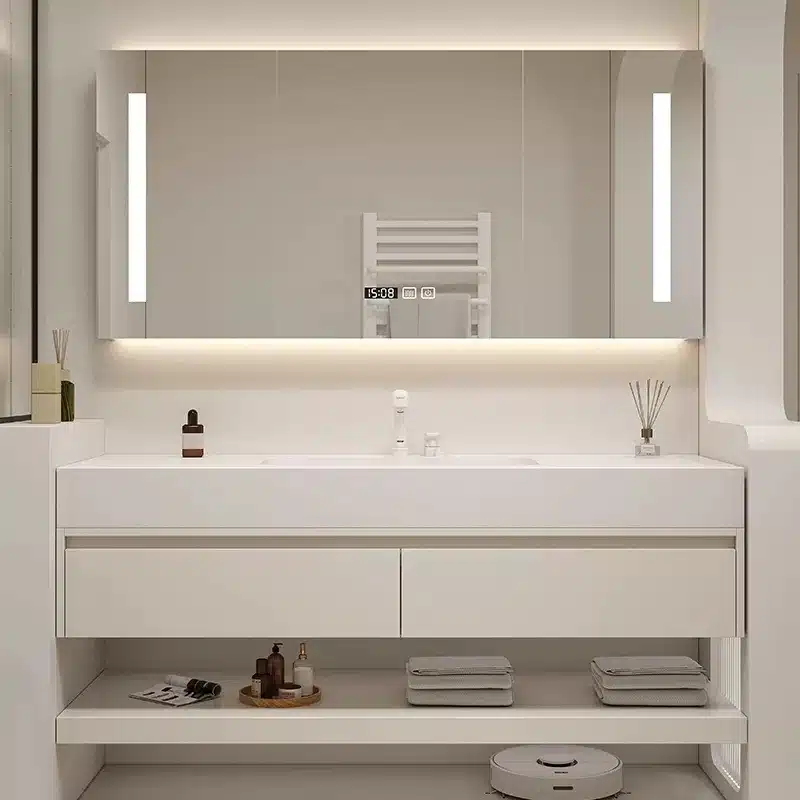
 An improperly specified Natural White Oak bathroom vanity is the main driver of premature failure from moisture, leading to costly project callbacks and irreversible client dissatisfaction. The visual subtleties between red oak and white oak are often missed, yet their structural differences in water resistance are significant. Misunderstanding these material properties—or the trade-offs between solid wood and veneer—can compromise an entire project, turning a high-end design feature into a maintenance liability.
This guide serves as a technical specification manual for using white oak in demanding environments. We will provide clear criteria for distinguishing white oak from red oak and explain the performance differences between solid and veneered construction. We will also detail fabrication details like slip vs. book matching, proper sealing techniques for raw wood, and how to maintain the material’s integrity when paired with stone or concrete.
What Is “Organic Modern”?
Organic Modern is a direct market response to consumer demand for sustainable, natural materials that add warmth to contemporary design without sacrificing clean, minimalist lines.
Historical Origins and Evolution
The style’s foundation comes from architect Frank Lloyd Wright’s early 20th-century philosophy of organic building. It emerged as a necessary alternative to the cold, industrial materials like steel and concrete that defined Bauhaus-era Modernism, answering a demand for more warmth in residential spaces. After a decline mid-century, it has resurged as consumers increasingly prioritize sustainability and push back against mass-produced goods.
- Traces its principles back to Frank Lloyd Wright’s architectural philosophy.
- Developed as a warmer, more textural counterpoint to the stark functionalism of Bauhaus interiors.
- Regained popularity in recent years, driven by a market shift toward natural, sustainable materials.
Key Characteristics
Organic Modern design blends minimalist forms with elements from mid-century and bohemian styles to create refined, textural spaces. The focus is on natural and sustainable materials, clean lines, and softer, curved forms. It pulls heavily from Scandinavian and Japanese design, balancing functionality with comfort to achieve a look that feels both sophisticated and genuinely lived-in.
- Integrates clean, minimalist shapes with materials that are natural, renewable, or recycled.
- Uses a mix of textures and curved silhouettes to introduce warmth and visual interest.
- Draws on Scandinavian and Japanese design concepts that prioritize both practical function and user comfort.
White vs. Red Oak: What Is the Difference?
White oak’s water-tight cellular structure makes it a premium, rot-resistant material for demanding applications, while red oak’s open grain positions it as a cost-effective standard for interior use.
Botanical Structure and Durability
The fundamental difference between these two hardwoods lies in their cellular structure. White oak contains balloon-like growths called tyloses that plug its pores, making the wood naturally water-tight and highly resistant to rot. This is why it has been the standard for boatbuilding and whiskey barrels for centuries. Red oak lacks these tyloses, leaving its grain open and far more susceptible to moisture if not properly sealed. This open-pored structure means it absorbs liquids readily, making it better suited for controlled interior environments.
| Feature | White Oak | Red Oak |
|---|---|---|
| Cellular Structure | Closed-pore (contains tyloses) | Open-pore (lacks tyloses) |
| Water Resistance | High; naturally water-tight and rot-resistant | Low; readily absorbs moisture if unsealed |
| Primary Application | High-moisture interiors, exterior furniture, cooperage | Interior cabinetry, flooring, general furniture |
| Market Price Point | Premium | Standard / Cost-Effective |
Market Applications and Cost
These structural differences directly influence how each wood is used and priced in the market. White oak’s superior durability makes it the material of choice for demanding applications, commanding a higher price. Red oak grows faster and is more abundant, positioning it as the cost-effective industry standard for indoor furniture, cabinetry, and flooring across North America. Choosing the correct species is not just an aesthetic decision; it’s a critical technical specification that determines long-term performance and value.
Unlock Your Region’s Market Potential

What Is the “Invisible Finish”?
An invisible finish is a transparent, matte protective coating that preserves the natural look and feel of wood while shielding it from moisture and stains, a key requirement for minimalist and organic modern designs.
Preserving Natural Aesthetics Without Sacrificing Protection
The “invisible finish” refers to a protective coating engineered to be as unnoticeable as possible. The goal is to maintain the raw, natural appearance and texture of wood, particularly white oak, while shielding it from moisture, humidity, and dirt. This modern approach avoids the glossy, plastic-like sheen of traditional varnishes, which directly supports the clean lines and material focus of organic and minimalist bathroom designs.
- It keeps the authentic texture and color of the wood visible and tactile.
- The finish provides crucial resistance to the humidity and stains common in bathrooms.
- It supports a modern aesthetic where natural materials are the central focus.
Common Types of Transparent Coatings
Achieving this raw-wood effect requires advanced sealants that deliver durability without adding sheen or altering the wood’s original color. These modern formulations are often water-based and developed with sustainability in mind, prioritizing both performance and environmental safety. The market has shifted toward these solutions to meet the demand for authentic, protected wood surfaces.
- Water-based polycrylics and polymers are popular for their clarity and minimal impact on the wood’s original tone.
- Dead-flat or matte-sheen sealants are specified to eliminate reflections, making the coating virtually undetectable to the eye.
- Manufacturers increasingly use low-VOC (Volatile Organic Compound) formulas to ensure better indoor air quality and more eco-friendly production.
Solid Wood vs. Veneer: Which Is Better for Oak?
The choice between solid oak and veneer is not about which is ‘better,’ but which is engineered for the specific application—solid wood for high-wear surfaces and veneer for its superior dimensional stability in cabinetry.
Application and Performance
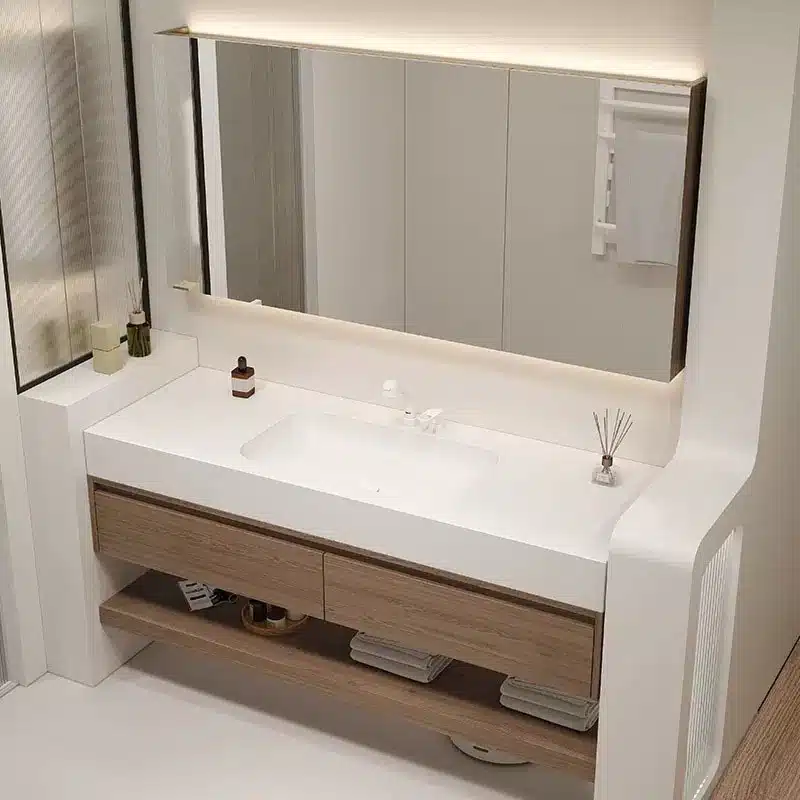
The debate has matured beyond a simple quality comparison. The right material is determined by its intended function and environment. Solid oak remains the standard for projects where durability and the option to refinish are critical, such as tabletops or stair treads. Veneer, on the other hand, is the superior choice for large-scale installations like cabinetry, wall panels, and built-ins where dimensional stability is paramount.
- Solid oak is specified for high-wear applications that anticipate heavy use and may require sanding and refinishing over decades.
- Veneer bonded to an engineered core (like HMR MDF or plywood) provides excellent stability, making it far less susceptible to the warping and cracking that can affect solid wood in environments with fluctuating humidity.
| Attribute | Solid Oak | Oak Veneer (Engineered Core) |
|---|---|---|
| Best Use Case | High-wear surfaces, furniture, structural components that require future refinishing. | Large panels, cabinet doors, built-ins, and wall paneling. |
| Dimensional Stability | Susceptible to expansion, contraction, and warping with humidity changes. | Highly stable; engineered core minimizes movement and warping. |
| Refinishing Potential | Can be sanded and refinished multiple times over its lifespan. | Limited to none; depends on veneer thickness (thick veneers may allow one light sanding). |
| Cost & Yield | Higher material cost and lower yield from the log. | More cost-effective with higher material efficiency. |
Cost and Material Stability
As solid oak prices continue to rise, veneer has become a more practical and economically viable option for many projects. It delivers the aesthetic of premium oak at a lower material cost while offering performance advantages. The market now offers tiered solutions based on project needs.
- Premium thick-veneers (5mm or more) offer a hybrid solution, combining the substantial feel of solid wood with the stability and cost-efficiency of an engineered product.
- Standard thin veneers maximize material yield, making them an environmentally conscious and highly consistent choice for product lines where uniform appearance is essential.
Slip vs. Book Match: What Is the Difference?
The choice between veneer matching techniques is a critical manufacturing decision, balancing the artistic symmetry of book matching against the production efficiency and uniformity of slip matching.
When working with wood veneers, especially on large surfaces like vanity doors or side panels, the way individual slices are joined together dramatically impacts the final look. The two dominant industry methods, book matching and slip matching, offer distinct aesthetic and production outcomes. Understanding this difference is key to specifying the right product for your project’s budget and design intent.
What Is Book Matching?
Book matching is a technique where two adjoining veneer slices are opened like a book, creating a mirrored, symmetrical grain pattern. This method is the standard for high-end furniture and cabinetry because it produces a visually striking and intentional effect, turning the natural wood grain into an artistic feature.
- Creates a perfectly mirrored, symmetrical image.
- Ideal for creating a focal point on premium vanities or cabinetry.
- Requires skilled craftsmanship and careful material selection to achieve a seamless match.
What Is Slip Matching?
Slip matching involves laying veneer slices side-by-side in the same orientation without flipping them. This approach results in a more uniform, repeating grain pattern that is less dramatic than book matching. Its primary advantage is efficiency, making it the preferred method for large-scale or commercial projects where consistency is valued over artistry.
- Produces a continuous and uniform grain flow across a surface.
- Minimizes material waste and is more cost-effective for production runs.
- Can sometimes create slight color or light reflection shifts between adjacent sheets.
| Feature | Book Matching | Slip Matching |
|---|---|---|
| Grain Pattern | Mirrored, symmetrical, and artistic. | Repeating, uniform, and continuous. |
| Best Use Case | High-end statement pieces where aesthetics are the top priority. | Large surfaces or commercial projects requiring consistency. |
| Cost & Waste | Higher cost due to skilled labor and material selection. | More cost-effective with minimal material waste. |
Key Differences in Application
The decision between book matching and slip matching comes down to project goals. Book matching is specified for its sophisticated, high-end appearance, making it the default for bespoke furniture and luxury interiors. Slip matching is valued for its practicality and efficiency, making it the workhorse of commercial applications where budget and material yield are primary concerns.
- Choose book matching for statement pieces where the grain pattern itself is a design element.
- Choose slip matching for large runs of cabinetry or wall paneling where grain consistency and cost-efficiency are critical.
How to Pair with Concrete or Marble?
Pairing a white oak vanity with concrete or marble creates a balanced design by combining the wood’s natural warmth with the cool, sophisticated texture of stone or industrial surfaces.
Marble Pairings
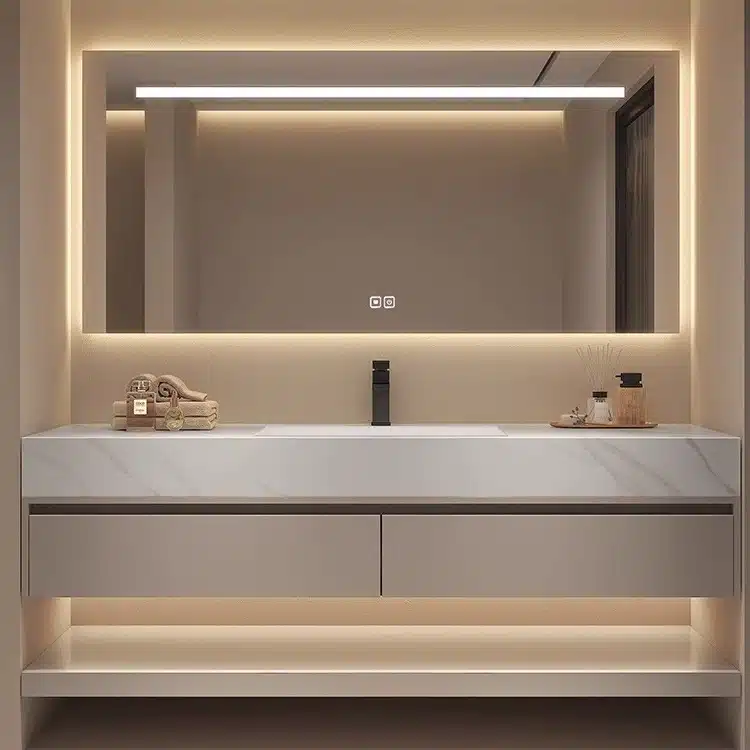
Marble brings a classic, sophisticated look when paired with a white oak base. The contrast between the warm wood and the cool stone creates immediate visual interest, and the unique veining in each marble slab ensures a one-of-a-kind countertop. To enhance the effect, use layered lighting like wall sconces or a backlit mirror to accentuate the stone’s natural patterns. In high-moisture environments like steam showers, remember that marble is a natural stone and requires regular sealing to protect it from impurities and maintain its integrity.
Concrete Pairings
For a more modern, industrial aesthetic, concrete countertops are a natural fit for white oak vanities. This combination blends the organic character of the wood grain with the clean, minimalist appeal of concrete. The resulting look is balanced and highly versatile, working well in both contemporary and more traditional bathroom designs without feeling out of place.
Key Design Considerations
To ensure a cohesive design, the details matter. Both marble and concrete pairings work best when the vanity base and its hardware are selected to complement the countertop material.
- Lighter, natural finishes on the oak vanity are most effective at highlighting the wood’s inherent grain and texture.
- Hardware finishes, such as matte black or brushed brass, should be chosen to coordinate with both the wood and the countertop for a unified look.
How to Maintain Natural Wood?
Effective maintenance for natural wood vanities relies on a consistent schedule of preventative care, focusing on gentle cleaning and strict moisture control to preserve the factory finish and extend the product’s lifespan.
Routine Cleaning and Preventative Care
Preserving the integrity of a natural wood vanity requires consistent, gentle cleaning and proactive care. The industry standard is to use non-abrasive, pH-neutral cleaning solutions that protect the wood’s sealant without stripping or damaging it. A disciplined maintenance schedule prevents the buildup of residue from soap and hard water, which can degrade the finish over time.
- Perform weekly dusting with a soft, dry microfiber cloth to remove surface particles before they become abrasive.
- For cleaning, use a damp cloth with a mild, pH-neutral solution. Avoid harsh chemicals, vinegar, or abrasive cleaners entirely.
- Conduct annual polishing with a high-quality wood care product to nourish the wood and reinforce its protective layer.
Moisture and Humidity Management
Humidity is the primary threat to any wood product in a bathroom. Managing it involves a combination of physical barriers and environmental control. A high-quality, factory-applied moisture-resistant sealant provides the first line of defense, but proper bathroom ventilation is critical to minimize ambient moisture that causes wood to warp, swell, or delaminate.
- Ensure the bathroom has adequate ventilation and use an exhaust fan during and after showers to control humidity levels.
- Regularly inspect the vanity’s sealant for any wear or gaps, paying close attention to the areas around the basin and faucets where water contact is highest.
- Wipe away all water splashes immediately with a dry cloth. Preventing moisture from sitting on the surface is the single most effective maintenance habit.
Conclusion
Achieving the clean, warm aesthetic of Organic Modern and Japandi styles is rooted in precise material specification. Choosing between white and red oak, solid wood and veneer, or rift and plain sawn cuts directly impacts the final look and durability. These details are what separate a premium, contemporary vanity from the dated oak cabinets of the past.
If you are ready to add a natural wood collection to your catalog, our team can help you specify the right materials. Contact us to discuss your project requirements or to order a refundable sample and see the quality firsthand.
Frequently Asked Questions
Is white oak good for bathroom vanity?
Yes, white oak is an excellent choice for a bathroom vanity. As a dense, closed-grain hardwood, it is naturally more resistant to water, rot, and decay than open-grained woods like red oak. Its tight grain structure minimizes moisture absorption, making it highly durable for a humid environment. For maximum longevity, it must be sealed with a high-quality waterproof finish, such as a marine-grade varnish or multiple coats of polyurethane. Aesthetically, its clean, linear grain and neutral tone align perfectly with modern, Japandi, and organic design styles.
How to seal raw wood vanity?
Properly sealing a raw wood vanity for a bathroom involves a multi-step process. First, sand the wood smooth, progressing from 120-grit to 220-grit sandpaper, and then thoroughly remove all dust. Next, apply a protective finish designed for high-moisture environments. The best options are oil-based polyurethane or a marine spar varnish, which offer superior water resistance and durability. Apply 3-4 thin, even coats with a high-quality brush, allowing each coat to dry completely and lightly sanding with 320-grit paper between coats. This ensures a hard, protective shell that prevents moisture penetration and is easy to clean.
Rift sawn vs plain sawn oak?
The primary differences are grain appearance, stability, and cost. Plain sawn (or flat sawn) is the most common and affordable method, producing a varied “cathedral” grain pattern. However, it is the least dimensionally stable and more prone to cupping. Rift sawn is a premium milling technique where boards are cut radially, resulting in a remarkably straight, linear, and uniform grain. This method produces the most stable wood, making it highly resistant to warping with humidity changes. Due to the complex process and lower yield, rift sawn oak is significantly more expensive and is reserved for high-end cabinetry and architectural millwork.
Red oak vs white oak for cabinets?
For cabinetry, white oak is technically superior, especially in kitchens and bathrooms. White oak has a closed-grain structure containing tyloses, which makes it naturally resistant to water and rot. Red oak is open-grained and absorbs moisture readily, making it unsuitable for wet areas unless perfectly sealed. Aesthetically, white oak has a neutral, golden-brown hue that is favored in contemporary design, while red oak has distinct pinkish-red undertones. While red oak is often slightly less expensive, white oak’s durability, water resistance, and modern appearance make it the preferred choice for high-quality, long-lasting cabinets.
Japandi style bathroom ideas?
A Japandi bathroom merges Scandinavian function with Japanese minimalism. Start with a floating vanity in a light wood like rift sawn white oak, featuring clean lines and minimal hardware. Pair it with a neutral color palette of beige, cream, and stone gray, accented with matte black or bronze fixtures. Use materials that add texture, such as concrete countertops, handmade Zellige-style tiles in a vertical stack, and linen textiles. Emphasize uncluttered surfaces, smart storage, and warm, layered lighting. Finish the space with a single biophilic element, like a small bonsai or bamboo plant, to create a serene, spa-like sanctuary.
Cleaning natural wood vanity?
For routine cleaning, use a soft, dry microfiber cloth to dust. For spills or smudges, use a slightly damp microfiber cloth with a drop of pH-neutral soap. Always wipe in the direction of the wood grain and immediately dry the surface with a separate clean cloth to prevent water damage. Crucially, avoid harsh, abrasive, or ammonia-based cleaners as they can strip the protective finish. Never let water stand on the surface. For deep cleaning or restoring luster on a hardwax oil finish, use the manufacturer-specified cleaning and maintenance products.




0 Comments