
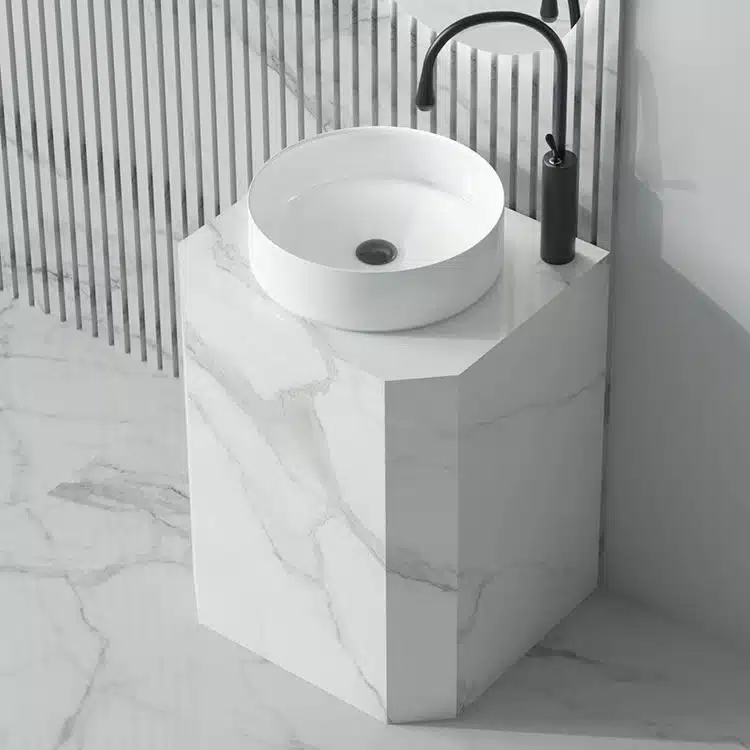
Quartz has been the default premium countertop for bathroom vanities for the better part of two decades. Sintered stone is newer, and the claims around it have outrun the documentation. Buyers on both sides hear conflicting stories — quartz scorches under a curling iron, sintered stone chips at the edge, one is a fad, the other is overpriced. None of that resolves a purchase decision. What resolves it is the material’s actual behavior: how it is made, what heat and stains really do to the surface, what the order costs across a lifecycle, and what you can verify before you commit. This article compares sintered stone vs quartz vanity tops on those four points. Sintered stone specifications trace to MFBATH’s published product data; quartz properties are general material knowledge, flagged as such. No prices, no marketing math.
How Each Material Is Made and What It Means for Your Vanity Top
Sintered stone starts as natural minerals — quartz, feldspar, and silica — ground to a fine grain and pressed at high temperature and high pressure until the particles fuse into a dense, homogeneous slab. The process uses no resin and no organic binder, and that single fact drives most of the performance differences you will actually notice in a bathroom. Because the finished body is fully mineral, it measures 7–8 on the Mohs hardness scale, resists heat up to 300°C, and is non-porous, so liquids stay on the surface instead of soaking into the body. Pigment runs through the full thickness of the slab, which is why sintered stone surfaces do not fade under ultraviolet (UV) exposure. And with no organic binder in the body, there is nothing for microbes to colonize — the surface is antibacterial by construction rather than by coating.
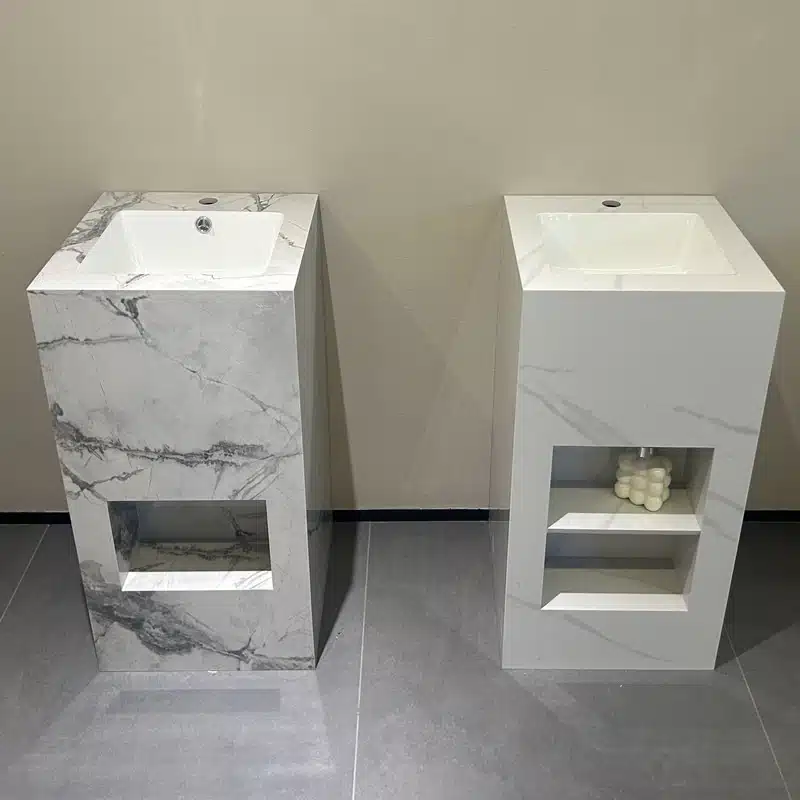
Quartz is a different build. Quartz countertops are roughly 90% quartz bound by a polymer resin matrix. That resin is what makes quartz workable: slabs can be cut, profiled, and polished with standard stone tooling, and the resin fills the gaps between quartz grains so the top reads as one consistent surface. It is also the material’s weak point. Under high localized heat — a flat iron left face-down, a hot pan set on the counter — the resin can scorch, yellow, or deform. Over years of use, a worn or micro-cracked surface can accept staining agents that a fully mineral surface would shed. None of this makes quartz a bad material; it has a long track record, consistent patterning, and predictable fabrication. The question is whether its failure modes belong in your project.
Sintered stone fabrication is a factory process by necessity. Diamond tooling is required to cut and profile the material, so edges, sink cutouts, and backsplash returns are machined and polished before the top ships. For a buyer, that cuts both ways: you lose the convenience of on-site adjustments, but you gain repeatability, because every top comes off the same programmed production line. The practical consequence is that the spec sheet matters more. Slab thickness, edge profile, cutout dimensions, and faucet hole locations must be locked before production, and the sample you approve becomes the geometry reference for the entire run.
What the Manufacturing Difference Means in Daily Use
Set the two materials side by side and the manufacturing difference reduces to three behaviors. Heat: sintered stone’s 300°C rating covers every heat source a bathroom can produce, while quartz depends on the resin holding at the contact point. Stains: a non-porous mineral surface has no capillary path for coffee, hair dye, or nail polish remover, while resin can absorb color once the polish layer is compromised. Maintenance: with no sealant cycle and no organic binder, sintered stone keeps the same surface properties for the life of the vanity. For a deeper technical breakdown, read our guide to sintered stone’s Mohs hardness and 300°C heat resistance, which covers the material’s physical specs in full.
Heat and Stain Performance, Side by Side
The table below shows where the two materials agree and where they split. The sintered stone column reflects MFBATH’s published specification for its sintered stone basins and vanity tops. The quartz column reflects general material properties that you should verify against your supplier’s own data sheet before you rely on them.
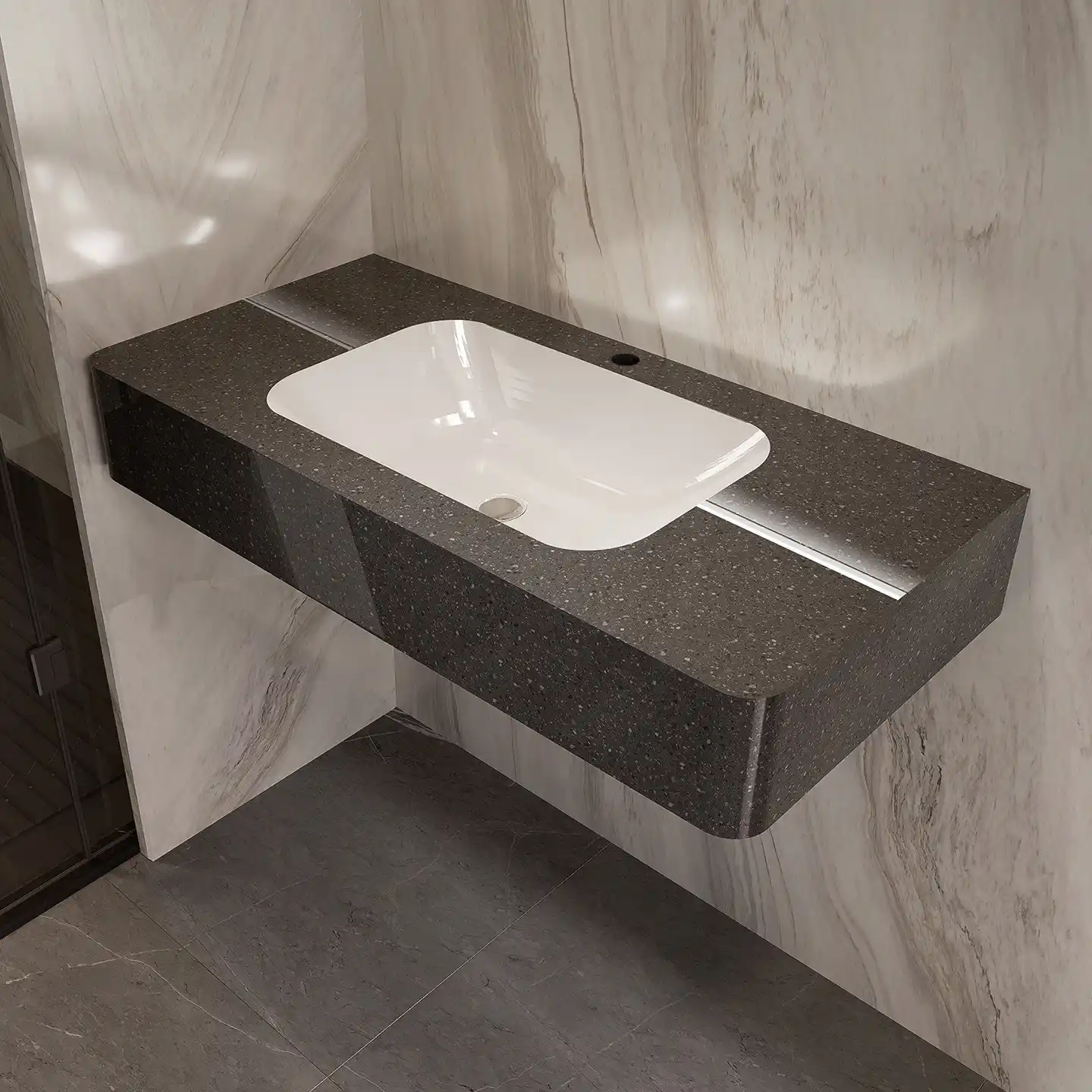
| Property | Sintered stone (MFBATH spec) | Quartz (general material knowledge) |
|---|---|---|
| Base composition | Natural minerals — quartz, feldspar, silica; no resin | Roughly 90% quartz in a polymer resin matrix |
| Hardness | Mohs 7–8 | Generally below sintered stone; marks more readily |
| Heat resistance | Resists heat up to 300°C | Resin binder can scorch or discolor under high localized heat |
| Porosity and stains | Non-porous; liquids cannot soak in | Resin seals the surface, but worn or micro-cracked areas can absorb stains |
| UV stability | Full-thickness color; no fade under UV | Generally stable; verify pigment on dark or patterned slabs |
| Antibacterial | Antibacterial surface; no organic binder | Not inherent; some slabs carry added antimicrobial agents |
| Fabrication | Factory-fabricated with diamond tooling | Site-cuttable with standard stone tooling |
Read the table top to bottom and the pattern is consistent: the split is not about looks, it is about what happens at the surface under stress. In a guest bath, a curling iron or flat iron is the most common heat event. Sintered stone’s 300°C heat resistance leaves a wide margin over the contact temperatures bathroom appliances reach. Quartz survives most normal use, but the contact point is where resin failure shows up first — and a scorch mark cannot be polished out.
Stains are the second test. Hair dye, toner, nail polish remover, and astringent cleaners are daily events around a vanity. On a non-porous sintered stone surface they bead and wipe off. On quartz, the resin polish is the line of defense; once it wears or the slab micro-cracks at a seam or sink cutout, the body can absorb color that cleaning will not remove. None of this means quartz fails in every bathroom — it means the buyer should match the material to the abuse level of the location.
Pattern consistency is where many buyers make their real choice. Engineered quartz delivers deliberately uniform patterning, which is why it photographs well and matches across multi-vanity projects. Sintered stone can also match across a run, but confirm it in writing: ask the supplier whether all tops for one order come from the same slab lot and what batch-to-batch variation to expect. That question belongs on the RFQ for either material, and the answer should be part of the production spec. If you are also weighing ceramic or marble, our overview of commercial vanity top materials compares all four on the same criteria.
Cost and Sourcing Reality: Compare Lifecycles, Not List Prices
Countertop pricing swings with slab grade, thickness, color, and region, so any price printed in an article is stale before it is read. What you can compare honestly is lifecycle cost: how long the surface keeps its properties, what the warranty covers, what the payment terms do to your cash flow, and what a field failure costs in rework. On durability, sintered stone removes the resin failure mode that drives many quartz replacements in high-use bathrooms. On warranty, MFBATH covers the whole cabinet for 2 years, and the return rate across its orders sits below 1%. Those are the numbers a procurement file can defend; a per-slab price list is not.
On the supply side, the terms are concrete. MFBATH’s sintered stone vanities come in floating units from 600 to 1800mm (24–71 inches) with single- or double-basin soft-close drawers, and floor-standing units from 800 to 2000mm (31–79 inches). The minimum order quantity (MOQ) is 15 units per model, color, and size, with mixed containers supported, so a distributor can test several SKUs in one shipment. Custom sizes and colors draw from 40,000+ documented combinations — Pantone-matched colors, eco materials, basin options, white-label hardware and packaging — and free samples ship in 10 working days so you approve the surface before production. Bulk production runs 20–30 days; for the US, Canada, and Mexico, total transit lands at 4–6 weeks. Shipments go FOB (free on board) Qingdao Port, with a 30% deposit and the balance due within a week of the draft bill of lading (draft BL).
The other half of lifecycle cost is logistics, and here the numbers are on the table. With FOB Qingdao Port terms, your freight cost depends on how you fill the container — which is why mixed containers matter: a 15-unit minimum per model, color, and size lets you combine several configurations in one shipment instead of paying for multiple partial loads. Buyers in the US, Canada, and Mexico should plan for 4–6 weeks total transit and time the 20–30-day production window against their sell-through. The 10-working-day sample window sits at the front of that schedule for a reason: the cost of a wrong color or wrong edge profile is not the rework alone, it is the weeks lost before a replacement can ship.
The claims around quartz also deserve a skeptical pass. Radon and certification claims circulate in quartz marketing; treat them as marketing until backed by lab documents. Apply the same verification standard in the other direction: MFBATH holds CE and UL markings, is ISO 9001 and ISO 14001 certified since 2017 and confirmed current in 2025, and its cabinets are designed to meet CSA, NOM, and ADA (Americans with Disabilities Act) requirements — note the phrasing: designed to meet, and the factory will walk you through the documentation either way. Environmental specifications are documented: E1 board at ≤0.1ppm, CARB Phase 2 and TSCA Title VI compliance, low-VOC finishes, and FSC-certified wood as an option. If indoor air quality is part of your spec review, the EPA’s indoor air quality guidance is the reference your client’s consultant will actually check.
Sintered Stone Vanities and Countertops for Wholesale Buyers
Browse this product, solution, or service page to explore relevant offerings.
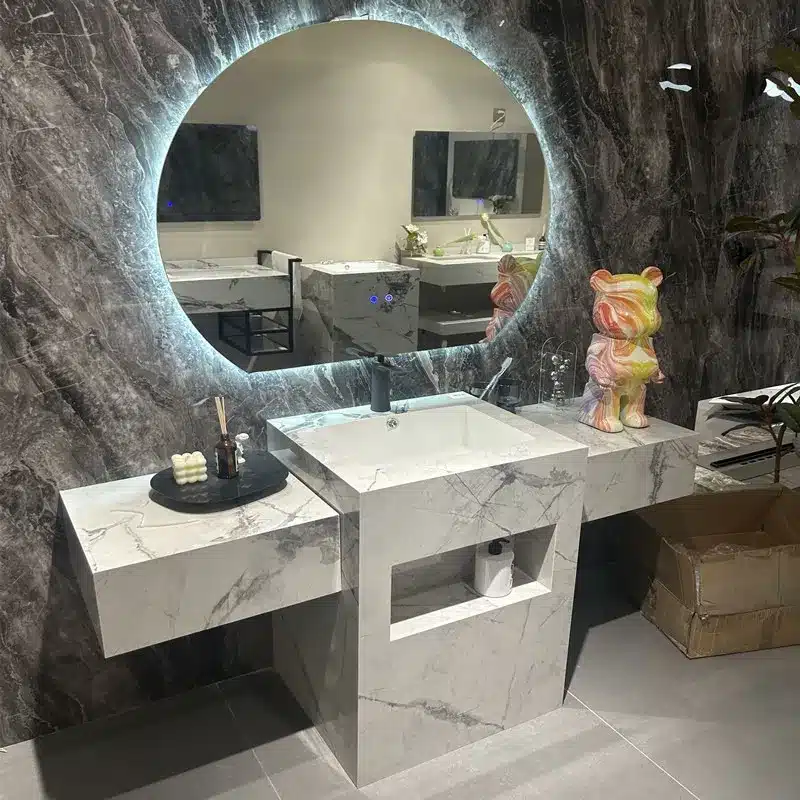
Specification and QC Checklist for Buyers
Once the material decision is made, the risk moves to execution: edge profiles, seams, cutouts, and the gap between sample and production. This is where vanities fail in the field. Here is what belongs on the RFQ and what to check at inspection.
Edge Profiles, Joint Seams, and Cutouts
Sintered stone is factory-fabricated: it requires diamond tooling, so edges, sink cutouts, and backsplashes are cut and polished before shipping rather than on site. That shifts quality risk to the factory, which is exactly where you want it for a repeatable product. Request the drawings: edge profile and radius, seam placement (a single-basin top should carry minimal or no visible seams), cutout tolerance for the basin, and overflow details. On the quartz side, on-site fabrication is common — a flexibility advantage, but also the main source of seam failures, because joints are where moisture enters. Whatever the material, get the seam count per top in writing.
What to Check on the Sample
Free samples ship in 10 working days, so there is no excuse for approving blind. When the sample lands: compare the color against your reference in daylight and under store lighting, because color shifts are real. Check the edge polish for a uniform radius and any hollow spots. Run a scratch test with a steel blade — sintered stone at Mohs 7–8 resists it, while a resin-rich surface will mark. Confirm thickness and squareness against the production drawing, and if the top carries a seam, inspect that joint before you sign off. If the sample is a full vanity rather than a bare top, work the drawers. Floating sintered stone configurations ship in single- or double-basin layouts with soft-close drawers; cycle the drawers, confirm the soft-close engages through the full travel, and check the cabinet for squareness by closing the doors against the frame. A vanity that arrives out of square is a vanity that gets reworked on site. Our guide to custom vanity top specifications walks through the full dimensional and material checklist, and our sintered stone vanity specifications covers integrated-basin details for high-end sourcing.
Third-Party Inspection and Documentation
MFBATH runs 5 quality control checks on every piece before packing, and third-party inspection by SGS or TÜV can be arranged. If your contract calls for it, schedule the inspection at the pre-shipment stage and have the inspector check the same points your client will: dimensions, edge quality, drawer function, packaging, and marking. When compliance documentation is part of the deal, our sintered stone basin certifications guide shows what CE, UL, CSA, NOM, and ADA paperwork should actually look like, so you do not accept a photocopy that says nothing. When your buyer asks how a property was measured, ASTM standards are the neutral reference point to cite.
When to Choose Which for Your Project
In a hotel bathroom, the surface takes heat and chemicals daily, cleaning crews work at speed, and a stained or scorched top reads instantly as a maintenance failure. Sintered stone’s non-porous, heat-resistant, antibacterial surface fits that abuse profile, and the 2-year whole-cabinet warranty with a return rate below 1% gives procurement a defensible record. For the project-level decision — room counts, renovation cycles, and floor-plan constraints — our commercial hotel vanity comparison covers the ground this article deliberately does not: this one is about the material, that one is about the project.
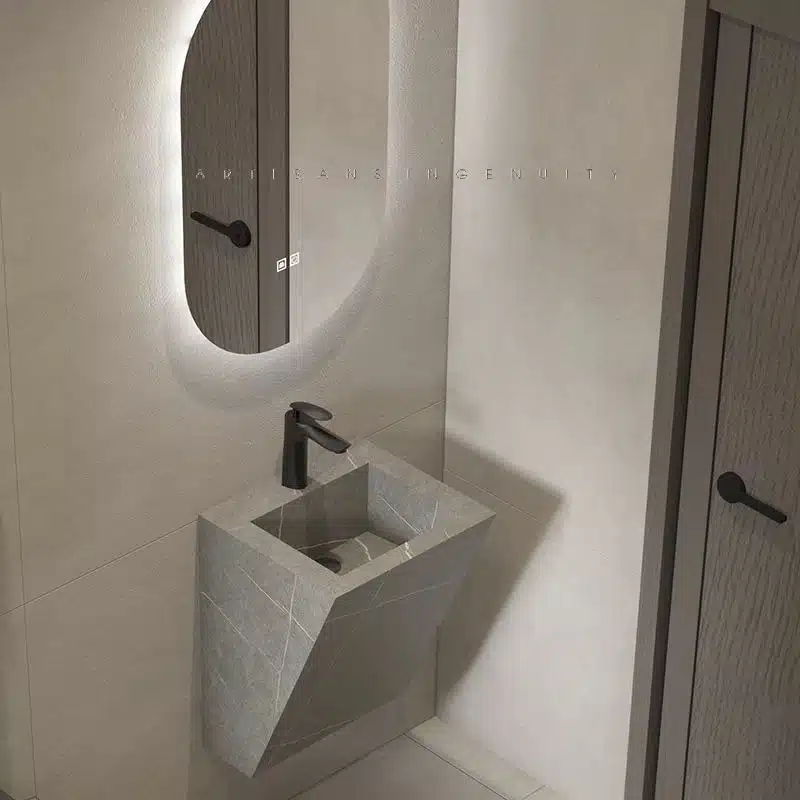
In a residential vanity, quartz remains a legitimate choice: abuse levels are lower, fabrication is flexible, and homeowners value pattern consistency. The case for sintered stone strengthens when the client keeps hot appliances on the counter, has heavy cosmetic use or hard water, or wants a surface that never needs resealing.
Light commercial spaces — offices, clinics, retail restrooms — sit between the two. Turnover is lower than a hotel, but chemicals and abrasion are constant, so a non-porous surface with no resealing cycle keeps the cleaning budget predictable. If wood is part of the vanity package, FSC-certified options are available; FSC’s site explains what that label actually certifies, which matters when your client’s spec mandates it.
Renovation projects add a constraint that new builds do not: matching. If the existing bathroom already carries sintered stone or quartz, order a sample against the installed surface before committing the full quantity, and use the 10-working-day sample window to settle the match. When timelines are tight, that same window tells you whether the factory can hold a 20–30-day production slot for your quantity — because a renovation delay costs more than the vanity does.
Frequently Asked Questions
Can I set a hot curling iron directly on a quartz countertop?
Not on the same basis as sintered stone. Quartz countertops are roughly 90% quartz bound by a polymer resin matrix, and the resin is the weak point under high localized heat — scorch or yellowing at the contact point is possible. Sintered stone resists heat up to 300°C, well above the contact temperatures bathroom appliances reach. If hot tools are a daily event in the project, specify sintered stone and drop the heat-pad policy.
Does sintered stone stain like quartz or marble?
No. Sintered stone is non-porous, so hair dye, coffee, and nail polish remover stay on the surface and wipe off, and there is no sealant cycle to maintain. Quartz depends on its resin seal for stain resistance; once that polish wears or the slab micro-cracks, the body can absorb color. For heavy-use bathrooms, the non-porous mineral surface removes that failure mode entirely.
What are the order terms for custom sintered stone vanities?
MFBATH’s minimum order quantity (MOQ) is 15 units per model, color, and size, with mixed containers supported. Custom sizes and colors are available, free samples ship in 10 working days, and bulk production takes 20–30 days, with 4–6 weeks total transit to the US, Canada, and Mexico. Terms are FOB Qingdao Port with a 30% deposit; the balance is due within a week of the draft bill of lading (draft BL).
The Bottom Line
The sintered stone vs quartz vanity top decision comes down to failure modes, not fashion. Sintered stone is a fully mineral, resin-free surface rated at Mohs 7–8 hardness and 300°C heat resistance — non-porous, UV-stable, and antibacterial — while quartz’s resin binder carries the heat and stain risk. Match the material to the abuse level, verify the documentation, and approve a sample before you commit: MFBATH’s sintered stone bathroom vanities come in single- or double-basin layouts from 600 to 2000mm, with a 15-unit MOQ and 10-working-day samples. More material comparisons live in our product knowledge section.




0 Comments