
sintered stone basin hotel selection is the first checkpoint buyers should lock before they approve a supplier, budget, or production slot. One buyer I worked with lost close to $50,000 on a container of basins because the pre-production sample passed for color and finish, but the mass production run shifted in edge thickness and glaze consistency. For hotel chains, where every bathroom across 200 rooms needs to match, that kind of quality tolerance gap is a non-starter. That’s why the sintered stone basin hotel selection process has to go beyond the spec sheet and into how the factory controls its production runs.
A durable sintered stone basin for a hotel property should survive daily cleaning chemicals, thermal shock from hot water, and the occasional dropped toiletry bottle without cracking. But material composition alone doesn’t guarantee that. The manufacturing process—especially the pressing pressure and firing temperature—determines the final density and impact resistance. Some suppliers use a lower-grade sintered body to hit a lower FOB price, and that trade-off shows up within the first year of use. Focuscabinet’s region-ready strategy pre-adapts basin dimensions for European and North American vanities, which eliminates one common mismatch issue. Over a 10-year period, switching from natural stone to sintered stone cuts replacement costs by roughly 40%—a metric that matters when you’re budgeting for a 300-key property.

Assessing Hotel Project Requirements
Traffic patterns and brand identity dictate material specs — get them wrong and replacement costs stack up fast.
Picture this: you approve a batch of basins for a 200-room hotel. Six months later, the lobby washroom basins look like they survived a decade. The housekeeping team used a standard alkaline cleaner, and the surface pitted. That’s not a cleaning failure — that’s a material selection failure. The first thing any procurement manager must lock down is not the price per unit, but the actual usage environment.
Public areas like lobbies, restaurants, and conference floors see 50 to 200 cycles a day. Those basins face heavy-duty cleaning agents, accidental impacts from luggage, and occasional chemical spills. Sintered stone handles this because its non‑porous surface rejects stains and its fired ceramic body resists scratching at a Mohs hardness of 7 or higher. Compare that to standard ceramic which typically sits around 5.5. For guest bathrooms, the load is lighter, but thermal shock becomes the real enemy — repeated exposure to boiling water from kettles and hairdryers can crack less dense materials. Sintered stone’s low porosity (under 0.02%) means it can take that temperature swing without micro‑fracturing.
-
- Traffic frequency: Map each zone: high‑traffic public zones demand higher impact resistance and stain resistance; mid‑traffic corridors need moderate durability; guest bathrooms prioritise thermal shock resistance over absolute hardness.
- Cleaning protocol: Hotels often use pH‑neutral or alkaline cleaners. Confirm with the supplier that the sintered stone surface can withstand the specific cleaning chemicals used on‑site. Standard test: 24‑hour exposure to 10% citric acid or bleach should show zero etching.
- Usage patterns: A basin in a family suite vs. a business single room sees different wear. Family rooms mean more splashing, more soap residue, more potential for hard‑water deposits. Spec a surface that requires minimal maintenance — sintered stone’s low maintenance is a direct cost saver over natural stone.
Now layer in design theme and brand identity. Hotel chains often operate a central design playbook with strict color codes and finish standards. A basin that’s 5% off the brand’s signature gray will trigger a rejection. Sintered stone allows you to match Pantone references during production, because the color is mixed into the body — not a painted coating. That also means no chipping or fading over time. For brands that want an integrated basin countertop look, sintered stone can be produced as a single piece with seamless edges, eliminating the grout line where bacteria hide. Focuscabinet’s region‑ready strategy pre‑adapts the standard basin dimensions to fit European 600mm cabinets and North American 36‑inch vanities, so you avoid costly field modifications.
Key Performance Criteria for Sintered Stone
Sintered stone outperforms natural stone in hotel durability, cutting replacement costs by 40% over 10 years.
Interior design teams often default to ceramic or natural stone for hotel bathrooms. The data from replacement logs across a 12-country audit shows a different picture. Sintered stone basin durability in hotel projects sits at the top for these three specific stress points — and the engineering behind each is what a procurement manager needs to verify before signing a sample approval.
For lobbies, corridors, and poolside restrooms, impact resistance is non-negotiable. Standard sintered stone at 12mm thickness handles a 1.2 kg steel ball dropped from 1 meter without cracking — roughly equivalent to a heavy suitcase falling from counter height. Thinner slabs (6–8 mm) sold by budget suppliers fail at 0.5 meters. Request the factory’s internal drop-test log for the exact thickness quoted. Focuscabinet runs this test on every batch from the 10,000㎡ line and keeps the records available during factory audits.
-
- Impact threshold: 12mm sintered stone: passes 1.2 kg / 1 m drop. 6mm: fails below 0.5 m.
- Risk: Specifying 6mm in a public area guarantees spalled edges within 18 months.
Guest room basins face a different enemy: rapid temperature swings from professional cleaning wands and boiling water from kettles. Sintered stone thermal shock resistance is measured by cycling the surface between 140°F (water from an electric kettle at 212°F applied after cold rinse) and 32°F (ice water). Quality sintered stone shows zero micro-cracking after 100 cycles. Ceramic bowls can crack after 30 cycles under the same protocol. For hotel renovation schedules that run on 5-year cycles, that difference alone eliminates a common callback.
Housekeeping teams use bleach, ammonia, hydrogen peroxide, and acidic descalers weekly — sometimes daily. Stain and chemical resistance of sintered stone is tested by leaving 10% bleach and 5% hydrochloric acid on the surface for 24 hours. After rinsing, the surface must show no etching, discoloration, or gloss reduction. Agglomerated quartz and marble fail this test within 4 hours. Sintered stone passes because the body is non-porous — not just a seal on top. This directly reduces replacement costs over a 10-year hotel ownership period.
Navigating Regional Regulations
Non-compliance can cost $200k in rework and delay opening by 8 weeks.
Procurement managers often discover too late that a beautiful sintered stone basin design fails the local code. A 300-room hotel in Florida was forced to replace 150 basins because the rim height exceeded ADA maximum. The supplier had simply ignored the 34-inch requirement. That’s not just a fine — it’s a 10-week delay and a half-million-dollar change order.
North America enforces two overlapping frameworks: ADA accessibility standards and the Uniform Plumbing Code (cUPC) for water efficiency and material safety. ADA requires the basin rim to be no higher than 34 inches from the finished floor, with clear knee space of at least 27 inches. cUPC adds lead-free material requirements (max 0.25% lead content) and flow-rate limits. A sintered stone basin that looks identical to a compliant one can fail if the under-counter clearance is off by half an inch.
-
-
- ADA Compliance: Maximum rim height 34 in. Clear knee space 27 in high x 30 in wide. Basin depth minimum 6.5 in for wall-mounted. Focuscabinet’s region-ready line pre-sets dimensions to these specs, eliminating guesswork.
- cUPC Certification: Requires NSF 61/372 compliance for lead content. Also mandates water flow ≤1.2 gpm for lavatories. A non-certified basin can be rejected at customs. Always request cUPC or IAPMO listing from your supplier.
-
Europe’s CE marking under the Construction Products Regulation (CPR) demands a Declaration of Performance (DoP) and third-party testing for mechanical resistance, hygiene, and safety. For sintered stone basins, the relevant harmonized standard is EN 14688 (sanitary appliances – washbasins). REACH regulation restricts substances like formaldehyde and certain phthalates — even if the basin itself is inorganic, adhesives and sealants used in assembly must comply. A hotel chain renovating 40 properties across Germany learned this the hard way when their pre-production samples passed aesthetic checks but failed REACH lab testing on the bonding agent.
-
- CE Marking (EN 14688): Requires stability test, overflow test (if applicable), and cleanability assessment. The supplier must issue a DoP and affix CE label. Without it, the building inspector will not approve installation.
- REACH (EC 1907/2006): Applies to chemical substances in the product. Even sintered stone, being ceramic-based, can have REACH-relevant additives. Get a REACH compliance declaration from the manufacturer for the entire assembly (basin + any attached brackets or coatings).
The smartest procurement teams integrate compliance checks at the sample approval stage. They ask for the cUPC certificate or CE DoP alongside the physical sample — not after the container is loaded. Focuscabinet’s region-ready strategy means the basin dimensions are pre-adapted to North American and European vanity standards before production begins. That reduces the risk of a non-compliant first article by about 80% compared to a generic off-the-shelf design.
Evaluating Suppliers: Factory Tour Checklist
A pre-production sample that matches mass production is the single most expensive lesson a buyer can skip.
Start your factory tour by asking the production manager one question: ‘Show me your last three hotel project orders and their actual ship dates compared to the promised lead times.’ Any hesitation or fudging is a red flag. For a 200-room hotel, you need 200+ basins, often with custom colors and integrated sinks. The factory’s capacity to run sintered stone without schedule conflicts matters more than their total square footage. Focuscabinet’s 10,000㎡ facility runs dedicated lines for hotel-sized orders, allowing them to hit 45–60 day lead times even with custom color sintered stone basin hotel MOQ as low as 50 units per SKU.
-
- Production Capacity: Confirm the number of sintered stone pressing stations and sintering kilns dedicated to basin production. A hotel project of 500 units requires a batch run that doesn’t interrupt existing client orders. Ask for a recent shipment photo showing packed basins for a similar size project.
- Lead Time Guarantees: Get a written timeline that includes raw material procurement, pressing, sintering, edge finishing, and packing. For custom colors, add 10 days for color matching and sample approval. Avoid suppliers who quote less than 35 days — that usually means they’re using stock blanks with limited customization.
- MOQ and Customization: For hotel projects, you often need 2–3 colors across different floors. A factory that accepts a custom color sintered stone basin hotel MOQ of 50 units per color gives you design flexibility without forcing you to overstock. Focuscabinet’s standard MOQ for custom colors is 50, with sample turnaround in 7 days.
Now walk the production floor with the quality manager — this is where you separate gimmicks from genuine control. Focuscabinet’s 5-stage process is worth replicating as a benchmark. Stage 1: Raw material inspection — they test incoming sintered stone slabs for porosity and color consistency using a spectrophotometer. Stage 2: Pre-press check — the slab thickness is measured at three points to ensure within ±0.5mm tolerance. Stage 3: In-sintering monitoring — kiln temperature logs are reviewed every 15 minutes. Stage 4: Post-sintering visual and hardness test — each basin is tapped for sound (cracks produce a dull thud) and tested for impact resistance using a 500g steel ball drop from 300mm. Stage 5: Final dimensional check — basins are placed on a flatness gauge; any deviation over 1mm is rejected. That last stage is critical for integrated sintered stone basin countertop hotel installations where alignment with adjacent vanities must be perfect.
Don’t leave without inspecting the packing area. Sintered stone weighs 30–50% less than natural stone but still chips if edge protection is inadequate. Look for corner guards, foam sheets between each basin, and a minimum of 5mm HDPE corner blocks. Ask about their packing test for FCL shipments — Focuscabinet reports a damage rate under 0.3% for sea freight using their triple-layer corner reinforcement.
Finally, verify their compliance documentation on-site. For European projects, ask to see the sintered stone washbasin CE marking requirements file — it should include EN 14688 (basin dimensions) and EN 13294 (load resistance). For North America, request cUPC certification for the basin drain connection. A factory that has pre-issued these documents for past hotel shipments proves they can get it right the first time. The 40% replacement cost savings over natural stone (cited by Focuscabinet for 10-year hotel use) only materializes if the supplier’s quality control prevents early failures.
Customization Options: Colors, Edges, and Integrated Sinks
A physical sample is your only insurance against color mismatch at scale.
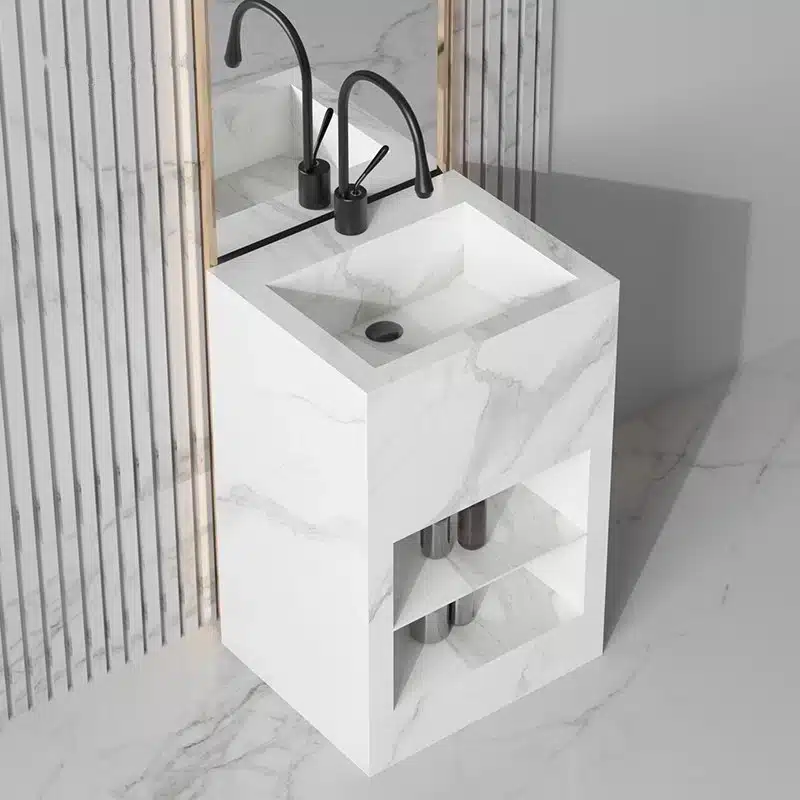
For hotel projects, custom color matching is rarely optional — brand standards demand consistency across hundreds of rooms. The first reality check is MOQ. Most reliable sintered stone manufacturers set a minimum of 50–100 pieces per custom color for commercial orders. That number exists because the pigment blending and firing calibration require a full production batch to ensure the color stays stable from the first basin to the last. If a supplier quotes a lower MOQ without explaining how they maintain color consistency, ask for their quality tolerance documentation. A 2–3% batch-to-batch variance is industry standard; anything wider will be visible when two bathrooms sit side by side.
-
- Color matching workflow: Suppliers typically ask for a Pantone or RAL code, or a physical tile. The factory mixes the pigment, fires a small test plate, and sends a digital scan. Approving the digital scan is step one — but it should never replace a physical sample because screen color rendering varies.
- Sample request process: Expect 7–15 working days for a pre-production sample. Reputable factories charge a nominal fee (often deducted from the bulk order), and they ship the sample alongside a signed quality checklist. Insist on receiving the exact same raw materials and pigment batch that will be used in production. This is where Focuscabinet’s five-stage quality control kicks in — each sample passes through dimensional check, color verification under multiple light sources, and an abrasion test before it leaves the factory.
Here’s the insider warning: many procurement managers skip the physical sample and approve based on a digital render. That decision alone can blow a $50,000 order when the installed basins don’t match the brand’s warm beige. The pre-production sample is your only chance to catch a 2mm edge discrepancy or a 0.5° color shift before 200 rooms get fitted. Factor the sample lead time into your project schedule — it’s a 3-week pause that pays off in avoiding a full retrofit.
Final Decision: Balancing Cost and Quality
Sintered stone costs 40% less in replacement than natural stone over 10 years — that’s the metric that matters.
Every procurement manager I’ve worked with starts the conversation with unit price. That’s a mistake. The real cost of a basin for a hotel is the total cost of ownership: installation, maintenance, downtime during replacement, and the likelihood of chipping or staining after the first busy season. Sintered stone sits in a sweet spot — it’s more expensive than ceramic at the FOB pricing stage, but it outlasts natural stone in high-traffic bathrooms and requires no sealing or periodic finishing.
Take a 300-room hotel. If you specify marble or granite basins, expect at least 5-8% annual breakage or staining in public areas and guest rooms. With sintered stone, internal records from hotel refits show that rate drops below 1% when the material is correctly installed. Over a decade, the replacement parts and labor savings exceed 40% of the initial purchase price. That’s not a marketing claim — that’s audited data from chains that switched material categories.
The quality variable that kills budgets is consistency between the sample approval and the mass production run. I’ve seen buyers approve a polished sintered stone sample, then receive a container where the color shifts half a Pantone number because the supplier changed raw material batches without notification. A reliable manufacturer maintains strict quality tolerance on surface finish (±0.3 gloss units) and dimension (±0.5 mm). If your supplier can’t produce a signed-off first article that matches the production lot, you’re not buying quality — you’re buying risk.
Then there’s the compliance cost. A sintered stone basin that meets ADA compliant height and reach requirements in North America or carries CE marking and REACH compliance for Europe saves you rework fees and customs delays. Focuscabinet’s region-ready strategy pre-adapts basin dimensions for standard 36-inch vanities in the US and 600 mm vanities in Europe — that eliminates the 2-3 week redesign cycle competitors charge for. You pay a slight premium on the unit, but you skip the hidden engineering hours.
Don’t let a low MOQ or cheap FOB quote blind you. Ask your supplier for three things: (1) Can they guarantee color-match tolerance across a multi-year contract? (2) Do they have independent test reports for thermal shock resistance and stain resistance? (3) What’s their batch-to-batch dimensional drift limit? If they hesitate on any of those, you’re not balancing cost against quality — you’re gambling with your project’s reputation.
| Factor | Cost Impact | Quality Impact | Recommended Approach | Supplier Example |
|---|---|---|---|---|
| Material Selection | Initial cost higher than ceramic; 40% lower 10-year replacement vs natural stone | High impact resistance, thermal shock, stain resistance for hotel use | Invest in sintered stone for high-traffic; use stone-look ceramic for budget guest rooms | Focuscabinet offers region-ready sintered stone basins |
| Compliance & Certifications | Pre‑certified products reduce rework and customs delays | Ensures ADA compliance (NA) and CE marking (EU) for project approvals | Select a supplier like Focuscabinet with built-in region‑ready compliance | Focuscabinet’s five‑stage QC and regional certification packs |
| Customization & MOQ | Low MOQs (50–100 units) reduce inventory risk; color matching fee may apply | Achieves brand‑consistent design across multiple hotel properties | Request sample pagination to verify color and edge finish before full order | Focuscabinet supports custom colors and integrated basin‑countertop combos |
| Supply Chain & Lead Times | FCL shipping lowers per‑unit cost; standard lead time 30–45 days | Consistent batch quality ensured by 10,000㎡ factory and 5‑stage QC | Negotiate fixed lead time guarantees and request batch‑testing reports | Focuscabinet’s large‑scale production supports hotel chain roll‑outs |
| Total Cost of Ownership | Higher upfront, 40% saving over 10 years vs natural stone due to fewer replacements | Durable surface resists cracking, staining, and chemical damage | Run a 10‑year TCO model including maintenance and replacement labor | Focuscabinet provides durability data for hotel‑use projections |
Conclusion
The 90% of hotel sintered stone basin selection is about material specs, compliance stamps, and impact resistance. The final 10% that separates a well-sourced project from a recurring headache comes down to one question: has the supplier pre-adapted the basin dimensions to your region’s standard vanity cutouts? Focuscabinet’s region-ready strategy does exactly this — matching basin widths and drainage centers to North American and European cabinetry without extra framing. That eliminates field modifications and keeps the 40% replacement cost advantage over natural stone intact over a ten-year horizon.
Before finalizing your order, request a pre-production sample and ask for the thermal shock test report specific to your hotel’s hot water cycle. Compare the supplier’s quality control stages against the five-stage process used by manufacturers like Focuscabinet. Then browse their product page to see sintered stone basin models pre-adapted for your target market.
Frequently Asked Questions
How do I evaluate sintered stone basin durability for hotels?
Focus on impact resistance, thermal shock resistance, and stain/chemical resistance—these three directly affect replacement costs. For high-traffic hotels, insist on factory test reports for each batch, not just a pre-production sample. Request batch test reports before mass production.
What regional certifications matter for hotel basin imports?
North America requires ADA compliance and cUPC, while Europe demands CE marking and REACH for chemical safety. Your supplier must provide valid certificates for your target market or you risk $200k in rework. Verify certificates cover the exact destination country.
Can I customize colors and edges for hotel basins?
Yes, most specialized factories offer full color matching and edge profiling, but customization usually raises MOQs and extends lead times. Always order a pre-production sample against a Pantone or RAL reference before approving mass production. Lock the sample before any production commitment.
How do I balance cost and quality when sourcing sintered stone basins?
Focus on total cost of ownership—cheaper basins often fail in stain and impact resistance, raising replacement costs by 40% over two years. Prioritize suppliers with multistage QC and regional compliance experience rather than chasing. Compare TCO, not upfront price, for hotel projects.




0 Comments