
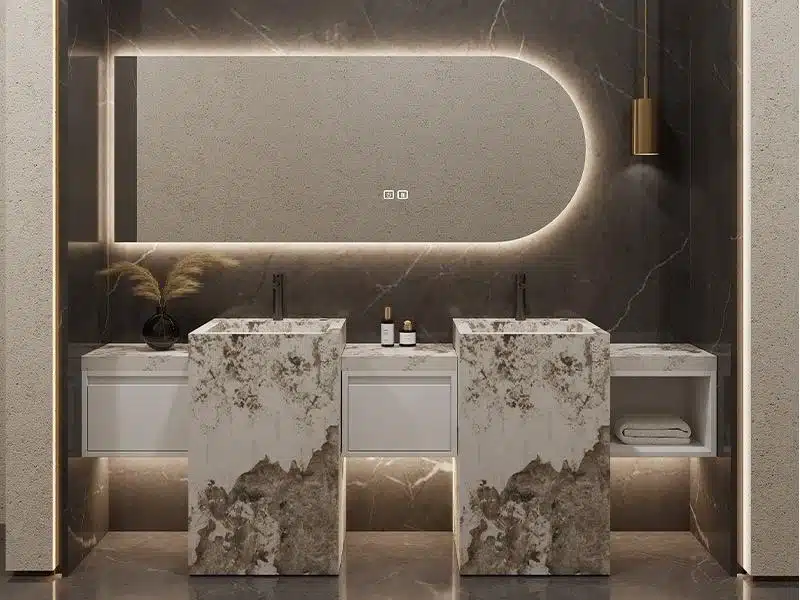
 Choosing the wrong hotel bathroom vanity material is the fastest way to fail a brand-mandated PIP and trigger unplanned capital expenditures within two years of a renovation. While lacquer and melamine may pass initial inspection, they frequently cannot withstand the constant moisture, chemical cleaning, and high traffic of a commercial environment. This material failure leads directly to peeling edges, stained surfaces, and negative guest reviews that flag a property for poor upkeep long before the next scheduled 5-year renovation cycle.
This guide serves as a technical standard operating procedure for vanity specification. We will analyze the performance differences between High-Pressure Laminate (HPL), lacquer, and melamine based on durability benchmarks. We will also cover critical fabrication details like NEMA LD3 compliance and the structural impact of using 1mm versus 2mm edge banding, giving your team a clear framework for calculating the true cost-per-key and ensuring your investment lasts.
What Is the “5-Year Renovation Cycle”?
The 5-year renovation cycle is the hotel industry’s standard for cosmetic refreshes, a timeline that has compressed from 12–15 years to just 5–7 years to meet modern guest expectations.
Components of a Soft Goods Refresh
The 5-year cycle centers on refurbishing “soft goods” to address the visible wear and tear that accumulates in high-traffic areas like guest rooms and lobbies. This process is essential for maintaining a property’s brand consistency and visual appeal. The scope typically includes:
- Replacement of wall coverings, carpeting, and tiling.
- Updates to bedding, draperies, and paint.
- Installation of new fixtures and other cosmetic items.
The Modern Renovation Timeline
This refresh is a critical touchpoint in a hotel’s maintenance schedule, fitting between annual upkeep and major 7–10 year renovations that cover infrastructure like plumbing and electrical systems. Guest expectations and intense competition have forced the industry to accelerate these cycles. What was once a 12–15 year process is now standard practice at 5–7 years. Luxury properties operate on an even faster timeline, often refreshing guest rooms every 3–5 years to stay ahead of market demands.
HPL (Formica/Wilsonart): The Gold Standard?
High-pressure laminate (HPL) is the default specification for hotel bathroom vanities because its core performance—moisture and scratch resistance—is a solved problem, making design innovation and sustainability certifications the key differentiators between major brands.
Durability and Performance in Hospitality
High-pressure laminates are the workhorse of the hospitality industry, offering a proven balance of durability and cost. In high-traffic hotel bathrooms, materials must withstand constant use and aggressive cleaning schedules. HPL is engineered specifically for these conditions, delivering exceptional moisture and scratch resistance. For established brands like Formica and Wilsonart, core performance is a baseline standard; both offer comparable durability, making them a low-risk specification for any commercial project.
Aesthetic Trends and Modern Finishes
Beyond its functional strength, HPL’s design versatility is a primary reason for its dominance. The market has moved far beyond basic patterns. Current aesthetic trends focus on sophisticated finishes that mimic natural materials like wood or stone without the associated maintenance liabilities. Specialty textures, including matte and fingerprint-resistant coatings, are now common specifications. Technology allows for enhanced tactile surfaces that improve the guest experience, making design innovation a key competitive battleground for manufacturers.
| Feature | Wilsonart HPL | Formica HPL |
|---|---|---|
| Core Durability | Excellent resistance to moisture, heat, and wear. Performance is comparable to other top brands. | Excellent resistance to moisture, heat, and wear. Performance is comparable to other top brands. |
| Aesthetic Specialization | Emphasizes premium textures and specialty finishes like HD Laminate and fingerprint-resistant surfaces. | Known for a wide range of classic solid colors and versatile standard finishes (matte, gloss). |
| Cost & Sourcing | Higher price point for premium lines. May require sourcing from authorized distributors for certain designs. | Generally more cost-effective with superior availability through most commercial suppliers. |
| Ideal Application | Luxury, boutique, and design-forward properties where advanced aesthetics justify the cost. | Large-scale hospitality projects where budget efficiency and reliable sourcing are critical. |
Sustainability and Manufacturing Standards
Environmental impact is a growing factor in material specification for commercial projects. Top HPL manufacturers actively pursue third-party certifications to validate their commitment to responsible practices. These standards are becoming a significant point of differentiation. Certifications you should look for include:
- GREENGUARD Certification: Ensures that a product has met some of the world’s most rigorous standards for low emissions of volatile organic compounds (VOCs) into indoor air.
- FSC (Forest Stewardship Council) Certification: Verifies that the paper products used in the laminate come from responsibly managed forests that provide environmental, social, and economic benefits.
Unlock Your Market with Custom Vanities

Why Is Lacquer High Risk?
Contrary to common belief, current industry data shows lacquer is not an inherently high-risk material for hotel bathrooms. Its performance is entirely dependent on the quality of the substrate and the sealing process, making it a reliable mid-tier option when specified correctly.
Challenging the High-Risk Perception
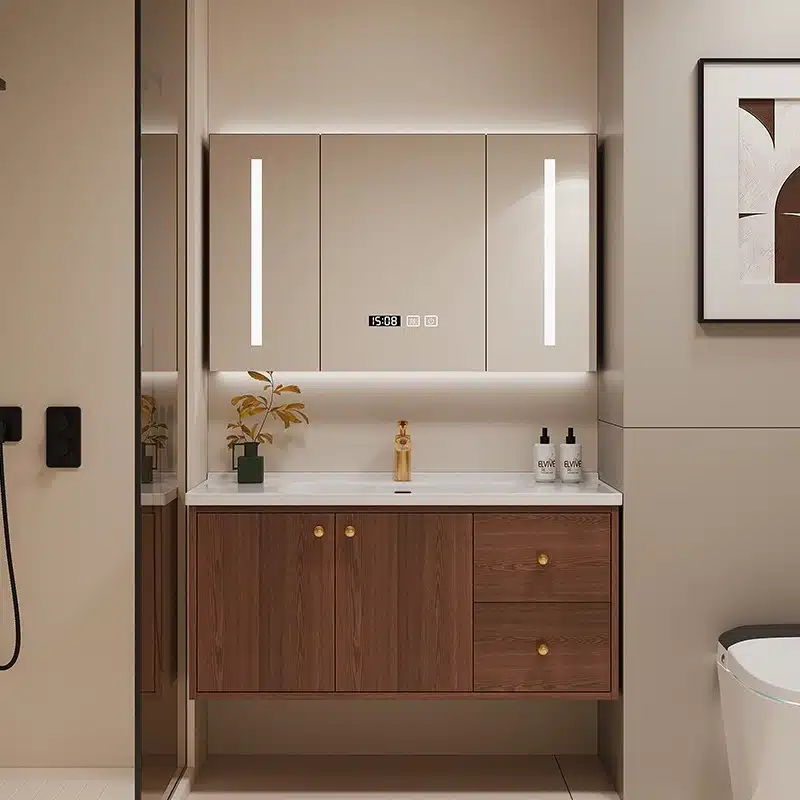
Industry analysis does not categorize lacquer as a high-risk finish for hotel bathrooms. Instead, it’s recognized as a durable and water-resistant coating that performs well in humid conditions, provided it is properly sealed and maintained. Its reputation for failure often stems from application over unsuitable substrates like standard MDF, not a flaw in the finish itself.
- Lacquer provides a smooth, modern, non-porous surface that is aesthetically flexible, available in various colors and finishes, including matte, glossy, and satin.
- It occupies a practical mid-tier position, balancing the visual appeal of a painted finish with the performance needed for guest bathrooms, fitting between budget-friendly HPL and zero-maintenance quartz.
Performance Factors in Bathroom Environments
The long-term success of a lacquer finish depends directly on the quality of its application and the substrate it protects. A multi-layer sealing process is critical to ensure its water-resistant properties remain effective. For the best results, lacquer should be applied over a high-quality core like High Moisture Resistant (HMR) MDF or high-density PVC, which provides a stable, water-resistant base and prevents moisture intrusion from compromising the finish.
- While non-porous materials like quartz offer the absolute lowest maintenance in high-traffic commercial settings, a well-executed lacquer finish is a durable solution for guest bathrooms where aesthetics are a primary driver.
- When the substrate and application process are specified correctly, lacquer delivers a reliable finish that withstands the demands of a hotel environment.
Is Melamine Worth the Risk?
Melamine’s value is tied directly to manufacturing quality; its vulnerability to moisture at the edges and core substrate degradation makes it a calculated risk for high-use hotel bathrooms.
The Critical Role of Edge Sealing
The primary vulnerability of any melamine vanity is water infiltration at the edges. While the melamine surface itself offers good moisture resistance, it’s the seal protecting the particleboard core that determines the product’s lifespan. Without a perfect, durable seal, moisture penetrates the substrate, causing it to swell, delaminate, and fail. This is the single most common point of failure in high-moisture hotel environments.
- Water damage from compromised edges is the leading cause of failure for melamine products in hospitality.
- Rigorous quality control during manufacturing is essential to create a lasting seal that fully protects the core material.
- Proper installation and maintenance routines are needed to ensure the edge banding remains intact and uncompromised over time.
Substrate Quality and Durability
The particleboard substrate typically used with melamine is cost-effective but highly susceptible to degradation if exposed to moisture. The balance between initial cost savings and long-term durability is a critical calculation for any hotel operator. A low-density core will fail much faster than a higher-quality, moisture-resistant alternative, turning upfront savings into future replacement costs.
- The density and grade of the particleboard core directly impact its resistance to both moisture and physical impact.
- Higher-quality melamine products use more robust substrates, like HMR (High Moisture Resistant) board, to mitigate these durability risks.
- Operators must weigh the upfront savings against the potential costs of premature replacement, maintenance, and room downtime.
Health and Environmental Factors
Concerns about volatile organic compound (VOC) emissions, particularly formaldehyde from adhesives in the particleboard core, are growing in the hospitality industry. Poor indoor air quality can directly impact guest satisfaction and health. Adhering to strict manufacturing standards is necessary to meet modern hygiene and environmental requirements.
- VOC emissions affect indoor air quality, a critical factor for guest safety and brand reputation.
- As environmental and health standards tighten globally, the source and composition of melamine products become more important procurement criteria.
- Look for products with certifications that guarantee low VOC emissions to ensure regulatory compliance and guest safety.
1mm vs. 2mm: Which Is Better?
For commercial bathroom applications, laminate thickness directly dictates durability; panels over 2mm offer superior moisture and impact resistance essential for high-traffic environments, while 1mm serves as a budget-conscious alternative.
Thinner Laminates (1mm): A Cost-Effective Option
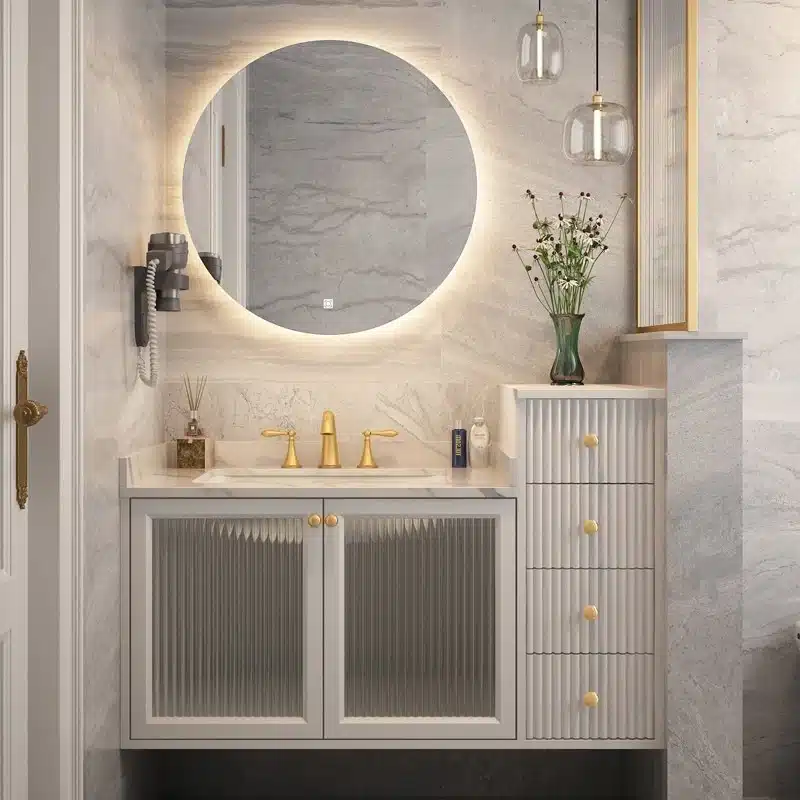
Laminates around the 1mm mark are specified almost exclusively for cost-driven projects. They are functional for low-traffic areas where budget is the primary constraint. Their thinner profile provides less protection against direct impact and is more susceptible to moisture ingress if edges are compromised, making them a poor fit for busy commercial washrooms that see constant use and aggressive cleaning schedules.
Thicker Laminates (>2mm): The Standard for Durability
In high-use commercial spaces like hotels, airports, and public facilities, HPL compact panels with a thickness greater than 2mm are the industry standard. Their dense construction delivers superior defense against water, impacts from luggage, and the wear from frequent cleaning. This added thickness significantly improves the durability of edges and provides a critical barrier that protects the substrate core from the type of water damage that leads to delamination and swelling over time. Market data confirms a strong trend toward thicker specifications to ensure long-term performance and reduce replacement cycles.
| Specification | 1mm Laminate | 2mm+ HPL Compact Panel |
|---|---|---|
| Primary Application | Budget-focused projects, low-traffic areas. | Premium hotels, high-traffic commercial washrooms. |
| Impact Resistance | Low to moderate. Less resilient to dents and chips. | High. Withstands significant impact without core damage. |
| Moisture Resistance | Moderate. Relies heavily on perfect edge sealing. | Superior. The dense panel provides an excellent barrier. |
| Longevity in Commercial Use | Shorter lifespan; prone to premature failure. | Extended lifespan; designed for 5+ year renovation cycles. |
Aesthetic Considerations
The choice of thickness is not just a technical decision; it also affects the final look and feel of the installation. Thicker profiles provide a more substantial and robust appearance, which is now an expected feature in upscale hospitality and commercial design. A thicker edge contributes to a premium finish, signaling quality and durability to guests and property owners alike.
What Is NEMA LD3?
NEMA LD3 is the definitive standard for high-pressure decorative laminates, establishing the testing protocols and performance grades required for commercial durability in hospitality environments.
When specifying materials for hotel vanities or other case goods, referencing a performance standard is non-negotiable. The National Electrical Manufacturers Association (NEMA) LD3 standard is the industry benchmark for high-pressure decorative laminates (HPDL). It outlines the minimum quality, performance requirements, and testing procedures that ensure a laminate can withstand commercial use. It provides a common language for manufacturers, fabricators, and buyers to ensure product consistency and reliability.
Core Specifications and Grades
NEMA LD3 defines multiple grades of HPDL, each engineered for a specific application. This classification system prevents the misapplication of materials—for example, ensuring a thin vertical-grade laminate isn’t used for a high-impact countertop. The standard dictates properties for grades designed for general purpose use, horizontal surfaces, and vertical applications, including those that require post-forming for rounded edges. It also standardizes sheet sizes, typically ranging from 30 to 60 inches in width and 96 to 144 inches in length, which streamlines fabrication and project planning.
| Grade | Full Name | Typical Application |
|---|---|---|
| HGS | General Purpose | Countertops, tabletops, and other high-impact horizontal or vertical surfaces. |
| HGL | Horizontal Grade Laminate | Specifically tested for horizontal applications requiring high wear resistance. |
| VGP | Vertical Grade Postforming | Cabinet faces, doors, and vertical panels that require forming into curved profiles. |
Key Performance and Durability Standards
The standard mandates rigorous testing to ensure laminates can survive demanding commercial environments. These tests are not theoretical; they simulate real-world conditions found in hotel bathrooms and other high-traffic areas. Key performance metrics include:
- Resistance to Boiling Water: Guarantees the surface will not delaminate, blister, or change appearance when exposed to extreme moisture and heat.
- High Heat Resistance: Ensures the surface can withstand heat up to 135°C (275°F), making it safe for use around hot styling tools like curling irons.
- Stain and Light Resistance: Confirms the laminate will resist common stains from cosmetics or cleaning agents and will not fade or discolor when exposed to light over time.
- Cleanability and Dimensional Stability: Verifies that the surface is easy to clean without damage and will not warp or change size due to shifts in temperature or humidity.
What Is the Cost Per Key?
Cost Per Key is the hospitality industry’s standard metric for project valuation, but its value is limited by the lack of a standardized scope, making direct project comparisons unreliable.
Defining the Scope of Project Costs
Cost Per Key is a financial metric used in hotel development that divides total project expenditures by the number of guest rooms. The primary challenge with this metric is the absence of a universal standard for what costs to include, which leads to significant variations in how owners and consultants calculate it.
- The calculation can include a wide range of expenses, such as furniture, fixtures, operating supplies, and even common areas like corridors.
- Because the scope isn’t standardized, comparing the feasibility and valuation of different projects can be complex.
- This metric remains a fundamental tool for assessing asset value and project viability in the hospitality industry.
Adjusting for Different Unit Types
The simple ‘per key’ calculation becomes more complicated when properties include a mix of room types. Multi-bay units like suites or condos require different calculation approaches compared to traditional single-occupancy rooms, which affects the final metric. The presence of these larger units can skew the average cost if not accounted for properly. To ensure accuracy, developers often use comprehensive differentiation documents to standardize cost allocation across various room layouts. Understanding the unit mix is essential for an accurate financial assessment of any hotel development or renovation project.
Conclusion
Choosing the right material for hotel vanities goes beyond aesthetics, directly impacting your long-term maintenance costs and guest satisfaction. High-Pressure Laminate with thick edge banding remains the industry standard for durability, resisting the wear that lacquer and melamine often cannot handle in a commercial setting. This decision is fundamental to managing your cost per key and avoiding premature renovations.
We can engineer vanities to meet your specific budget and performance requirements, from premium HPL builds to cost-effective alternatives. Contact our team to discuss your project specifications or request a refundable sample to test our quality firsthand.
Frequently Asked Questions
Best material for hotel bathroom vanity?
For hotel bathroom vanities, the best combination is a High-Pressure Laminate (HPL) cabinet box built on a moisture-resistant substrate (like MR MDF) paired with an engineered quartz or solid surface countertop. This pairing provides maximum durability against impact, scratches, and moisture, which is critical for high-traffic commercial environments. HPL offers a vast range of design options, while quartz and solid surface provide non-porous, hygienic, and easily maintainable top surfaces.
Is HPL better than melamine?
Yes, for commercial applications like hotels, High-Pressure Laminate (HPL) is definitively better than standard melamine (TFL/LPM). HPL is constructed from multiple layers of resin-saturated paper fused under intense pressure, making it significantly more resistant to impact, scratches, heat, and moisture. Melamine consists of a single decorative paper layer fused to a substrate, making it more suitable for lower-traffic, dry applications. The superior durability of HPL makes it the preferred choice for longevity in hospitality settings.
How long do hotel vanities last?
Hotel vanities, which are classified as case goods, are designed to last for a minimum of 7 to 12 years. This lifespan aligns with hotel renovation cycles, which typically involve a major case goods update every 7-10 years to keep the property competitive and modern. The actual longevity depends on the quality of materials used, such as HPL versus standard melamine, and the hotel’s brand standards. Luxury properties may replace them sooner for aesthetic reasons, while well-built units can physically last much longer.
Recommended edge banding for commercial?
The industry standard for high-moisture commercial environments is 1mm to 2mm thick PVC or ABS edge banding applied with PUR (Polyurethane Reactive) adhesive. PUR adhesive creates a cross-linked, thermoset bond that is permanently waterproof and highly heat-resistant. This combination effectively seals the substrate from moisture ingress, which is the most common point of failure for bathroom cabinetry, and provides superior durability against chipping and impact.
Wilsonart vs Formica for vanities?
Both Wilsonart and Formica are premier manufacturers of High-Pressure Laminate (HPL) with comparable, high-quality products that meet commercial-grade specifications. Neither brand is inherently superior in terms of performance or durability. The final selection for a project is typically driven by three factors: the specific design, color, or texture desired by the designer; regional availability and lead times for the required volume; and contract pricing negotiated for the project.
Cost of hotel grade bathroom cabinets?
The cost for a hotel-grade bathroom vanity cabinet (base only, excluding countertop and fixtures) typically ranges from $400 to $950 per unit in 2026. This price varies based on factors such as materials (HPL costs more than TFL), substrate (moisture-resistant is key), hardware (soft-close mechanisms), construction quality, and order volume. For large-scale projects, pricing is highly competitive and negotiated based on the specific requirements of the hotel brand and project scope.




0 Comments