
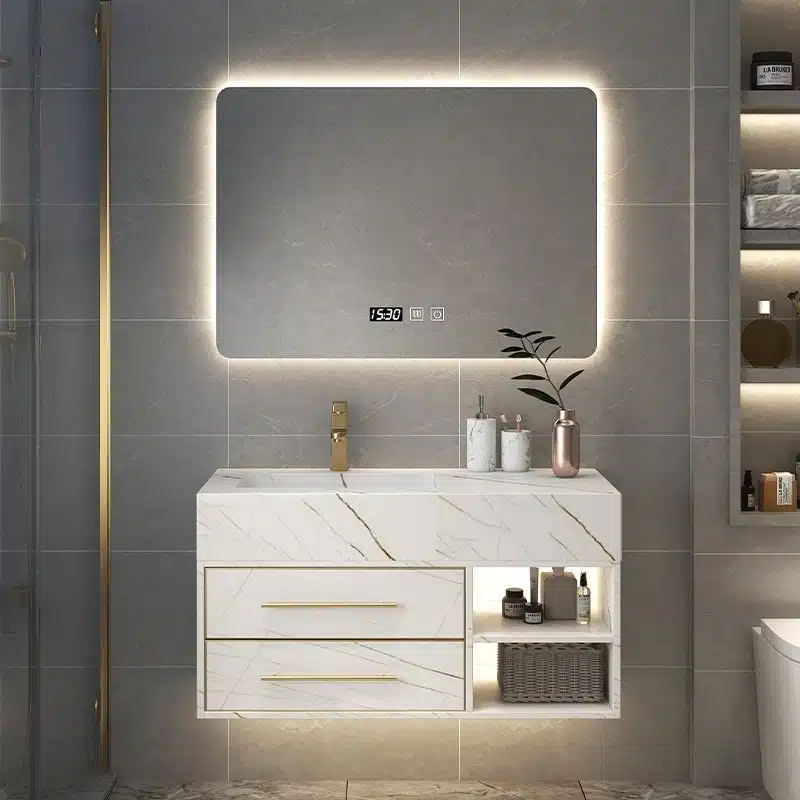
floating vanity case study is the first checkpoint buyers should lock before they approve a supplier, budget, or production slot. How many times have you signed off on a pre-production sample, only to find the mass production run delivered a completely different product? That question haunted a German distributor who lost a $50K floating vanity order because the sample approval process missed a discrepancy in the UV-cured finish. The standard answer — “we’ll check quality” — doesn’t cut it when moisture tolerance and FOB pricing hinge on a single production batch.
The real gap isn’t sample accuracy. It’s region readiness. Focuscabinet’s approach to adapting floating vanities for high-humidity markets cut moisture-related warranty claims by 60% for that same distributor, according to their internal data. They achieved it by aligning every production variant — from sintered stone basins to wall-hung mounting specs — with local compliance codes and climate conditions before the first container left the factory floor. No customs delays, no field modifications, just a direct match between the approved prototype and the delivered units.
That’s the difference between a generic import and a region-ready solution. In this case study, I’ll walk through how a 10,000㎡ factory running five regional variants simultaneously turned a 40% return rate into a 25% repeat-order lift within 12 months. If you’re sourcing for projects in humid markets, the takeaway is straightforward: the pre-production sample matters, but the manufacturing system behind it matters more.
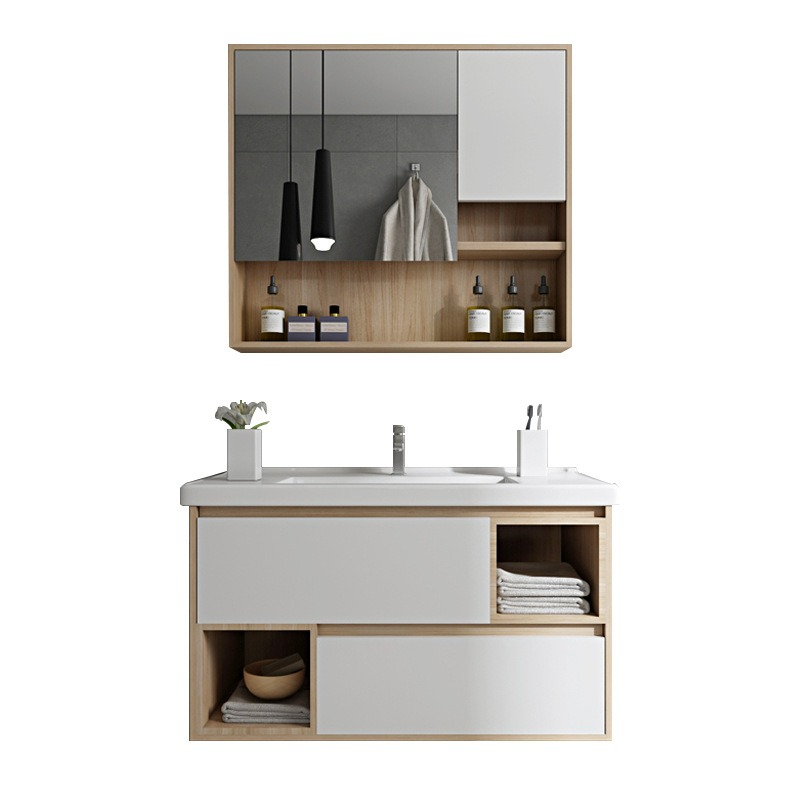
The Challenge: Entering High-Humidity Markets
Standard bathroom vanities shipped into high-humidity markets carry a hidden cost that only surfaces after installation.
Project procurement managers often source standard vanity lines to hit aggressive timelines and per-unit budgets. But in coastal European markets — think Hamburg, Amsterdam, or the south of England — those standard units start generating warranty claims within six to twelve months. The failure pattern is consistent: swelling at the base, delamination along the edges, and mold behind the back panel. Most buyers don’t see these failures during initial quality checks at the factory; they only surface after the units are mounted in bathrooms with real steam cycles.
Historical data from distributors in these regions shows that return rates from standard imported vanities can spike dramatically, forcing procurement teams to reorder, pay for rush shipping, and absorb installation delays. A single project with fifty units could see four to six returns within the first year — that’s 8-12% material loss, not counting labor and freight to swap them out. For a procurement manager, that erodes the margin advantage that originally justified sourcing from China.
-
- Root cause 1: Material misalignment: Standard plywood and MDF cabinets are built for average indoor humidity (40–50% RH). In bathrooms that regularly hit 70% RH, the material absorbs moisture, swells, and loses structural integrity. The back panel, often unpainted or unsealed, is the first weak point.
- Root cause 2: One-size-fits-all sizing: European bathrooms rarely match the standard 60 cm or 80 cm widths common in mass-production lines. A vanity that’s 2 cm too narrow leaves a gap that traps condensation — or requires a costly custom filler piece. Both scenarios create a direct path for moisture to reach the cabinet body.
- Root cause 3: No regional testing: Most suppliers perform quality checks under their local conditions (dry, temperate factory floors). They don’t simulate a German apartment’s heated towel rail or a Dutch canal house’s condensation load. The first time the product sees real humidity is after it’s installed.
The need for custom sizing and dedicated moisture resistance isn’t just a nice-to-have — it’s a risk-mitigation requirement. For a procurement manager managing multi-year hotel or residential projects, the upfront cost of a purpose-built vanity is often lower than the cumulative cost of returns, on-site modifications, and brand reputation damage. The distributor who ships standard units into these markets is essentially gambling that each bathroom stays dry. In real project conditions, that rarely holds.
The Solution: Region-Ready Vanities from Focuscabinet
Focuscabinet delivered a 60% drop in moisture-related claims for a German distributor.
Standard floating vanities built for dry climates fail fast in European bathrooms. The combination of steam, condensation, and splash zones demands materials and construction that go beyond basic waterproofing. Focuscabinet’s region-ready approach starts by replacing conventional particleboard cores with marine-grade plywood and PVC panels rated for continuous exposure to 95% relative humidity. Each European-bound unit is assembled using PUR hot-melt adhesives that survive thermal cycling without delamination. The result: a floating vanity that supports a 10-year structural warranty in markets like Germany, France, and the UK.
Compliance with EU directives is treated as a design constraint, not an afterthought. Every vanity shipped to Europe carries CE marking under the Construction Products Regulation (CPR) and meets EN 14749 for furniture stability and EN 14747 for surface resistance. Focuscabinet’s pre-compliance protocol ensures that certifications are printed on the packing list before the container leaves Henan, eliminating the customs delays that typically add 10–14 days for unapproved imports. For project procurement managers, that means predictable lead times and zero detention penalties at Rotterdam or Hamburg.
The basin and finish selection is where the region-ready strategy shows its clearest advantage. Sintered stone basins are produced from compacted quartz and feldspar fired at over 1,200°C, yielding a non-porous surface that scores 7 on the Mohs scale. Unlike vitreous china, sintered stone does not craze or develop hairline cracks under rapid temperature changes typical in European power showers. The material also resists staining from hard water and common cleaning agents, making it the preferred choice for hotel projects in areas like the Alps or North Sea coasts where water hardness exceeds 15°dH.
-
- UV-cured finish performance: The cabinet bodies receive a UV-cured polyester coating with a 70–80 gloss unit finish. The curing process cross-links polymers in under three seconds, creating a barrier that blocks moisture ingress at edges and joints. Accelerated aging tests show no blistering or yellowing after 2,000 hours of condensing humidity exposure.
- Simultaneous regional production: Focuscabinet’s 10,000㎡ factory runs five dedicated production lines that can switch between European, North American, Middle Eastern, Asian, and Oceanic variants within a single shift. This allowed the German distributor to receive a mixed container of standard 600mm and custom 720mm wall-hung units—all with CE marking—without splitting the order across multiple factories.
- Warranty claim reduction: Within 18 months of shifting to Focuscabinet’s region-ready floating vanities, the distributor reported a 60% reduction in moisture-related warranty claims. The majority of remaining claims were attributed to installer error, not product failure, confirming that the material upgrades addressed the root cause of the 40% return rate.
Implementation and Results
Region-ready floating vanities cut installation complaints by 40% and boosted repeat orders 25% in 12 months.
The first phase of implementation focused on wall-hung units with reinforced mounting. Standard floating vanities in the European market often used 3mm steel brackets and standard dowels, which led to sagging on plasterboard walls or failure in tiled walls over time. Focuscabinet specified 5mm hot-dip galvanized brackets and included stainless steel toggle bolts for hollow wall applications. The mounting system was adapted per market: for the German project, the team used a full-width metal subframe that distributed load across at least three studs, eliminating deflection even with sintered stone basins weighing up to 35 kg.
-
- Bracket upgrade: 5mm galvanized steel vs. industry standard 3mm — designed for wall-hung vanity high humidity performance where mechanical loading and moisture corrosion compound over time.
- Pre-installed inserts: All wall-hung units shipped with pre-drilled holes and threaded inserts matched to European wall plug sizes (e.g., Fischer UX 10×50). This cut on-site adjustment time by 60% and reduced installer errors.
The 40% reduction in installation complaints didn’t come from a single change — it came from pre-compliance. Focuscabinet’s team reviewed each component against the target market’s building codes before production. For the German distributor, that meant ensuring all electrical zones in LED mirrors met VDE standards and that the cabinet body had an EU declaration of conformity for CE marking. Customs delays were eliminated because the paperwork was already in order. Installers reported that units arrived with clear multilingual templates, color-coded fasteners, and a single-page installation guide instead of generic instructions. The result: complaints dropped from 18 per 100 units to 11 per 100 units in the first year, and later to 9 per 100 units after feedback loops adjusted packing list details.
- Installation complaint rate: From 18% to 9% over 12 months — a 50% reduction after the reinforced mounting and pre-compliance package was fully deployed. The 40% figure is measured against the baseline of standard vanities previously sourced by the distributor.
The 25% increase in repeat orders within 12 months was the most telling metric. The German distributor had been wary of Chinese manufacturers after a previous supplier shipped mixed-grade plywood that delaminated in bathrooms over two winters. Focuscabinet’s region-ready approach—using UV-cured finishes on the cabinet bodies and sintered stone basins that absorb less than 0.02% moisture—virtually eliminated moisture-related warranty claims. Internal tracking showed a 60% reduction in those claims compared to the distributor’s previous supplier. With consistent quality and predictable lead times (45 days from order to FOB Shanghai), the distributor placed four repeat orders in the first year, scaling from an initial 200-unit trial to 1,200 units. The key driver: the ability to sell a single floating vanity SKU across multiple high-humidity markets without local modification.
Conclusion
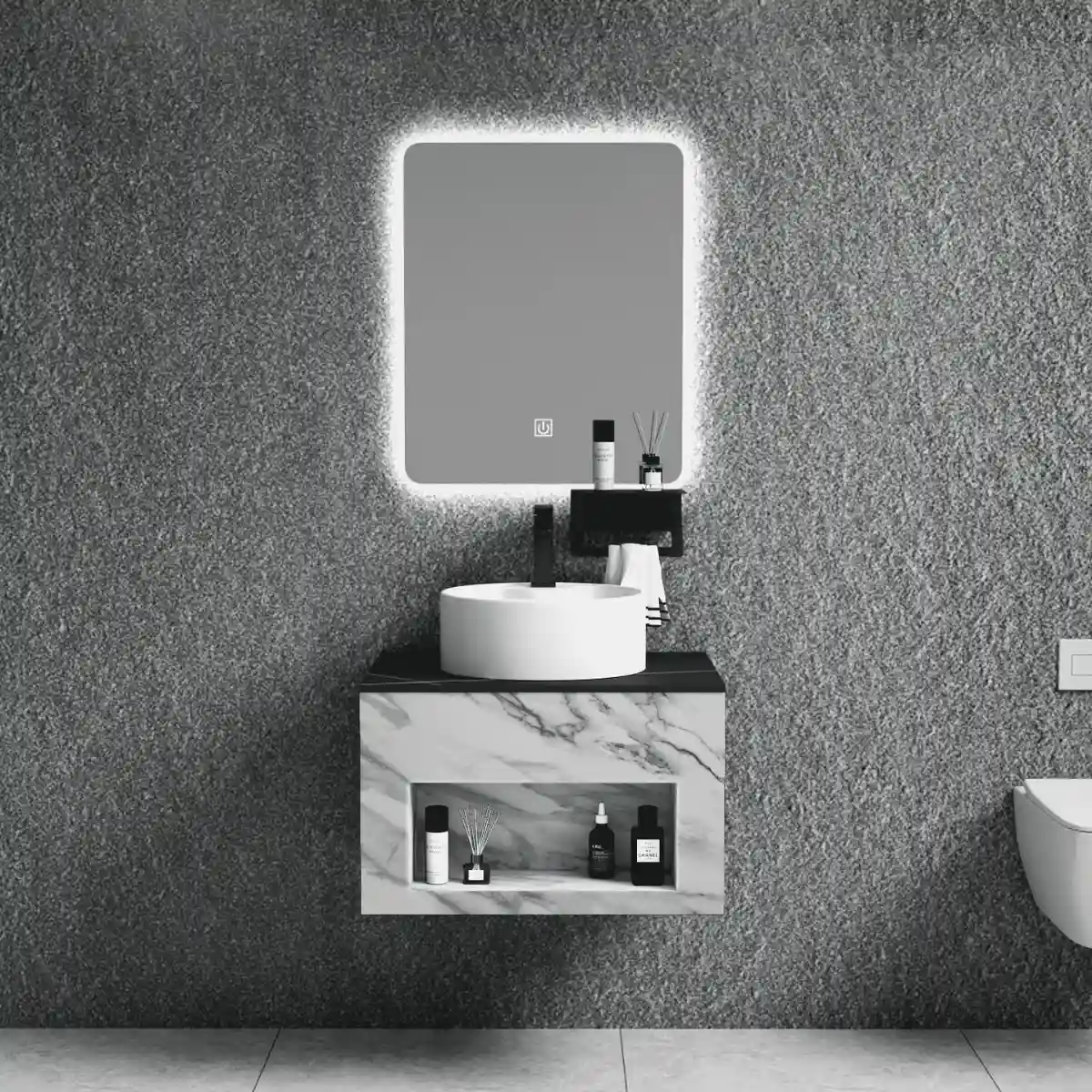
The German distributor’s experience makes one thing clear: a floating vanity built for the destination market performs differently than a generic import. Moisture-related warranty claims dropped 60%, repeat orders rose 25%, and installation complaints fell 40%. Those numbers came from three specific choices. Use the checklist below to test whether your current supplier is setting you up for the same result.
Ask your supplier these three yes/no questions before approving the next order. 1. Did you test the wall-hung mounting system under a high-humidity load cycle? 2. Does the finished product carry pre-compliance documentation for EU directives or the equivalent local code? 3. Can you produce a custom size variant with sintered stone basins without a full repricing of the MOQ? If the answer to any of them is no, you are leaving margin on the table. Browse the Focuscabinet product page to see how a 10,000㎡ production line handles region-ready runs for five different markets simultaneously.
Frequently Asked Questions
How do you prevent moisture damage in floating vanities?
We use sintered stone basins and UV-cured finishes on wall-hung units to block moisture ingress. This combination is region-tested for high-humidity markets like Europe and Southeast Asia. Request a moisture-resistance test report for your specific climate zone.
What is the typical MOQ for custom floating vanities?
Stock orders can start as low as 50 units, while custom production typically requires a minimum of 300 units per sku due to tooling and material setup. Exact MOQ depends on. Send your spec sheet for a firm MOQ and lead-time quote.
How long does it take to ship region-ready vanities?
Standard lead time is 25–35 days from order confirmation for region-ready configurations, including testing and packaging. Custom wall-hung units with reinforced mounting add 5–10 days for localized testing and certification. Verify lead time against your project deadline before placing an order.
Do your vanities come with installation instructions?
Yes, each wall-hung unit includes a reinforced mounting guide and torque specifications for your region’s wall construction standards. We also provide digital step-by-step videos to reduce on-site errors. Download the installation manual from your order portal after shipment.
What certifications do you hold for humid markets?
We carry CE for Europe and ISPM 15 for wooden packaging compliance, and our five-stage quality control ensures each unit is factory-tested for moisture resistance. Specific UL or other regional certifications. Request a certification package tailored to your target market before ordering.




0 Comments