

Here is the uncomfortable truth about cabinet box joint construction: in a bathroom vanity, the joint is rarely the first thing to fail. Moisture reaches the panel edge and the glue line long before any dovetail or dowel gives up. Pick the wrong joint, though, and the mistake still surfaces — as racking, corner gaps, or a drawer that binds — usually within two to three years of daily showers.
This guide compares the three carcass joint systems buyers meet on the factory floor: dovetail, dowel, and joints cut on CNC (computer numerically controlled) machines. It explains where each one earns its keep, where it fails, and how the choice interacts with board material, edge sealing, and drawer hardware. The verdict matters more on a bulk order than on a single retail purchase, because a joint failure never arrives alone. It arrives as a container of complaints.
The Three Joint Systems Explained at the Bench
Every vanity carcass is a box of four or five panels held together by geometry, glue, and fasteners in some ratio. That ratio defines the cabinet box joint construction you are actually buying, and it predicts how the box behaves years after installation. Spec sheets rarely name the joint system, yet it decides whether a door stays square after five years of humidity. The three systems below cover almost everything a B2B buyer will meet on a factory floor.
Dovetail: Geometry That Holds After the Glue Ages
A dovetail joint cuts wedge-shaped pins into one board and matching tails into the other, so the two pieces interlock like a three-dimensional puzzle. The flared geometry resists pull-apart along one axis through shape alone, with no help from adhesive. Machine cutting preserves that geometry while running far faster than hand work — the dovetail joint entry on Wikipedia traces the craft from timber framing into cabinetmaking.
The interlock is the whole point in wet rooms. Adhesives age badly under humidity cycling, but wood geometry does not degrade at all. A dovetailed corner keeps carrying load even after its glue line gives up, which is why the joint survives on century-old furniture. Premium solid wood lines lean on exactly that story at the showroom.
One constraint deserves respect. Dovetails lock one axis firmly and rely on glue for the other, so they reward precise cutting and punish sloppy tolerances. Ask any factory how it cuts them: dedicated dovetailing machines produce consistent pins, while improvised routing shows up as visible gaps at the corner.
Dowel: Alignment Pins Riding Entirely on Adhesive
Dowel joinery drills matching holes in both panels, inserts cylindrical hardwood or composite pins, and bonds the whole assembly with adhesive. The pins mostly keep panels aligned; the glue carries the structural load. Fit decides everything, because holes off by a fraction of a millimeter produce corners that rack the first time an installer lifts the unit.
The weakness follows directly from that design. A doweled corner is only as durable as its glue bond, and bathroom humidity attacks glue bonds before anything else. The Wikipedia reference on dowels describes the pin as a load-transfer element that depends on adhesive. In a wet room, that load path is the first one to watch.
None of this makes dowel joinery useless. It works well in dry-service furniture, and it keeps hardware costs low. The mistake is specifying it for bathroom carcasses on price alone — if a supplier quotes doweled construction for a wet-room project without edge-sealing documentation, treat the quote with suspicion.
CNC-Machined Carcasses: Precision Cuts Plus Fasteners
CNC machining routes every panel on a computer-controlled bed, cutting dados and rabbets and boring holes for cam locks or confirmat screws with repeatable accuracy. Strength comes from cut precision, fastener clamp force, and — decisively — how the panel edges get sealed afterward. No single heroic joint holds the box together; the system does.
Consistency is the property B2B buyers should care about. A hand-cut joint varies with the operator, whereas a CNC program repeats the same tolerances at unit one and unit one thousand. That repeatability turns quality control into a sampling exercise instead of a piece-by-piece gamble.
The trade-off lives in setup. Programming and fixturing cost real money, so machined carcass systems reward factories running volume — exactly the profile of an OEM vanity line shipping containers rather than individual pieces.
Why Bathrooms Punish Cabinet Joints Differently
A bathroom is the harshest room in any building for wood-based furniture. Hot showers push relative humidity toward saturation, and ventilation pulls it back down — a full swelling and shrinking cycle, twice a day, every day. Cleaning chemicals splash across panel edges in the same room, and condensation settles on any surface below the dew point, including the inside of the cabinet under a cold basin.
The damage concentrates at two spots: the glue line and the panel edge. Particleboard and plywood both swell at exposed edges first, and swelling generates forces that no joint geometry was designed to absorb. The sequence is predictable. An edge swells, the panel pushes against the joint, the glue line cracks or a fastener loosens. A corner then opens, moisture penetrates deeper into the board, and the whole cycle accelerates.
Adhesive chemistry sets the pace. Standard PVA (polyvinyl acetate) wood glues soften with repeated moisture exposure, while PUR (polyurethane) adhesives resist it far better — a typical industry distinction worth knowing before comparing quotes. Ask which glue a factory runs on bathroom lines, and ask how panel edges are sealed, because those two answers predict joint life more accurately than the joint name itself.
Installation adds one more load that buyers forget. A vanity carcass gets lifted, twisted through doorways, and clamped to walls that are rarely flat. Every one of those forces lands on the corners — the exact points where joint geometry, glue, and fasteners all meet.
That sequence carries one practical conclusion. Panel swelling precedes joint failure, so edge sealing belongs inside the joint design rather than appended to it as a cosmetic step. A sealed carcass with an ordinary joint will outlive a dovetailed box with raw edges in the same room. Evaluating joints without evaluating edge banding means grading the exam on the wrong subject.
Dovetail vs Dowel vs CNC-Machined Joints Compared
The table below compresses cabinet box joint construction into the four variables that decide real-world performance: mechanical interlock, moisture failure mode, structural behavior under load, and cost driver. Treat it as the spine of this decision; the sections that follow unpack each row.
Dovetail vs Dowel vs CNC-Machined Joint Systems Compared
| Joint Type | Mechanical Interlock | Moisture Failure Mode | Main Cost Driver |
|---|---|---|---|
| Dovetail | High — pins and tails lock mechanically | Glue degrades slowly; interlock keeps carrying load | Dedicated cutting time and tooling |
| Dowel | Low — pins align panels; adhesive carries load | Glue line softens and cracks under wet cycling | Drilling precision and fit tolerance |
| CNC-machined | Medium — depends on dado depth and fasteners | Fasteners loosen when edge swelling opens joints | Machine programming plus edge banding |
The table makes the bathroom verdict plain. CNC-machined carcasses with sealed edges are the most stable choice for volume bathroom projects, because their strength does not sit in a glue line that humidity can digest, and because cut precision keeps every unit inspectable. Dovetail wins wherever adhesive is the risk — drawer boxes and premium solid wood lines. Dowel is the weakest of the three in wet service, because its entire structural budget sits in the one element the bathroom attacks first. None of this makes dovetail inferior; it makes dovetail specialized.
Which Joint Fits Which Buyer
- Project and hospitality buyers ordering hundreds of identical units: CNC-machined carcasses with full edge banding, because consistency scales and inspection stays fast.
- Distributors running a premium solid wood line: dovetailed carcasses and drawer boxes, where the visible interlock supports a higher price point.
- E-commerce and white-label brands: machined construction tuned for shipping damage resistance rather than showroom craft.
- Buyers in coastal or tropical markets: whichever joint you pick, specify waterproof edge sealing and moisture-resistant board before negotiating price.
Match the Joint to the Carcass Board
Joint choice never happens in isolation, because the board decides which joints are even practical. MFBATH runs three carcass families — plywood, solid wood, and PVC board — and each one pairs differently with the joint systems above.
Plywood Carcasses Hold Fasteners and Stay Calm
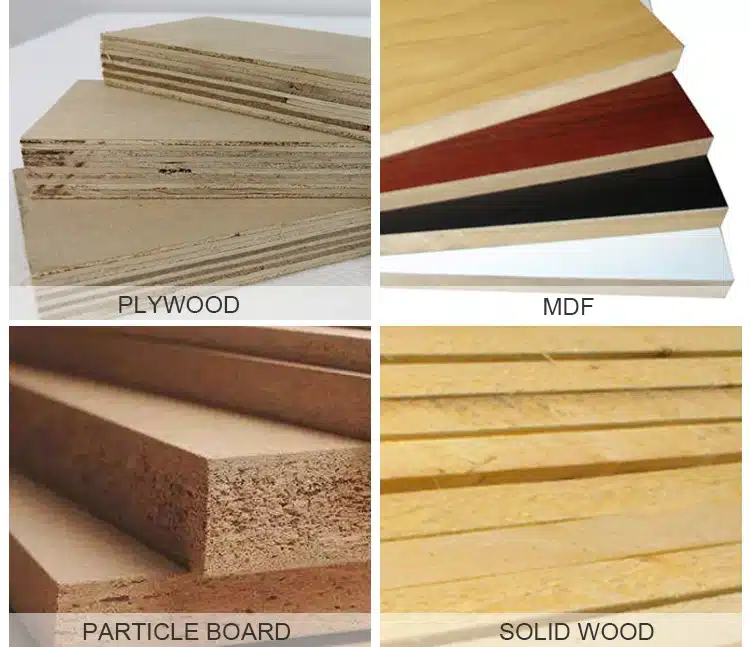
Cross-laminated plywood holds screws far harder than particleboard, which is exactly why machined joints perform on it. MFBATH offers plywood vanities in standard, BWR (boiling-water-resistant), and marine-grade boards, rated E1 (≤0.1 ppm) and CARB (California Air Resources Board) Phase 2 for formaldehyde emissions, with optional FSC (Forest Stewardship Council) certification, 15 standard finishes, and waterproof edge banding built into construction.
Grade selection should follow the room. BWR boards resist boiling-water exposure, which matters for hotel bathrooms where hot-water plumbing runs inside the vanity. Marine-grade ply sits at the top of the moisture ladder. The BWR vs marine-grade plywood comparison breaks down where each grade pays for itself.
Solid Wood Carcasses Let Dovetails Earn the Premium
Solid oak, walnut, maple, and ash move with ambient humidity — boards expand and contract across the grain as seasons change. Dovetail interlocks tolerate that movement better than glued butt joints, and the visible joint doubles as a craftsmanship story on premium lines. MFBATH solid wood vanities in these four species carry a multi-layer polyurethane (PU) waterproof coating that protects surfaces while the joinery handles structure. The solid wood vs MDF vanity guide covers the material decision in full.
PVC Board Removes the Swelling Variable Entirely
PVC board absorbs no water at all, so the swelling failure mode that punishes wood joints simply does not exist here. The joint conversation shifts to machining accuracy, adhesive compatibility with a plastic substrate, and sensible fastener spacing to keep the box stiff. The PVC vs plywood vanity guide weighs the two materials side by side.
For high-humidity markets, that makes PVC carcasses the lowest-risk pairing with any joint system. The board removes the failure mode the joint would otherwise have to manage on its own.
Spec Your Vanity Carcass with Factory Support
Browse this product, solution, or service page to explore relevant offerings.
Drawer Boxes Deserve a Separate Conversation
Carcass joints carry static loads; drawer joints carry dynamic ones. A drawer box absorbs a pull-out tug every single use, with the front panel levering against the side joints, day after day for a decade. That load profile is exactly what dovetail interlock resists, which is why dovetailed drawer boxes remain the premium standard even in factories that machine everything else.
Hardware choice interacts with the joint decision. Under-mount slides hide below the box and clamp the drawer bottom, while side-mount slides fix to the box walls and route pull-out torque straight into the side joints. Soft-close dampers add a controlled deceleration at the end of every cycle, cutting the slam loads a joint must absorb. The under-mount vs side-mount drawer slide guide and the soft-close vanity hardware guide cover both decisions; MFBATH ships soft-close doors and drawers as available options across its vanity lines.
Construction style matters too. Frameless carcasses expose the joint line at the box edge, so joint quality becomes a visible finish detail; framed construction hides it behind the face frame. The frameless vs framed vanity comparison maps that choice to market expectations.
Drawer box material follows the same logic as carcass board. Plywood boxes with sealed edges shrug off bathroom humidity; raw particleboard boxes swell at the bottom edge where condensation collects. Specify the box material with the same rigor as the slide.
How to Spec and Verify Joints Before Ordering
For commercial and project-volume orders, the cabinet box joint construction decision follows cost-performance logic. CNC-machined carcasses with disciplined edge banding offer repeatable cuts, predictable inspection, and no critical skill concentrated in individual operators. Reserve dovetail joinery for solid wood lines and drawer boxes, where it functions as a visible premium feature buyers pay for. Specify dowel construction only with a supplier who can evidence the glue process — ask for pull-test records before the order, not after the container ships.
What to Inspect on the Sample
Four checks expose most joint problems. First, pull and wiggle each assembled corner by hand; any detectable movement means the joint is riding on hope. Second, inspect edge banding along every exposed edge, because gaps at corners are moisture entry doors. Third, hold a bright light against outside corners and look for daylight gaps. Fourth, confirm fasteners sit flush and glue squeeze-out is cleaned off — residual glue blocks finishes and hides cracks forming underneath.
Verifying Quality From Across an Ocean
Distance changes how verification works, not whether it works. Request quality control (QC) photos and video of assembled carcasses before packing, and schedule third-party inspection through SGS or TÜV when the order size warrants it — MFBATH arranges both, and runs a five-step inspection on every unit before shipment. A physical sample still settles arguments faster than any spec sheet. Samples are free, ship in 10 working days, and production orders carry a 2-year whole-cabinet warranty backed by a return rate under 1%.
Order structure helps too. Custom dimensions, colors, materials, logos, and packaging all start at 15 sets per specification, with a minimum order quantity (MOQ) of 15 sets per model, color, and size. Mixed containers are accepted, so several models and sizes can share one shipment once the total volume meets the threshold — a practical way to test a new joint specification without committing to a full single-SKU container.
Put the joint specification in writing on the purchase contract: joint type, board grade, edge sealing method, and glue type. Ambiguity in the spec sheet becomes ambiguity in the container, and containers are expensive places to discover a misunderstanding.
Frequently Asked Questions
Is dovetail joinery always more expensive and more durable?
Not automatically. Machine-cut dovetails cost far less than hand-cut ones, and durability depends on board quality and edge sealing as much as joint geometry. Dovetail’s true advantage is carrying load after adhesive ages, which matters most on drawer boxes.
How can I verify joint quality before the goods ship?
Request QC photos and video of assembled carcasses, then book SGS or TÜV third-party inspection for large orders. MFBATH supports both. A free sample arrives in 10 working days so you can pull, wiggle, and measure a real joint.
Do custom sizes change which joint to specify?
They do. Custom dimensions alter panel span, fastener spacing, and door alignment, so joint geometry needs re-engineering rather than stretching. MFBATH handles custom sizes, colors, materials, and logos from 15 sets per specification, keeping engineering cost proportional to order size.
Conclusion: Match Joints to Moisture, Not Marketing
The three joint systems solve three different problems. Dovetail answers glue aging with mechanical interlock, dowel answers cost pressure with simple alignment, and CNC machining answers volume with repeatability. In a bathroom, where humidity cycles attack glue lines and panel edges first, repeatability plus sealed edges is the combination that survives.
- Dovetail interlock keeps carrying load after adhesive ages, making it the strong call for drawer boxes and premium solid wood lines.
- Doweled corners ride entirely on the glue bond — the exact element bathroom humidity destroys first.
- CNC-machined carcasses with intact edge banding deliver the most stable cost-performance for volume projects in wet rooms.
- Verify through pull and wiggle tests, edge banding checks, QC photos and video, and SGS or TÜV third-party inspection; MFBATH samples are free and ship in 10 working days.
Send your carcass specification and target board grade to the MFBATH team for a joint recommendation matched to your market. Samples cost nothing, and every production order carries a 2-year whole-cabinet warranty.




0 Comments