

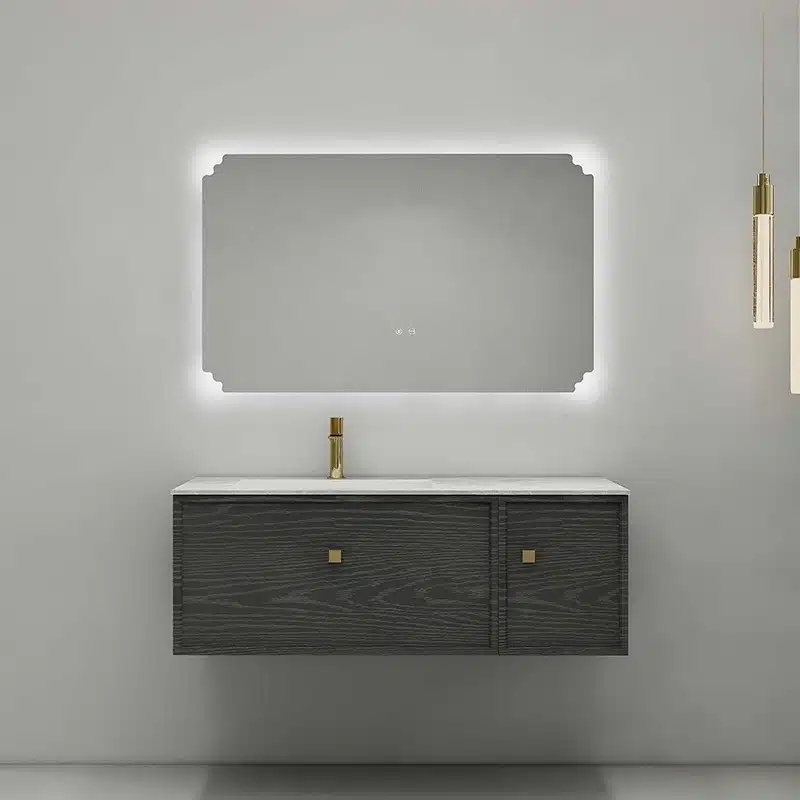
Distributors planning their 2027 product mix face a familiar problem: the finishes that moved well last season are not necessarily the ones buyers will request next year. Order the bathroom vanity wood finish trends 2027 wrong and you are not guessing — you are locking inventory into a style cycle that has already turned. This guide maps where wood finishes are heading, which directions are safe to stock, and the orderable specs behind each trend.
The reference points come from order patterns at Main Focus Cabinet (MFBATH), a vanity factory in Changge, Henan, China, operating since 2015 and serving 1000+ dealers across 20+ countries. These are the numbers buyers actually order against: standard finish counts, custom-color minimums, sample and production lead times, and compliance thresholds. None of them is a projection; each one is a working condition of a real order. Read them as a brief before you brief your supplier.
Key Takeaways
Six numbers summarize the 2027 finish picture. Skim them before the detail, then use them when you brief your factory.
- Warm natural oak with visible grain leads the direction, and solid wood models ship in 20 standard finishes — the safest bets are already in the catalog, not waiting on a custom program.
- Custom colors for PVC and solid wood start at 15 sets per color, which keeps custom programs practical for regional buyers and small launches.
- The MOQ (minimum order quantity) is 15 sets per model, color, and size, with mixed loading allowed, so one container can test several directions at once.
- Free samples arrive within 10 working days; bulk production runs 20–30 days; total lead time to the US, Canada, and Mexico is 4–6 weeks.
- Emission specs cover North American requirements: E1 at or below 0.1 ppm, CARB Phase 2, TSCA Title VI, and low-VOC finishes.
- The factory has held ISO 9001 certification since 2017, confirmed valid in 2025, and every product passes 5 inspection checks before shipping.
Table of Contents
Jump straight to the section you need.
- Where Wood Finishes Are Heading in 2027
- Four Finish Directions to Watch
- Translating Trends into Orderable Specs
- Matching Finish Trends to Your Market
- Frequently Asked Questions
- The Bottom Line
Where Wood Finishes Are Heading in 2027
Finish trends in the vanity market turn on the same signals as the rest of the home category, but they arrive with a delay that distributors feel as inventory risk. For 2027 the signals are consistent: buyers want warmth back, they want to see the wood, and they want surfaces that shrug off humidity. The bathroom vanity wood finish trends for 2027 lean toward natural, tactile, and serviceable — a deliberate move away from the cool gray and flat-color era that filled so many catalogs.
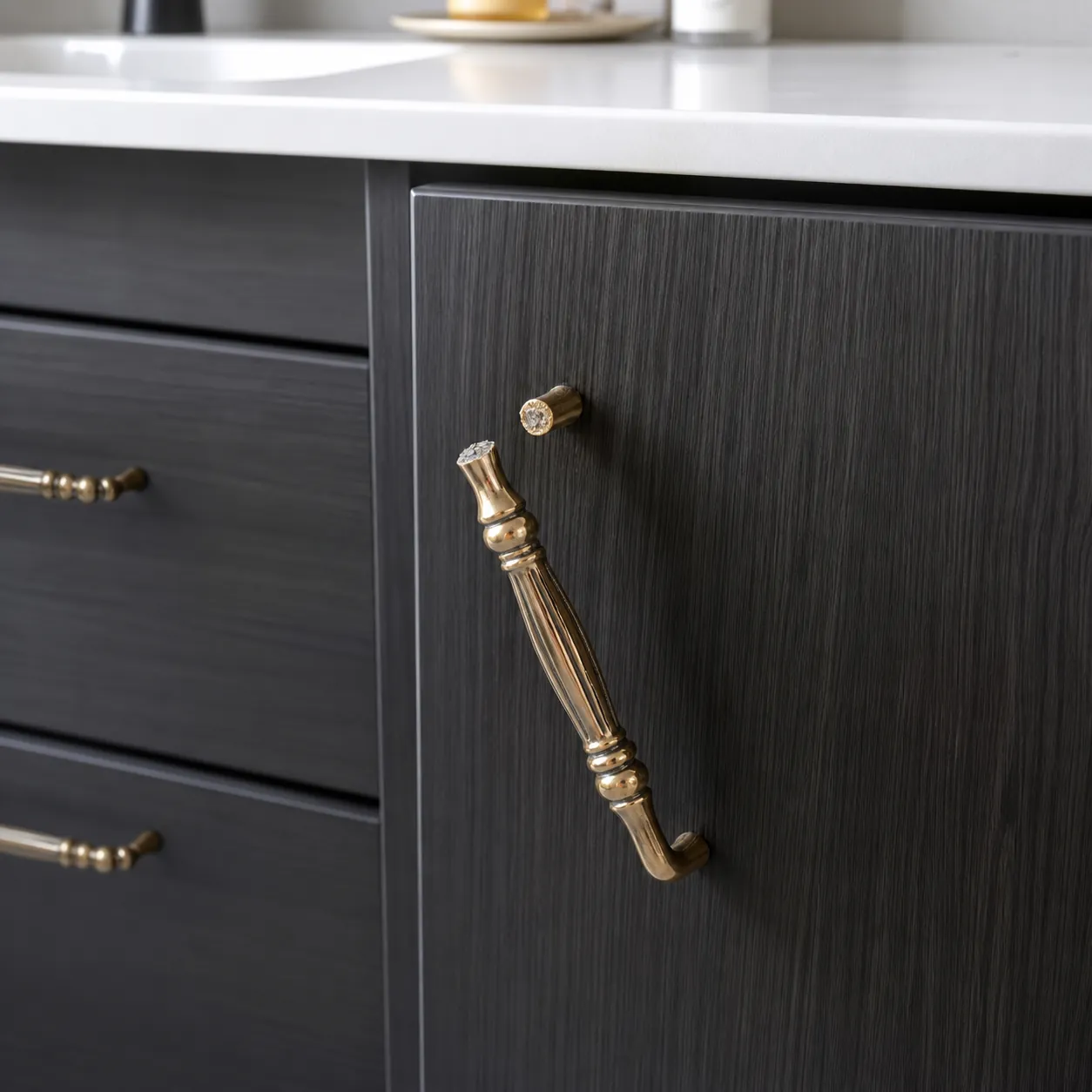
Warm tones replace gray
Gray and greige dominated vanity catalogs for years because they photographed well and looked safe next to any tile. The 2027 direction favors warm oak, honey, and caramel tones — wood that reads as wood at a glance. If a customer still orders gray, treat it as the exception rather than the signal. Warm neutrals with amber undertones are the safer inventory bet, and they pair naturally with the brass and black hardware buyers are specifying.
Visible grain comes back
Flat, opaque finishes hid the material. The current direction does the opposite: open-pore oak, pronounced cathedral grain, and topcoats that let light catch the texture. Visible grain also simplifies the sales story — a customer can see why the cabinet costs what it costs. Solid wood carries this direction naturally, and plywood with wood-grain PVC reaches the same look at a lower price point for volume programs.
Matte over high gloss
High-gloss lacquer keeps its niches in modern bathrooms, but matte and satin sheens carry most 2027 orders. Matte surfaces show fewer fingerprints, read as more expensive in photos, and tolerate the hard water and cleanser contact a bathroom produces. Satin sits between the two and remains a safe middle option for distributors unsure of their market’s taste.
Durability is part of the trend
A finish trend only works if the finish survives the room. Solid wood vanities get a multi-layer PU waterproof coating, and that construction detail is what makes the natural-look finishes viable in a bathroom. When a buyer asks for light oak in a humid market, the honest answer is not just the color — it is the coating underneath that keeps the color from failing.
Why B2B finish trends move slower
Consumer furniture cycles move at retail speed; distribution cycles move at container speed. A finish that peaks in showrooms this year still has selling seasons left in wholesale channels, because distributors order ahead and sell through stock. That lag is an advantage: by the time a trend shows up in dealer catalogs, the factory specs and minimums behind it are already proven. For the broader picture of how 2027 styling splits between extremes, see our maximalist vs minimalist 2027 comparison.
One more shift matters before the directions themselves. The finish conversation has moved from decoration to specification: buyers ask what the coating is, which plywood grade is inside, and what the emission numbers read. A finish that cannot be written into a purchase order does not survive the buying process, no matter how strong the showroom display looks.
Four Finish Directions to Watch
Narrow the 2027 conversation to four finish directions, and each one maps to a spec you can actually order. The bathroom vanity wood finish trends in 2027 are not a dozen scattered looks; they are four repeating patterns, each with clear material and finish options behind it. Pick the directions that fit your customer base, then let the orderable details below do the rest.
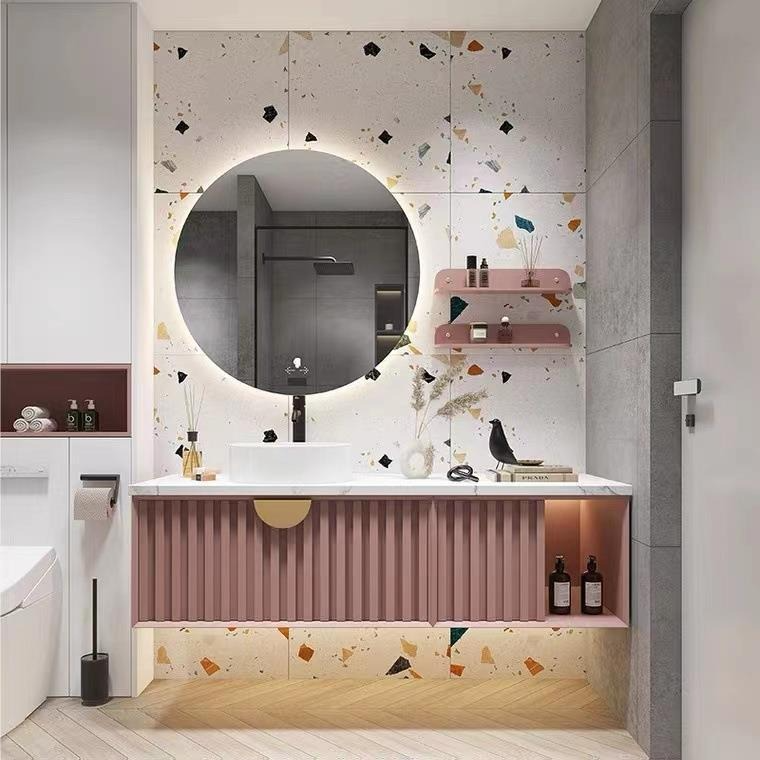
Warm natural oak with visible grain
Light oak anchors the 2027 palette. In solid wood, oak ships as one of 20 standard finishes spanning natural tones and white, with the grain showing through a matte or satin topcoat. For a closer look at how species behave in wet rooms, the oak vs rubberwood vs walnut guide covers the trade-offs. The orderable spec is simple: solid oak, natural matte finish, and a 15-set custom minimum if you need your own tone. This is the direction with the widest buyer base, so it belongs in the core of the lineup rather than the edges.
Dark walnut and smoked tones
The dark side of the trend is walnut and smoked oak, used for statement vanities, accent walls, and powder rooms where the cabinet is the focal point. Walnut’s rich brown reads premium without the maintenance story of black. Spec it as solid walnut, or as walnut-veneer plywood to control cost on larger pieces. Both paths clear the same 15-set custom-color threshold when a buyer wants a proprietary dark tone, and the finish holds its depth under the same multi-layer PU coating that protects the lighter looks.
Matte wood-tone finishes, including wood-grain PVC
Not every 2027 order will be solid wood, and the trend accommodates that. Wood-grain PVC offers 1000+ standard finishes — matte white, glossy black, and wood-grain patterns among them — and it is 100% waterproof. That is a decisive advantage in humid markets where solid wood depends on its coating story. For distributors serving rentals, hotels, or coastal regions, wood-grain PVC delivers the warm-wood look with lower service risk, and the matte sheen keeps it aligned with the 2027 palette.
Two-tone combinations with brass or black hardware
Two-tone schemes — a light oak body with a dark base or top drawer section, wood against a painted interior — extend one finish family across several price points. Hardware does the heavy lifting: brass and black fittings turn a standard cabinet into a designer piece. Finish, size, hardware, and logo placement all customize within the same minimum, and 40,000+ combination options keep a two-tone program proprietary without a full redesign. It is the smallest order line that often produces the highest margin per set.
Each direction above is orderable today through standard finishes, and none of them requires a gamble on an unproven material. The question for 2027 is not which look to chase; it is which of these four to weight first in your container.
Stock the 2027 Finishes
Browse this product, solution, or service page to explore relevant offerings.
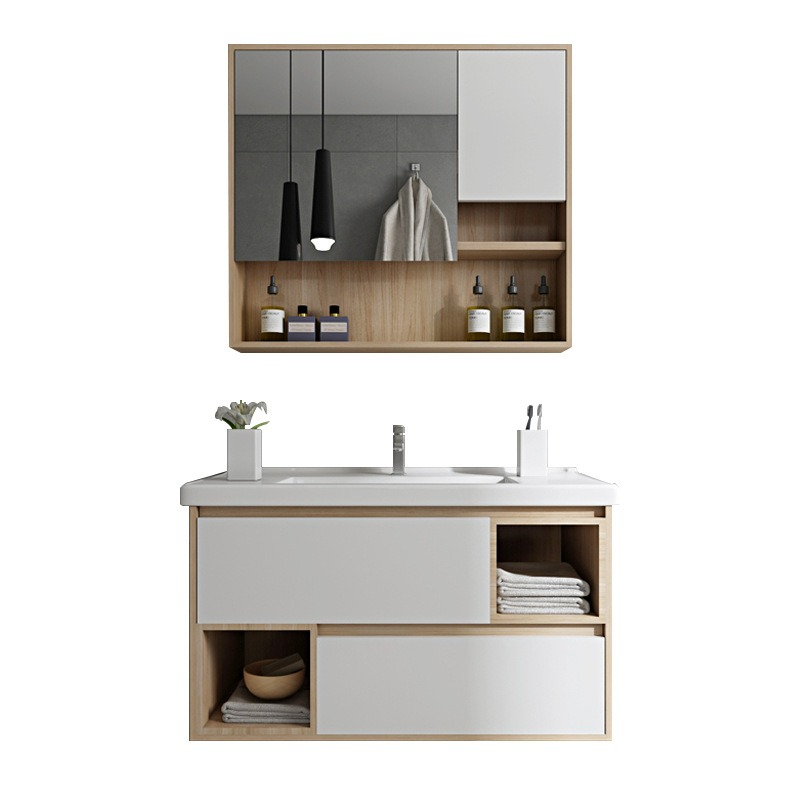
Translating Trends into Orderable Specs
A trend only becomes useful when it turns into a purchase order, and the translation is more direct than most buyers expect. The factory’s standard range already covers the 2027 directions: 20 standard solid-wood finishes, a 1000+ finish library for plywood programs, and 1000+ standard PVC finishes for volume lines. Custom work starts at 15 sets per color for PVC and solid wood, with Pantone color matching available when a brand needs an exact tone. For the full range of stockable models, start with the bathroom vanity product lines.
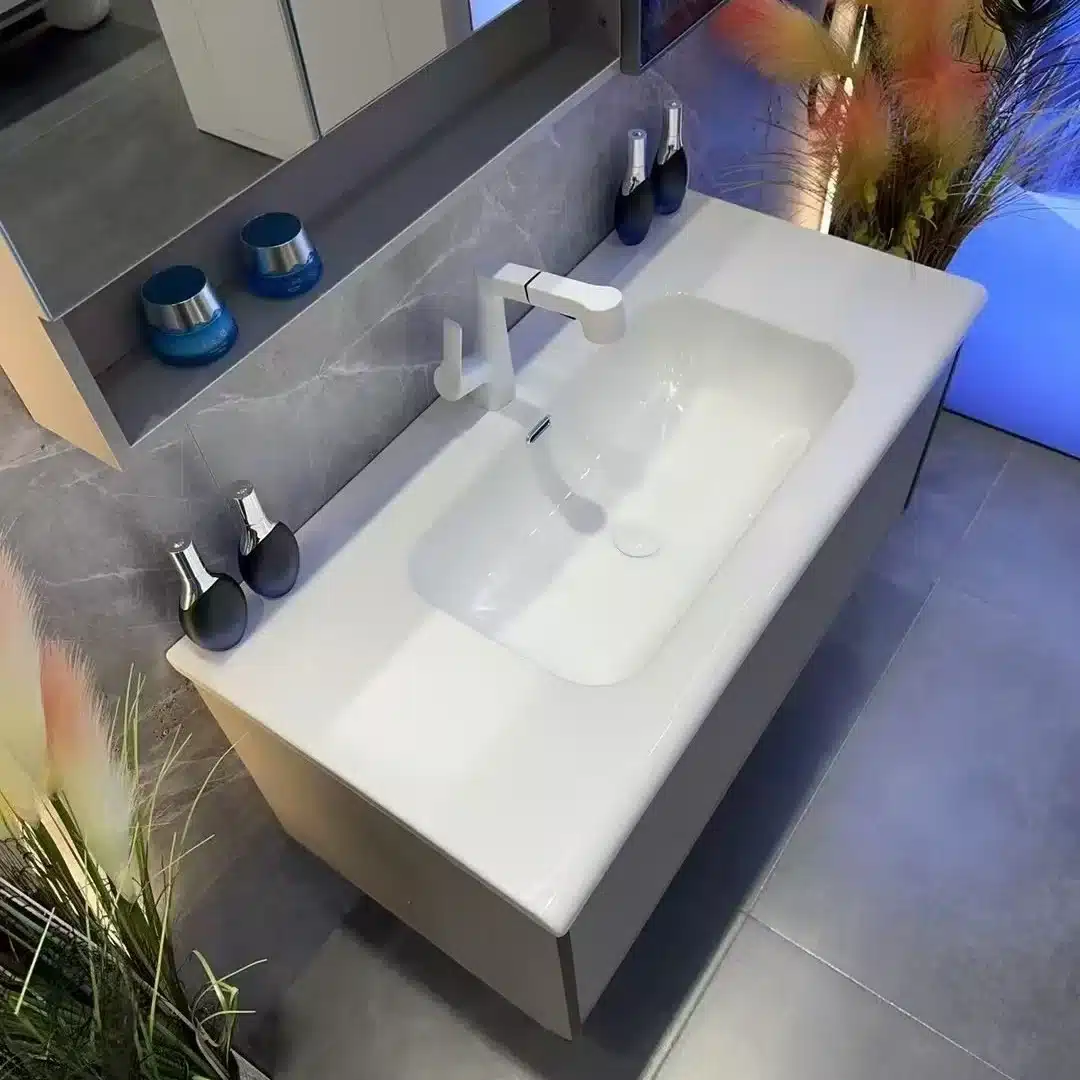
Standard finishes cover most orders
Solid wood ships in 20 standard finishes spanning natural tones, white, and the warm browns that anchor the 2027 palette. Plywood programs draw on a 1000+ finish library, and PVC adds 1000+ standard finishes of its own, including matte white, glossy black, and wood-grain patterns. In practice, most distributor orders land inside these standard ranges; custom color is the exception that solves a specific market, not the default. Ask your account manager which standard codes match the four directions above, and you will usually get a match without a custom program.
Custom colors from 15 sets
Custom colors start at 15 sets per color for PVC and solid wood, low enough for a regional launch. Plywood custom colors start at 50 units, so the 15-set threshold applies to most vanity programs. Pantone color matching keeps brand-specific tones consistent across repeat orders, and the same minimum covers wood type, finish, size, hardware, and logo engraving or printing. If the tone you need appears in the 2027 bathroom vanity wood finish trends mapping, it can be matched rather than approximated.
Wood type, sourcing, and compliance
Solid wood is available in oak, walnut, maple, and ash, all sustainably sourced, with an FSC (Forest Stewardship Council) option on request — see the FSC forest certification page for what the label covers. Compliance is standard rather than special: E1 emissions at or below 0.1 ppm, CARB Phase 2, TSCA Title VI, and low-VOC finishes across the range. Plywood grades add another layer of choice, from standard to BWR to marine, depending on the humidity your market expects.
Use this table as a shortlist when you brief your factory. Each row pairs a 2027 direction with a concrete orderable spec.
| Trend Direction | Recommended Wood or Material | Finish Spec | MOQ Note |
|---|---|---|---|
| Warm oak with visible grain | Solid oak or wood-grain PVC | Natural matte, within the 20 standard solid-wood finishes | 15 sets per model, color, size |
| Dark walnut and smoked tones | Solid walnut or walnut-veneer plywood | Custom dark tone from 15 sets, or standard library | 15 sets per model, color, size |
| Matte wood-tone finishes | Wood-grain PVC | 1000+ standard PVC finishes, 100% waterproof | 15 sets per model, color, size |
| Two-tone with brass or black hardware | Solid wood or plywood body | Finish pairing plus hardware and logo options | 15 sets per model, color, size |
The pattern across the table is deliberate: every trend row leads back to a standard finish, a custom minimum, or a material grade you can order in writing. That is the difference between following bathroom vanity wood finish trends 2027 and actually ordering them.
Planning the timeline matters as much as picking the finish. Samples ship within 10 working days, bulk production takes 20–30 days, and the full lead time to the US, Canada, and Mexico runs 4–6 weeks. Map that against your selling season: a finish ordered in January can be on your dock in time for spring promotions, while the same order placed late lands in the summer lull.
Matching Finish Trends to Your Market
The right finish for your market is the one your customers can sell, and that depends on how you test, what your region demands, and how much of your lineup you rotate. Four habits separate distributors who profit from a trend cycle from those who get stuck holding it.
Sample before you commit
Free samples arrive within 10 working days, which makes sample-first the least expensive insurance in the buying process. Request the finishes you are considering, compare them under your showroom lighting, and check them against the tiles and countertops your customers pair with them. Ten working days is a short enough loop to test two or three directions before a production order, and the samples cost nothing beyond shipping.
Know the compliance context
Finish choices sit inside a compliance frame North American buyers expect to see in writing: E1 at or below 0.1 ppm, CARB Phase 2, TSCA Title VI, and low-VOC finishes. When a customer’s spec sheet references California rules, the CARB composite wood products program is the regulatory source to cite. Compliance documents are part of the finish story, and having them ready shortens the sales cycle. You do not need to explain the standards; you need to be able to produce the paperwork.
Mix trends across your lineup
The 15-set MOQ (minimum order quantity) per model, color, and size means one container can hold several finish experiments at once. Put a two-tone model with brass hardware next to a matte wood-grain PVC line and a solid oak staple, and each tests your market without betting the whole order. Mixed loading is allowed, so the risk spreads across the container instead of concentrating in a single finish direction. Plan the mix with your lead time in mind: bulk production runs 20–30 days, and total lead time to the US, Canada, and Mexico is 4–6 weeks, so a spring launch needs a winter order.
Balance trend risk with proven neutrals
Trends earn their place, but proven neutrals pay the rent. Keep white, natural oak, and dark walnut in the core lineup while newer directions earn repeat orders, then adjust the mix next season. Related material decisions move on the same cycle — the sintered stone vanity trends guide covers how countertop directions interact with cabinet finishes. Stock the proven colors at depth and the trend colors at minimum; depth is what your dealer network actually reorders.
For surrounding context on layout, materials, and styling shifts beyond finishes, browse the design trends library for related reading.
Frequently Asked Questions
Short answers to the finish questions distributors ask most often.
Which wood finishes should distributors stock for 2027?
Warm natural oak with visible grain, dark walnut, and matte wood-tone finishes are the three safest bets; two-tone combinations with brass or black hardware extend the same finish into higher price points.
Can I order custom wood finish colors?
Yes, custom colors start at 15 sets per color, and the factory offers 20 standard solid-wood finishes plus a 1000+ finish library with Pantone color matching for brand-specific tones.
Are wood finishes durable enough for bathrooms?
Yes, with the right construction: solid wood gets a multi-layer PU waterproof coating, plywood comes in standard, BWR, and marine grades, and wood-grain PVC is 100% waterproof for humid markets.
What is the MOQ when testing a new finish?
The MOQ is 15 sets per model, color, and size, with mixed loading allowed, so you can test two or three 2027 finishes in one container instead of committing to a single direction.
The Bottom Line
Treat 2027 as a rotation, not a reinvention. Stock warm natural oak with visible grain, dark walnut, and matte wood-tone finishes as your core, add two-tone pieces with brass or black hardware for margin, and let proven neutrals carry the baseline while new directions earn repeat orders. Start with samples within 10 working days, hold orders to 15-set MOQs per model, color, and size, and let the 2027 bathroom vanity wood finish trends prove themselves before you expand the mix.





0 Comments