
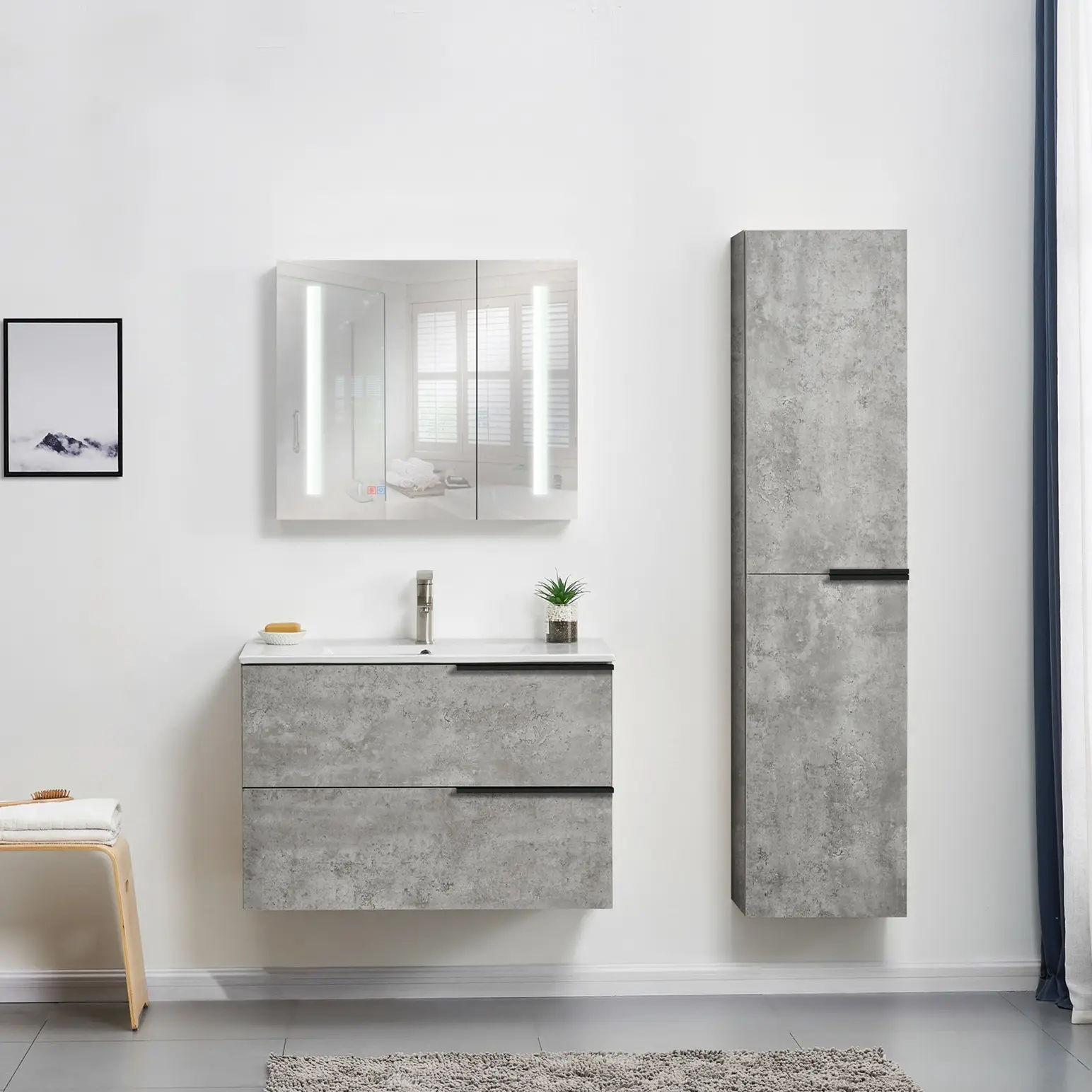
Bathroom design in 2027 is splitting into two clear directions, and the split shows up first at the vanity. On one side, maximalism: pattern, color, texture, and a cabinet that announces itself the moment a door opens. On the other, minimalism: restraint, clean lines, and a unit that nearly disappears into the wall. Both directions are being specified in real projects, which leaves distributors with a practical planning question: which line do you stock, and in what mix? This article defines both directions in bathroom terms, explains what each one demands from the vanity product itself, and walks through the material, finish, mirror, and sourcing decisions you can put into a 2027 plan. No invented trend percentages here — just product detail you can build a line around.
Defining Maximalist and Minimalist in Bathroom Terms
The maximalist vs minimalist bathroom 2027 question comes down to how surfaces talk. The fastest way to read a bathroom’s style direction is to look at its surface language. Minimalism asks surfaces to be flat and continuous: flush doors, single-plane countertops, hardware that draws no attention to itself. Maximalism asks surfaces to carry a message: layered textures, deliberate color, and details that reward a second look. Neither direction is new, and design media such as ArchDaily treat them as live design conversations rather than settled verdicts — which is exactly why a distributor planning 2027 should treat them as parallel product lines instead of a winner-take-all choice.
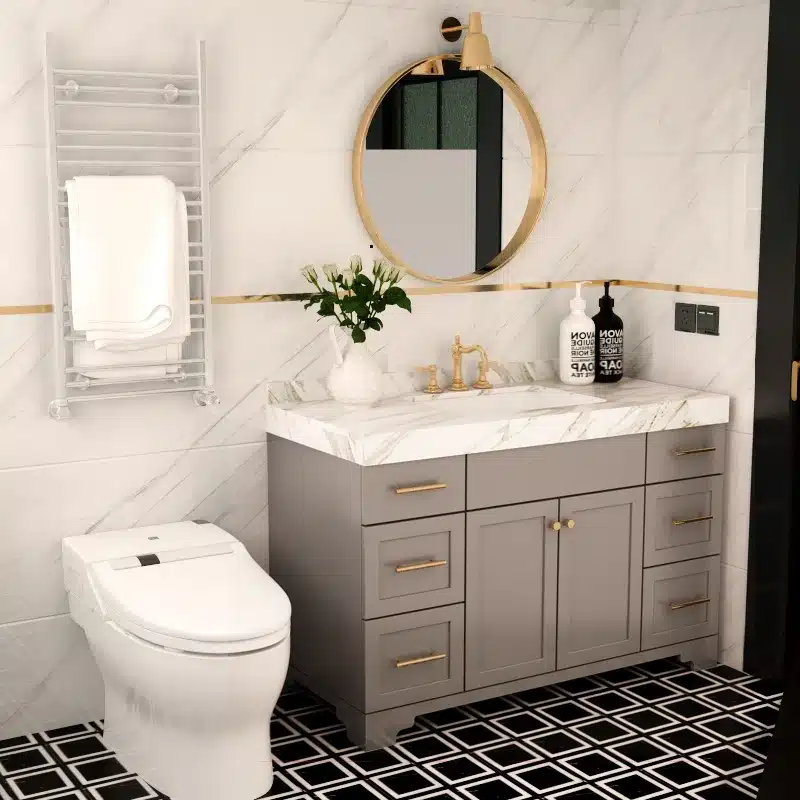
The differences show up across four elements a bathroom specifier touches first. Hardware: minimalism favors handleless doors and discreet pulls, while maximalism uses sculptural knobs and visible metal finishes. Mirrors: the minimalist side works with frameless rectangles or thin frames, the maximalist side with oversized panels, arched shapes, and decorative surrounds. Lighting: linear light-emitting diode (LED) fixtures and recessed sources suit the restrained room, while sconces and sculptural fixtures build the layered glow a maximalist room wants. Vanity proportion: minimal units read as volumes — floating boxes with open air beneath — while maximal units read as furniture, with visible feet, paneled fronts, and deeper bodies.
Storage behavior differs too. Minimal styling tends to hide everything behind flush doors or open shelves that are curated rather than cluttered; maximal styling can display more, because the room is designed to be looked at and what sits on the vanity is part of the composition. That difference matters when you spec drawer counts and shelf layouts: the same footprint serves both directions, but the interior organization is planned differently.
None of this means one direction is easier to manufacture than the other. It means they are different product jobs, and the differences translate directly into spec-sheet decisions. The table below summarizes how the two directions diverge across the choices that matter when you are building a vanity line.
| Dimension | Minimalist Direction | Maximalist Direction |
|---|---|---|
| Design language | Restraint, clean lines, flat planes | Pattern, color, texture, statement pieces |
| Vanity body | Flush doors, handleless look, slim profiles | Statement hardware, rich wood or stone textures |
| Countertop | Matte, monochrome, quiet veining | Bold color or heavy veining, patterned stone |
| Hardware | Discreet pulls, integrated handles | Sculptural knobs, visible metal finishes |
| Mirror | Frameless or slim metal frame | Oversized, arched, or decorative frame |
| Lighting | Linear LED, recessed sources | Sconces, sculptural fixtures, layered light |
| Basin | Understated integrated basin | Integrated basin as the centerpiece |
Both directions show up throughout our design trends coverage, where the product specs behind each look are broken out in more detail.
What Each Direction Demands from the Vanity
Once the style direction is set, the vanity becomes the product test. A minimal bathroom punishes anything that breaks the line — a protruding handle, a thick edge, a busy door panel. A maximal bathroom punishes anything that reads as cheap — hollow hardware, flat printed grain, an integrated basin that looks bolted on. The two directions pull the same factory in opposite ways, and that is useful when you review bathroom vanity collections for the next season.
The Minimalist Product List
Start with the door. Flush doors with no visible panel detail, a handleless look achieved through push-to-open mechanisms or integrated pulls, and slim profiles that keep the whole unit visually light. Matte finishes do most of the work in this direction; a low-sheen surface reads quiet in a way gloss cannot. Floating units fit naturally — a wall-mounted cabinet with open air beneath is part of the aesthetic, not a compromise — and our sintered stone line runs 600–1800mm (24–71 in) in floating single- or double-basin configurations to cover that look. Open shelving works the same way: console and open-shelf vanities trade closed storage for a clean, staged appearance. What the minimalist line cannot afford is visible clutter: hinges, gaps, or off-alignment doors. That makes precise reveals, aligned drawer fronts, and soft-close hardware baseline requirements rather than upgrades. Drawer organization follows the same logic: full-extension drawers that close silently keep the quiet operation the style promises, and the interior layout — dividers, trays, towel bars — is part of the spec, not an afterthought.
The Maximalist Product List
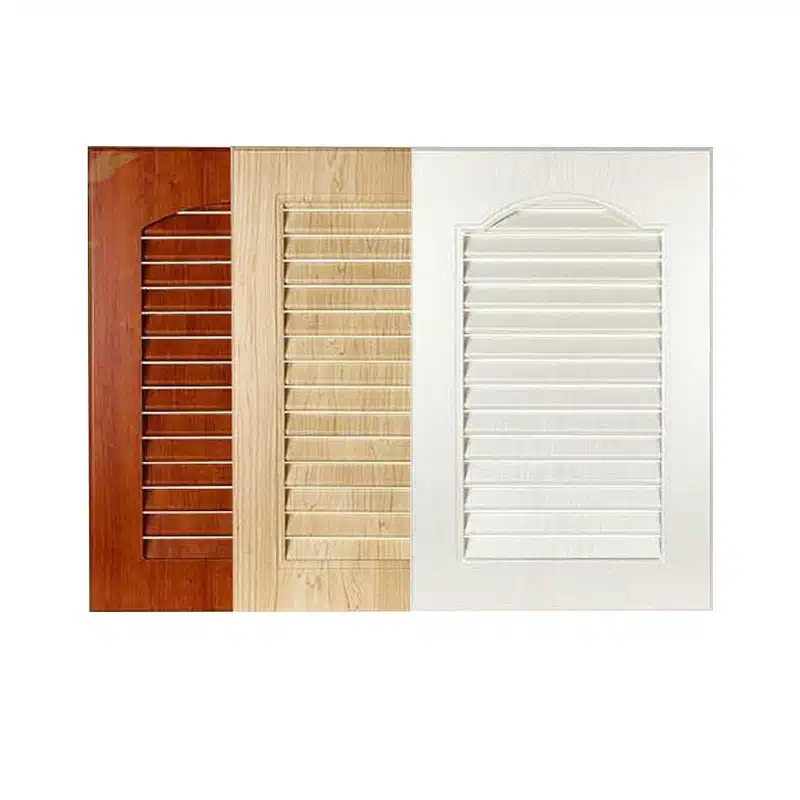
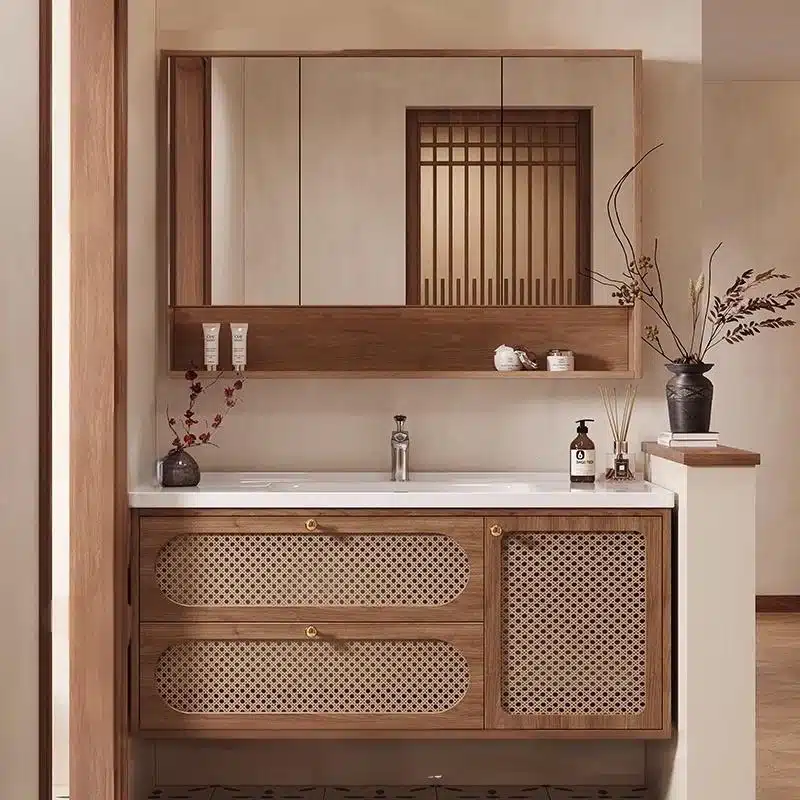
On the other side, the vanity earns its place in the room. Statement hardware is the fastest signal — the hardware trends that carry into maximal bathrooms are about visible metal, sculptural forms, and finishes that contrast with the cabinet body. Texture matters just as much: fluted doors and panels give a flat cabinet body the depth that maximal styling needs, and they photograph well for resale listings. Rich wood or stone surfaces carry the rest: oak, walnut, maple, or ash with visible grain, or tops with marble and granite veining. Bold color can sit on the cabinet body or on the top, and veined tops work in either position. The integrated basin earns its place here as well — when the basin is formed from the same material as the top, with the pattern running through both, it becomes the centerpiece of the room instead of an accessory. That is the detail that separates a specified maximalist vanity from a standard cabinet in a bold color. Double-basin widths carry the brief well too: wider units give the veining more surface to move across, and a floor-standing piece at the top of the 800–2000mm (31–79 in) range reads as furniture in a way a compact single does not.
Material and Finish Implications
Style direction determines what a finish needs to do, but the base material decides whether the finish can do it, so plan both at the same time. The three material families used across the line — polyvinyl chloride (PVC), solid wood, and sintered stone — each carry different constraints and advantages for the two directions.
PVC Covers Both Directions
PVC is 100% waterproof, non-warping, and scratch-resistant, and it cleans with a damp cloth, which makes it the workhorse for rental, resale, and high-turnover bathrooms. Its real advantage for a style-driven line is finish flexibility: more than 1,000 standard finishes are available, so the same cabinet architecture can run matte white for a minimalist series and a bold color or wood-look film for a maximalist series. Because the waterproofing is inherent to the material rather than applied as a coating, a PVC line is a low-risk answer to the moisture question that dominates every bathroom spec. PVC vanities run 24–60 in wide and 18–24 in deep, which covers the common spec range for both styles. Custom sizes and colors are available when the standard deck does not cover a regional preference, and custom paint matching extends the color work beyond the catalog.
Solid Wood for Warmth and Grain
For the maximalist line, wood is often the fastest way to communicate richness. Solid wood vanities are built in oak, walnut, maple, and ash, protected by a multi-layer polyurethane (PU) waterproof coating that keeps moisture out of the grain without hiding it. Twenty standard solid wood finishes cover the common spectrum, and because wood is a living material, finish consistency is managed at the coating stage — the PU layers are what make a solid wood cabinet viable in a humid bathroom. If your market requires verified sourcing, FSC-certified wood is available on request; it is one of the few places where a certificate claim attaches to the material itself. For the minimalist direction, wood works too, but it is usually specified in flat-sawn, low-contrast tones where the grain stays subtle under a matte finish.
Sintered Stone for Veining and Heat
The maximalist bathroom’s showpiece top — veined stone with visible movement — is where sintered stone earns its place. Made from natural minerals sintered at high temperature and pressure with no resin, sintered stone carries marble and granite veining, tests at Mohs 7–8 hardness, withstands 300°C heat without damage, and is non-porous, UV-stable, and antibacterial. For commercial or rental applications that combination matters because the top is the highest-touch surface in the room. Sintered stone vanities are available as floating units from 600–1800mm and floor-standing units from 800–2000mm, with single- or double-basin configurations and soft-close drawers.
Finish Language: Gloss, Matte, and Color
Once the material is chosen, the finish language decides the style. Matte finishes dominate the minimalist direction: they read flat, hide water spots better, and photograph cleanly. Glossy and veined surfaces carry the maximalist direction: they catch light and draw the eye. Maintenance follows the same split: matte surfaces tolerate daily use without showing every touch, while high-gloss and veined tops need the right cleaner to stay photographable — a note worth writing into your line card, because resale and rental buyers will hold you to it. Color is a separate axis. The standard deck of more than 1,000 finishes covers the common range, and custom Pantone colors let a distributor or brand lock a signature shade; the wider custom program covers more than 40,000 combinations, from color to basin style to private-brand hardware and packaging.
Finish compliance is not style-dependent, but it is market-dependent. Emissions hold to E1 (≤0.1 ppm), California Air Resources Board (CARB) Phase 2, and TSCA Title VI levels with low-VOC finishes, and the factory has been certified to ISO 9001 (quality) and ISO 14001 (environmental) since 2017, confirmed current in 2025. The relevant product lines hold CE and UL markings, and units for North American and Mexican projects are designed to meet CSA, NOM, and Americans with Disabilities Act (ADA) requirements — put those on the spec sheet early rather than discovering them at inspection.
2027 Vanity Lines for Distributors: Minimalist or Maximalist
Browse this product, solution, or service page to explore relevant offerings.
Mirror and Lighting Pairing per Style
The mirror and its light are the second purchase decision in every bathroom, and they follow the same style logic as the vanity. A minimal room wants the mirror to be quiet: a frameless rectangle or a slim metal frame with light that feels architectural rather than decorative. A maximal room wants the mirror to be seen: oversized, framed, or backlit as a panel. Both needs are covered by the same two product families, and the metal frame trends in current bathroom design show how much of the style signal actually lives on the mirror rather than the cabinet.
Classic mirrors — round or rectangular, from 24×36 to 48×72 in — cover the straightforward specification, with an anti-fog coating available where steam is a daily event. LED mirrors add the features that make a bathroom feel current: adjustable brightness, adjustable color temperature, anti-fog heating, touch control, digital display, and energy-saving auto-off, with voice control and Bluetooth available as options. For a minimalist line, a backlit mirror with touch dimming can be the entire lighting plan. For a maximalist line, the same LED mirror can sit inside a decorative frame or pair with sconces, and color temperature control becomes a selling point rather than a convenience. In hospitality projects, these features answer a practical brief as well: anti-fog heating keeps mirrors usable through back-to-back showers, and adjustable color temperature lets guests tune the light to the room.
When you pair mirrors to vanities, plan the sizing math at the same time. Vanity widths across the ranges run from 600mm to 2000mm depending on line and configuration, and mirror width should track the vanity rather than the wall; a 24×36 in mirror above a 60-inch unit reads underscaled, while a mirror that matches the vanity width reads intentional. The vanity sizing guide walks through the layout math, including how mirror height interacts with lighting placement and basin position.
Sourcing Decisions: What Distributors Need to Plan
Style direction changes what you sell; sourcing terms decide whether you can afford to sell it. The practical point for 2027 planning is that both directions run on the same rails: the same minimums, the same lead times, the same quality gates. Focus Cabinet, founded in 2015 in Changge, Henan, builds these lines in a 10,000 m² plant with 95 employees and monthly capacity of about 5,000 sets, serving more than 1,000 dealers across 20+ countries. Whether you open with a minimalist core, a maximalist accent series, or a mixed program, the planning math below applies to every SKU.
Minimum Order Quantities and Custom Work
Every custom configuration — model, color, and size — starts at a minimum order quantity (MOQ) of 15 units. That number matters for style planning because it is deliberately low: you can test a maximalist statement color and a minimalist matte white in the same quarter without committing a container to either. Mixed containers let you combine both directions and multiple styles in a single shipment, which is how distributors build a balanced line without oversized inventory. Custom sizes and colors ride the same 15-unit rail, and the broader custom program — 40,000+ combinations including Pantone colors, basin options, and private-brand hardware, logos, and packaging — is where a line stops being generic.
Lead Times and Payment Terms
Samples take 10 working days, so a style review board can physically hold both directions before committing. Bulk production runs 20–30 days, and total delivery to the US, Canada, and Mexico is 4–6 weeks. Shipments leave from Qingdao under free on board (FOB) terms, with a 30% deposit upfront and the balance due within a week of the draft bill of lading. For a launch calendar, work backward from those windows: sample approval in month one, production confirmation in month two, and stock on the water by month three.
Quality Gates and Warranty Planning
Each vanity passes five QC checks before it leaves the factory, and third-party inspection by SGS or TÜV can be arranged when a buyer requires an independent set of eyes. The commercial terms are built for distributors: a 2-year warranty on full containers and a return rate under 1%. When you quote a maximalist line with veined tops, put the inspection points on the document — veining consistency and finish matching are exactly the details an inspector catches before your customer does.
Matching the Line to Your Market
The last decision is where each direction sells. Frame this as product-planning reasoning rather than market statistics: Europe has leaned toward the minimal direction in the projects specified to us, which fits flush doors, handleless looks, and compact floating units; North America buys both directions, with maximalist statement pieces and minimalist volume lines running side by side; hospitality projects standardize on one direction per property so corridors, rooms, and public bathrooms read consistently, while residential resale follows whichever direction the local housing inventory favors — the listing photograph usually decides. Compliance follows the market, not the style: CE and UL markings are held on the relevant lines, units are designed to meet CSA, NOM, and ADA requirements for North American and Mexican projects, and emissions levels hold to E1 (≤0.1 ppm), CARB Phase 2, and TSCA Title VI.
Frequently Asked Questions
Should we stock both maximalist and minimalist vanities for 2027?
Many distributors do, because the two directions serve different buyers rather than competing for the same one. The 15-unit MOQ per model, color, and size makes a dual-line test affordable: run a minimalist core in matte finishes and a maximalist accent series with statement hardware and veined tops, then let order data set next season’s ratio. Mixed containers let you ship both directions in one load.
What is the difference between PVC, solid wood, and sintered stone for style-driven lines?
PVC is 100% waterproof, scratch-resistant, and easy to clean, with more than 1,000 standard finishes, so it covers both matte minimal and bold color work. Solid wood in oak, walnut, maple, or ash adds the grain warmth maximalist rooms use, with 20 standard finishes and a multi-layer polyurethane waterproof coating. Sintered stone tops add veining with Mohs 7–8 hardness and 300°C heat resistance.
What lead times apply to a 2027 vanity order?
Samples take 10 working days, so you can review both style directions physically before committing. Bulk production runs 20–30 days, and total delivery to the US, Canada, or Mexico is 4–6 weeks. Shipments leave Qingdao under FOB terms, with a 30% deposit upfront and the balance due within a week of the draft bill of lading. Build your launch calendar backward from those windows.
The Bottom Line
Maximalist and minimalist are not competing verdicts on taste; they are two product architectures, and both can be built on the same factory floor, under the same 15-unit MOQ, inside the same 20–30 day production window. The 2027 decision for distributors is not which direction wins but what ratio your market can absorb, in which finishes, and at which price points. Test both directions with samples in 10 working days, check the veining and the reveals at inspection, and let order data set next season’s mix.




0 Comments