
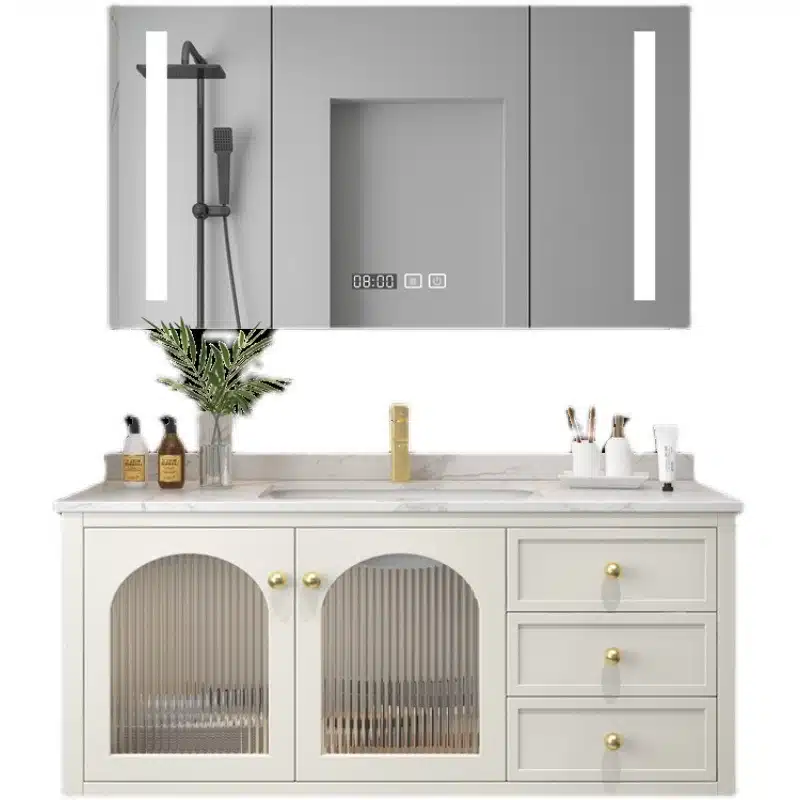
Warm minimalism is the quiet direction taking over bathroom design heading into 2027. After years of cool grays and glossy whites, the next phase of minimalism trades clinical contrast for comfort: warm oak cabinetry, stone surfaces with real texture, and soft whites that read like natural light. For importers, designers, and wholesale buyers, this is not just a mood — it is an orderable specification. This guide breaks the warm minimalism bathroom 2027 trend into its core materials, the finishes that carry it, and the sourcing details that matter at wholesale, including minimum order quantities (MOQ), lead times, and compliance. Every specification below is the kind you can hand to a factory and turn into a product line.
What Warm Minimalism Means for Bathrooms in 2027
Warm minimalism takes the restraint of Scandinavian design and trades its cool undertones for earthier materials. Where a typical 2010s bathroom used cool gray tile, white gloss cabinetry, and chrome fixtures, the 2027 version pairs warm oak with matte stone and whites that carry a hint of cream. The geometry stays simple — clean boxes, flat fronts, minimal trim — but every surface feels softer and warmer. It is minimalism with the thermostat turned up: the same quiet lines, with materials people actually want to touch.
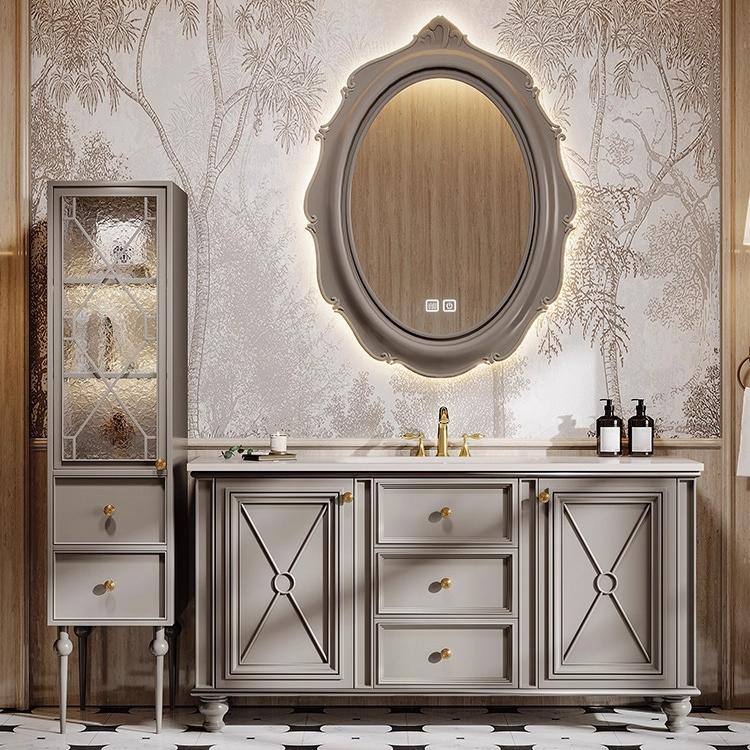
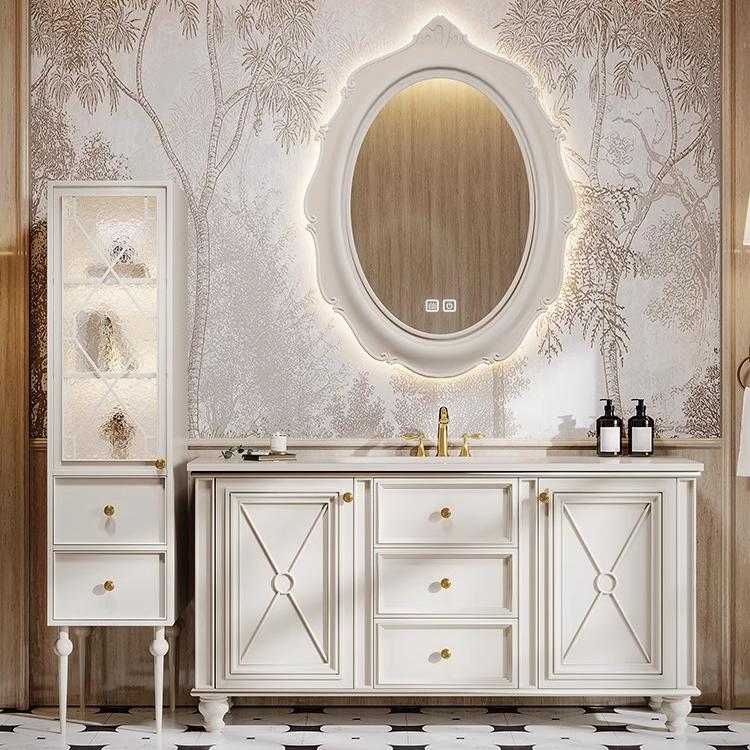
Three material families do most of the work. Warm oak, either solid or as a wood-grain finish, anchors the cabinetry. Sintered stone or marble-look surfaces carry the countertop and basin. Soft whites — warm white, oat, ivory — cover walls, fixtures, and paint. Hardware stays muted and low-contrast: brushed nickel, matte black, or unlacquered brass in slim profiles. None of these elements is new on its own. The trend lives in how they are combined and stripped down to fewer, quieter pieces.
Why now? The drivers are cultural as much as visual. Bathrooms became multi-use spaces over the past decade — part spa, part utility room, part overflow storage — and the materials shifted to match. People want rooms that feel restorative rather than clinical, which favors warm wood, tactile stone, and soft light over reflective surfaces and cool gray palettes. Designers also lean on these materials because they age well: a natural oak tone and a matte stone surface stay current longer than a novelty color, which matters for buyers who need lines with a multi-year shelf life.
It helps to see warm minimalism against neighboring styles. Japandi adds Japanese restraint and asymmetry, and it shares warm minimalism’s love of natural wood — our white oak bathroom vanity collection shows how the Japandi-leaning side of this palette is built. Mid-century modern brings tapered legs, bold grain, and a retro silhouette. Modern farmhouse leans on rustic details such as shiplap and barn-door hardware. Warm minimalism keeps fewer pieces than all of them, uses softer whites, and lets the wood and stone carry the room without decorative extras. For buyers, the practical takeaway is that this is a spec-friendly style: it relies on materials and finishes, not novelty hardware.
The 2027 Warm Minimalist Palette: Oak, Stone, and Soft Whites
The palette is the easiest part of the trend to standardize, which makes it ideal for catalog planning. Warm minimalism works on low contrast: whites with warm undertones, wood that reads honeyed rather than orange, and stone in soft, quiet tones. The goal is a room where no single color shouts — light bounces between wood, stone, and white instead of bouncing off high-gloss surfaces.
| Palette layer | 2027 direction | Typical tones | Why it works |
|---|---|---|---|
| Walls and ceilings | Soft whites with warm undertones | Warm white, oat, ivory | Reflects light without the chill of cool gray |
| Cabinetry | Warm wood or warm white fronts | Natural oak, honey-toned walnut, warm white | Supplies the warmth that defines the style |
| Countertops and basins | Matte stone with soft veining or a quiet solid tone | Marble-look, granite-look, concrete-look, warm gray | Adds texture without visual noise |
| Hardware and fixtures | Muted metal in slim profiles | Brushed nickel, matte black, unlacquered brass | Low contrast that lets wood and stone lead |
Wood tone is where most buying decisions are made, because the oak family spans a wide range. Pale natural oak keeps the room bright and reads closest to the Scandinavian end of the spectrum. White oak with a clear, matte finish is the most versatile option for warm minimalism because it pairs with almost any white. Walnut adds a honeyed depth that works when the palette leans darker, and ash offers a tighter, lighter grain for contemporary programs. The rule of thumb is to keep the wood in the yellow-to-honey range and avoid orange stains, which clash with soft whites.
Two practical reasons this palette works for wholesale lines. First, it photographs consistently. Warm neutrals hold their tone across different lighting conditions, which matters when the same vanity appears in a catalog, a showroom, and an e-commerce listing. Second, it is low risk: because the palette sits close to existing Japandi and Scandinavian programs, it can be added as a finish family rather than a full product rebuild. Buyers can keep proven silhouettes and update the finishes to match the warm minimalism bathroom 2027 direction.
If your team tracks color direction at the source, Pantone publishes seasonal color palettes that frequently lean into warm neutrals — a useful reference when your team selects finish tones. Treat those references as input for finish selection, then translate them into concrete finish codes with your factory.
Three Material Routes to the Warm Minimalist Look
Warm minimalism can be delivered at three price tiers, and each route changes the spec sheet more than the silhouette. The same boxy, flat-front vanity can be built in solid oak, plywood with a wood-grain finish, or PVC with a printed wood-grain film. The right choice depends on your market, your price points, and the humidity of your target projects. Our bathroom vanity material comparison covers the full trade-off; the table below summarizes the three routes that carry the warm minimalist look.
| Criterion | Solid oak cabinet | Plywood cabinet, wood-grain finish | PVC cabinet, wood-grain finish |
|---|---|---|---|
| Wood-grain realism | Real oak grain, varies naturally by board | Veneer or high-fidelity printed grain | Printed pattern with a consistent repeat |
| Moisture resistance | Good with multi-layer polyurethane (PU) waterproof coating | Good; waterproof edge banding; boil-water-resistant (BWR) or marine grade optional | 100% waterproof, non-absorbent, no warping |
| Finish program | 20 standard finishes; custom colors from 15 sets per color | 15 standard finishes plus a 1000+ finish library; custom colors from 50+ units | 1000+ standard finishes including matte white, gloss black, and wood grains; custom colors from 15 sets per color |
| Price tier | Premium | Mid | Entry to mid |
| Where it fits | Showrooms, hotel suites, high-end residential | Multifamily, condo projects, retail lines | Humid climates, rental units, value-driven programs |
Solid Oak: The Signature of the Trend
Real oak grain is the visual anchor of warm minimalism. Each board carries natural variation in tone and figure, which gives a bathroom the character that printed patterns cannot fully copy. Main Focus Cabinet sources oak, walnut, maple, and ash from sustainable suppliers, with Forest Stewardship Council (FSC)-certified oak available on request. Every solid wood cabinet receives a multi-layer polyurethane (PU) waterproof coating to protect the wood against steam, splashes, and daily cleaning. Solid wood also drives the premium tier of the trend: hotels and high-end showrooms specify it because the grain reads as authentic in person. Our solid wood bathroom vanity guide explains the buying details for importers, from species selection to moisture protection.
Plywood with Wood-Grain Finish: Engineered Stability
For projects where price points are tighter but the look still has to be right, plywood with a wood-grain finish is the workhorse route. Multi-layer construction resists warping, waterproof edge banding seals the vulnerable edges, and boil-water-resistant (BWR) or marine grade plywood is available for high-moisture zones. The finish library is the largest flexibility point here: 15 standard finishes plus a 1000+ finish library, so the warm oak look can be matched across a whole program. Note the custom-color threshold: plywood custom colors start at 50+ units, compared with 15 sets per color on solid wood and PVC. For more on veneer and grain options, see our wood veneer vanity spec guide. If you want to benchmark engineered wood performance, the grading standards published by APA – The Engineered Wood Association (apawood.org) are the industry reference.
PVC with Wood-Grain Finish: The Moisture-Proof Route
PVC cabinets solve the one problem bathrooms always present: moisture. The material is 100% waterproof, does not absorb water, will not warp, and wipes clean with a cloth. For coastal markets, rental units, and high-humidity climates, PVC is the lowest-maintenance way to carry a wood-grain warm minimalist look. The finish range is the broadest of the three: 1000+ standard finishes including matte white, gloss black, and wood grains, with custom colors available from 15 sets per color. Because the printed grain is consistent, PVC also suits programs that need every unit in a series to look identical — a property that matters in multifamily and hospitality rollouts.
Warm Minimalist Vanities in Oak, Stone and Soft Whites
Browse this product, solution, or service page to explore relevant offerings.
Sintered Stone: The Countertop That Carries the Trend
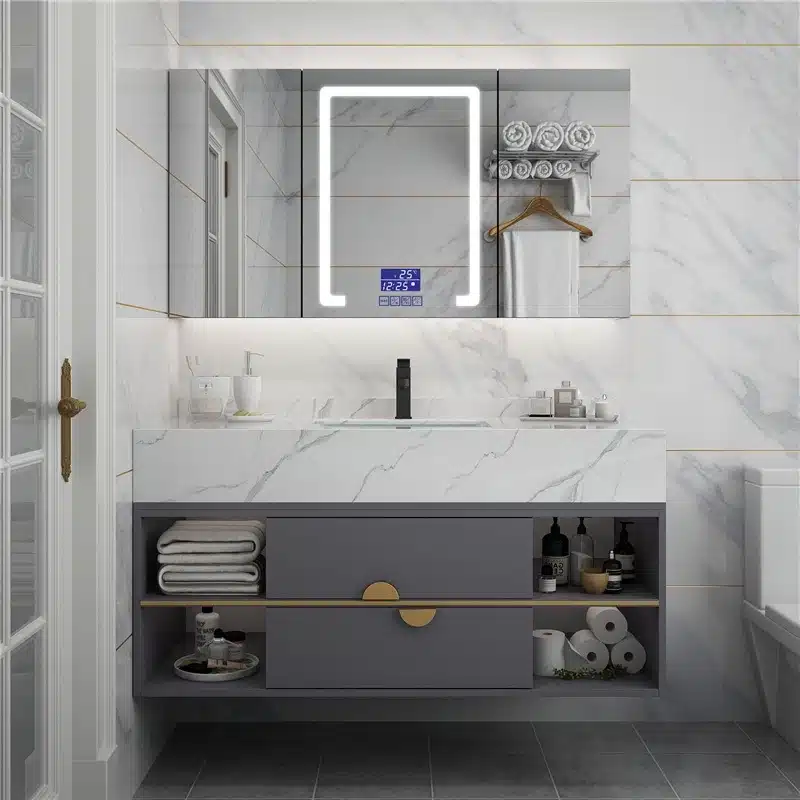
In warm minimalism, the countertop and basin do almost as much work as the wood. A matte stone surface with soft veining, or a quiet solid tone, gives the room its texture and anchors the warm whites and oak around it. Sintered stone is the material that makes this practical in a production bathroom vanity: it delivers the stone look with none of the maintenance of natural stone.
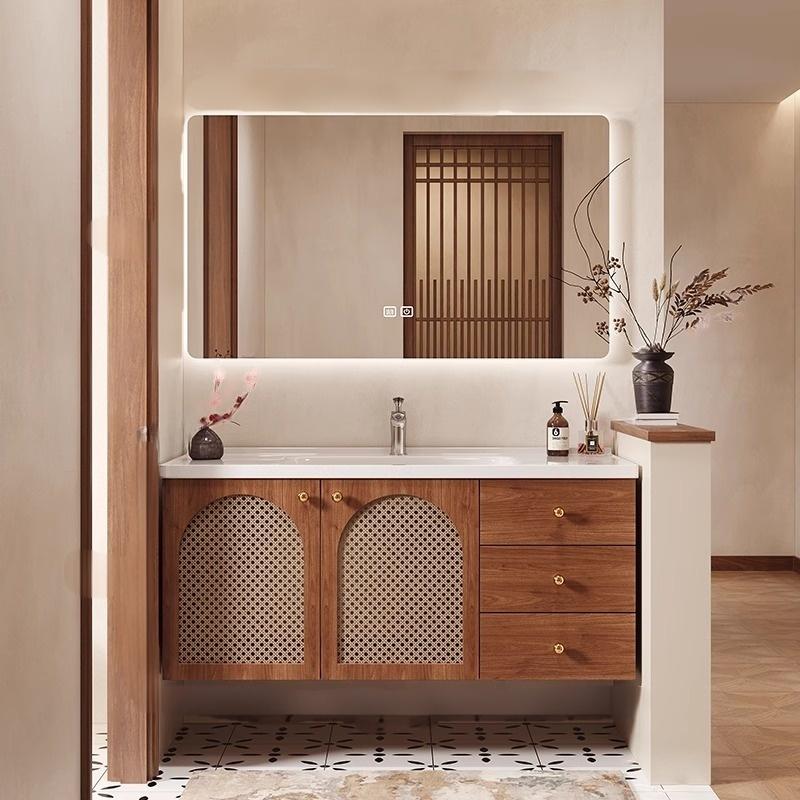
The physical properties are what make sintered stone a wholesale-safe choice. The surface measures 7–8 on the Mohs hardness scale, so it resists scratching. It withstands heat up to 300°C, meaning hot styling tools will not mark it. The surface is non-porous, so spills do not stain and bacteria have no place to collect; the material also carries antibacterial properties. Color stays stable because the pigment is fired through the slab, so it does not fade under UV exposure. Countertops and basins come in marble-look, granite-look, concrete-look, and solid color patterns, with matte, satin, and polished finishes.
Finish pairing matters more in warm minimalism than in busier styles. For 2027, matte and satin surfaces lead: they soften the reflections that polished stone throws across a room and let the oak grain stay the focal point. Polished finishes still have a place in small powder rooms where buyers want light to bounce, but the warm minimalist palette leans on matte stone against warm wood. The two finish families can even be mixed within one line — matte for the hero models, satin for entry price points — without breaking the visual program.
The biggest design advantage for warm minimalism is the integrated basin. A one-piece sintered stone countertop with a molded sink removes the seam where water and grime usually collect, and the clean, single-surface line matches the style’s restraint. Sizing follows the vanity format: floating sintered stone vanities run from 600 mm to 1800 mm, and floor-standing models from 800 mm to 2000 mm. Our sintered stone vanity specs guide lists the dimension and sink options in detail.
Sourcing Warm Minimalism at Wholesale: MOQ, Finishes, and Lead Times
A trend becomes a product line when it can be specified, sampled, and ordered. The warm minimalist program at Main Focus Cabinet is structured around one number: a minimum order quantity (MOQ) of 15 sets per model, color, and size across the entire product line. The single exception is custom colors on plywood cabinets, which start at 50+ units because of finishing setup. With 40,000+ custom combinations available, a buyer can assemble a small, coherent line — two oak models, one sintered stone option, and a PVC entry model — and validate it in market before scaling. Our custom color vanity page walks through how color matching works, and the product page lists current collections.
The timeline is predictable. Samples ship in about 10 working days, so a pre-order sample set fits a normal planning cycle. Bulk production runs 20–30 days, and shipments to the United States, Canada, and Mexico arrive within 4–6 weeks. All orders ship free on board (FOB) from Qingdao port. Payment terms are a 30% deposit to start production, with the balance due within a week of the draft bill of lading. Every cabinet carries a 2-year warranty on the whole unit, which simplifies claims handling for importers.
Compliance is where the detail matters. All cabinets meet the E1 formaldehyde emission class (≤0.1 ppm), California Air Resources Board (CARB) Phase 2, and Toxic Substances Control Act (TSCA) Title VI, the formaldehyde standard enforced by the U.S. Environmental Protection Agency (EPA). Finishes are low-VOC (volatile organic compounds), and FSC-certified oak is available for programs that need documented sourcing. Main Focus Cabinet operates to International Organization for Standardization (ISO) 9001 and ISO 14001 management systems, certified since 2017 and confirmed current in 2025. The factory, established in 2015 in Changge, Henan, China, employs 95 people, produces up to 5,000 sets per month, and runs five quality checks on every piece. For importers with sustainability requirements, our eco-friendly bathroom vanities guide covers the full compliance picture.
A practical launch sequence looks like this: request the free 2025 product catalog (100+ pages), shortlist three to five vanities across the material routes above, order samples to verify the warm oak and soft white finishes in person, and place a first production order at the 15-set MOQ. Because samples and bulk production are decoupled, the total time from first inquiry to a stocked container is roughly two to three months — short enough to ride the trend window without overcommitting inventory.
Frequently Asked Questions
What is the minimum order quantity for a warm minimalist vanity collection?
The MOQ is 15 sets per model, color, and size across the full product line, so a small test program is realistic for most importers. The one exception is custom colors on plywood cabinets, which start at 50+ units because of the finishing setup. That structure means you can open a line with one hero model in two finishes, validate sell-through, and scale. Samples ship in about 10 working days, and bulk production runs 20–30 days.
Can we customize finishes and colors to match the 2027 warm minimalist palette?
Yes. Solid wood cabinets come in 20 standard finishes, including natural oak and white, with custom colors from 15 sets per color. PVC cabinets offer 1000+ standard finishes — matte white, gloss black, and wood grains among them — with the same 15-set custom threshold. Plywood uses a 1000+ finish library with 15 standard options, and custom colors there start at 50+ units. Across the line, that adds up to 40,000+ combinations you can spec for a cohesive warm minimalist program.
How do lead times and payment terms work for an order?
Samples take about 10 working days, and bulk production runs 20–30 days after order confirmation. Shipments to the United States, Canada, and Mexico typically take 4–6 weeks, and all orders ship free on board (FOB) from Qingdao port. Payment is a 30% deposit to start production, with the balance due within a week of the draft bill of lading. Every cabinet also carries a 2-year whole-cabinet warranty.
The Bottom Line
The warm minimalism bathroom 2027 trend is built on materials rather than novelty: warm oak, textured stone, and soft whites that read premium in person and photograph well in catalogs. For wholesalers, the path to market is a clean spec — choose a material route, lock finishes, confirm the 15-set minimum order quantity, and sample before scaling. Main Focus Cabinet’s combination of solid wood, plywood, PVC, and sintered stone programs lets you test the trend at small scale.




0 Comments