

The LED mirror lifespan L70 rating is the one figure that survives contact with real bathrooms. Chip datasheets routinely print 50,000 hours, yet drivers and thermal paths usually end service life years earlier than the diodes alone would allow. Bulk buyers who can read that gap separate engineered products from assembled bargains.
This guide unpacks what L70 actually measures, why electrolytic capacitors fail before diodes do, and which documents convert a lifespan claim into a checkable fact. A verification table and three field questions close the article, ready to paste into a supplier email this week.
What L70 Really Means for LED Mirrors
L70 marks the hour when a light source delivers only 70 percent of its initial luminous flux. Nothing has died, and the LEDs still glow. Output has simply faded to the point where lighting designers consider the fixture unfit for purpose.
A Slow Fade Instead of a Sudden Death
Incandescent bulbs fail in an instant, so shoppers expect the same behavior from everything else. Light-emitting diode products decline gradually instead, losing a small percentage of output every thousand hours. Hotel guests notice dim vanity lighting long before any unit goes dark, so complaints arrive as “the rooms feel tired” rather than “the mirror is broken.”
Depreciation also drifts units apart over time. Two mirrors installed on the same day can reach different brightness levels if their drivers push different currents or their enclosures trap different amounts of heat. For a property operating 200 identical guest rooms, that drift becomes visible mismatch across entire floors.
Color shift accompanies the fade. Phosphor degradation skews white light toward blue or yellow as hours accumulate, so an aging mirror can look wrong even at unchanged brightness. Retailers then face returns describing “bad light” with no dead lamp to show the courier.
Hours Do Not Equal Calendar Years
Rated life figures assume continuous operation, and bathroom mirrors rarely oblige. A worked example shows the gap: 50,000 hours divided by three powered hours per day equals roughly 45 nominal years, while eight daily hours shrink the same figure to about 17. No sourcing team should plan inventory around arithmetic ceilings like these.
The useful reading is comparative rather than literal. A fixture documented at L70 after 30,000 hours of credible testing beats one quoting 50,000 hours with no supporting report. ENERGY STAR, the US program for energy-efficient products, treats lumen maintenance as a core requirement for qualified luminaires, and its public library explains the metric through ENERGY STAR lighting requirements.
B-scores add another layer of comparison. L70B50, for example, names the hour at which no more than half of a tested population is expected to sit below 70 percent flux. Buyers comparing two quotes should confirm the B-score behind each headline number before judging.
Chips, Drivers, and Heat Decide Who Fails First
Three components compete to end a mirror’s service life: the LED packages, the driver electronics, and the thermal path connecting them. Chips rarely lose that race on their own. Bond wires and phosphor layers survive tens of thousands of hours when fed stable current at reasonable temperatures.
Chip specifications also look more impressive than they are. Diode ratings come from small samples mounted on ideal heat sinks at controlled laboratory temperatures. Mount the same diode behind warm bathroom glass and the operating point moves somewhere the datasheet never plotted.
Drivers lose far more often than diodes. Inside most drivers, the weak link is the electrolytic capacitor, whose liquid electrolyte evaporates slowly as temperature climbs. Capacitance falls, equivalent series resistance rises, and the mirror starts flickering at the edge of perception before eventually going dark.
Why Capacitors Set the Real Clock
Capacitor aging follows a thermal rule of thumb used across the electronics industry: every 10 degrees Celsius added to operating temperature roughly halves expected service life. A capacitor rated for 105 degrees and 5,000 hours in the lab ages much faster inside a sealed back panel mounted above a hot shower. Datasheet numbers describe laboratory conditions, not your wall.
Moisture joins heat as an accelerator. Steam works into gaskets that flex through thousands of heating cycles, and condensation inside the enclosure corrodes solder joints and connector pins. Bathrooms are the harshest indoor mounting location a mirror can draw.
Field symptoms point at the driver. Flicker that appears after warm-up and fades as the unit cools is a textbook capacitor signature, and so is a mirror that powers on only after a multi-second delay. Diode failures, by contrast, tend to kill whole segments at once.
Replaceable Drivers Beat Sealed Designs
Given that failure hierarchy, the design question becomes access. A driver mounted in an accessible compartment with a plug connection lets an installer swap the electronics in minutes. A fully potted, sealed assembly turns the same failure into complete mirror replacement.
Between the two options, buyers should favor accessible and replaceable drivers every time. Shelf stock and hotel maintenance budgets absorb one small component without complaint; they do not absorb 300 complete mirrors failing two years after opening. Ask how the driver mounts before discussing price.
For a 150-room hotel, the arithmetic turns brutal. One driver failure per week means housekeeping calls, spare parts logistics, and a maintenance budget that compounds quietly for years. Component access decides whether that story ends with a five-minute fix or a wall repair.
Insider rule: when a quote lists chip hours but stays silent on the driver brand and model, the weakest component is being hidden.
Documents Bulk Buyers Must Verify Before Ordering
Lifespan claims become verifiable only on paper. Four document families matter: the LM-80 lumen maintenance report for the chips, the TM-21 projection built on top of it, the driver datasheet, and the factory’s own burn-in records. Each answers a different question, and each fails in a characteristic way when missing or faked.
None of this requires laboratory training. The documents arrive as ordinary PDFs, and the excuses arrive in equally ordinary forms: the file sits with the chipmaker, the test covered a similar model, the report is proprietary. Recognize that pattern and keep asking.
LM-80 Reports Cover the Chips Only
LM-80 is the Illuminating Engineering Society method for measuring how LED packages maintain output, and accredited laboratories run the test for at least 6,000 hours. The report a buyer needs must name the exact chip model and correlated color temperature used in the quoted mirror. A PDF covering another chip family proves nothing about your order.
Check the lab name, sample count, and measured temperature points, normally presented at 55 and 85 degrees Celsius. Undated documents or missing tables mean the claim is unverified. At that point the rational move is to walk away or demand the real file.
Sample size matters too. Reports built on ten packages carry less weight than ones built on the larger arrays typical of serious programs, and short test windows hide slow failure modes. If the numbers look extraordinary, ask for the raw lumen maintenance curves instead of the summary page.
TM-21 Projections Carry a Hard Ceiling
TM-21 is the companion method that projects lumen maintenance beyond the measured period, and it caps projections at six times the tested duration. A 6,000-hour LM-80 dataset therefore supports a projection no larger than 36,000 hours, regardless of what the brochure claims. As a worked example, a 50,000-hour L70 claim needs at least 8,340 hours of measured data behind it.
The DesignLights Consortium publishes technical requirements for commercial LED products and anchors those same test methods through DesignLights Consortium technical standards. Procurement teams in North America frequently meet them inside utility rebate programs, which is one more reason to insist on the paperwork.
Driver Datasheets and Burn-In Records
Driver paperwork deserves equal scrutiny. Request efficiency, power factor, maximum case temperature, and the ingress protection rating of the driver itself. Power factor below about 0.9 at mirror wattages usually signals economy-grade electronics, and economy-grade electronics is where the capacitor problem starts.
Then ask how the factory ages finished units before packing. Reputable lines power mirrors on test racks and log every unit that flickers, dims, or goes dark. Quality control photos or video of that rack belong in the pre-shipment file as a matter of routine.
Burn-in duration deserves a direct question: how many powered hours does each unit log before packing? Answers measured in minutes deserve suspicion, while documented hours with defect logs deserve a follow-up order. The difference between those two answers predicts your dead-on-arrival rate.
The table below compresses the request list into a single page. Sourcing teams can paste it directly into a request-for-quotation email, giving the LED mirror lifespan L70 rating an audit trail instead of a promise. Each row names a document, the question it answers, and the risk it removes.
Verification Documents for an LED Mirror RFQ
| Document | Question It Answers | What to Check | Risk If Missing |
|---|---|---|---|
| LM-80 report | Do the chips hold output? | Lab name, chip model, color temperature, hours | L70 claims stay unverifiable |
| TM-21 projection | How far do hours extend? | Input data, six-times cap respected | Inflated life numbers |
| Driver datasheet | Who built the weak link? | Efficiency, power factor, case temperature | Early flicker and dark units |
| Burn-in records | Did units run before packing? | Duration, photos, defect log | Dead-on-arrival stock reaches shelves |
| IP rating report | Can electronics survive steam? | Rating, standard, enclosure scope | Moisture failures after installation |
Missing even one row raises the risk profile of the whole container. Teams new to the exercise can pair this table with the walkthrough in the bathroom vanity mirrors wholesale sourcing guide. The LED mirror buying mistakes article covers the sample-versus-production pitfalls that usually follow.
Source LED Mirrors with Verifiable Specs
Browse this product, solution, or service page to explore relevant offerings.
Thermal Design and IP Ratings in Humid Bathrooms
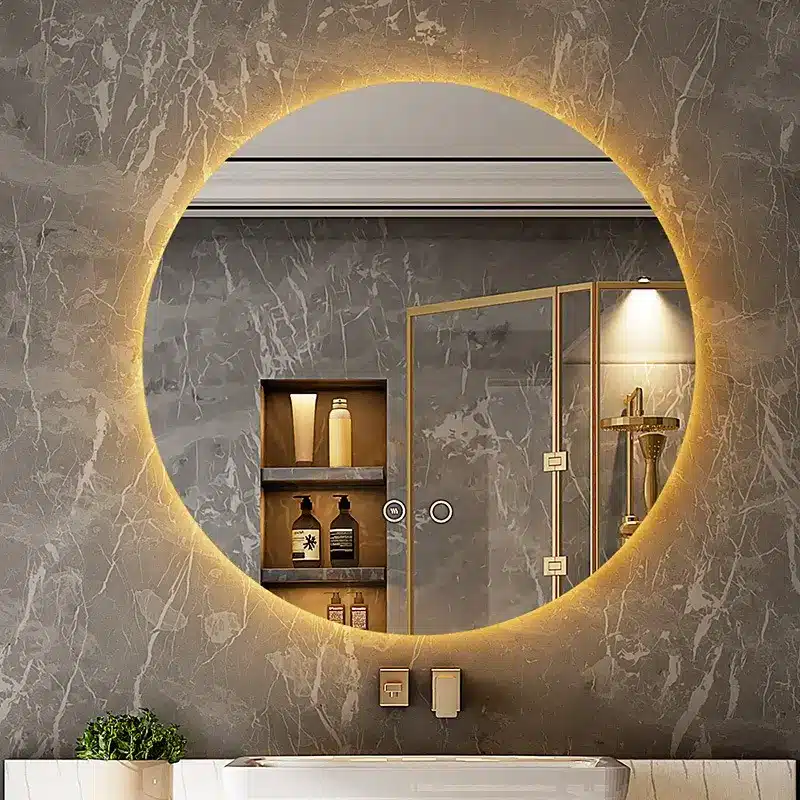
Longevity paperwork means little if the enclosure works against physics. Heat generated at the LED strip must travel outward through aluminum profiles or backing plates, because glass itself spreads heat poorly. Mirrors that trap warm air behind a sealed back panel cook their own drivers.
Ask suppliers what material sits behind the strip and how air moves through the back pan. Aluminum extrusion with a thermal interface beats a flexible strip glued straight to glass in nearly every thermal comparison. The difference costs a few dollars per unit at factory scale and pays for itself in years of service life.
Frame the thermal questions in writing before sampling. Ask which aluminum profile carries the strip, whether the back panel vents or seals, and what case temperature the driver expects in still air. Written answers become the baseline to test against when the sample arrives.
Reading IP Codes for Bathroom Placement
Ingress protection codes classify defense against solids and water, and the two digits matter separately. The first covers dust, the second covers moisture. For mirrors mounted beside sinks and showers, the second digit drives the decision, and splash-level protection in the IP44 family is the common industry baseline for bathroom zones. The companion guide to smart mirror IP ratings maps protection classes to commercial anti-fog installations.
Commercial tenders often spell out the required rating, so confirm what the quote actually covers. A driver rated IP44 inside an unrated back box still leaves connectors and splices exposed to the same steam. Scope matters as much as the number.
Placement decisions follow the code. Mirrors directly beside shower enclosures face more spray than ones mounted over vanities, and tender documents increasingly split the two cases. Quoting one protection level for both positions can leave a project under-specified where it matters most.
Certification language deserves the same precision. MFBATH smart mirrors carry CE and UL certification, and the designs target CSA, NOM, and ADA requirements without holding those certificates yet. Buyers serving North American or accessible-design tenders should match those phrases against their own compliance needs rather than assume equivalence.
Glass selection ages alongside the electronics. Copper-free mirror glass resists edge corrosion in humid rooms longer than standard silver coatings do, and the same steam that stresses driver boards attacks mirror edges first. The copper-free mirror construction explainer covers that difference in detail.
Smart Mirror Features Worth Putting on the Checklist
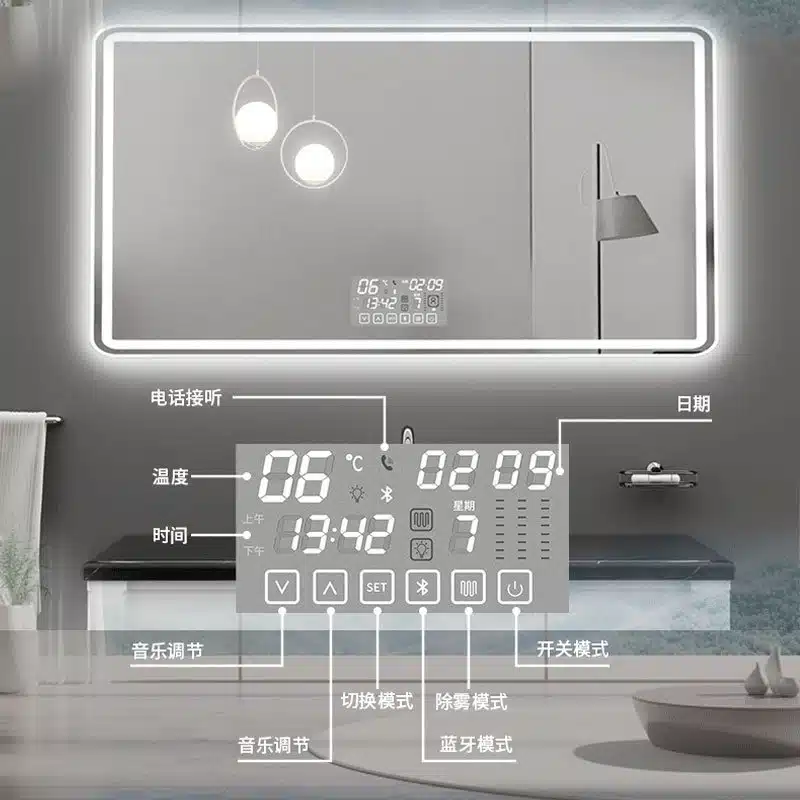
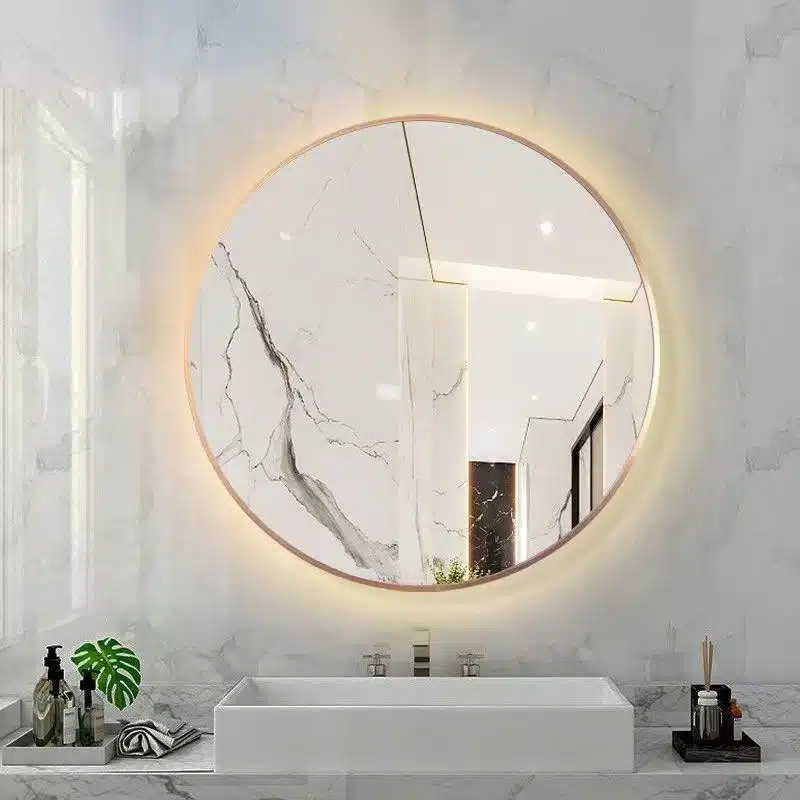
Verification narrows the field; features decide the order. The MFBATH smart LED mirror line pairs the lighting fundamentals above with dimmable brightness and adjustable color temperature, plus anti-fog heating for steam-heavy rooms. Touch controls handle daily operation, while the digital display carries time, date, and weather information.
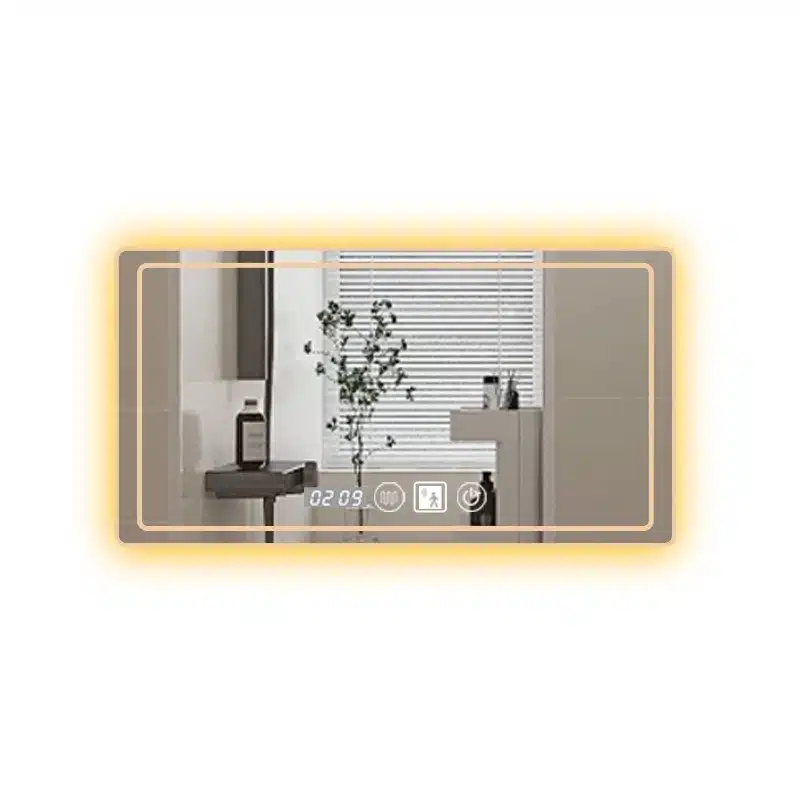
An energy-saving auto-off function cuts powered hours whenever the room sits empty, which slows every aging mechanism discussed earlier in this guide. Voice control and Bluetooth audio finish the optional equipment list for hospitality and retail projects that want more than illumination.
Anti-fog heating deserves a sentence of its own in any lifespan discussion. The heating film draws power during showers, so mirror electronics already live inside a designed thermal cycle. Clean design treats that load as a first-class input instead of an afterthought, which is another question worth putting to any supplier.
Sizes and Customization for Bulk Programs
Standard sizes run from 24 by 36 inches up to 48 by 72 inches, covering single vanities and double-vanity walls. Custom dimensions, Pantone frame colors, feature sets, and logo branding all start at 15 sets. The minimum order quantity is 15 sets per model, color, and size, with mixed containers accepted once total volume meets the threshold.
For teams validating a new line, samples ship in 10 working days, and bulk production takes 20 to 30 days. Door-step timelines to the United States, Canada, and Mexico typically land at four to six weeks including logistics. Terms are FOB Qingdao, with a 30 percent deposit and the balance due within one week of the draft bill of lading.
White-label buyers can add logo printing or laser engraving and custom packaging within the same 15-set customization window. That flexibility matters for brands testing a new market, because a small first order can still carry its own identity instead of factory-generic cartons.
Factory Signals Worth Weighing
Scale and history never replace documents, but they frame them. MFBATH has manufactured in Changge, Henan since 2015, employs 95 people, and holds ISO 9001 and ISO 14001 certifications first issued in 2017 and confirmed valid in 2025. Monthly capacity stands at 5,000 sets, and more than 1,000 dealers across 20-plus countries carry the product lines.
Every unit passes a five-step inspection before packing, third-party inspection through SGS or TÜV can be arranged ahead of shipment, and the historical return rate sits below 1 percent. Pair those factory signals with the document checklist above, and the order decision stops resting on trust alone. The smart mirror features checklist and the LED mirror specifications guide extend this section for teams writing their own templates.
Frequently Asked Questions
How Many Years Does L70 at 50,000 Hours Represent?
Divide 50,000 hours by daily use. At three hours per day the nominal math suggests about 45 years; at eight hours, roughly 17. Drivers rarely match that horizon, so treat L70 as a chip ceiling, not a whole-mirror promise.
Is a Mirror Scrap When Its Driver Fails?
Not usually. Mirrors built with accessible, replaceable drivers need one new component, not a new panel. Before ordering, ask how the driver mounts, whether it unplugs without cutting, and whether spare drivers ship with bulk orders.
How Can Remote Buyers Verify Quality Before Shipment?
Request burn-in records, quality control photos and video, plus LM-80 and driver documents. Then order samples and arrange third-party inspection through SGS or TÜV where volume justifies it. MFBATH supports sample orders in 10 working days and third-party inspections.
Verify the Weak Links Before You Commit Volume
Reducing the LED mirror lifespan L70 rating to decoration and buying on chip hours alone is a bet that the marketing outlives the capacitors. Drivers age with temperature, TM-21 projections stop at six times tested duration, and trapped moisture ignores both. The exposure is not one broken unit. It is a container of identical units drifting toward the same failure window and landing on your shelf, or your client’s punch list, at the same moment.
- L70 marks the hour where output falls to 70 percent of initial flux; it describes dimming, not death.
- LM-80 and TM-21 documents must name the exact chip, color temperature, and lab, and projections cap at six times tested hours.
- Driver datasheets, burn-in records, and IP scope expose the component that actually fails first.
- Replaceable drivers, sensible protection scope, and pre-shipment inspection convert lifespan claims into service facts.
A low-risk next step is a sample round measured against the document checklist. MFBATH ships samples in 10 working days, publishes a free 2025 catalog of more than 100 pages, and welcomes third-party inspection before any container leaves Qingdao.


0 Comments