


Here is the number that should decide your first container import strategy for furniture: 68. That is roughly how many cubic meters of usable space a 40-foot high cube offers once cartons, pallets and dead air are counted. Every meter you leave empty is sunk cost, and every SKU that sits unsold is capital on a shelf. A first container also freezes $20,000–$30,000 of working capital for four to six months, from deposit to sell-through. So the loading plan is not a logistics detail. It is the whole bet. This guide sets the order of operations for first-time importers in North America and Europe: which SKUs to load first, in what sequence, and where the failure points hide. The goal is a container that validates your market and funds the second order.
Your First Container Is a Market Test, Not a Profit Center
The failure pattern repeats with depressing regularity. A first container gets built to maximize margin on paper, then arrives full of SKUs nobody has ordered. Meanwhile the two sizes customers actually ask for were left off the plan. Treat the first box as paid research instead. Its real job is to answer three questions: which widths move, which finishes repeat, and which price point your market accepts.
Run the cash math before the SKU math. Consider a worked example of 130 vanities at a blended $170 FOB price. FOB, Free On Board, means you take ownership and risk once goods cross the rail at the port of loading. That order ties up about $22,000 in goods alone. The factory collects a 30% deposit at order, roughly $6,600, with the balance due within a week of the draft bill of lading. Add ocean freight and import duty, and one container can pin down $28,000–$35,000 of your cash for four to six months.
That freeze is the real price of a wrong mix. Dead 60-inch cabinets do more than lose margin. They occupy rack space, tie up cash, and delay the reorder of what actually sells. A first container import strategy for furniture should therefore optimize for learning speed over unit profit. You want evidence back fast enough to shape container two while demand signals are still fresh.
Write the success criteria down before loading. A workable set starts with volume: at least half the volume-base units committed or sold within 90 days of arrival. Add at least one stretch SKU showing repeat interest, and damage claims below a pre-agreed threshold. Criteria like these turn a vague “let’s see how it goes” into a test with a verdict.
The first container is a market survey that happens to travel in a steel box. Budget it like research, not like a clearance sale.
Two low-cost moves de-risk this stage before serious money moves. Pull free samples and run them through your showroom or job sites; sample lead time runs about 10 working days. And pressure-test your factory choice on mix flexibility, not only price. Factory clusters such as Changge and Foshan behave differently on minimums, range and lead time, and that difference shows up directly in your loading plan.
SKU Priority: Rank by Sell-Through Speed, Not Margin
Rank every candidate SKU by how fast it should sell, not by what it earns per unit. A practical split for a first load is 70/20/10. Around 70% of units go to volume bases: proven single-sink widths in neutral finishes. About 20% goes to stretch SKUs that test one variable at a time, such as a double-sink 48-inch or a second finish. The final 10% is an image piece: the 60-inch sintered stone top vanity that anchors your showroom and your marketing photos.
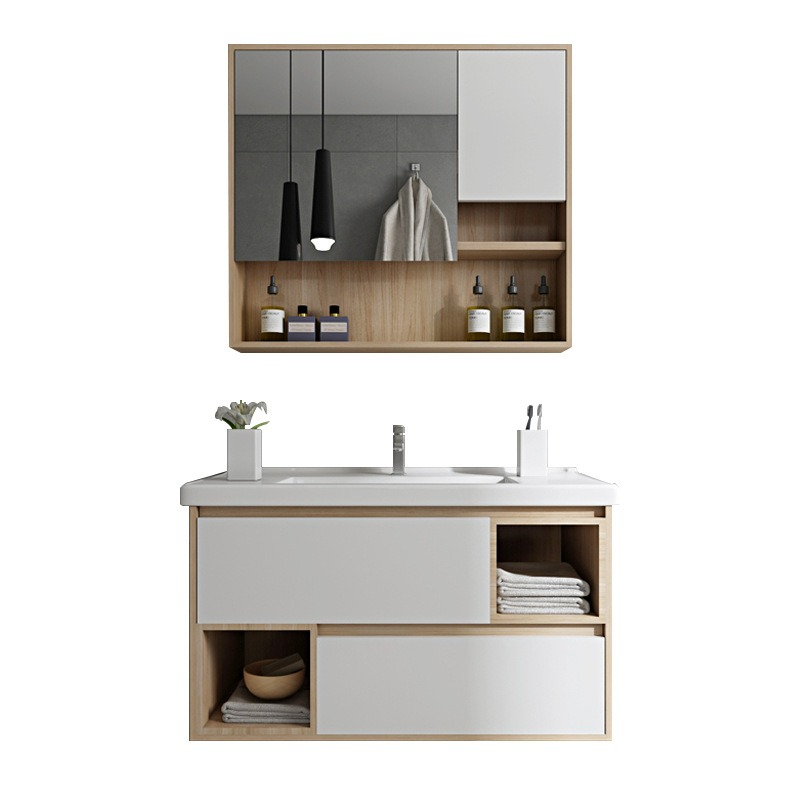
The standard width band for these cabinets runs 24 to 60 inches, with depths of 18 to 24 inches. Volume bases should sit in the lower half of that band, where replacement demand is deepest. The image piece earns its space only if it pulls traffic and dealer attention. It is a billboard, not a volume plan, so keep it at minimum quantity. Before deciding how deep to go on any single line, see how unit cost moves at 15, 100 and 500 units. Quantity leverage is real, but it should never talk you into a second container’s worth of an unproven SKU.
The table below shows a worked example for a first 40-foot high cube order. Planning volumes assume assembled units in export cartons; flat-pack constructions ship more units per cube. Confirm every carton dimension with the factory before you finalize anything.
| SKU role | Example | Units | Planning CBM | Job on arrival |
|---|---|---|---|---|
| Volume base | 36-inch single-sink plywood vanity, white | 45 | ~27 | Funds the reorder; fastest expected turn |
| Volume base | 24-inch single-sink vanity, apartment grade | 30 | ~12 | Entry price point for small bathrooms |
| Stretch | 48-inch double-sink vanity | 15 | ~13 | Tests upsell demand with one new variable |
| Image piece | 60-inch sintered stone top vanity | 15 | ~14 | Showroom anchor and marketing asset |
| Add-on | Smart LED mirror | 20 | ~4 | Attached sale; fills odd gaps in the stack |
Total: about 125 units and roughly 70 cubic meters (CBM is the standard measure of cargo volume) of planning volume. That sits right at the practical ceiling of a 40HQ, whose nominal internal volume is 76 CBM. Real fit depends on carton dimensions, stackability and how tightly the rows lock together. Small cartons of mirrors and hardware are what make the last few meters possible. Browse the full vanity range to map these roles onto actual models and materials.
Build the Mix Around the 15-Unit MOQ
The minimum order quantity at MFBATH is 15 units per model, per color, per size. That low threshold is what makes a mixed first container possible at all. With roughly 125 units of capacity, you can carry six to eight SKU-color combinations, each at or near minimum quantity. No single line becomes a dangerous overbet, and every line still clears the factory minimum.

Mixed loading is supported across models and sizes in one container, as long as the total quantity meets the minimums. Use that flexibility deliberately. Put your volume bases in two or three sizes, test one alternative finish on a proven model, and let the image piece stand alone. Each SKU then answers one clean question at sell-through. Two SKUs that differ in five variables answer nothing.
Container size deserves a quick word, though the deeper math lives elsewhere. A 20-foot general purpose box holds roughly 33 CBM nominal and usually weighs out before it cubes out, because cabinets are dense. A 40HQ nominally holds 76 CBM and is the default choice for a broad first mix. Still weighing Full Container Load (FCL) against Less than Container Load (LCL) shared space? Start with our guide to FCL vs LCL container loading math. It covers the CBM calculations in detail.
Container dimensions and ratings follow ISO 668, the international standard for series 1 freight containers. Nominal figures vary slightly by manufacturer, so plan against the factory’s packing list rather than brochure numbers. One more lever worth pulling: shipments leave FOB Qingdao, and the factory’s consolidated logistics package can reduce freight cost by roughly 15% on United States, Canada and Mexico lanes. On a first container, where every dollar is tuition, that line item matters.
Loading Order: Heavy Low, Fragile Last, No Door-Side Surprises
Loading order is risk management disguised as a stacking game. The rules below apply to any furniture container and cost nothing to follow.
- Heavy, tall cabinets go first, on the floor, toward the nose of the container. Build the weight low and forward, and keep the stack level side to side.
- Lighter cartons and flat-pack components ride on top and fill the gaps between rows. Ready-to-assemble (RTA) packs are useful spacers because they compress into odd voids.
- Sintered stone tops and smart LED mirrors travel on edge, never flat, with corner protection and lashing. Glass and stone content is where claim costs concentrate.
- The last meter near the doors gets deliberate attention. Strap or net the tail so nothing falls onto the dock when the doors open.
Mirror panels deserve a line of their own. Thickness and edge finishing decide how much shock a panel absorbs over 30 days of road, rail and sea. A thin, poorly edged mirror is a claim waiting in the stack, and the difference between glass specs is larger than most buyers expect. We break that down in our guide to bathroom mirror glass thickness.
Inspect the container itself before a single carton goes in. Check for holes, odors, residual moisture and damaged floor boards; a compromised box ruins good packaging. Photograph the empty container, then photograph every stage of stuffing, plus the container number and seal number. Five minutes of photos becomes the difference between a settled claim and a shrug when something arrives damaged.
Weight distribution also protects you on land. A 20-foot box can nominally carry around 28,000 kg of payload, and vanities rarely approach that limit; volume runs out first. But axle-weight rules in the United States and Europe still bite if the load is lopsided. Ask the factory to plan stowage so weight spreads evenly across the floor, and keep the packing list matched to the actual load.
Browse the Full MFBATH Vanity Range for Your First Container
Browse this product, solution, or service page to explore relevant offerings.
Moisture Is the Silent Claim: Packaging for a 30-Day Voyage
A sealed steel box crossing the ocean is a humidity chamber. Day-night temperature swings push moisture out of the air and onto the coolest surfaces, a phenomenon loaders call container rain. For wood furniture, that condensation is the leading invisible damage source: swollen edges, warped doors, mold blooming on cartons. The defense works on two levels, the product and the pack.
Start with the product. Multi-layer plywood carcasses resist warping by construction, and waterproof edge sealing blocks the paths moisture travels. Solid wood units rely on multi-layer polyurethane (PU) waterproof coatings; the film integrity of that coating is what survives the voyage. If you sell into humid coastal markets, carcass choice matters even before packing does. Our comparison of BWR and marine-grade plywood for vanity carcasses covers that decision in depth.
Packaging is the second wall. Export practice for a full container run includes sealed poly bags or shrink wrap per unit, foam corner protection, and desiccant packs inside the carton to absorb residual moisture. Cartons should be dry before stuffing; loading rain-soaked boxes is a self-inflicted claim. Where wooden pallets or crates are used, most destinations require ISPM 15 treatment and marking, the international rule set for wood packaging. The IPPC publishes the ISPM standards that customs authorities check at arrival.
Factory discipline closes the loop. Every unit at MFBATH passes five inspections before packing, and full-container orders run a return rate below 1%. Ask any supplier you consider for their inspection count and their return rate. If they cannot answer either number, keep looking.
Checkpoints Before the Doors Close: Inspection, Documents, Payment
Risk control is a sequence of gates, not a single heroic inspection at the end. The first gate is sample approval, on the bench in front of you, before any deposit moves. The second is during-production monitoring, where dimensions, finishes and hardware get verified against the approved sample. The third is pre-shipment inspection on the finished, packed goods. MFBATH supports third-party inspection by SGS or TÜV at this stage, which puts an independent set of eyes on the cargo before the container is sealed.

Payment terms decide how much leverage each gate carries. The standard structure is a 30% deposit with order and the balance within one week after the draft bill of lading. The draft lets you verify shipper, quantities and destination before the final transport document issues. Because the balance falls due after loading, you hold the right to inspect before you pay the bulk of the order. Use it. Book inspections early, and make container sealing itself a documented event with photos and a supervision report.
Paperwork is the unglamorous half of the same discipline. Commercial invoice, packing list, bill of lading and any inspection certificates must agree on quantities and descriptions. United States importers should keep the CBP guide to importing basics open during the first order; it covers entry, valuation and the filings your broker needs. Marine cargo insurance on the full container value is standard practice, and it costs little relative to one crushed pallet of stone tops.
Certification shapes what you can legally sell on day one. MFBATH holds CE and UL certificates, and its products are designed to meet CSA, NOM and ADA requirements. Electrical SKUs like LED mirrors are the ones to verify first, because plugs, drivers and labeling differ by market. If Mexico is part of your plan, our companion guide to NOM certification for bathroom vanities maps that path. Once the box ships, real-time logistics tracking keeps the 4–6 week North America window visible from your desk.
The Post-Arrival Review Sets Your Reorder Clock
The first container keeps teaching after it is empty. Open the doors with a checklist, not a crowbar. Photograph the stowage as found, then tally every carton against the packing list before anything leaves the dock. Damage found at door-open, documented with photos the same day, is a claim. Damage found two weeks later is a story nobody is obliged to believe.
Then run the review that decides container two. Score each SKU on four numbers: units sold in the first 30 days, weeks of cover remaining, damage or claim rate, and realized margin after duty and freight. Cut anything that produced neither sales nor showroom traffic. Double down on the volume base that turned fastest, and test exactly one new variable next time. A tidy scorecard beats a vivid anecdote every single quarter.
The reorder clock is unforgiving, so set it early. Production takes 20–30 days, and the full door-to-door window to North America runs 4–6 weeks with the factory’s logistics solution. Working backward, a reorder placed at 10–12 weeks of remaining stock keeps your proven SKUs from going dark. Importers who reorder only at empty shelves hand their fastest movers to competitors for two months. The factory’s monthly capacity of 5,000 sets means your second order will not be the bottleneck; your calendar will.
Two structural protections make the review cheaper to run. Full-container orders carry a 2-year warranty, and the sub-1% return rate means the claims pile should stay small. Keep spare hardware and a touch-up kit from the sample stage. It resolves a surprising share of post-delivery issues without involving the factory at all.
Two Playbooks: The Conservative Load and the Aggressive Load
Every workable first container import strategy for furniture lands somewhere between two poles. The conservative load puts about 80% of capacity into two volume bases. Picture a 24-inch and a 36-inch single in one or two neutral finishes, with LED mirrors as the only add-on. Validation is fast, the units are easy to resell if plans change, and the capital freeze stays minimal. The trade-off is thin: you learn less per voyage, and your showroom says little about your range.
The aggressive load spreads roughly 125 units across six to eight SKU-color combinations, led by the 60-inch sintered stone image piece and stacked with stretch sizes. It tests the premium channel in one shot and returns richer data: which widths, finishes and price points your market actually absorbs. The cost is exposure. If the image piece sits for a quarter, that is 14 cubic meters of cash standing on your floor.
Neither playbook is wrong. The fatal version is the one in between: a container picked for margin instead of evidence, carrying eight SKUs with no hypothesis behind any of them. Pick the pole that matches your cash position and your sales channel, write down the three questions the container must answer, and judge success by how quickly it answers them. Container two is where the profit lives. Container one only has to be right about what to load next.
Frequently Asked Questions
How many SKUs should a first container hold?
Five to eight SKU-color combinations suit most first-time importers. With a 15-unit minimum per model, color and size, a 40HQ can carry a full test range without overbuying any single item.
What loading order protects furniture on a sea voyage?
Load heavy cabinets first, low and toward the front wall, with lighter cartons on top. Mirrors and stone tops travel on edge, protected and lashed, and tail cargo gets strapped before the doors close.
When should I place the order for a second container?
Reorder when on-hand stock covers roughly ten to twelve weeks. That window absorbs 20–30 days of production plus the 4–6 week door-to-door transit window for North America without a gap.





0 Comments