

Here is a fact that surprises most first-time buyers: the wrong bathroom mirror glass thickness usually fails in the shipping container, not on the wall. Thicker is not automatically better. Every millimeter adds weight, freight cost, and load on the mounting hardware, and a 5mm panel specified out of caution can cost more in transport than it saves in strength.
Choosing thickness is a structural decision with a physics problem at its center: stiffness, edge stress, and brittleness all scale differently as glass grows. This guide compares 3mm, 4mm, and 5mm mirror glass the way an engineer would. It covers deflection limits, failure mechanisms, tempering, transit risk, and cost, then closes with a method for writing thickness into your spec sheet.
Why Mirror Thickness Is a Structural Decision
Glass does not bend like steel, and it does not dent like aluminum. It is a brittle material that stores elastic energy until a flaw grows into a crack, then releases everything at once. No yielding, no warning deformation, no gradual failure mode. That single property explains why thickness matters more for glass than for almost any other bathroom component.
Thickness primarily controls stiffness. The bending stiffness of a flat panel scales with the cube of its thickness, a relationship engineers write as t³. Step from 3mm to 4mm and stiffness roughly multiplies by 2.4. Step from 3mm to 5mm and it multiplies by about 4.6. A one-millimeter change in the spec produces an outsized change in how the panel behaves on the wall.
Stiffness is only half of the mechanism. The other half is stress concentration at the edges and mounting points, where clips, channels, and adhesive concentrate a panel’s entire weight onto a few square centimeters of glass. Thin panels flex more between those points, and every flex cycles load through the micro-chips left by cutting, handling, and edging — exactly where cracks begin. Procurement teams that specify thickness without understanding these two mechanisms end up paying for either breakage or unnecessary freight.
Commercial mirror glass is drawn on float lines in a standard ladder of nominal thicknesses. The three rungs the mirror industry actually stocks are 3mm, 4mm, and 5mm. Each one has a size range, a mounting style, and a cost profile where it makes sense. The sections below pin down those ranges.
3mm vs 4mm vs 5mm at a Glance
The comparison table below is the spine of this article. Size ceilings are industry rules of thumb used by fabricators, not absolute limits; frames, adhesive coverage, and mounting hardware shift them in both directions. Weights follow from the density of soda-lime glass, roughly 2.5 kg per square meter for each millimeter of thickness.

| Thickness | Practical size ceiling | Typical applications | Weight per m² | Cost positioning |
|---|---|---|---|---|
| 3mm | ~60 cm / 24 in long side | Framed vanity mirrors, cabinet doors | ≈7.5 kg | Low glass cost, lightest freight |
| 4mm | ~1.2 m / 48 in long side | Hotel guest-room mirrors, mid-size walls | ≈10 kg | Commercial default, balanced |
| 5mm | 1.2–1.8 m / 48–72 in | Oversized panels, frameless, public walls | ≈12.5 kg | Premium glass and freight |
The engineering position is direct: 4mm is the commercial default for bathroom mirrors, and it should carry your order unless a specific condition argues otherwise. 3mm belongs inside frames and on small formats, where the frame does the structural work. 5mm is reserved for panels too large for 4mm to hold flat, or for walls that take hard use. Each option earns its place under specific conditions.
3mm: Light Duty, Small Format, Always Framed
3mm mirror glass is a light-duty material. At 7.5 kg per square meter it is the lightest option, and that lowers freight cost and eases handling. The t³ rule works against it, though. 3mm brings only a third of the bending stiffness that 5mm does.
Fabricators therefore limit 3mm to small formats, roughly 60 cm or less on the long side. The other acceptable case is where a wood, metal, or PVC frame carries the load, or where the glass is bonded across its full back surface. Framed vanity mirrors and cabinet-door mirrors are its natural territory. Specify 3mm on an unsupported wall panel and you are borrowing stiffness you will pay back in deflection and edge stress.
4mm: The Commercial Default
4mm is the workhorse of commercial bathroom mirrors. At 10 kg per square meter it stays light enough for standard fixings. It also delivers about 2.4 times the stiffness of 3mm. That holds panels flat up to roughly 1.2 m on the long side with clip or J-channel mounting.
That range covers the majority of hotel guest-room vanities, office restrooms, and hospitality corridors. Most fabricators quote 4mm without being asked because it resolves the stiffness-weight-cost equation at the sizes projects actually order. If your spec sheet says nothing about thickness, 4mm is the thickness you should assume the quotation is built on. Confirm it in writing anyway.
5mm: Stiffness for Oversized Panels
5mm glass costs more and weighs 12.5 kg per square meter, and it earns both penalties on large panels. Its stiffness is about 4.6 times that of 3mm and roughly double that of 4mm. That holds oversized formats — 1.2 to 1.8 m, the 48×72 in territory — flat under their own weight. Thinner glass would visibly bow at those sizes.
Frameless designs, mirror walls in salons and gyms, and high-traffic public restrooms all justify the premium. Below roughly 1.2 m, the extra stiffness solves no real problem. The extra weight also loads every fixing and every container harder. Reserve 5mm for the panels that need it and spec it deliberately.
Deflection and Failure Mechanisms: How Mirrors Actually Break
A wall mirror carries its own weight every second of its service life, and gravity loads the weakest geometry: the span between mounting points. Deflection grows quickly as thickness drops, following the t³ rule, so a thin panel spanning between two clips flexes where a thick one would barely move. Two consequences follow. The reflection distorts at grazing angles, which housekeeping notices long before anyone measures anything. Repeated flexing also works stress into edge flaws, the same fatigue-style mechanism that breaks panels in transit.
The second failure family starts at the mounting points. Clips, channels, and adhesive pads concentrate a panel’s weight onto a few square centimeters of glass, and the load grows with every millimeter of thickness. A 60×90 cm panel weighs about 4.1 kg at 3mm, 5.4 kg at 4mm, and 6.8 kg at 5mm — glass alone, before frame or hardware. At the top of the range, a 48×72 in (122×183 cm) panel carries roughly 22 kg at 4mm and 28 kg at 5mm. Those numbers belong in the hardware specification, not just the glass one.
Impact is the third family, and the edges are the vulnerable zone. Glass strength is governed by surface flaws, and the cut edges of a mirror carry the densest population of them. A knock from a luggage cart, a cleaning trolley, or an unguarded corner during installation lands exactly where the material is weakest. Polished edges reduce the flaw population; protective channels and generous clearances reduce the chance of a hit in the first place. Thickness helps, but edge treatment and mounting design do the heavy lifting here.
The practical reading is simple. Deflection governs the maximum size a given thickness can hold flat, edge stress governs the mounting design, and impact governs the protection. Any spec sheet that names a thickness without addressing the other two is incomplete.
Tempering and Safety Backing: What They Change
Heat treatment is the most misunderstood option in mirror procurement. Fully tempered glass is heated and then quenched, putting the surfaces into compression and the core into tension. Industry references commonly put its mechanical strength at roughly four to five times that of annealed glass of the same thickness, as summarized in the tempered glass reference. When tempered glass does break, it fragments into small granular pieces instead of large shards, which is why safety codes push it toward high-risk locations.
Mirrors complicate the picture because of manufacturing order. A mirror blank is cut and edged before the reflective coating is applied, so a tempered mirror must pass through the furnace before silvering. The process also leaves slight roller-wave distortion from the furnace rollers, and at the grazing angles of a bathroom wall that waviness shows in the reflection. That trade-off is one reason tempered mirrors are common in gyms and public restrooms but rare in hotel guest rooms, where reflection quality drives complaints.
Safety backing offers a second route. A film laminated to the mirror’s back holds the shards in place if the panel breaks. The approach comes from the safety glass playbook and aligns with impact-performance classes under standards such as ANSI Z97.1, the American National Standard for safety glazing. Public restrooms, schools, and healthcare projects typically pair 5mm glass with a backing film rather than pay the tempering premium across every panel.
Neither option replaces thickness. Tempering multiplies strength but leaves stiffness untouched — a tempered 3mm panel still deflects like a 3mm panel. Choose thickness for deflection and edge stress first, then add tempering or backing film where occupancy risk justifies it. Coating choice matters too in humid rooms: copper-free silvering resists edge corrosion better than standard copper-backed coatings, a trade-off covered in the copper-free vs standard silver mirror glass comparison.
Most Mirror Losses Happen in Transit
Ask any claims department where mirror losses concentrate and the answer is between the factory dock and the installation floor. The physics explains why. Road and sea vibration flexes unsupported panels thousands of times per journey, cycling stress through the same edge flaws that govern wall failure. Handling adds point impacts at corners and edges, the locations where glass is weakest. A panel can leave the factory intact and arrive cracked — or arrive with a micro-chip that grows into a crack three weeks after hanging.

Packaging is the engineering countermeasure. Export practice for mirrors runs to corner protectors, foam or paper edge guards, and cartons sized so the panel cannot shift. Very large sheets travel on edge in crated frames rather than flat. Flat-packed panels need engineered carton support, because every unsupported span is another flex cycle.
Loading strategy matters just as much. A shared container with multiple transload touchpoints multiplies handling events. That is why the FCL vs LCL loading comparison changes breakage math even when the product is identical. Suppliers that support mixed-container loading — as MFBATH does — let buyers consolidate mirrors with vanities in one full container. The alternative is paying less-than-container handling fees at every touchpoint.
Inspection converts this risk from dispute into documentation. A pre-shipment check that photographs edge condition and carton integrity gives buyers a baseline for any claim. MFBATH runs five inspections per unit on its line and supports SGS or TÜV third-party inspection for buyers who want an independent record before the container sails.
The Cost Equation: Glass, Freight, and Breakage
Thickness costs money in three places. The glass itself is priced roughly in proportion to weight, so 5mm costs materially more per square meter than 3mm. Freight is priced on weight and volume too, and glass is dense: the extra 2.5 kg per square meter between 4mm and 5mm compounds across every panel in a container. Breakage is the third line — thinner glass flexes more, so using 3mm outside its size ceiling raises claims, while using 5mm everywhere simply moves the spend to freight.
Running the numbers for a 60×90 cm panel shows the scale. Glass-only weight steps from 4.1 kg (3mm) to 5.4 kg (4mm) to 6.8 kg (5mm). Across 500 units, the spread between the lightest and heaviest option is 650 kg to 1,350 kg. Within its size range, each thickness is the lowest-cost solution that does the job: 3mm for framed small formats, 4mm for standard walls, 5mm for oversized panels. Cost discipline means matching thickness to panel size, not minimizing millimeters.
Compare Mirror and Vanity Options for Your Project
Browse this product, solution, or service page to explore relevant offerings.

Choosing Thickness by Project Type
The right bathroom mirror glass thickness depends on the room, so the rules only matter once they map to real project types. The pattern across commercial projects is consistent: panel size, mounting style, and occupancy abuse decide the answer. Most projects need more than one thickness.
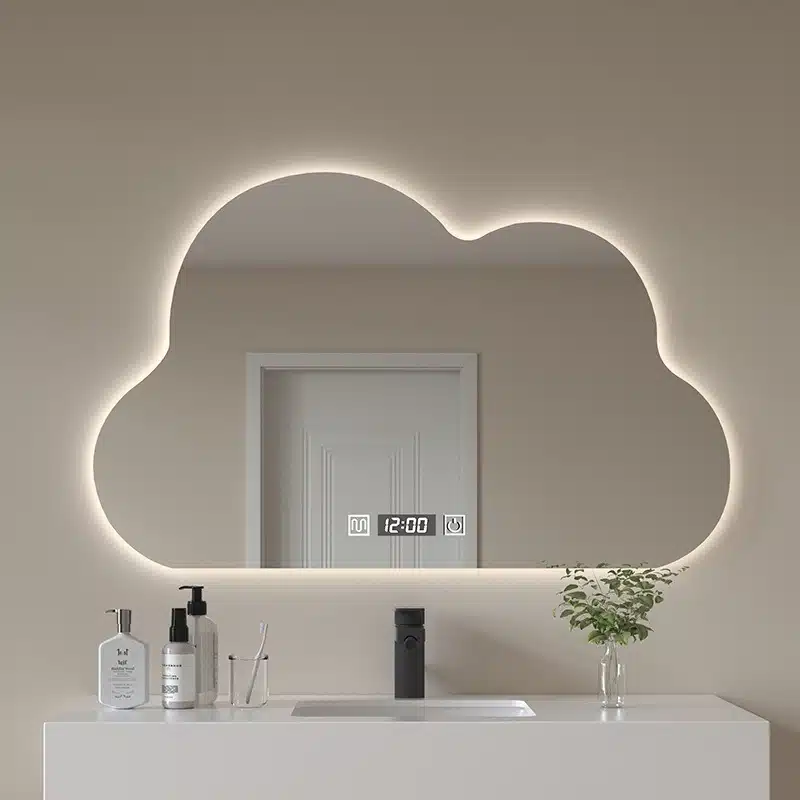
- Hotel guest-room vanities. The dominant case. Panels typically run 24×36 in to 36×48 in, squarely inside the 4mm ceiling. MFBATH’s mirror line spans 24×36 to 48×72 in (61×91 to 122×183 cm) in wood, metal, and PVC frames, so nearly every hotel RFQ lands in the 4mm-vs-5mm decision zone. LED (light-emitting diode) mirrors add driver and frame weight to the same mounting points, which makes hardware ratings as important as the glass.
- Public restrooms — airports, malls, stadiums. Hard use, vandalism risk, and cleaning chemicals argue for 5mm plus a safety backing film, held in stainless J-channels with tamper-resistant fixings. This is the scenario where over-engineering is actually cheap insurance.
- Gyms, spas, and salons. Humidity, steam, and defogger films define the environment. Pick 4mm or 5mm by panel size, specify copper-free silvering, and confirm the anti-fog element is compatible with the backing and the mounting adhesive.
- Budget chains and guesthouses. Framed 3mm mirrors on small formats are a legitimate cost move, provided the frame carries the structure. The savings come from the frame doing its job, not from the glass doing a job it cannot.
Whatever the scenario, define thickness per room type rather than per project. A single hotel can legitimately run 4mm guest-room mirrors and 5mm public-restroom panels in the same order; mixed specifications are normal, and factories quote them line by line. Current mirror and vanity options are listed on the product page.
Writing Thickness into Your Spec Sheet
Vague specs produce vague quotes. “Thick mirror glass” means nothing to a factory and everything to a dispute. A workable spec line names eight elements:
- Nominal thickness and tolerance. State the thickness (for example, 4mm) and request the mill’s tolerance range in writing, so delivered glass can be checked with a caliper at inspection.
- Glass type. Annealed or fully tempered. If tempered, note that roller-wave distortion is inherent to the process and agree an acceptable level.
- Coating and backing. Silver type, copper-free or standard, and the number of backing paint layers. This is where humidity performance is decided.
- Safety requirement. Backing film or not, and the impact-performance class the installation must meet, referencing standards such as ANSI Z97.1.
- Edge work. Polished or pencil edges, with chip acceptance criteria defined before production, not argued after delivery.
- Mounting system. Clips, J-channel, or adhesive, with load ratings checked against the panel weights calculated above.
- Packing standard. Corner and edge protection, carton strength, and orientation markings. Packing is part of the product, not an afterthought.
- Inspection and acceptance. Per-unit inspection, sampling level, and third-party verification such as SGS or TÜV if the order size justifies it.
The same discipline applies to every hardware decision on a vanity order. Name the standard instead of the adjective, the way the under-mount vs side-mount drawer slides comparison does for slides. Bathroom mirror glass thickness belongs on the drawing, the quotation, and the packing list, so three documents agree before anything ships.
If your project needs non-standard sizes, custom frame colors, or private-label branding, check the economics early. Mirror customization at MFBATH starts at 15 sets per model, color, and size, and the OEM minimum order quantity (MOQ) math guide shows how those minimums interact with container fill. Samples ship in 10 working days, which keeps the spec conversation moving.
Frequently Asked Questions
Is 5mm always better than 4mm for commercial bathroom mirrors?
No. On panels over roughly 1.2 m or hard-use public walls, 5mm earns its cost; below that, it adds freight and mounting load without solving a real problem. Match thickness to panel size and occupancy.
Can 3mm mirror glass be used on a hotel vanity?
Yes, if the panel is framed or bonded to a backboard and stays around 60 cm or less on its long side. Unsupported wall-hung panels above that size should move to 4mm or 5mm.
Does tempering replace the need for thicker glass?
No. Tempering multiplies strength roughly four to five times but does nothing for stiffness, which still scales with the cube of thickness. A tempered 3mm panel deflects exactly like a 3mm panel.
A Thickness Spec Is a Risk Decision
Mirror thickness decides four things at once: stiffness, edge stress, panel weight, and freight cost. 3mm serves framed small formats, 4mm carries standard commercial walls, and 5mm holds oversized panels and hard-use locations. Every project pays for one of those three, whether anyone chose it deliberately or not.
Key takeaways:
- Bending stiffness scales with the cube of thickness: 4mm is about 2.4 times stiffer than 3mm, and 5mm about 4.6 times.
- Most mirror losses happen in transit and handling, where edge chips grow into cracks — packing and container strategy are part of the thickness decision.
- Tempering multiplies strength but not stiffness, and can add roller-wave distortion to the reflection; backing film is the usual public-area compromise.
- Write thickness as a full spec line — nominal value, tolerance, edge work, backing, packing, inspection — and keep it consistent across the drawing, quotation, and packing list.
For a hotel or multi-unit project, verify the decision with physical samples before committing volume. MFBATH ships samples in 10 working days, and production orders start at 15 sets per model, color, and size, with mixed-container loading supported. The 15-unit MOQ trial-order guide shows how to size that first order, and the first-container strategy covers loading it efficiently.
The risk does not disappear; it only moves. Under-spec and you pay in breakage claims and call-backs; over-spec and you pay in freight and overloaded fixings. The losing move is letting the millimeter happen by default. Name it in the spec sheet, inspect it before shipment, and hold someone accountable for it before the container leaves the dock.




0 Comments