

Bathroom vanity unit price tiers separate a workable wholesale margin from a deal that evaporates in freight and rework. The per-unit price a factory quotes at your minimum order quantity (MOQ) of 15 units is not the price it charges at 100 or at 500 units, and buyers who ask for only one number are negotiating on incomplete information.
This guide maps the three tiers that matter for wholesale buyers — 15, 100, and 500 units — explains what each price absorbs, and shows how to request tiered quotes so the numbers you compare are the numbers you will pay. You are choosing an order quantity against a project pipeline, and the right tier matches your real demand rather than your hope for a better unit price.
Why One Unit Price Never Tells the Story
Inside a vanity factory, two identical vanities can carry very different unit costs depending on the order they travel in. The reason sits in three layers of factory economics: batch setup, material purchasing, and labor allocation. Each layer behaves differently as a run grows, and the unit price you see is the sum of all three at your quantity.
Batch setup is the fixed cost that starts every run: programming the CNC cutting, mixing the finish, setting the edge bander, and preparing the first article for inspection. A run of 15 units absorbs that cost 15 ways; a run of 500 absorbs it 500 ways. The setup itself does not change — the denominator does.
Material purchasing works the opposite way. PVC board, plywood sheets, sintered stone slabs, hinges, and slides are bought in lots, and the factory’s buying power steps up with your order size. At 15 units, purchasing draws from stock or small lots; at 500, it can commit to container-level quantities against a confirmed schedule.
Labor allocation is the layer buyers overlook. Skilled workers on the edge bander, the assembly line, and the QC benches cost the same per hour whether the run is 15 units or 500, but short runs carry idle time between setups while long runs keep the line moving. The labor content per unit falls as the run lengthens, and that fall is part of the price break you are being offered.
MFBATH’s minimum order quantity is 15 units per model, per color, per size across the whole product line, with custom sizes and colors starting at the same 15 units. That threshold exists because the factory would rather win a small first order and prove itself than price a trial order as if it were a container. The full rules around MOQ and mixed loading sit in the guide to navigating MOQs.
What you are really reading when a supplier shows tiered prices is economies of scale applied to a furniture factory: fixed costs spread thinner, inputs bought larger, labor used more steadily. None of that shows up in a one-line unit price, which is why the first question to ask any factory is not “what is your price” but “what is your price at each tier.”
What Actually Moves the Unit Price
Five cost blocks make up most of a bathroom vanity’s factory price: the carcass, the top and basin, the hardware, the finish, and the size you order. Each scales with volume differently, and the table below shows where volume helps and where it does not.
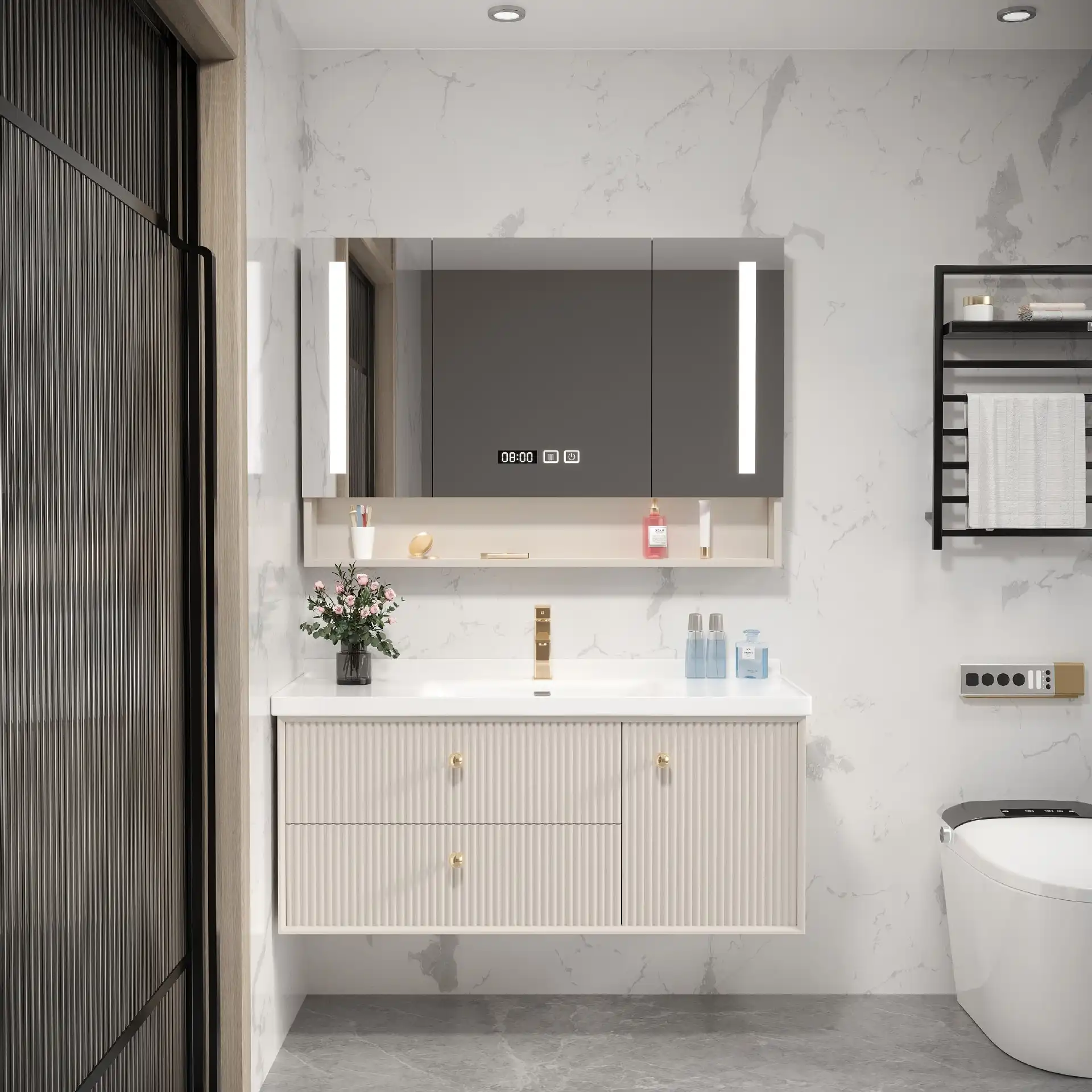
The carcass is the largest single cost block. PVC vanities are 100 percent waterproof, built in widths from 24 to 60 inches and depths from 18 to 24 inches, with more than 1,000 standard finishes. Plywood vanities come in three grades — standard, BWR, and marine — across the same width and depth range, with 15 standard finishes plus access to the 1,000-plus finish library; custom colors on plywood start at 50 units. Solid wood vanities use oak, walnut, maple, or ash, with FSC-certified wood available on request and a multi-layer PU waterproof coating.
The top and basin sit second. Sintered stone tops and basins machine in longer runs more efficiently than short, mixed batches, and the material itself is engineered for hard use: Mohs hardness 7 to 8, heat resistance to 300°C, and widths from 600 to 2,000 mm.
Hardware is the smallest cost block but the one buyers feel first. Soft-close hinges and drawer slides either hold up for years or fail in month six, and volume buying from hardware suppliers moves this line more than any production technique, because the factory buys the same hinge whether the order is 15 units or 500.
Finish drives both cost and lead time. Standard finishes draw from the 1,000-plus library with no setup penalty, while custom colors add mixing and Pantone matching — available from 15 units on PVC and from 50 units on plywood. Size determines how many carcasses come out of one board, which is why standard widths batch better than nonstandard ones.
The factory tracks more than 40,000 custom combinations across materials, colors, sizes, and hardware. A detailed view of where each dollar goes lives in the custom vanity cost breakdown.
| Cost driver | What scales with volume | What does not |
|---|---|---|
| Carcass material (PVC, plywood, solid wood) | Sheet and board purchasing in larger lots | Panel cutting and edge-banding labor per unit |
| Top and basin (sintered stone) | Slab buying and machining runs | Polishing and edge work per piece |
| Hardware (soft-close hinges and slides) | Bulk purchases from hardware suppliers | Fitting and adjustment time per unit |
| Finish | One color through the finish line per run | Custom color mixing and Pantone matching |
| Size and configuration | Standard sizes cut efficiently across sheets | Nonstandard widths and depths reset the cut plan |
The 15-Unit Tier: Trial Order Economics
A 15-unit price is the honest cost of testing a supplier. It absorbs the full batch setup, small material lots, and the highest labor content per unit of the three tiers, because the factory cannot spread fixed costs across a run that small. That is not a penalty; it is the real cost of a short, carefully made run.
What you buy at this tier is information: whether the carcass quality matches the spec sheet, whether the finish color lands where your Pantone reference says it should, and whether the factory answers emails when something needs correcting. MFBATH keeps the entry honest — the trial-order guide walks through what a 15-unit order should and should not include.
Samples come free, produced within 10 working days, with shipping paid by the buyer. A 15-unit trial order is not a sample order: samples validate one piece, while a trial run validates a supplier’s production line, packing, and paperwork on the exact SKUs you intend to scale.
The SKU mix is where a trial order gets smart. Mixed container loading is allowed, meaning different models and sizes can be combined in one order, and the tier applies to the total units across models, colors, and sizes. You can test three models in three finishes as a single 15-plus-unit order instead of three separate MOQ orders, and custom sizes and colors start at 15 units, so the trial can carry the exact spec you will eventually reorder.
Payment terms at this tier follow the standard factory schedule: 30 percent deposit on order, with the balance due within one week of receiving the draft bill of lading. That structure protects the factory on a low-margin trial run while most of your cash stays in your account until the goods are on the water. The full details are on the payment terms page.
The 100-Unit Tier: Where Batch Economics Kick In
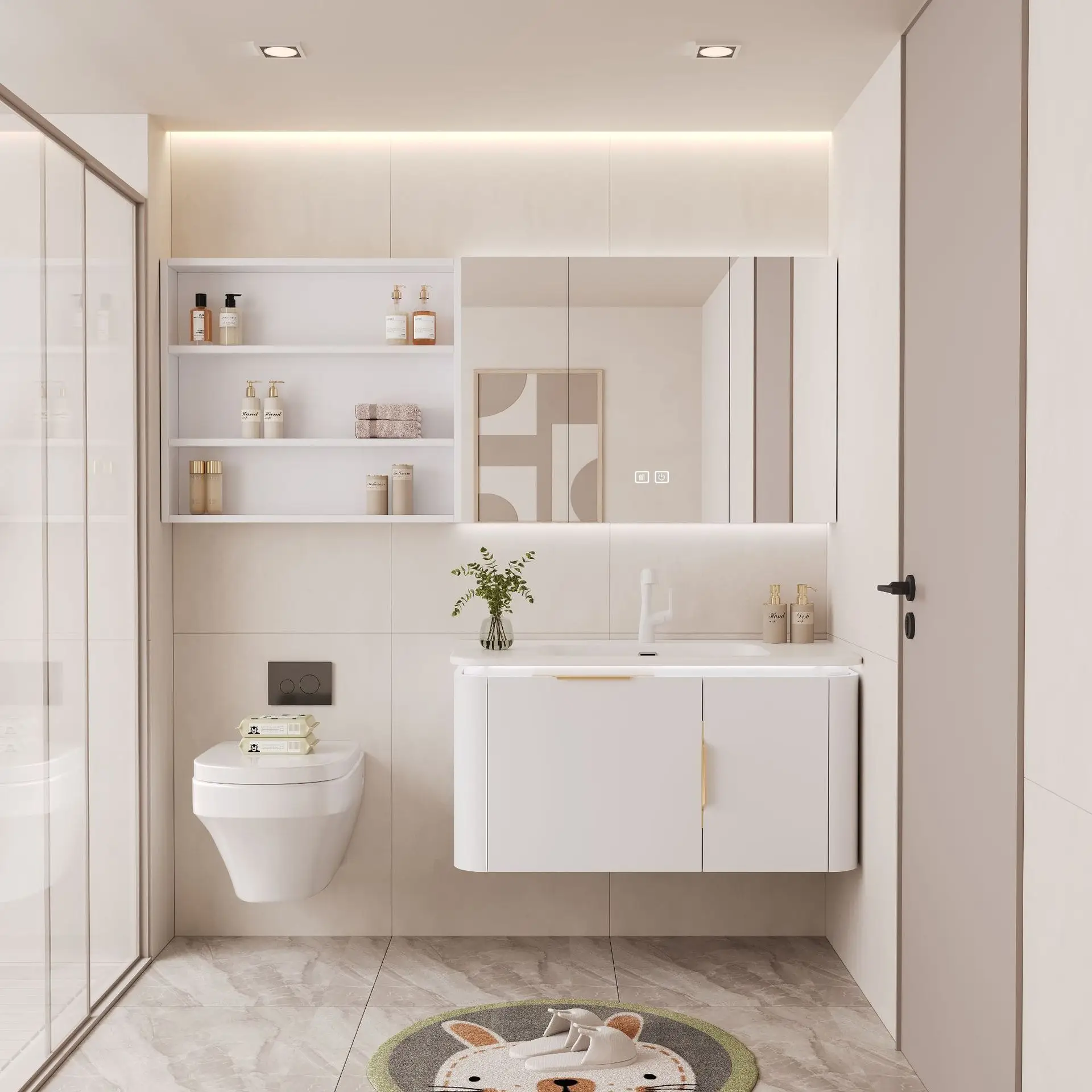
At 100 units, the factory stops pricing a run and starts pricing a batch. Three things change: panels batch, the finish line runs in dedicated shifts, and hardware purchases move to volume buys. The unit price drops because each of those steps removes a layer of per-unit cost.
Panel batching
Panel batching means cutting programs for one carcass family run across many sheets in one pass. Yield improves, the CNC table is set once instead of repeatedly, and the edge bander stays on the same material for hours. The same PVC or plywood that cost more per sheet at 15 units is now bought in truckload lots and cut in longer sequences.
Finish-line runs
Finish-line runs matter even more. A dedicated run of one color through the spray line eliminates changeover waste — the cleaning, the color mixing, the test panels that every color switch consumes. When your 100 units are one finish, the line runs your color for a full block instead of switching three times.
Capacity and schedule
Bulk production runs 20 to 30 days at this tier, inside a factory of 10,000 square meters with 95 employees producing about 5,000 sets per month. MFBATH has supplied more than 1,000 dealers across 20-plus countries since 2015, and the sintered basin line alone serves 500-plus dealers, so a 100-unit order sits well inside normal scheduling rather than consuming dedicated resources.
Quality holds at every tier
Quality checks do not loosen as volume grows. Every unit passes the same 5-stage inspection at every tier, and third-party inspection by SGS or TÜV is supported on request. The 2-year whole-unit warranty and a return rate below 1 percent apply to a 15-unit trial the same as a 500-unit container.
Factory-Direct Vanity Pricing at 15, 100 and 500 Units
Browse this product, solution, or service page to explore relevant offerings.

The 500-Unit Tier: Container-Level Pricing
At 500 units you are no longer buying vanities; you are buying container economics. The price tier shifts because three things happen at once: full container load (FCL) utilization locks in freight efficiency, material buying moves to container-level commitments, and the factory assigns dedicated production slots to your order.

FCL utilization means your cartons are measured and the container cube is planned before production starts, so the shipment packs to the container rather than paying for air. Less-than-container-load (LCL) freight charges by volume with higher per-cubic-meter rates and more handling; a 500-unit order built around FCL avoids that premium.
Container-level material buying lets purchasing commit to board, stone, and hardware quantities against a confirmed schedule, which is where the largest steps of the tiered price actually come from. Dedicated production slots mean your order owns a block of line time, with a production window inside the standard 20-to-30-day bulk schedule rather than competing with other programs.
Tier pricing at this level is quoted free on board (FOB) at Qingdao Port. Under the Incoterms rules, FOB means the factory’s responsibility ends when goods are loaded on the vessel; ocean freight, insurance, and destination-side costs are yours to plan. Two buyers can receive the same FOB line price and pay very different landed prices, so treat FOB as one layer of the total.
Total lead time from order to delivery in the US, Canada, and Mexico runs 4 to 6 weeks including logistics, with real-time tracking once the shipment moves. The factory’s logistics program claims freight savings of about 15 percent for US, Canada, and Mexico customers through consolidated routing — worth asking about when you compare this tier against LCL quotes, since it changes the effective unit cost beyond the FOB line.
For North American buyers, documentation matters at container scale. MFBATH holds CE and UL certification, runs ISO 9001 and ISO 14001 systems certified since 2017 with validity confirmed in 2025, and boards meet E1 emission limits of 0.1 ppm or less, CARB Phase 2, and TSCA Title VI. Products are designed to meet CSA, NOM, and ADA requirements — confirm the specific compliance evidence with the factory before you commit a container.
How to Request a Tiered Quote (RFQ Template)
A tiered quote starts with a structured request for quotation (RFQ). The format matters because a factory can only price what it can see: one line per SKU, quoted at all three tiers, with the same finish, packaging, and Incoterms on every line. Ask for 15, 100, and 500 units per SKU and you can compare bathroom vanity unit price tiers across your whole list instead of one headline number.
Per-SKU lines prevent one common failure: a single blended price that hides which models carry the cost. If your list mixes a 60-inch solid wood vanity with a 24-inch PVC unit, the blended number is meaningless for margin planning. Line quotes at each tier let you weight your actual order mix.
Beyond the FOB line, model the landed cost before you choose a tier: freight, insurance, duty, and inland delivery. The total cost of ownership article covers how those layers move the real comparison, because a higher FOB tier can win on total cost when freight efficiency is included.
A worked example (illustration only)
The shape of a tier spread is easier to see with numbers. The example below uses placeholder figures, not quotes.
For illustration, say a 36-inch PVC vanity line comes back at USD 185 per unit at the 15-unit tier, USD 162 at the 100-unit tier, and USD 143 at the 500-unit tier. The step from 15 to 100 units is USD 23 per unit; the step from 100 to 500 is USD 19 per unit. On 500 units, that second step is worth USD 9,500 against the 100-unit price — more than many trial orders cost — which is why the tier spread, not the single MOQ price, drives the negotiation. Example figures only.
What a vague quote hides
A vague quote hides its costs in the gaps: no quantity tier, no finish code, no carton dimensions, no Incoterms, no payment terms. Each missing field is a place where the unit price can move later — a finish charge added at spec time, freight quoted at LCL rates, packaging changed after the deposit. The fix is a written line per field.
Fields a complete quote line must carry
Use this checklist when you send an RFQ:
- SKU or model number plus finish code for every line
- Unit price quoted at the 15-unit, 100-unit, and 500-unit tiers
- Incoterms basis — FOB Qingdao — and port of loading
- Carton dimensions, weight, and units per carton
- Production window and total lead time to your destination
- Payment terms: 30 percent deposit, balance within one week of the draft bill of lading
- Customization details: Pantone color, logo printing or laser engraving, white label or private label, custom packaging
Frequently Asked Questions
Are price breaks linear as quantity grows?
No. Each tier reflects a different cost driver: the 15-unit tier absorbs full setup costs, the 100-unit tier captures batch and finish-line efficiency, and the 500-unit tier adds container-level material buying and freight utilization. The steps between tiers usually shrink as volume grows, and the only way to know the shape of your curve is to request all three prices in one RFQ.
Can mixed SKUs count toward one tier?
Yes. Mixed container loading is allowed — different models and sizes can be combined in one order — and the tier applies to the total units across models, colors, and sizes. A 120-unit order split across three models and two finishes qualifies for the 100-unit tier, so build your SKU mix toward the tier you intend to reach.
What should a FOB line quote include?
The unit price at the named tier, the Incoterms basis (FOB Qingdao), the finish and specification codes, carton dimensions with units per carton, the production window, and payment terms. If any of those fields is missing, ask for it in writing before you compare quotes — a complete line is the only thing you can negotiate against.
Key Decisions Before You Ask for a Quote
Tier pricing is factory economics made readable: setup costs spread thinner, materials bought larger, and container utilization pushing the unit price down as your order grows. The spread between tiers — not the MOQ price alone — is what you negotiate with, and a structured RFQ is what gets you the numbers.
- Decide what you are buying: a trial order at 15 units validates the supplier, 100 units starts batch economics, and 500 units prices at container level.
- Request every SKU at all three tiers in one RFQ, with identical finish, packaging, and Incoterms on each line.
- Model landed cost beyond FOB — freight, duty, and inland delivery — before you choose a tier.
- Confirm mixed loading, payment terms, and lead time in writing before any deposit.
The free 2025 catalog runs 100-plus pages across the PVC, plywood, and solid wood lines, and free samples are produced within 10 working days with shipping at your cost. Ask for both, browse the full product range, and send your SKU list with the three-tier request — the price breaks are there for buyers who ask.




0 Comments