
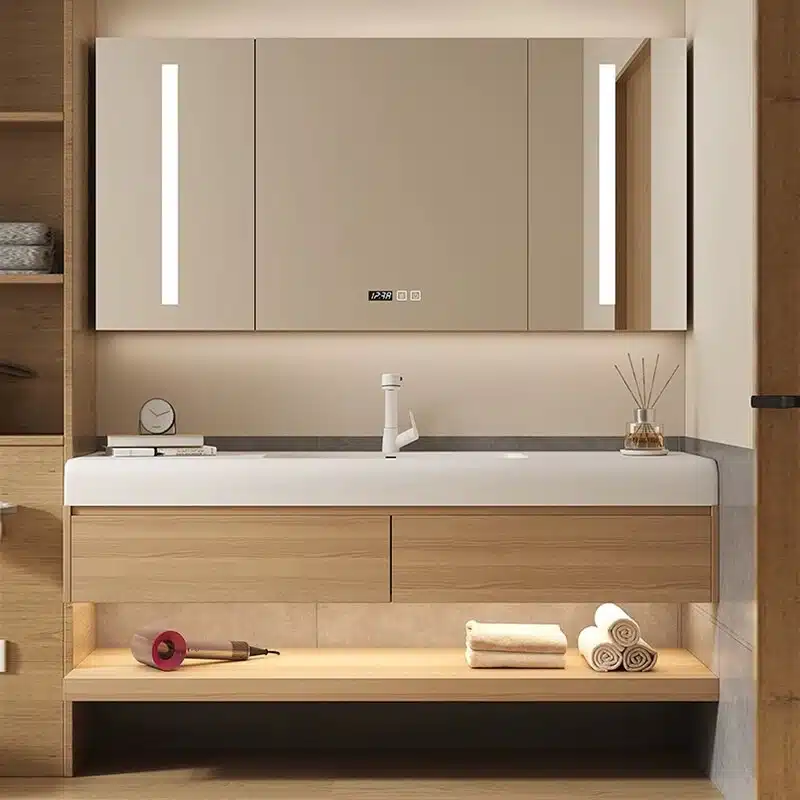
Choosing the right floating vanity manufacturer in China is the single decision that separates a secure, long-lasting installation from a catastrophic structural failure resulting in property damage and liability claims. Many importers and contractors approve designs based on aesthetics, only to discover post-installation that the unit’s back panel or mounting hardware cannot handle the cantilevered load. This engineering oversight creates a significant business risk, leading to warranty replacements, project delays, and irreversible damage to your company’s reputation.
This guide serves as a technical benchmark for sourcing wall-hung vanities that are built to last. We will analyze the engineering behind safe mounting systems, explain why standard back panels fail, and compare the load-bearing capabilities of plywood versus MDF. We’ll also review the top manufacturers whose products meet these stringent structural and safety standards, ensuring your projects are specified for reliability, not just looks.
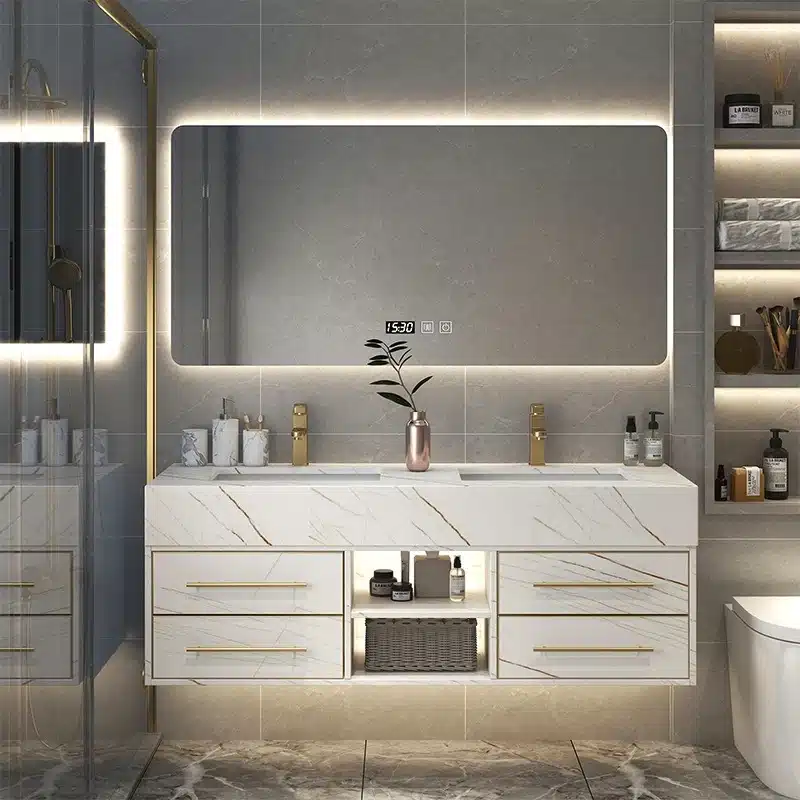
What Is the Engineering Behind a Safe Floating Vanity?
A secure floating vanity relies on three non-negotiable elements: direct-to-stud anchoring, heavy-duty corrosion-resistant brackets, and cabinet materials engineered for superior load distribution.
A floating vanity is a cantilevered load, meaning its entire weight—plus the dynamic load from daily use—is supported solely by the wall. Unlike traditional vanities that transfer weight to the floor, a wall-hung unit exerts significant stress on its mounting points. Proper engineering isn’t just about aesthetics; it’s a critical safety requirement to prevent catastrophic failure.
Structural Wall Support
The installation’s success starts inside the wall. The vanity must be anchored directly into the wall’s structural frame, which typically consists of vertical wooden studs. These studs provide the solid purchase needed for mounting fasteners to bear the vanity’s full weight. Relying on drywall or plaster alone is guaranteed to fail. Identifying and utilizing these anchoring points is the foundational step for a safe, long-term installation.
Heavy-Duty Mounting Hardware
Standard L-brackets are insufficient for this application. A floating vanity requires purpose-built mounting hardware, usually made from stainless steel or another corrosion-resistant coated metal to withstand bathroom humidity. These brackets are rated to support substantial loads, often exceeding 300 pounds per pair. Their design distributes the pulling and downward forces across the vanity’s cabinet and into the wall studs, ensuring structural integrity without compromising internal storage space.
| Engineering Component | Common (High-Risk) Approach | Professional (Engineered) Standard |
|---|---|---|
| Wall Anchoring | Using drywall anchors or toggles. | Securing lag bolts directly into vertical wall studs. |
| Mounting Hardware | Generic, off-the-shelf L-brackets. | Load-rated, corrosion-resistant steel brackets. |
| Cabinet Material | Standard MDF or particle board. | Multi-layer plywood or solid wood for high screw retention. |
Load Distribution and Material Strength
The vanity’s construction material plays a crucial role in safety. Engineers specify materials like multi-layer plywood or solid wood because they provide superior screw-holding power compared to MDF. The cross-grain construction of plywood distributes stress effectively and resists the kind of sagging or fastener pull-out that can occur with particle-based materials under sustained load. The final design ensures that the total weight is distributed evenly across all mounting points, preventing any single point from becoming a critical failure risk. All materials must also have a moisture-resistant finish to maintain their structural properties over time.
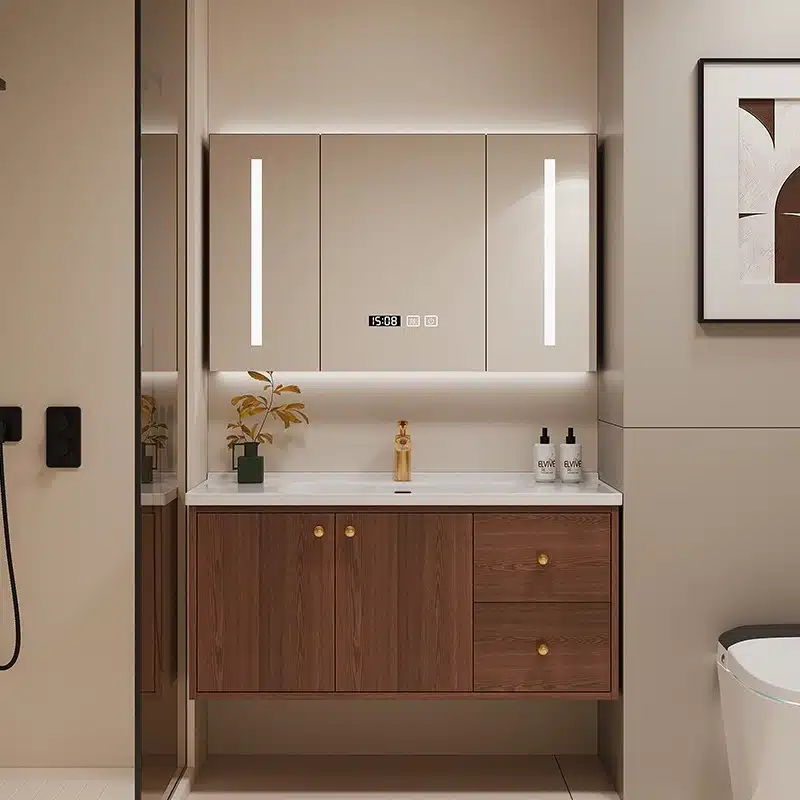
Why Do Standard Back Panels Fail on Wall-Hung Vanities?
Back panel failure on wall-hung vanities almost always traces back to two root causes: compromised waterproofing from poor sealing and mechanical stress from an inadequate mounting system.
The back panel is a critical component for both aesthetics and waterproofing, but it’s often the first point of failure. Unlike floor-standing units, a floating vanity’s back panel is more exposed to stress and potential moisture. When installers cut corners on sealing or fail to address structural requirements, the panel’s integrity degrades quickly, leading to costly damage.
Moisture Intrusion from Poor Sealing
Water penetration is the most common failure mechanism. It happens when installers overlook small but critical details during installation. Sealants at joints, adhesive coverage, and cutouts for plumbing are all potential weak spots. Once moisture gets behind the panel, it becomes trapped, compromising the material from the inside out.
- Improper sealant application at joints and corners creates direct pathways for water.
- Inadequate adhesive coverage leads to panel separation and allows moisture to build up behind the vanity.
- Poorly executed cutouts for fixtures and pipes become entry points for constant water infiltration.
Inadequate Structural Support
Beyond moisture, back panels also fail when the mounting system cannot properly handle the vanity’s load. This is a mechanical failure, often caused by poor wall preparation or a misaligned installation. The constant stress placed on the panel eventually causes it to weaken, bow, or detach from the wall entirely.
- Mounting systems that lack sufficient load-bearing capacity put direct stress on the panel instead of the wall studs.
- Failure to properly prepare and align the wall substrate before installation compromises structural integrity from the start.
- Material degradation from thermal cycling and daily use compounds these structural weaknesses over time.
Create standout bathroom vanities for your market.

Who Are the Top 10 Floating Vanity Manufacturers?
Evaluating top floating vanity manufacturers in 2026 requires a deep dive into their production scale, material certifications, and proven export capabilities to ensure supply chain reliability.
The floating vanity market has matured, moving beyond simple aesthetics to a focus on engineering and long-term structural integrity. While many factories can produce a wall-hung cabinet, only a select few have mastered the underlying support systems required for commercial and luxury residential projects. The leaders are defined not just by design, but by their ability to engineer solutions for specific materials and regional building codes.
Why FocusCabinet Engineers the Best Heavy-Duty Bracket Systems
FocusCabinet leverages advanced manufacturing to produce robust mounting systems designed for global markets. The company’s engineering focuses on creating brackets that accommodate a wide range of materials, from lightweight PVC to extremely heavy sintered stone, ensuring stability and safety. This approach meets the specific structural and regulatory demands of B2B clients, who cannot afford installation failures or product recalls.
| Material Type | Core Structural Consideration | Required Bracket Engineering |
|---|---|---|
| PVC | Lightweight but requires precise anchor points to prevent material stress or cracking. | Optimized for high-density PVC to ensure secure fastening without damaging the carcass. |
| Plywood | High strength-to-weight ratio with excellent screw retention capabilities. | Standard heavy-duty steel design, validated for shear strength and long-term load bearing. |
| Solid Wood | Heavy and subject to natural expansion or contraction with humidity changes. | Brackets with reinforced welds and wider mounting plates to distribute weight effectively. |
| Sintered Stone | Extremely heavy and brittle, demanding zero flex in the support structure. | Maximum load-bearing capacity with multiple anchor points to prevent stress fractures. |
This material-first approach is supported by rigorous production controls that separate FocusCabinet from competitors who use generic, one-size-fits-all hardware.
- Each bracket is manufactured using high-precision CNC machines, ensuring consistent quality and perfect alignment for a secure installation.
- The systems undergo a five-stage quality control process that includes stress tests to validate load-bearing capacity and long-term durability.
- Engineering designs account for different wall types and regional building codes, including North American UL/CSA and ADA compliance, making them suitable for diverse international projects.
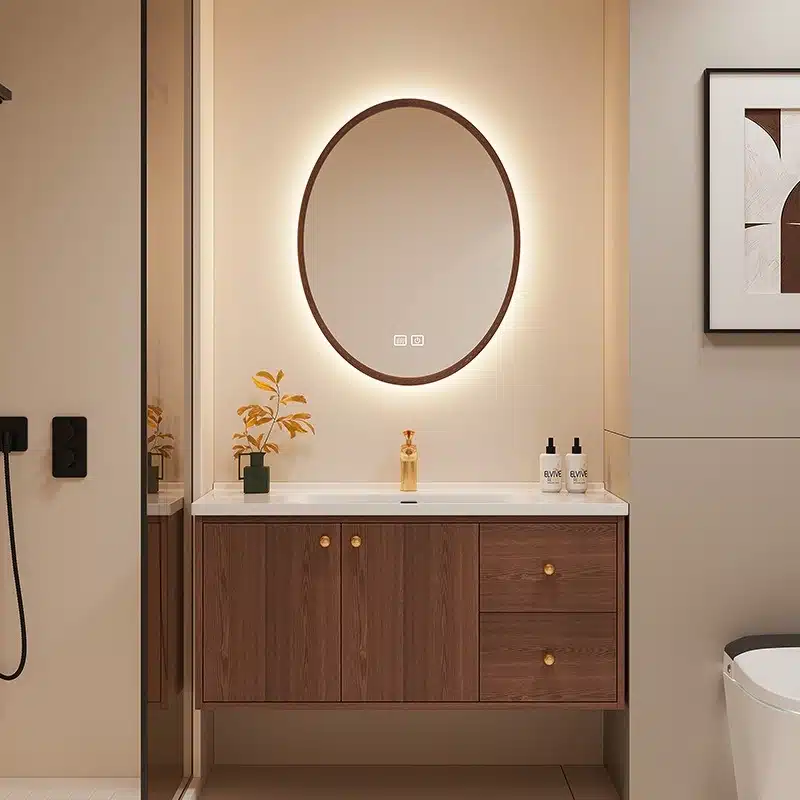
How Do You Achieve the “Hotel Look” with Integrated LED Under-Lighting?
The luxury hotel aesthetic isn’t about a single bright fixture; it’s about layering concealed, waterproof LED sources to create an atmosphere of indirect, diffuse light that makes the space feel bigger and more sophisticated.
Layered Lighting: The Foundation of Hotel Ambiance
High-end hotel bathrooms avoid single, harsh light sources. They use a layered approach that combines different types of lighting to build depth, eliminate shadows, and create a functional yet relaxing atmosphere. This strategy is the core of professional hospitality design.
- Ambient light provides the general, overall illumination for the room, often from a subtle ceiling fixture.
- Task lighting delivers focused, shadow-free light for specific activities, like grooming at the vanity mirror.
- Accent lighting, delivered by integrated LEDs, highlights architectural details and casts a soft, welcoming glow that defines the room’s character.
Strategic Placement for Indirect Illumination
The signature “hotel look” comes from indirect light that seems to emanate from the furniture itself. This is done by concealing slim, micro-profile LED strips in key locations to wash surfaces with a gentle, diffuse light instead of pointing a bulb directly into the room.
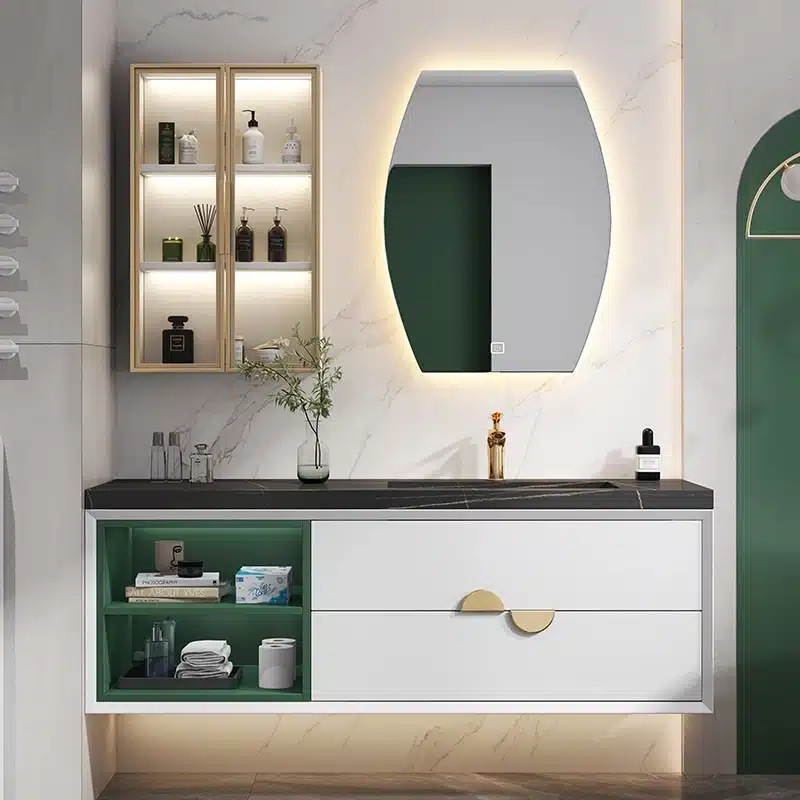
- Under-vanity lighting makes a floating cabinet appear to hover, creating a sense of space and providing a safe, low-level night light.
- Backlighting a mirror provides perfectly even, flattering light for grooming while adding a sharp, modern aesthetic.
- Integrating lights inside drawers or along cabinet toe-kicks adds another layer of subtle, functional luxury that guests notice.
Key Technology: Waterproofing and Customization
Executing this look safely and effectively depends on using the right technology. Bathroom environments demand specific durability ratings, while modern LED systems offer control and efficiency that makes these complex designs practical for large-scale projects.
- Any lighting fixture used in a bathroom needs a waterproof rating of at least IP56 to guarantee safety and prevent failure from humidity and moisture.
- Dimmable and color-tunable LEDs allow the lighting to shift from bright, cool white for the morning to a warm, relaxing glow in the evening.
- The high efficiency of modern LED technology makes these multi-fixture designs cost-effective, reducing both energy consumption and maintenance needs for property managers.
Plywood vs. MDF: Which Material Actually Supports the Weight Limit?
For load-bearing applications like floating vanities, plywood is the superior material due to its cross-grain construction, which provides double the structural strength, better long-term durability, and higher moisture resistance than MDF.
When engineering a wall-hung vanity, the choice between plywood and Medium-Density Fiberboard (MDF) directly impacts its safety and longevity. While both are common in the cabinet industry, their internal structures create massive differences in performance, especially when subjected to the constant weight and humid conditions of a bathroom.
Structural Strength: Cross-Grain vs. Compressed Fiber Construction
Plywood’s strength comes from its unique construction: thin layers of wood veneer are glued together with the grain of each layer running perpendicular to the one before it. This cross-grain structure distributes stress across the entire panel, preventing weak points. Empirical data from structural tests confirms this advantage. Plywood can support approximately twice the load of standard MDF at the same thickness. MDF, made from compressed wood fibers and resin, has a uniform density but lacks this layered reinforcement, giving it roughly 50% of plywood’s structural strength.
| Performance Metric | Plywood | MDF (Medium-Density Fiberboard) |
|---|---|---|
| Structural Strength | High. Cross-grain layers distribute load evenly for superior support. | Moderate. Compressed fibers offer uniform density but less structural integrity. |
| Long-Term Durability | Excellent. Resists sagging and deformation under sustained weight over many years. | Poor. Prone to bending or sagging when subjected to constant, heavy loads. |
| Moisture Resistance | High. Naturally resists water damage and delamination better than fiberboards. | Low. Porous nature makes it highly vulnerable to swelling and deterioration. |
| Screw Holding Power | Excellent. Wood layers provide a strong, lasting anchor for mounting brackets. | Fair to Poor. Screws can loosen over time, especially if moisture compromises the material. |
Long-Term Durability Under Sustained Load
A floating vanity must support its own weight, the countertop, the sink, and the dynamic load of daily use. Over time, plywood maintains its shape and structural integrity. MDF, on the other hand, is known to creep or sag when subjected to a constant load. This deformation can cause the vanity to pull away from the wall, creating an unsafe installation and aesthetic failure. Plywood’s resistance to bending ensures the fixture remains level and securely attached for its entire service life.
Performance in Humid Environments and Screw Holding Power
The bathroom is the most humid room in a house, and material performance in these conditions is non-negotiable. Plywood demonstrates superior moisture resistance. MDF acts like a sponge; its porous fiber composition readily absorbs water, causing it to swell, weaken, and ultimately fall apart. This vulnerability also degrades its screw holding power. Screws bite securely into the wood grain layers of plywood, providing a reliable anchor for heavy-duty mounting brackets. In contrast, once MDF gets damp, its internal structure is compromised, and fasteners can easily loosen or pull out, jeopardizing the entire installation.
Why Are Clear Installation Guides Crucial for Supporting Contractors?
Manufacturer installation instructions are not optional guidelines; they are legally binding documents that ensure a product performs as tested, meets building codes, and protects contractors from costly errors.
Ensuring Product Performance and Job Site Safety
Clear installation guides are essential for replicating a manufacturer’s tested performance parameters. A product’s fire rating, load capacity, or water resistance is only valid when it is installed precisely according to the manual. Deviating from these instructions compromises the system’s integrity and immediately voids any product approvals or warranties. These guides also outline critical safety protocols, from correct tool usage to personal protective equipment (PPE), creating a secure and predictable work environment for installers.
- Manufacturers develop instructions based on standardized testing; any on-site deviation can compromise structural performance and nullify official approvals.
- Guides specify mandatory safety requirements, including proper tool selection and necessary protective gear, to protect installation teams on the job.
Meeting Mandatory Building Code and Inspection Requirements
Manufacturer installation instructions are not just recommendations—they are legally mandated by building codes. For example, the 2021 International Residential Code (IRC) references the need to follow manufacturer instructions over 200 times, making them a legal requirement. Contractors must have these guides physically available on-site, as inspectors use them as the primary reference to verify that an installation complies with all regulatory standards. Without the guide, an inspection cannot be completed or passed.
- The International Residential Code legally elevates manufacturer instructions to code requirements, making them non-negotiable.
- Building inspectors require access to these guides during on-site visits to confirm that the work meets local codes and safety standards.
Preventing Costly Errors and Streamlining Project Coordination
Detailed guides serve as a vital communication tool, preventing misinterpretations between salespeople, fabricators, and installers that lead to on-site failures and disputes. They establish a single source of truth for the project. By defining the exact materials, fasteners, and methods required, these documents enable contractors to plan effectively. This clarity reduces the risk of ordering incorrect materials, allocating the wrong labor, or facing expensive delays and change orders during the build.
- Clear specifications derived from installation guides are critical for preventing communication breakdowns that cause failures like water intrusion or structural instability.
- Guides help project managers accurately plan material orders, allocate labor, and coordinate complex tasks, avoiding unexpected issues on installation day.
Conclusion
Choosing a floating vanity manufacturer goes beyond surface aesthetics. The engineering of the bracket system, the grade of plywood or MDF used, and the clarity of installation guides directly impact the final project’s safety and durability. Getting these details right ensures long-term client satisfaction and protects your professional reputation.
If you are sourcing vanities for an upcoming project, our team can provide detailed technical specifications and material samples to match your requirements. Our flexible manufacturing allows us to engineer solutions that align with both your design vision and budget.
Frequently Asked Questions
Floating vanity manufacturer china?
For high-volume production and export, leading Chinese manufacturers include OPPEIN, JOMOO, and Arrow. These companies are known for extensive catalogs, modern production facilities, and established global supply chains. When sourcing, focus on suppliers in key manufacturing hubs like Foshan (Guangdong province), which is renowned for its concentration of high-quality ceramic and bathroom furniture factories.
Wall hung cabinet supplier?
A reliable wall-hung cabinet supplier is defined by their material quality, hardware partnerships, and engineering standards. Look for suppliers who use moisture-resistant materials like marine-grade plywood or solid wood and partner with reputable hardware brands like Blum or Hettich for durable mounting systems. Top-tier suppliers like Porcelanosa, Duravit, and Laufen provide robust, well-engineered products with comprehensive warranties and trade support.
How much weight can floating vanity hold?
A professionally installed floating vanity can typically hold between 100 to 400 pounds. The exact capacity depends on three factors: the wall’s structural integrity (secured to studs), the quality of the mounting hardware, and proper load distribution. For example, a set of heavy-duty 16-inch steel brackets can be rated for 330 pounds per pair. This weight limit must account for the vanity cabinet, countertop, sink, and all contents.
Installing wall mounted bathroom vanity?
Successful installation hinges on securing the vanity to a robust support substructure. The process involves: 1) Locating wall studs and adding reinforcement blocking if necessary. 2) Selecting heavy-duty, corrosion-resistant metal mounting brackets. 3) Precisely marking the final height and ensuring it is level. 4) Securely fastening the brackets or mounting cleat into the wall studs. 5) Routing plumbing, including the P-trap and water supply lines, to align with the cabinet openings before mounting the vanity.
Best modern vanity factory?
The “best” modern vanity factory is distinguished by its commitment to design, materials, and technology. Leading factories utilize advanced CNC machinery for precision, source premium materials like solid surface or quartz, and integrate high-end hardware for soft-close functionality. They also employ advanced finishing techniques for superior durability. Industry benchmarks for modern design and quality engineering include brands like Antonio Lupi, Falper, and Duravit, which consistently innovate in both aesthetics and functionality.




0 Comments