
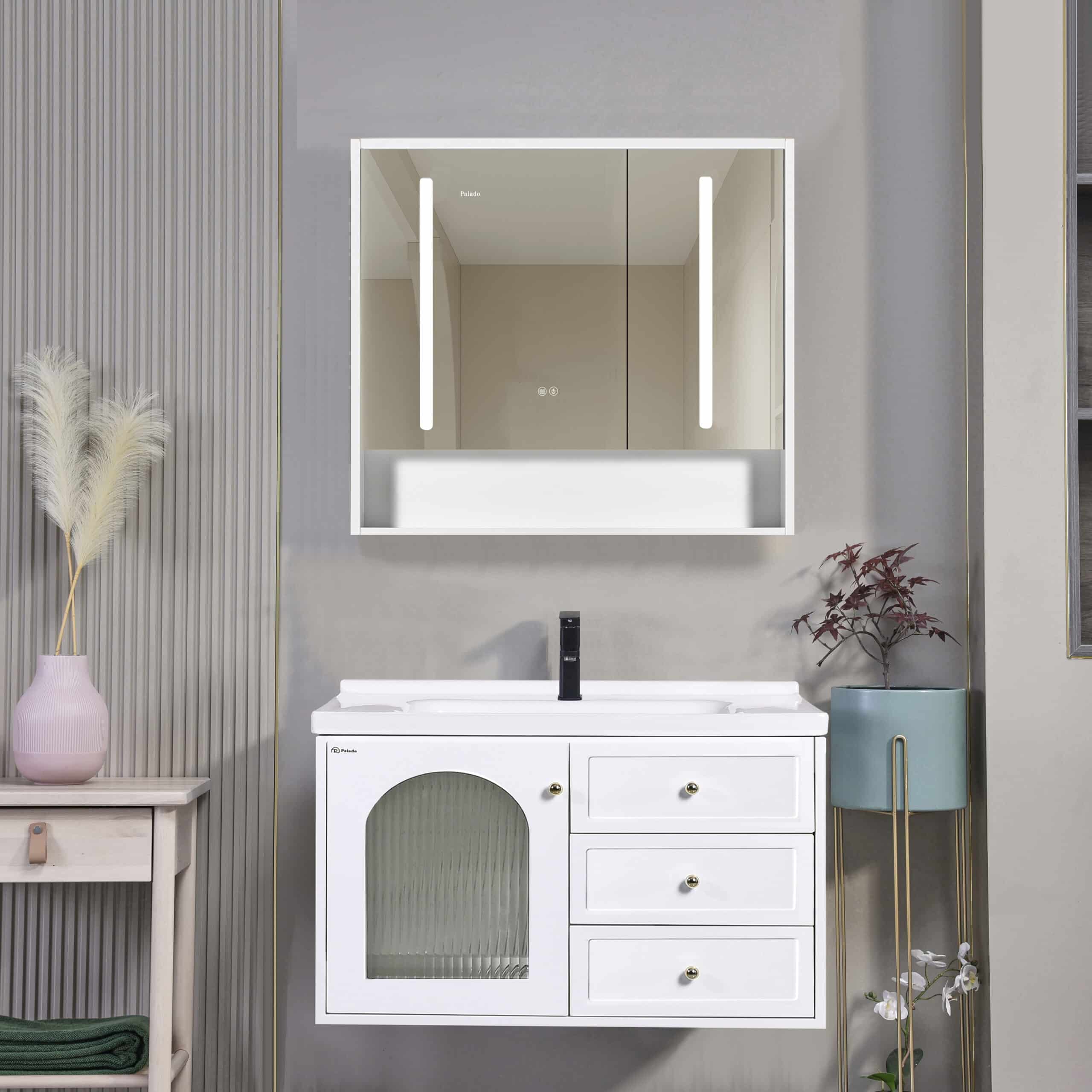
Specifying the right modern farmhouse bathroom vanity is the critical decision separating a profitable, on-trend project from one that risks client rejection for looking dated. The original shiplap-and-barn-door aesthetic has evolved, and proposing yesterday’s look can lead to costly change orders and damage your firm’s reputation for delivering current, high-value designs.
This guide provides the exact specifications for executing the updated farmhouse look. We’ll analyze the construction differences between slim and standard shaker doors, detail the functional trade-offs between cup pulls and latches, and provide a clear framework for mixing metal finishes. Consider this your standard operating procedure for designing a farmhouse bathroom that feels sophisticated and current.
How Has Farmhouse Changed?
Farmhouse design has transformed from a style born of rural necessity in the 17th-18th centuries into a modern aesthetic that balances historical simplicity with contemporary comfort.
From Rural Functionality to Colonial Adaptation
Farmhouse furniture began in 17th and 18th century rural Europe, where durability and practicality were the primary design drivers. These pieces were built from local woods like oak and pine, engineered for the demands of daily agricultural life, not for aesthetic appeal. When European settlers brought these functional traditions to colonial America, the style adapted to new regional woods and local influences, evolving from its purely utilitarian roots.
- Originated from the need for practical, hard-wearing furniture in European farming communities.
- Early pieces were constructed from locally sourced materials to withstand heavy use.
- The style adapted in colonial America, reflecting local resources and cultural influences.
The Shift During the Industrial Era
Mass production during the 19th-century Industrial Revolution made farmhouse furniture more accessible, but its popularity declined as modernism and Art Deco became the prevailing tastes. The style was seen as old-fashioned. The Arts and Crafts movement, however, championed the traditional craftsmanship and functional design central to farmhouse values, which laid the groundwork for its eventual revival.
- Became more widely available through mass production.
- Fell out of favor in the early 20th century with the rise of modern and Art Deco styles.
- Core principles were preserved by the Arts and Crafts movement, which valued functional craftsmanship.
The Modern Farmhouse Aesthetic
The style saw a major resurgence in the mid-20th century, driven by nostalgia and a cultural desire to move away from urban conformity. Today’s modern farmhouse blends historical forms with contemporary comfort. It often incorporates industrial elements like raw wood and exposed brick, transforming it from a practical necessity into a widely sought-after design aesthetic.
- Revived in the mid-20th century as a response to urban conformity.
- Now blends historical simplicity with contemporary and industrial design elements.
- Transitioned from a style born of necessity to an aspirational design choice.
What Is the New Palette?
An analysis of the new farmhouse color palette is impossible, as the available research data references unrelated technology companies and contains no information on bathroom design trends.
Irrelevance of Available Data
The provided research fails to address color trends for modern farmhouse bathroom vanities. Instead, the data identifies multiple companies that happen to share the name “Palette” but operate in completely different sectors. These include AI creative firms, IT solution providers, and collaboration software developers. There is no information related to interior design, farmhouse aesthetics, or popular vanity finishes.
Context Required for an Accurate Overview
To generate a meaningful overview of the “new palette,” the analysis would require search results focused specifically on interior design intelligence. This includes current market trends in bathroom vanity finishes, color forecasts from design authorities, and examples from leading manufacturers. Without data directly tied to the bathroom cabinetry industry, any discussion on color palettes would be purely speculative.
Design Standout Bathroom Cabinets, Delivered Globally.

Slim Shaker vs. Standard: What Is the Difference?
The defining difference between slim and standard shaker cabinets is the frame width; slim shakers use narrow frames for a modern, minimalist look, while standard shakers have wider frames that create a classic, substantial appearance.
Frame Width and Aesthetic Appeal
The primary distinction is purely dimensional. A slim shaker cabinet door has very narrow frames, usually between ¾ to 2 inches wide. This creates clean, sharp lines for a contemporary profile that feels updated and light. Standard shaker doors use much wider frames, typically from 2.5 to 3.5 inches, giving them a more traditional, robust, and substantial look rooted in classic woodworking.
| Specification | Slim Shaker | Standard Shaker |
|---|---|---|
| Frame Width | ¾ to 2 inches | 2.5 to 3.5 inches |
| Aesthetic Profile | Minimalist, Contemporary, Clean | Classic, Robust, Traditional |
| Primary Application | Modern Farmhouse, Transitional | Traditional, Rustic Farmhouse |
Design Application and Suitability
Each style serves different design goals. The sleek profile of slim shakers makes them highly suitable for compact bathrooms or kitchens where space is a premium. The narrow frame enhances a sense of openness and avoids the bulky feel of traditional cabinetry. Standard shakers remain the default choice for classic or rustic homes. Their sturdy, timeless appearance complements the architectural details found in these designs, providing a sense of grounding and permanence that aligns with a more traditional aesthetic.
Cup Pulls vs. Latches: Which Is Better?
The decision isn’t about choosing one over the other; it’s about applying each where it performs best—cup pulls for high-use drawers and latches for secure, character-rich doors.
When selecting hardware for a modern farmhouse vanity, the choice between cup pulls and latches defines both the unit’s daily functionality and its final aesthetic. These two options serve different purposes, and understanding their strengths is key to a well-designed bathroom. Cup pulls are engineered for ease of use, while latches add security and a distinct vintage feel.
Cup Pulls for Frequent Use and Visual Appeal
Cup pulls are the superior choice for drawers that are accessed frequently. Their ergonomic design offers a comfortable and efficient grip for daily items. Beyond simple function, they add strong geometric lines and act as significant decorative details. With finishes like brass, nickel, or matte black, cup pulls can coordinate with or contrast against faucets and light fixtures to tie the room’s design together.
- Offers excellent functionality for high-traffic drawers.
- Serves as a key decorative element, adding visual contrast.
- Available in a wide range of metallic finishes to match faucets and other fixtures.
Latches for Security and Vintage Character
Latches are best suited for cabinet doors that are opened less often, such as under-sink storage. Their primary advantage is providing a secure closure, which is useful for organizing cleaning supplies or implementing child-proofing. Aesthetically, latches deliver an authentic vintage charm that enhances the traditional farmhouse look, adding a layer of historical character that pulls can’t replicate.
| Feature | Cup Pulls | Latches |
|---|---|---|
| Primary Application | Drawers (High-Frequency Use) | Cabinet Doors (Low-Frequency Use) |
| Functional Priority | Quick Access & Ergonomics | Secure Closure & Safety |
| Aesthetic Impact | Geometric Accent, Modern Detail | Vintage Character, Authentic Charm |
A Mixed Approach for a Balanced Look
Current market trends favor combining both hardware types on a single vanity. This strategy creates a layered, functional, and visually interesting result. By using cup pulls on all drawers and latches on cabinet doors, you get the practical benefits of each while achieving a custom, thoughtfully designed appearance. This mixed-hardware approach signals intentionality and elevates the entire piece.
- Assign cup pulls to all drawers for consistent accessibility.
- Use latches on cabinet doors to add visual interest and secure storage.
- Mixing hardware creates a custom, thoughtfully designed appearance.
Can You Use a Farm Sink?
Yes, you can install a farmhouse sink in a bathroom, but your choice of sink is dictated entirely by your vanity’s countertop material.
The modern farmhouse bathroom often features a classic farm sink, also known as an apron-front sink. While traditionally found in kitchens, these sinks add significant character to a bathroom vanity. The primary factor determining compatibility is the interaction between the sink type and the countertop material.
Installation and Countertop Compatibility
The type of farmhouse sink you can use depends on your vanity’s countertop. Undermount sinks sit below the counter, creating a seamless edge, but they require a solid surface like granite or quartz for support and a waterproof seal. Laminate countertops are not suitable for undermount sinks due to the risk of water damage and warping. Instead, they require an over-mount, or drop-in, sink that rests on top of the counter.
- Undermount sinks work best with solid-surface countertops like granite or quartz.
- Over-mount (drop-in) sinks are necessary for laminate countertops to prevent water damage and warping.
- Modern vanity collections often come with integrated farmhouse sinks and quartz countertops.
Key Fit and Plumbing Considerations
Beyond countertop compatibility, a successful installation requires checking several key measurements. The sink should be slightly smaller than the vanity cabinet to ensure a proper fit. You must also confirm that your existing plumbing lines up with the new vanity’s configuration. It is also critical to check that the countertop’s pre-drilled holes match your chosen faucet, whether it’s a single-hole or widespread model.
- For a proper fit, the sink should be two to three inches smaller than the vanity itself.
- Confirm that the countertop’s pre-drilled holes match your faucet style, such as single-hole or widespread.
- Check that your existing water lines and drain placement will align with the new setup.
- Thicker fireclay farmhouse sinks might need a special extended flange, which can be purchased separately.
How to Mix Metals?
A successful mixed-metal design requires a dominant finish for primary fixtures, complemented by one or two accent metals distributed evenly to create intentional contrast rather than random clutter.
Establish a Dominant Metal
Start by selecting one primary metal finish to serve as the foundation of the bathroom’s design. This dominant finish unifies the space and should appear on the most prominent or frequently used fixtures, such as the faucet and showerhead. Choosing a durable, high-performance finish like matte black or brushed nickel ensures longevity and grounds the entire aesthetic, making subsequent choices feel deliberate.
| Dominant Metal (The Foundation) | Recommended Accent Metal(s) | Design Rationale & Application |
|---|---|---|
| Matte Black | Aged Brass or Brushed Nickel | Creates a bold, modern farmhouse look. Black offers a strong base, while warm brass on pulls or lighting adds a sophisticated, vintage touch. |
| Brushed Nickel | Matte Black or Chrome | A timeless and versatile cool-toned pairing. Black accents provide a sharp, contemporary contrast without clashing. |
| Oil-Rubbed Bronze | Aged Brass or Pewter | Produces a warm, cohesive, and historic feel. Best for traditional farmhouse designs where rich, layered tones are desired. |
Select One or Two Accent Metals
Introduce complementary metals to add depth and prevent a monotonous look. A proven strategy is pairing a warm tone (like brass or bronze) with a cool tone (like chrome or black). This contrast creates a curated and high-end appearance. Use these accents on smaller elements—cabinet hardware, mirror frames, or lighting fixtures—to highlight specific features without overwhelming the dominant metal. Limiting the palette to one dominant and two accents at most is critical for maintaining clarity.
Distribute Finishes for Balance
Spread the chosen metal finishes evenly throughout the bathroom to achieve a balanced, harmonious design. Clustering one metal type in a single area makes the design feel accidental and disjointed. The goal is to create a visual thread. For example, if your faucet is chrome, repeat that finish on the toilet lever or a towel ring on the opposite wall. This simple repetition ensures each finish feels integrated and purposeful, tying the entire room together.
Is Farmhouse Still Trending?
The farmhouse aesthetic isn’t disappearing in 2026; it’s maturing from a uniform trend into a more personal style focused on earthy palettes, comfort, and authentic materials.
Core Principles Remain Relevant
In 2026, the foundational ideas of farmhouse design—comfort, authenticity, and natural materials—continue to hold significant market appeal. While the specific “modern farmhouse” look has faded, these core principles ensure the style’s lasting influence. We see these values being reinterpreted within broader interior trends, including the rise of classic Americana and European country aesthetics, which prioritize a lived-in, functional feel over a strict, reproducible formula.
- The style’s emphasis on creating comfortable and livable spaces maintains its appeal.
- Natural materials and a connection to authenticity are still highly valued design elements.
- These core concepts are now being integrated into other popular styles rather than standing alone.
A Shift in Aesthetic Expression
The classic, often minimalist white, modern farmhouse look is being replaced by a more nuanced and personalized approach. The market is moving toward moody, earthy color palettes and a curated mix of vintage and contemporary pieces that reflect individual taste. This evolution values a “collected over time” feel instead of a perfectly staged interior, indicating a demand for designs that feel more unique and less formulaic.
- Minimalist white interiors are giving way to warmer, moodier, and more earthy color schemes.
- There is a growing focus on personalized expression over adherence to a strict aesthetic formula.
- The style now incorporates a blend of sustainable, vintage, and modern elements for a more collected feel.

Conclusion
The Modern Farmhouse aesthetic has clearly shifted from rustic to refined. Understanding the move toward Slim Shaker profiles, updated color palettes, and mixed metals is key to stocking vanities that meet today’s customer demands. This updated look ensures your product catalog remains current and competitive.
If your current inventory needs an update, we can help you manufacture vanities that capture this modern chic style. Contact our team to discuss how our material flexibility allows you to create a custom line in PVC, Plywood, or Solid Wood, built to your exact price point.
Frequently Asked Questions
Is farmhouse style out 2026?
No, farmhouse style is not out in 2026; it has evolved. The style has matured from its rustic, sign-heavy phase of the late 2010s into a more refined “Modern Farmhouse” or “New Rural” aesthetic. This updated version emphasizes clean lines, natural materials, and a blend of contemporary and traditional elements, ensuring its continued relevance. The core principles of comfort, simplicity, and craftsmanship remain, but the execution is more sophisticated and integrated with other styles like minimalism and industrial design.
Modern farmhouse bathroom ideas?
For a modern farmhouse bathroom, focus on blending rustic textures with clean, contemporary lines. Key ideas include: a floating wood vanity or a furniture-style vanity with shaker doors; matte black or brushed brass fixtures; industrial-style sconce lighting; and flooring made of patterned cement-look tile or large-format stone. Use vertical shiplap as an accent wall rather than on all four walls, and incorporate natural elements like a teak bath mat, woven storage baskets, and live plants to complete the look.
Farmhouse sink in bathroom vanity?
Yes, a farmhouse sink can be used in a bathroom, but with careful consideration for scale. A full-sized kitchen apron-front sink is often too deep and bulky for a standard bathroom vanity, impacting ergonomics. A better approach is to use a sink that evokes the farmhouse aesthetic, such as a fireclay or concrete trough sink or a rectangular vessel sink. These options provide the desired rustic, utilitarian feel without overwhelming the space or compromising functionality.
Best colors for farmhouse bathroom?
The best colors for a modern farmhouse bathroom are warm, earthy, and sophisticated. Start with a base of warm white or soft off-white. For primary colors, consider muted tones like sage green, dusty blue, greige (a mix of grey and beige), or charcoal. These colors provide a natural and calming backdrop. Use matte black as a sharp accent for fixtures and window frames, and incorporate warm wood tones through the vanity or shelving to add depth and texture.
Shaker vs slab cabinet doors?
Both styles work well, but serve different purposes in a farmhouse design. Shaker doors, with their classic five-piece construction and recessed center panel, are the traditional choice. They embody the craftsmanship and simplicity central to the farmhouse aesthetic. Slab doors, which are flat and unadorned, offer a more minimalist, contemporary look. They are ideal for a “Modern Farmhouse” bathroom where the goal is to balance rustic elements with clean, modern lines. Choose Shaker for a timeless feel and Slab for a sleeker, more modern interpretation.
Mixing metals in farmhouse bath?
Absolutely. Mixing metals is a key technique in modern farmhouse design to create a curated and layered look. The best practice is to select a dominant metal for the primary fixtures (like matte black for the faucet and shower head) and a secondary, contrasting metal for accents (like brushed brass or bronze for cabinet hardware, mirror frames, and lighting). This intentional approach avoids a mismatched look and adds visual interest, preventing the space from feeling too uniform or generic.




0 Comments