

 Sourcing custom vanity tops that fit perfectly on arrival is the main defense against expensive project delays and material waste. A single miscalculation in overhang, an incorrect faucet spread, or a misunderstood edge profile can trigger a domino effect of installation failures. When dealing with heavy materials like quartz and natural stone, these mistakes create budget overruns and force time-consuming reorders that derail tight construction schedules.
This guide provides a technical breakdown of the specifications required to get your order right. We will cover the complexities of stone sizing, compare the fabrication limits of quartz versus marble, and clarify the standards for edge profiles, sink cutouts, and faucet drilling. Think of this as a sourcing SOP for specifying every detail correctly, from backsplash requirements to safe packaging protocols for transport.
Custom Stone Sizing: Why Is It So Complex?
Custom stone sizing is a multi-stage process where precision templating, advanced CNC fabrication, and structural management converge to ensure a perfect fit in imperfect, real-world spaces.
On-Site Templating for Unique Spaces
Every custom stone project starts with precise on-site templating. This step is non-negotiable because job sites, particularly in renovations or older buildings, rarely have perfectly square walls or level cabinets. A detailed digital template captures the real-world conditions, not just the blueprint specs, ensuring the final piece fits the unique contours of the space without unsightly gaps.
- Digital measurements capture actual site conditions, not just design plans.
- Templating identifies and accommodates wall irregularities and cabinet variations.
- This process prevents gaps and ensures seamless visual continuity after installation.
The Demands of Precision Fabrication
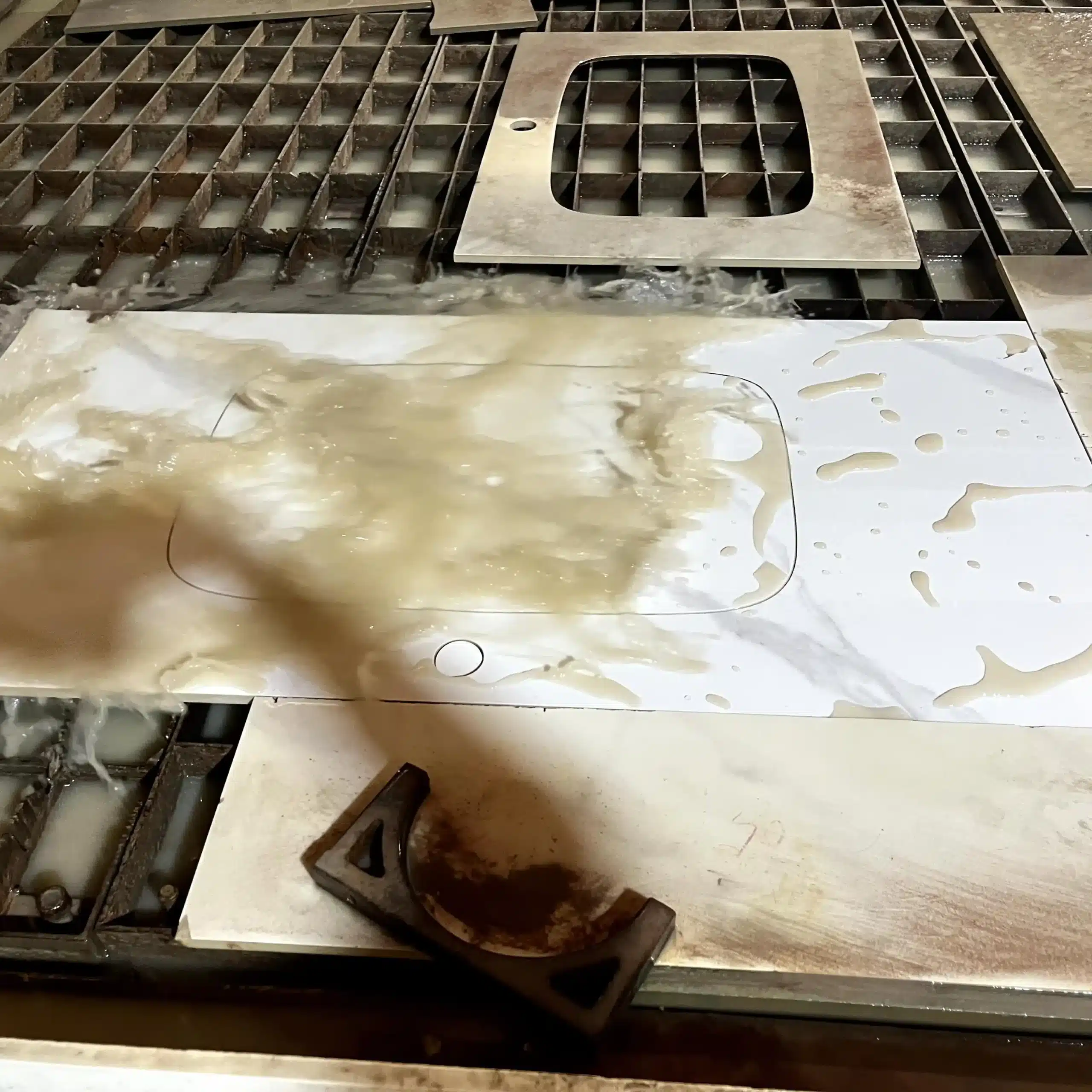
Converting a digital template into a physical stone top requires specialized equipment. Fabricators use waterjet cutters and CNC machinery to execute complex shapes, curves, and cutouts with sub-millimeter accuracy. This technology is essential for working with hard materials like quartz and granite without introducing micro-fractures or imperfections. These machines are the only way to reliably produce accurate sink cutouts, faucet holes, and other integrated features that modern designs demand.
| Fabrication Stage | Core Activity & Technology | Primary Impact on Complexity |
|---|---|---|
| Templating | Digital measurement of as-built conditions | Corrects for non-square walls and uneven surfaces, ensuring a perfect fit. |
| Fabrication | CNC & Waterjet cutting for sinks, curves, and edges | Enables complex designs but requires expensive machinery and skilled operators. |
| Coordination | Managing edge profiles, seams, and structural weight | Ensures long-term durability and visual flow; adds 7–14 days to the timeline. |
Managing Structural and Design Elements
True complexity emerges when coordinating design choices with the stone’s physical limits. Fabricators must balance aesthetic details like edge profiles and overhangs with structural factors like stone weight, support requirements, and seam placement. This intensive, detail-oriented workflow is why a custom job often takes 7–14 days. Every decision impacts handling, installation logistics, and the final durability of the product.
- Each design choice, from edges to overhangs, is factored into the fabrication plan.
- The stone’s weight dictates specific handling and installation procedures.
- This precision-driven workflow directly impacts the final quality and longevity.
Quartz vs. Natural Stone: How Do Customization Limits Differ?
The choice between quartz and natural stone hinges on a clear trade-off: quartz delivers engineered consistency for scalable projects, while natural stone offers unique, non-replicable aesthetics for high-end applications where authenticity is the primary goal.
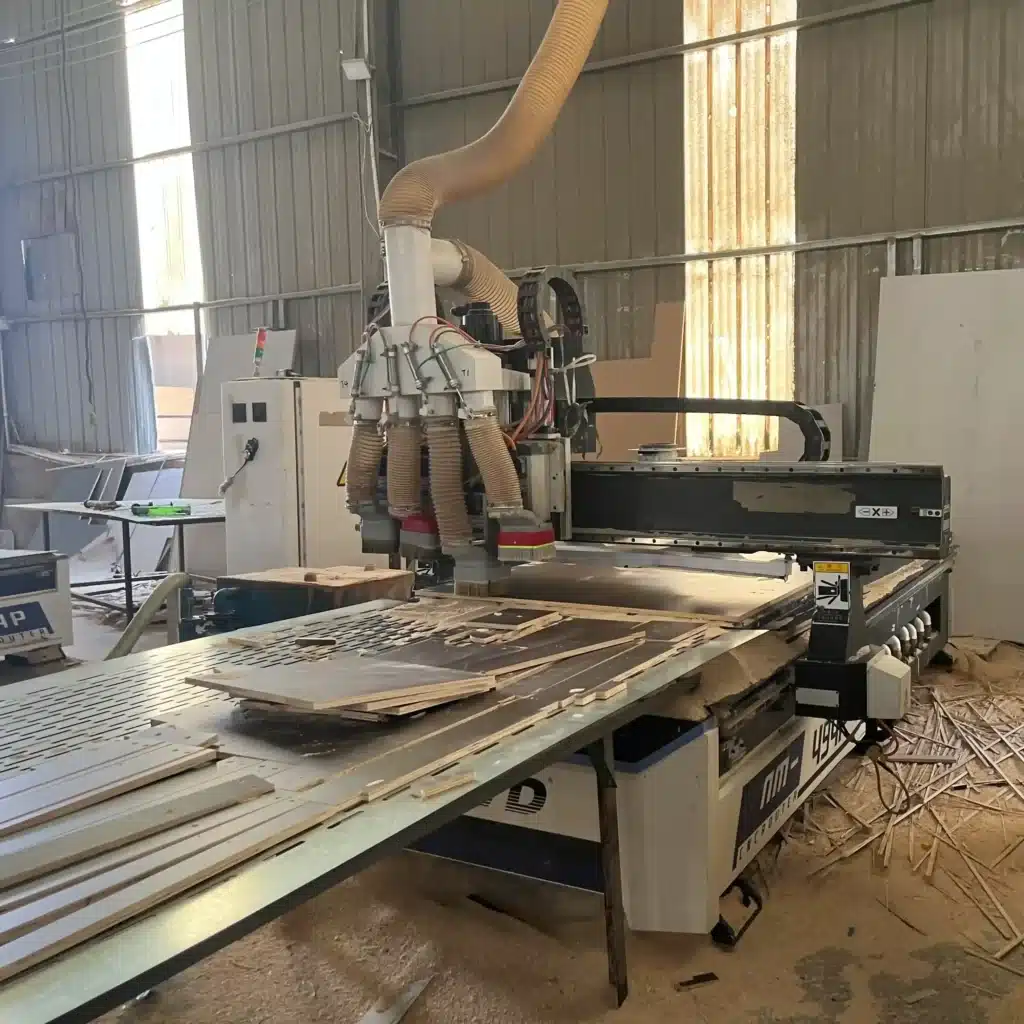
When specifying custom tops, the material choice dictates the boundaries of design. Engineered materials like quartz provide a controlled, predictable palette ideal for projects demanding uniformity. Natural stone, by contrast, operates within organic constraints, offering one-of-a-kind slabs that cannot be standardized. Understanding this fundamental difference is critical for aligning material capabilities with project requirements.
Quartz: Engineered for Consistent Customization
Quartz offers predictable and replicable customization because its manufacturing process is entirely controlled. This allows for consistent colors, patterns, and engineered aesthetics, making it the ideal choice for commercial or multi-unit residential projects that require absolute design uniformity across dozens or hundreds of surfaces. Whether the design calls for a bold contemporary color or a specific marble-like pattern, quartz delivers a reliable and scalable solution.
- Delivers virtually limitless color and pattern combinations that are consistent from slab to slab.
- Ensures a uniform look for large-scale projects where multiple tops must match perfectly.
- Allows for precise replication of designs, a key advantage for clients who need predictability and brand consistency.
| Feature | Quartz (Engineered) | Natural Stone (Organic) |
|---|---|---|
| Consistency | Uniform and replicable slab to slab | Each slab is unique and non-replicable |
| Ideal Use Case | Large-scale commercial and residential projects | High-end, luxury applications seeking exclusivity |
| Design Control | Virtually limitless, predictable options | Limited by natural availability and formation |
| Veining & Pattern | Engineered and repeatable | Organic, one-of-a-kind mineral deposits |
Natural Stone: Embracing Unique, Organic Limitations
Customization with natural stone means working within nature’s constraints. Each slab of granite, marble, or quartzite is inherently unique, with non-replicable veining, fissures, and mineral patterns. This makes standardized customization impossible, but it is precisely this quality that appeals to clients seeking exclusive, one-of-a-kind aesthetics. For luxury applications where natural authenticity is the defining feature, the limitations of the material become its greatest strength.
- Every slab features unique, non-replicable veining and mineral deposits.
- Standardized customization is impossible, which guarantees each piece is an original.
- Best suited for high-end projects where uniqueness and natural beauty command a premium.
Boost Sales with Region-Specific Bathroom Vanities

Edge Profiles: Should You Choose Eased, Bullnose, or Mitered?
Edge profile selection in 2026 is driven by two distinct market demands: minimalist, cost-effective profiles for modern projects and complex, decorative edges for luxury and traditional renovations.

The choice of an edge profile directly impacts a vanity top’s aesthetics, safety, and cost. The current market is split. On one side, minimalist profiles like the eased edge dominate contemporary designs due to their clean lines and affordability. On the other, fully rounded bullnose edges remain the standard for projects where safety is the primary concern, such as in family homes or high-traffic commercial spaces. Both profiles are practical, widely available, and serve functional purposes beyond pure style.
Eased and Bullnose Edges for Practicality and Safety
In 2026, eased and bullnose profiles continue to be the workhorses of the industry. The eased edge is essentially a squared profile with slightly softened corners, preventing sharpness while maintaining a modern, clean look. It is often the most cost-effective option. The bullnose edge features a fully rounded profile, which is excellent for minimizing potential injuries from sharp corners. This makes it a preferred choice for households with children or in any environment where user safety is a priority.
| Profile Type | Primary Characteristic | Ideal Application |
|---|---|---|
| Eased Edge | Squared profile with slightly softened corners for a clean, modern look. | Contemporary kitchens and bathrooms; budget-conscious projects. |
| Bullnose Edge | A fully rounded edge that minimizes the risk of injury from impact. | Family homes, healthcare facilities, and high-traffic areas. |
| Mitered Edge | Two pieces joined at an angle to create a thick, seamless block appearance. | Luxury residential projects and modern commercial designs. |
| Ogee Edge | A classic ‘S’-shaped curve that adds a decorative, elegant touch. | Traditional kitchen and bathroom renovations. |
Mitered and Ogee Edges for Distinctive Styles
For projects demanding a specific aesthetic, mitered and ogee edges provide strong visual statements. A mitered edge joins two pieces of stone at a 45-degree angle, creating the illusion of a thick, monolithic slab. This technique is gaining traction in luxury projects for its dramatic, modern look. The fabrication process is labor-intensive and requires precision, adding $30 to $60 or more per linear foot to the project cost. The ogee edge, with its classic ‘S’-shaped curve, remains a fixture in traditional designs, offering timeless elegance that complements classic cabinetry and fixtures.
Sink Cutouts: How Do Oval and Rectangular Specs Compare?
The choice between oval and rectangular sink cutouts boils down to a clear trade-off: ovals optimize for space efficiency in smaller bathrooms, while rectangles maximize usable basin area for modern, larger vanities.
When specifying a vanity top, the sink cutout is a critical decision that impacts both aesthetics and daily function. Oval and rectangular sinks serve different design goals and fit distinct spatial requirements. Understanding their standard dimensions and market positioning helps ensure the final product aligns with project needs, whether for a compact guest bathroom or a spacious master suite.
Oval Sinks: Classic Form and Space Efficiency
Oval sinks are defined by their traditional aesthetic and space-saving dimensions, making them a popular choice for compact or transitional bathrooms. Their corner-free construction simplifies maintenance and cleaning, a practical benefit for high-traffic areas. The curved geometry is inherently space-efficient, allowing for more usable counter space on smaller vanity tops.
- Typical dimensions range from 16 to 20 inches in diameter with depths of 5 to 8 inches.
- The curved shape is optimized for smaller vanities and guest bathrooms where maximizing counter space is a priority.
- Their softer lines complement classic and transitional design styles effectively.
Rectangular Sinks: Modern Lines and Functional Surface
Rectangular sinks offer a contemporary look with clean lines and a larger basin surface, making them a fixture in modern bathroom design. The flat bottom and straight sides provide more usable area within the basin compared to an oval sink of similar overall dimensions. Recent design innovations focus on improving functionality by addressing issues like water splashing, making them more practical than earlier models.
- Standard measurements are 20 to 24 inches wide by 16 to 23 inches front-to-back.
- The design provides more usable surface area within the basin, which is ideal for master bathrooms.
- Many new rectangular models now feature rounded corners and sloped bottoms to improve drainage and minimize splashing.
Faucet Drilling: Should You Specify a 4″ or 8″ Spread?
The choice between a 4-inch and 8-inch faucet spread is a direct trade-off between the space-saving efficiency of integrated centerset units and the design flexibility of widespread installations.

4-Inch Centerset Spacing for Compact Designs
The 4-inch spread is the industry standard for centerset faucets, where the handles and spout are mounted together on a single base plate. This compact configuration is engineered for smaller vanities or bathrooms where countertop space is limited. Its integrated design simplifies the installation workflow, making it a practical and cost-effective specification for high-volume projects.
- Ideal for single-basin vanities, powder rooms, or secondary bathrooms.
- Simplifies installation since all components are part of a single unit.
- A cost-effective solution often used in multi-unit residential projects.
8-Inch Widespread Spacing for Mainstream Flexibility
An 8-inch spread is the most common specification for widespread faucets, which feature separate hot and cold handles and a standalone spout. This layout provides a more substantial, upscale appearance and has become the benchmark for most residential master bathrooms and hospitality projects. The separation of components allows for greater design freedom in selecting handle styles and spout shapes to match the overall aesthetic.
- Provides a balanced, classic look suitable for larger vanity tops.
- Allows for greater design flexibility with a variety of handle styles and spout shapes.
- Considered the industry benchmark for primary residential and hospitality installations.
Confirming Hole Diameter and Layout
Beyond the spread measurement, verifying the correct hole diameter is critical for faucet compatibility. Installers must confirm that the vanity top’s drilled holes match the faucet’s technical requirements to prevent fitment issues on site. A mismatch here can cause significant delays and may require costly re-fabrication of the stone top.
- Most faucet holes are drilled to a standard diameter between 1¼ and 1½ inches.
- Verifying specifications before fabrication minimizes the risk of errors.
- Custom layouts with spreads between 6 and 16 inches are possible but require precise coordination with the fabricator.
Backsplash & Side Splash: What Are the Key Requirements?
Backsplashes and side splashes have evolved from optional accents to essential infrastructure, providing critical moisture protection and ensuring health code compliance in both residential and commercial projects.
Standard Height and Material Specifications
Backsplash and side splash requirements differ based on the installation environment. Residential projects typically specify a 4 to 6-inch height, which is sufficient to create an effective moisture barrier for drywall behind the vanity. Commercial applications, on the other hand, have stricter requirements, often mandating completely non-porous materials to meet durability standards and local health codes.
- A standard height of 4 to 6 inches is the common specification for residential projects to protect walls from water damage.
- Commercial settings demand non-porous, highly durable materials to comply with stringent health and safety regulations.
- Using a custom-matched backsplash made from the same material as the countertop creates a seamless, non-porous barrier that satisfies both aesthetic and functional needs.
Functional Role in Safety and Code Compliance
Beyond simple aesthetics, splashes are a critical component for safety and hygiene. They form an essential protective barrier where the countertop meets the wall, preventing water from seeping into gaps and causing structural damage or mold growth. This function is especially important for meeting building and health regulations, particularly when vanities are installed near high-traffic walkways or food preparation surfaces.
- Splashes serve as a crucial moisture barrier, protecting drywall and wall cavities from water infiltration and subsequent mold.
- Proper installation is often required for health code compliance, especially when fixtures are located within 18 inches of walkways or food prep areas.
- Integrated or seamless splash designs contribute directly to better hygiene and infection control by eliminating joints and creating a continuous, easy-to-clean surface.
Packaging Heavy Stone: How Can You Ensure Safe Transport?
The industry’s shift from manual labor to mechanized handling and strict regulatory compliance forms the foundation of safe heavy stone transport.
Specialized Equipment and Handling Protocols
Modern stone transport prioritizes mechanized handling over manual labor to reduce risks. Using specialized equipment like A-frame carts and slab lifters is now a standard practice for safely moving heavy materials. These tools are not optional; they are essential for preventing the crushing and struck-by injuries common with manual handling.
- Utilize A-frame carts and demountable transport frames equipped with locking mechanisms to secure slabs.
- Employ slab lifters to minimize direct manual handling and prevent crushing or struck-by injuries.
- Implement routine equipment inspections to confirm all machinery functions correctly and safely.
Load Securement and Stabilization Techniques
Properly securing stone slabs is key to preventing them from shifting or breaking during transit. A cracked or fallen slab is a total loss and a significant safety hazard. This involves using a combination of tight wrapping, strong strapping, and internal stabilization measures to create a solid, immovable block of material.
- Tightly wrap and strap individual slabs or bundles to create a unified, stable block.
- Use bracing and other stabilization methods inside the transport vehicle to prevent load shifting.
- Ensure the weight is distributed evenly across the transport frame to maintain balance.
Regulatory Compliance and Operator Training
Adhering to transportation and workplace safety standards is mandatory. Operators must be trained on current protocols to handle heavy stone according to regulations from bodies like OSHA and the DOT. Untrained operators are a liability that no professional operation can afford.
- Ensure all transportation practices comply with current OSHA and DOT load securement rules.
- Provide operators with thorough training on safe handling procedures and equipment operation.
- Establish integrated safety protocols that cover every step from loading to final delivery.
Conclusion
Sourcing custom vanity tops involves navigating numerous details, from material selection and sizing to edge profiles and faucet specs. Each choice directly impacts the final product’s appearance, functionality, and cost-effectiveness. Paying close attention to these specifications—including backsplash requirements and safe packaging—ensures your vanities meet precise project goals and client expectations.
If you are ready to define the specifications for your next project, our team can help you align materials and designs with your budget. Contact FocusCabinet to discuss your requirements or to request a refundable sample and test our quality firsthand.
Frequently Asked Questions
Can I order custom size vanity tops?
Absolutely. Custom sizing is a core part of modern stone fabrication. The process involves precise on-site templating to capture the exact dimensions of your space, followed by advanced CNC or waterjet cutting to ensure a perfect fit. This tailored approach accommodates unique layouts, non-square walls, and specific design requirements.
What is the best material for custom tops?
The “best” material depends on your priorities. For maximum durability and low maintenance, Quartz is the industry leader as it is non-porous and resists stains and scratches. For natural beauty and heat resistance, Granite is an excellent choice but requires periodic sealing. For a luxurious, high-end look, Marble is unparalleled, though it is softer and requires more careful maintenance to prevent etching and staining.
Difference between 4 inch and 8 inch faucet spread?
The measurement refers to the distance between the centers of the hot and cold water handle holes. A 4-inch “centerset” faucet combines the handles and spout on a single base plate, fitting three holes drilled closely together. An 8-inch “widespread” faucet has three separate, individual components—two handles and a spout—offering a more spacious and premium look. Your choice determines how the holes must be drilled in the vanity top.
How much overhang should a vanity top have?
The industry standard overhang for the front and any exposed sides of a vanity top is between 1 inch and 1.5 inches. This slight extension serves a functional purpose by directing spills away from the cabinet doors and drawers below, and it also provides a clean, finished aesthetic. Sides that are flush against a wall typically have no overhang.
Is mitered edge expensive?
Yes, a mitered edge is considered a premium and more expensive option. It requires cutting two pieces of stone at a 45-degree angle and joining them to create the illusion of a much thicker, solid slab. This process is significantly more labor-intensive and requires a high degree of precision to make the seam invisible, which contributes to its higher cost compared to simpler edge profiles.
Can you match the vein on the backsplash?
Yes, vein matching between the countertop and the backsplash is a hallmark of high-quality fabrication. To achieve this seamless “visual continuity,” both pieces are cut from the same slab of stone. The fabricator carefully plans the cuts to ensure the veining flows uninterrupted from the horizontal surface up the vertical backsplash. This technique, often called bookmatching, creates a stunning, continuous look but requires more material and meticulous labor.





0 Comments