

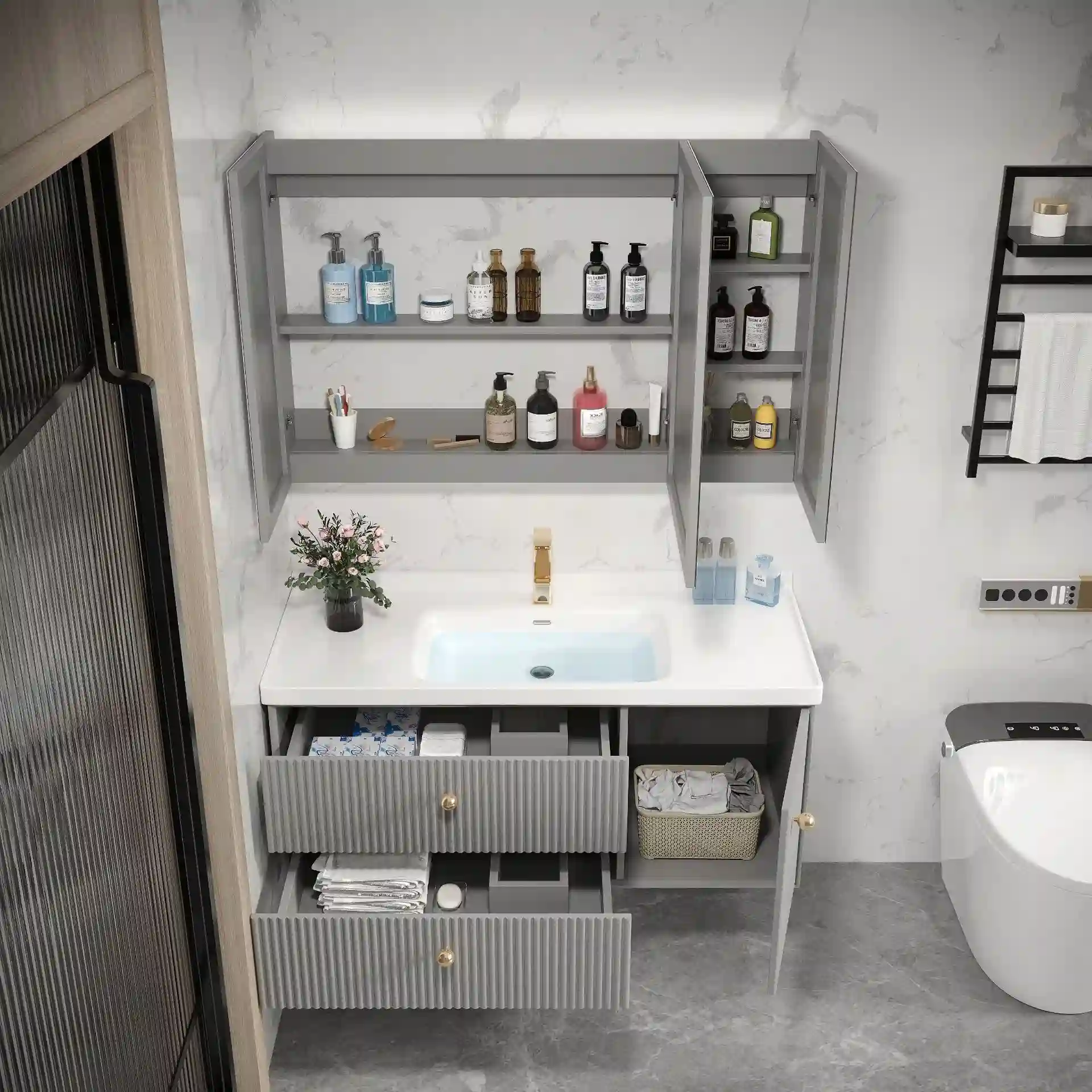
A vanity sample approval checklist is the difference between a signed purchase order and a container full of surprises. The sample always looks flawless in the showroom. The trouble starts with the production batch: finish shades drift, hardware gets substituted, and packaging thins out after your sign-off. That gap between prototype and container is where importers lose the most margin.
This guide walks through seven checks any purchasing team can run on a bathroom vanity sample, with clear pass lines and the cost of skipping each one. It then maps those checks onto a repeatable workflow, from sealed samples to pre-shipment inspection, so approval becomes a process instead of a gamble.
Why Vanity Samples Drift From Production Batches
Sample units and mass-production units are made by different systems. A prototype is typically built by senior technicians who hand-fit every door and cherry-pick boards. A production line does neither. MFBATH runs a 95-person team turning out 5,000 sets per month, and that scale is why importers order from a factory. It is also why a sample can flatter.
Four Places Drift Usually Starts
- Finish lots. Laminate, veneer, and paint batches shift slightly between production runs. With a library of 1,000+ standard finishes available, only a sealed physical chip pins the color down.
- Purchased hardware. Handles and drawer slides come from outside suppliers. If the spec sheet names a function instead of a model number, any substitute counts as compliant.
- Packaging value engineering. Samples ship in hand-built crates, while production cartons are costed separately. Corner protection can shrink without anyone announcing it.
- Line conditions. Jigs wear, blades dull, and press settings drift between a one-off bench and a full production run.
Photos make the problem worse. Many teams approve samples from supplier photographs, which flatten gloss, hide texture, and render color under unknown lighting. A sample approved by photo is a sample approved by marketing. The physical unit needs to travel to you, so the checks in this guide happen on your floor rather than the factory’s.
None of this implies bad faith. Drift is the default state of manufacturing, and approval discipline is what suppresses it. Importers who treat the sample as a contract rather than a souvenir catch problems before they ship. A structured factory audit checklist helps judge whether a supplier has that discipline before money changes hands.
Checks 1 and 2 Cover Dimensions and Finish
These two checks top every serious vanity sample approval checklist because they cause the most arguments between buyers and factories. Measure twice, photograph once, and record everything in millimeters.
Check 1: Dimensional and Structural Tolerance
Pull the spec sheet and a tape measure before admiring anything. Record width, depth, and height at three points each, then compare diagonals to check squareness. Standard PVC vanities run 24 to 60 inches wide and 18 to 24 inches deep, so verify any custom dimension against the agreed drawing rather than memory. Door and drawer gaps should sit within 1 to 2 mm of each other, a typical acceptance band for cabinet work rather than a universal rule.
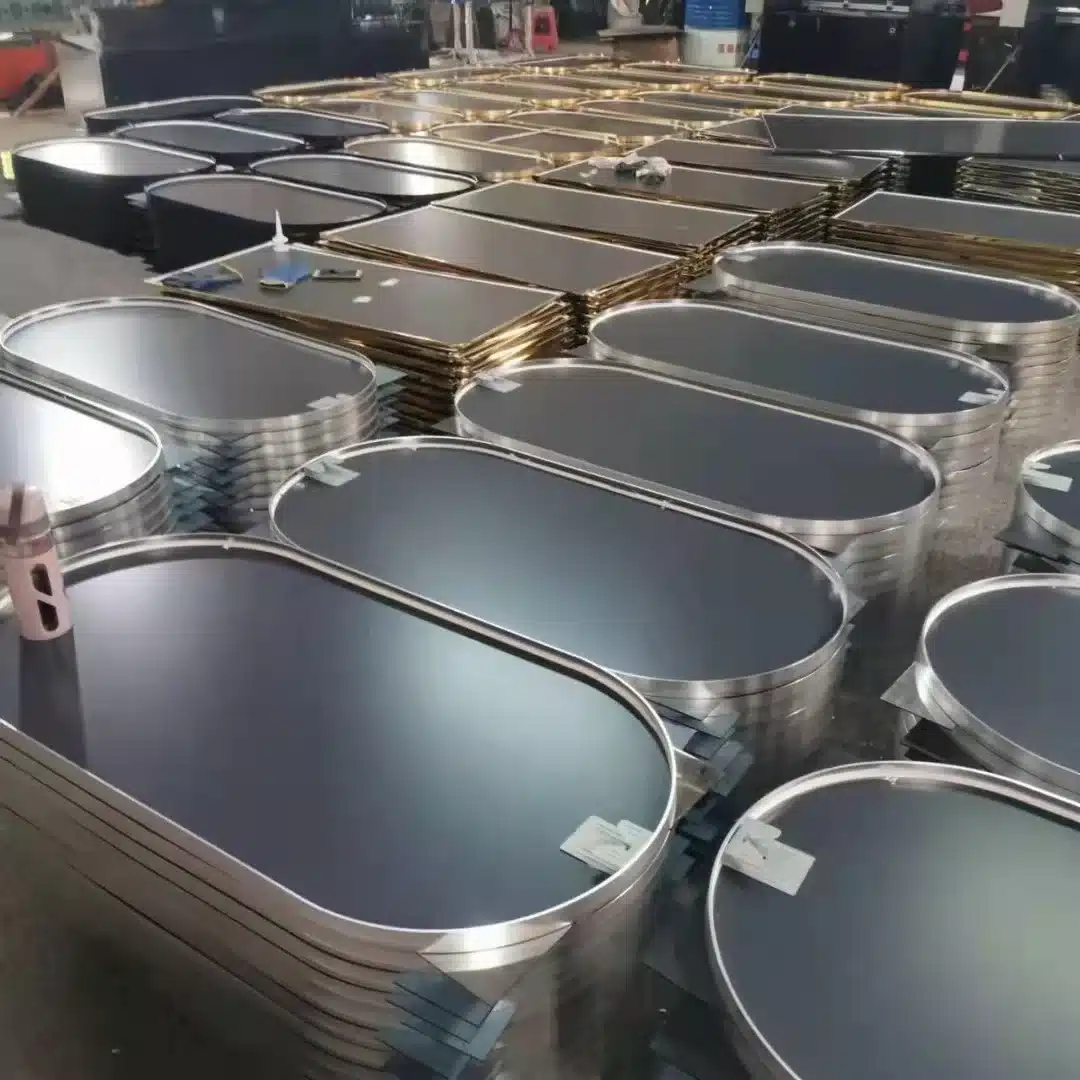
Write every deviation on the sample sheet with the measured value, not an impression. A cabinet 3 mm wider than spec may still fit the showroom display. The same error repeated across 300 units becomes an installation problem on every job site. Wall-hung models deserve extra care: mounting rail positions must match the drawing, because holes drilled on site cannot be moved.
Look past the outside. Cabinet joinery should be tight, with no visible glue lines or stepped panels. Back panels and shelf pins carry load in daily use, so flex them by hand. Drawers deserve a pull test at full extension with weight inside, because a loaded drawer reveals slide and joint weaknesses an empty one hides. These are common bench checks, not lab procedures, and they take five minutes.
Check 2: Finish and Color Consistency
Compare the sample against the physical color chip or reference panel under the same lighting your store uses. Warm retail LEDs and daylight render the same finish differently, so name the light source in the sample sheet. On wood finishes, check grain direction and sheen. On painted or laminated surfaces, inspect the edges, where touch-up work usually hides.
Express the tolerance as a number. Color difference is measured in delta E units, and a value of 1.0 or below is generally imperceptible. That is a common industry benchmark, so quote it in the sample sheet instead of phrases like “close match.” MFBATH offers 1,000+ finishes on the PVC line, 15 standard finishes on plywood, and 20 on solid wood, with custom colors available from 15 sets per color. A library that large makes a sealed reference chip non-negotiable.
Gloss is measurable too. A gloss meter reports reflectance in gloss units, and suppliers can hold a finish within an agreed band, again as typical industry practice rather than a fixed rule. If no meter is available, compare the sample and the chip side by side at a raking angle, where sheen differences show first.
Skip this step and the batch arrives two shades off, with no sealed reference to argue from. Markdowns and returns follow, and the negotiation is unwinnable.
Checks 3 and 4 Cover Hardware and Basins
Hardware and basins are the components factories substitute most often, because both are bought in from outside suppliers. The defense is identical for both: name the exact part on the sample sheet.
Check 3: Hardware and Drawer Slides
Open and close every drawer and door at least ten times, a common acceptance practice borrowed from furniture inspection. Soft-close should engage smoothly and draw the drawer in over the final centimeters without a slam. Then identify the slide itself: brand, model, and load rating must match the spec sheet. If the sheet says only “soft-close slides,” any slide that closes softly has technically passed, which is precisely the loophole to eliminate.
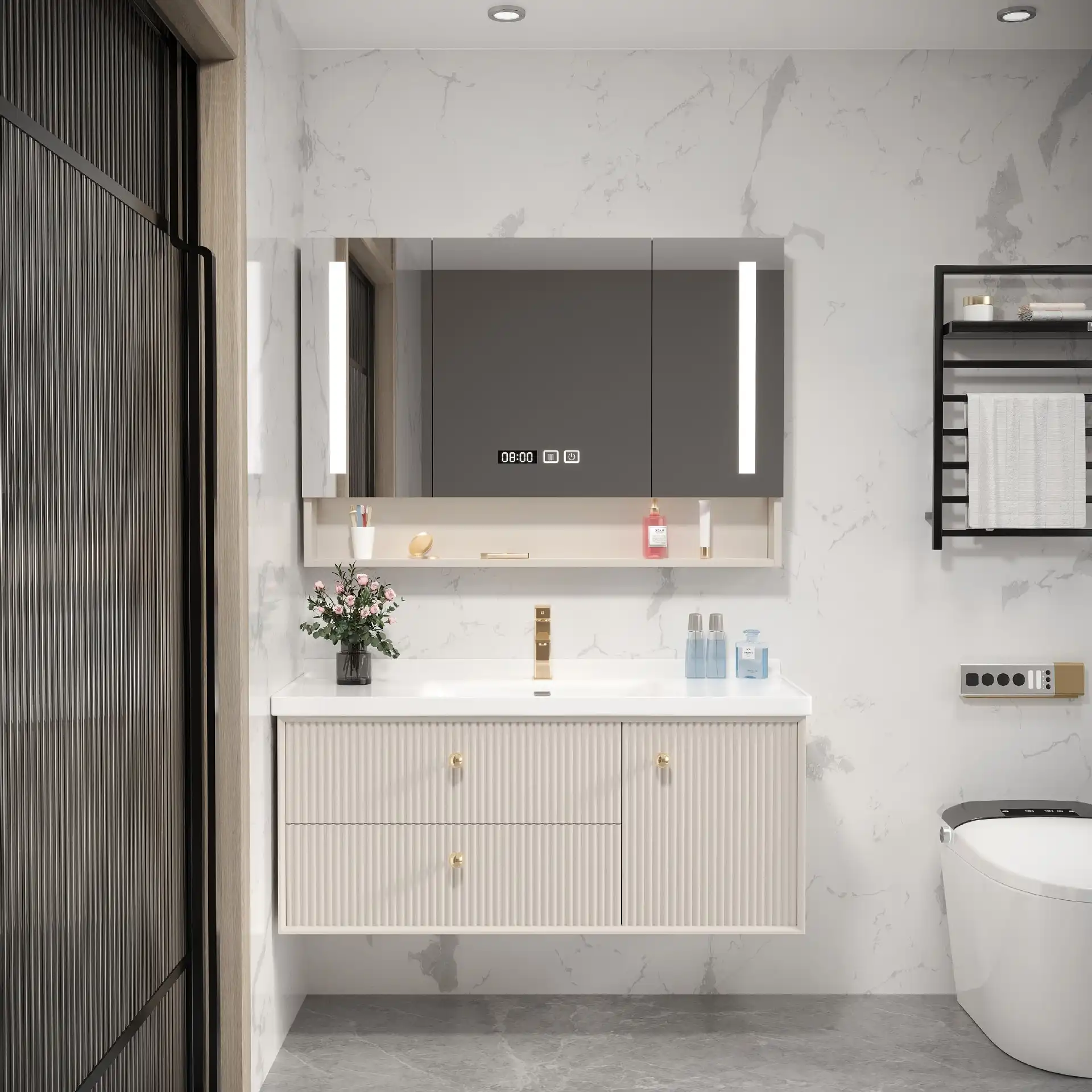
The PVC line shows the range of options worth pinning down: modern handles, classic knobs, or bar pulls in chrome or brushed nickel, plus soft-close doors, extra drawers, open shelving, and mirror cabinets. Every option becomes a line item, and every line item needs a named component. Hardware runs out at suppliers. “Equivalent” then means whatever the factory decides it means.
Electronics need their own pass. Smart LED mirrors carry dimmable brightness, adjustable color temperature, anti-fog heating, touch controls, a digital display, energy-saving auto-off, and optional voice control or Bluetooth. Test every function on the sample, cycle the power, and record the behavior on the sheet. Defects found at this stage cost a re-sample; the same defects found at destination cost a return shipment.
Branded projects add one more layer, because logo hardware and custom packaging travel through the same supply chain. Deciding who owns each specification is part of the OEM vs ODM manufacturing conversation, and it should be settled before sampling starts.
Check 4: Basin and Countertop Fit
Set the basin in place and inspect the seat along the full perimeter. Gaps between basin and countertop, or between countertop and carcass, let water reach board edges. That is the fastest route to a swelling problem. Drain and overflow holes must align with the rough-in dimensions on the drawing.
Sintered stone basins carry their own spec to verify: Mohs hardness 7 to 8, heat resistance to 300 degrees Celsius, a non-porous stain-resistant surface, and UV-stable color. Widths run 600 to 2000 mm, in marble, granite, cement, or solid textures with matte, satin, or polished finishes. A basin that matches those numbers on paper but arrives cracked or the wrong texture fails this check regardless of price.
Checks 5 to 7 Cover Moisture, Packing, Documents
The final three checks protect what happens after the sample leaves the room: humidity inside a sea container, drops during handling, and disputes after delivery.
Check 5: Edge Sealing and Board Grade
Inspect every cut edge, starting with the sink cutout, back-panel penetrations, and the underside. Any exposed board is a moisture entry point, and a bathroom vanity lives in humid rooms long before it crosses an ocean. Plywood carcasses should carry paperwork for the agreed grade: standard, boil-water-resistant BWR, or marine-grade. Baseline environmental specs are formaldehyde class E1 at 0.1 ppm or below and CARB Phase 2, with FSC certification available as an option.
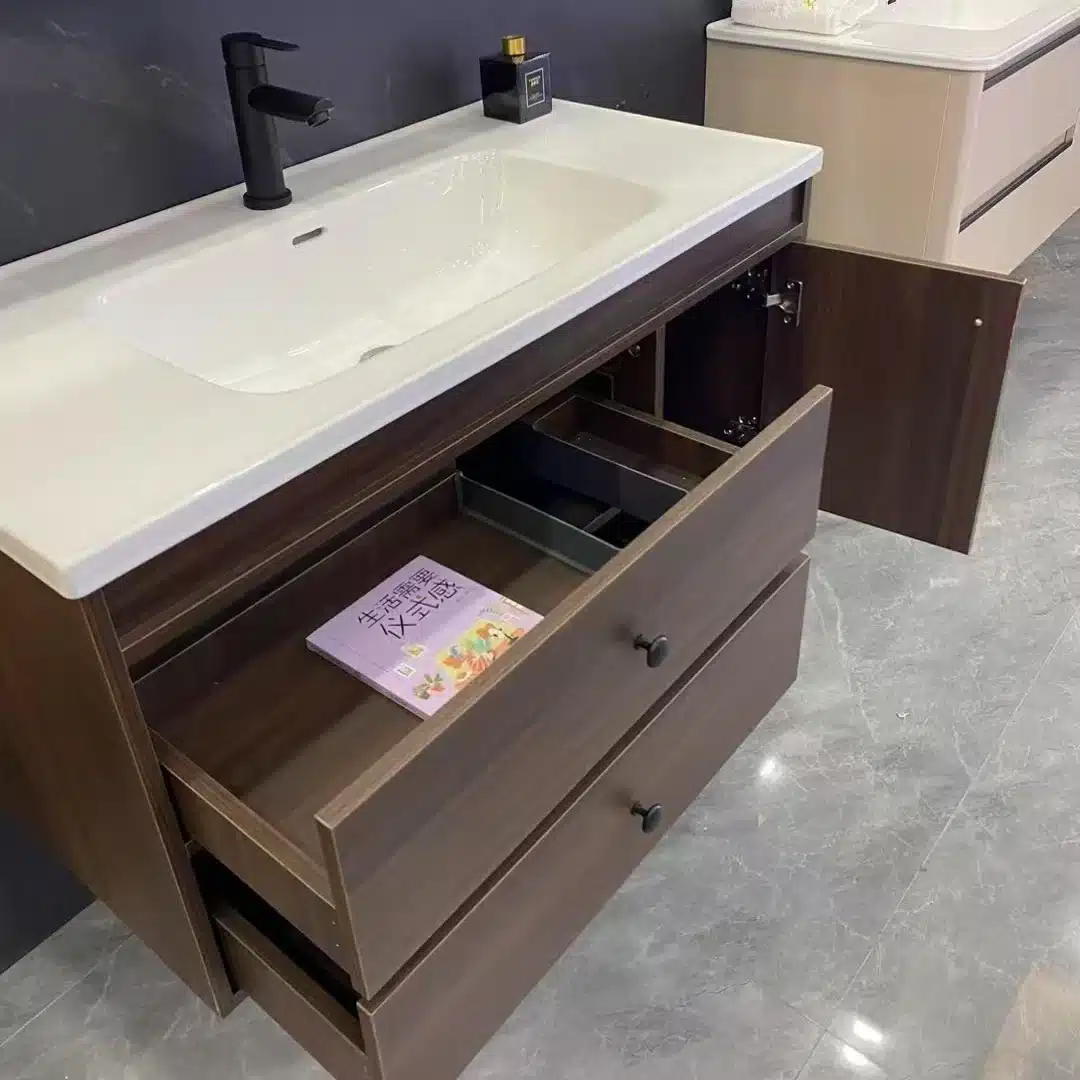
Solid wood units rely on a multi-layer polyurethane waterproof coating. Check coverage on end grain, because that is where absorption starts. Oak, walnut, maple, and ash are the standard species, each backed by 20 standard finishes. A sample with flawless faces and raw edges passes the showroom test and fails the container test.
Check 6: Packaging and Drop Protection
Approve the packaging on the sample itself, packed exactly the way production will pack it. Check corner protectors, foam density, carton wall strength, and the pallet pattern. Then request a drop test on the packed unit, filmed, as a standard pre-shipment practice aligned with courier handling tests. A factory that films the drop test has nothing to hide. One that hesitates is telling you something.
Transit damage is margin damage. A crushed corner on one cabinet in a fifty-unit order means one return, one replacement shipment across an ocean, and one installer standing idle on site. Packaging approved on paper but never tested is a bet, not a specification.
Shipping marks belong in this approval too. Retail buyers scan barcodes and match carton labels to purchase orders, so approve the mark layout, handling symbols, and carton copy with the same signature as the product. A wrong label at destination can stall a container as effectively as a broken cabinet.
Check 7: Documentation Consistency
The last check is paperwork, because paperwork is what a dispute becomes. The sample sheet, spec sheet, QC photos and video, and inspection reports should all describe the same unit. MFBATH runs five inspections on every unit and can arrange third-party inspection by SGS or TUV in advance. Ask for records from both layers rather than just the final result.
Certifications belong in the same file: ISO 9001 and ISO 14001 held since 2017 and confirmed valid in 2025, with CE and UL certificates on record. Where your market expects ADA clearance design or CSA and NOM compliance, specify that units must be designed to meet those requirements and record the factory’s written position on the sample sheet.
The 7-Point Vanity Sample Approval Checklist at a Glance
| Check | What to verify | Pass criteria |
|---|---|---|
| 1. Dimensions and structure | Width, depth, height, squareness, door gaps | Within 1 to 2 mm of the spec sheet, a typical band |
| 2. Finish and color | Finish code, gloss, grain, edge color | Matches the sealed chip within the agreed delta E limit |
| 3. Hardware and slides | Slide model, soft-close action, handle finish | Exact components named on the sample sheet |
| 4. Basin and top fit | Seat gaps, drain alignment, material spec | No visible gaps and drain matches the rough-in drawing |
| 5. Edge sealing and board | Banding on every cut, board certificates | All edges sealed with E1 and CARB P2 documents attached |
| 6. Packaging | Corner protection, carton spec, drop test video | Packed sample passes the agreed drop test |
| 7. Documentation | Spec sheet, QC photos, inspection records | Documents match the sample unit exactly |
Approve Samples with a 15-Unit MOQ Factory
Browse this product, solution, or service page to explore relevant offerings.
Turning Sample Approval Into a Repeatable Process
One approved sample protects one order. A process protects every order after that. It turns a one-time vanity sample approval checklist into standing procedure, and that is what separates importers who receive consistent containers from importers who receive lucky ones.
Seal the Sample and Sign the Sheet
Keep two identical signed samples: one stays at the factory, one travels with you. Attach the sealed finish chip, the identified hardware, and the approved packaging spec, then sign across the labels so neither side can swap parts later. This golden-sample step becomes the reference for every later comparison. MFBATH applies the same approach to branded and made-to-order projects in its custom vanity sample approval process.
Confirm Before Production and Inspect Before Shipment
Before mass production starts, reconfirm the finish lot number, the hardware source, and the packaging spec in writing. During production, request the factory’s own quality records, five inspections per unit with photos and video, and compare them against your own bathroom vanity quality control checklist. Before loading, book third-party inspection through SGS or TUV early enough to act on the findings.
A sampling plan gives the inspection teeth. Acceptance quality limit tables define how many units to open and how many defects break the lot. The mechanics are covered by ASQ’s sampling inspection resources and the AQL reference on Wikipedia. Many importers inspect furniture shipments at AQL 2.5 for major defects, a typical band rather than a rule, and hold the signed sample as the visual standard.
Plan the failure path in advance. If a check fails, the options are rework, re-sampling, or cancellation, and the sample sheet should say which applies to which defect. Conditional approval keeps leverage: sign for the dimensions but hold the finish until the sealed chip matches. Factories respond to precise conditions; vague dissatisfaction just starts an argument.
The clock matters as much as the checklist. Samples are free and ready in 10 working days. Mass production runs 20 to 30 days after written approval, and orders bound for the US, Canada, or Mexico land in 4 to 6 weeks total, FOB Qingdao. Payment terms split a 30% deposit from a balance due within one week of the draft bill of lading. That structure puts final inspection ahead of final payment.
New relationships can start small. The minimum order quantity is 15 sets per model, color, and size, with different models allowed to mix until the container fills. That structure is built for a 15-unit MOQ trial order. When the process works, the results show up in the numbers: a two-year whole-unit warranty and a return rate under 1%.
Frequently Asked Questions
Are vanity samples free, and how fast do they arrive?
Yes. MFBATH supplies free samples, ready in 10 working days, so you can run all seven checks before committing. Mass production then takes 20 to 30 days after your written approval.
How should I define color tolerance on the sealed sample?
Use a number, not adjectives. Agree a delta E limit, where 1.0 or below is generally imperceptible as a typical industry band, and seal a physical finish chip signed by both sides.
What can I do if production does not match the approved sample?
Enforce the sample sheet. Request the QC records, arrange an SGS or TUV inspection before paying the balance, and use the draft-BL payment milestone as leverage. A two-year whole-unit warranty and a sub-1% return rate are the benchmark to hold suppliers against.
Approve the Sample You Can Measure
Sample-to-production drift is a management problem, not a luck problem. The seven checks convert a subjective sign-off into measurements, sealed references, and named components. The workflow then repeats that discipline on every order your team places.
Key Takeaways
- The sample sheet is the approval: dimensions in millimeters, finish codes, hardware models, and packaging spec, all signed.
- Seal physical references on both sides, and express color tolerance as a delta E number rather than a phrase.
- Free samples arrive in 10 working days, production runs 20 to 30 days, and SGS or TUV inspection must be booked before loading.
- Payment timing is leverage: a 30% deposit with the balance due within one week of the draft bill of lading, so inspection happens before the money moves.
If you are comparing factories right now, start with the free 100-plus-page 2025 catalog and shortlist the finishes your market actually buys. A 15-set trial order is then the lowest-risk way to run this checklist on real production units.




0 Comments