
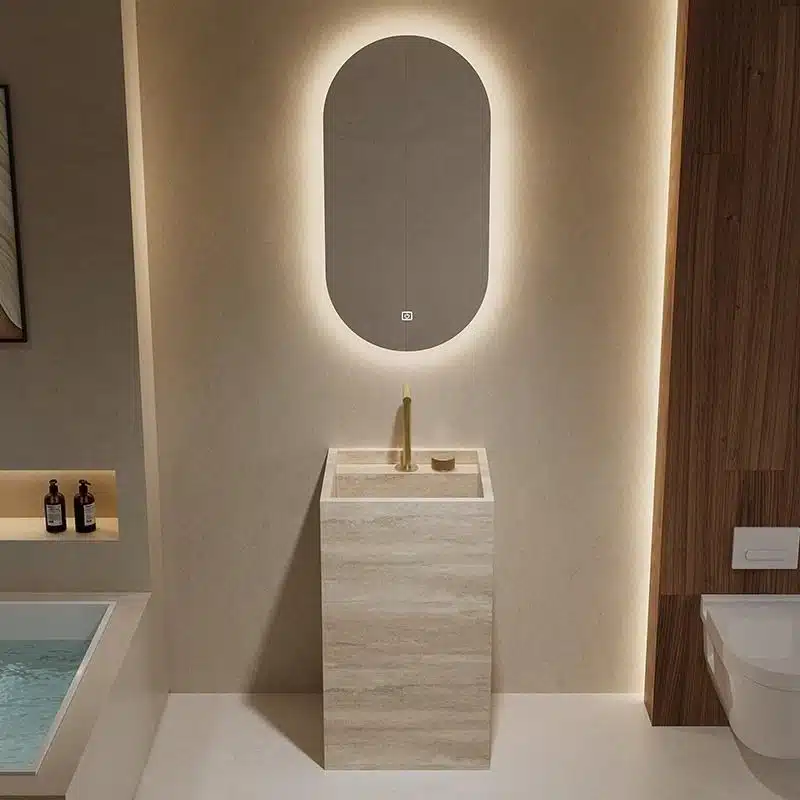
Terrazzo vanity top sourcing usually starts with a reference board, not a spec sheet. A hotel operator points at a terrazzo chip pattern and asks for it across every guest bathroom. A wholesaler asks whether the finish will still look right after daily cleaning. Both questions come back to the same manufacturing answer: sintered stone.
Main Focus Cabinet, sold under the MFBATH brand, has built bathroom vanities in Changge, Henan, since 2015. The factory spans 10,000 m² with 95 staff and monthly capacity of 5,000 sets, supplying more than 1,000 dealers across 20+ countries. Its sintered stone vanity tops start as natural minerals — quartz, feldspar, and silica — fired at high temperature and high pressure with no resin in the body. The surface that comes out of that process rates 7–8 on the Mohs hardness scale, handles heat up to 300°C, and is non-porous, so stains have no pores to soak into.
This guide covers the design side and the factory side of the decision. You will see why terrazzo and patterned stone have gained traction in commercial bathrooms, how the pattern is reproduced on a mineral slab, which performance numbers to hold suppliers to, and what sample, MOQ, and lead-time terms look like in practice. If you quote vanities for hotels or sell them through a wholesale catalog, this is the material brief you can hand to a sourcing desk.
Key Takeaways
- Terrazzo and stone patterns on MFBATH tops are fired into sintered stone during sintering — a resin-free mineral body of quartz, feldspar, and silica.
- Sintered stone surfaces rate Mohs 7–8 hardness, handle heat up to 300°C, resist stains because they are non-porous, hold color under UV, and are antibacterial.
- Sintered stone vanities ship floating at 600–1800 mm (24–71 in) with single or double basins, or floor-standing at 800–2000 mm (31–79 in); basins run 600–2000 mm.
- Minimum order is 15 sets per model, color, and size, and mixed-container loads are accepted.
- Samples ship in 10 working days; production takes 20–30 days; US, Canada, and Mexico delivery lands at 4–6 weeks.
- Certification options include ISO 9001 and ISO 14001 (certified since 2017), E1, CARB Phase 2, TSCA Title VI, and FSC wood.
Table of Contents
- Why Terrazzo Patterns Keep Showing Up in Bathroom Specs
- How Sintered Stone Reproduces Terrazzo and Marble Patterns
- Performance Specs That Decide the Material Choice
- Sizing, Basin Configurations, and Cabinet Formats
- Samples, MOQ, and Lead Times for Patterned Tops
- Quality Checks and Certifications for Sintered Stone
- A Sourcing Checklist for Wholesalers and Hotel Designers
- Terrazzo Vanity Top Sourcing FAQ
- The Bottom Line
Why Terrazzo Patterns Keep Showing Up in Bathroom Specs
Terrazzo has gained a steady following in hotel bathrooms, multifamily buildings, and retail washrooms across recent design cycles. Design media have covered the material’s speckled chips and concrete base from residential renovations to large hospitality projects, and ArchDaily’s terrazzo archive is a useful barometer of how far the look has traveled. The pattern works in practice, not just in photos: it hides water spotting, coordinates with warm wood and brushed metal, and photographs well under vanity lighting.
That media presence matters to buyers for a practical reason. Guests and tenants see the look, and operators have to deliver it. The pressure lands on the sourcing desk, where the question shifts from “do we want the look” to “how do we make it repeatable.” Wholesalers feel the same pull from the other direction: retailers request terrazzo lines because customers ask for them by name.
Three old answers carry real trade-offs. Cast terrazzo is heavy, needs on-site curing, and adds labor risk. Printed laminates deliver the pattern but sit on a thin decorative film. Painted surfaces wear exactly where the traffic is highest. None of them combine pattern depth with surface durability the way a fired mineral slab does.
Sintered stone closes that gap. The terrazzo or marble pattern is part of the mineral surface, so the look carries the mechanical properties of the stone itself. For a wholesaler deciding whether to carry the category, the risk calculation changes: the pattern is repeatable across a run, and the surface does not depend on a coating that can fail. That is the argument worth taking into your next product meeting.
How Sintered Stone Reproduces Terrazzo and Marble Patterns
At MFBATH, terrazzo and stone looks are produced on sintered stone vanity tops, not cast in concrete or printed on film. The slab starts as natural minerals — quartz, feldspar, and silica. High temperature and high pressure consolidate those minerals into a dense, resin-free body. That structure is what gives the surface its hardness, heat rating, and stain resistance.
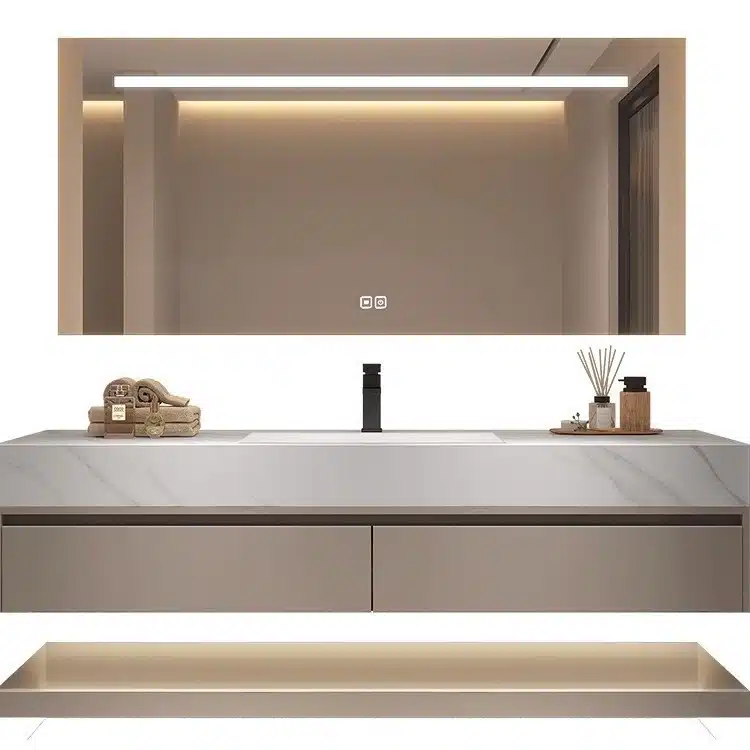
The pattern layer is fused into the slab during sintering. Terrazzo chip mixes, marble veining, granite flecks, and cement textures are reproduced as part of the surface, which means the design you approve on a sample matches the surface that ships in a container. The same process supports several finish levels — matte, satin, and polished — so one pattern can read quiet for a boutique property or bold for a high-traffic washroom.
Finish choice deserves a decision, not an accident. Matte hides water spots and fingerprints, which suits guest bathrooms cleaned quickly between stays. Satin splits the difference and is the common default for vanity tops. Polished shows the pattern at its sharpest but asks more of housekeeping, so reserve it for low-traffic spaces. State the finish in your RFQ; suppliers will hold to it if it is written down.
Reference matching starts with a photograph, but it ends with a physical sample. Send the supplier a clear image plus a note on chip size and background tone; the sintering line turns that into a sample within 10 working days. Approve that sample in writing, and the production run follows it.
Two sourcing implications follow. First, the pattern is not a coating, so it wears the same way the mineral wears: slowly and evenly. Second, because the factory controls the sintering line, matching a specific reference — chip size, background tone, vein density — is a production question, not a hope. If you want the full breakdown of how the material performs, the Sintered Stone 101 guide walks through the hardness and heat data in depth. Before approving anything, ask the supplier how the pattern is applied. The answer separates sintered stone from the rest: printed film peels, coated surfaces scratch through, a fired mineral pattern stays.
Performance Specs That Decide the Material Choice
Four numbers drive most material conversations on vanity tops: hardness, heat resistance, porosity, and color stability. Sintered stone scores on all four. The surface rates 7–8 on the Mohs hardness scale, which puts it ahead of most common counter materials on scratch resistance. It handles heat up to 300°C, so a hot styling tool left on the counter is not a damage event.
Porosity is where the daily-use argument is won. The surface is non-porous, so liquids sit on top instead of soaking in. Coffee, dye-heavy cosmetics, and cleaning chemicals leave nothing behind. The same surface resists UV fading, which matters in bathrooms where the vanity sits in direct window light, and it is antibacterial, which matters in shared and guest bathrooms.
For a commercial program, that combination beats polished natural marble on maintenance. Marble is porous, etches around acidic products, and needs periodic sealing. It earns its place in low-traffic designer bathrooms. For repeatable hotel and wholesale programs, sintered stone is the more defensible spec, and the comparison below shows why.
| Property | Sintered stone (terrazzo or marble pattern) | Natural marble | Solid-color laminate |
|---|---|---|---|
| Surface body | Fired mineral slab, resin-free | Cut natural stone | Thin printed film over board |
| Hardness | Mohs 7–8 | Soft, scratches easily | Low, surface film only |
| Heat resistance | Rated to 300°C | Sensitive to thermal shock | Film can burn near heat |
| Stain resistance | Non-porous, resists stains | Porous, needs sealing | Resists water, chips at edges |
| Color stability | UV-stable | Tone varies by slab | Can fade in strong sun |
| Maintenance | Standard cleaners | Periodic sealing | Surface replacement |
The top also has to sit on the right body. MFBATH pairs sintered tops with PVC cabinets that are 100% waterproof and easy to clean, or with plywood and solid wood options that carry E1, CARB Phase 2, and FSC choices. A mineral top on a water-resistant carcass is the combination that survives commercial cleaning cycles, and it is the one worth defaulting to for hotel work.
Sizing, Basin Configurations, and Cabinet Formats
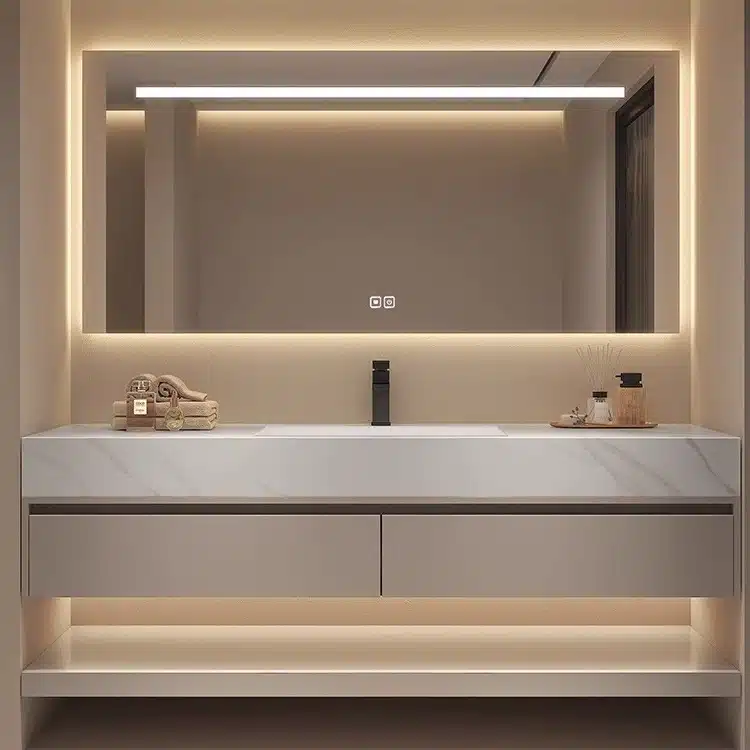
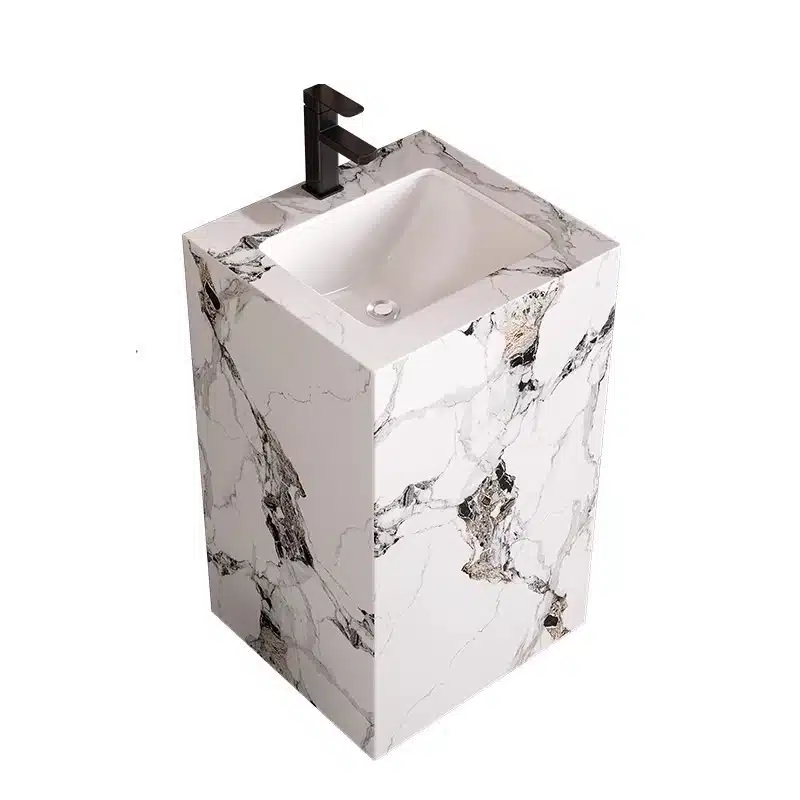
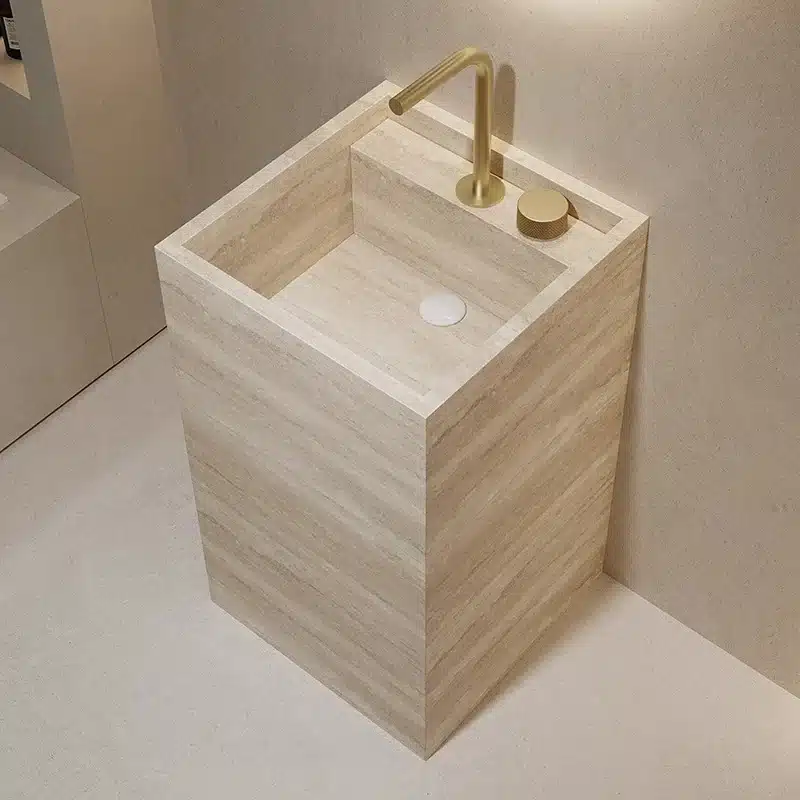
Patterned tops ship on two cabinet formats. Floating vanities run from 600 to 1800 mm (24 to 71 inches) with a single or double basin, which covers boutique guest bathrooms and most residential en suites. Floor-standing units run from 800 to 2000 mm (31 to 79 inches) for layouts where the vanity carries more visual weight or more storage.
Basin widths follow the same logic. Sintered stone basins are available from 600 to 2000 mm, so a single-basin floating unit and a double-basin floor-standing unit can share one stone pattern and finish. Keeping the top and basin in the same material family is what makes a terrazzo program read as intentional rather than assembled from parts.
| Configuration | Size range | Basin layout |
|---|---|---|
| Floating sintered stone vanity | 600–1800 mm (24–71 in) | Single or double |
| Floor-standing sintered stone vanity | 800–2000 mm (31–79 in) | Single or double |
| Sintered stone basin | 600–2000 mm | Single or double |
Two notes for specifiers. Measure the rough-in before locking a floating size, because the range only helps if supply lines and drain centers line up. And when a project mixes floating and floor-standing units, confirm that both formats can take the same basin and top pattern before you approve a sample.
Floating versus floor-standing is a structural decision, not a style one. Floating units at 600–1800 mm suit plumbing that runs inside the wall, while floor-standing units at 800–2000 mm hide supply lines inside the cabinet and carry more storage. When a program mixes both formats, the shared top pattern keeps the bathrooms visually consistent even as the cabinet lines differ. The floating vanity buying guide covers the production errors that appear when dimensions drift from the drawing.
Planning a terrazzo-patterned vanity program?
MFBATH produces sintered stone vanities with fired-in stone patterns for wholesalers and hotel projects. Free samples and the free 2025 catalog (100+ pages) are available. Send your terrazzo reference to the team and get a pattern-match quote with MOQ and lead-time terms in writing.
Sintered Stone Vanities with Terrazzo-Style Tops
Browse this product, solution, or service page to explore relevant offerings.
Samples, MOQ, and Lead Times for Patterned Tops
MFBATH supports free samples, and on a patterned product a sample is not optional. A terrazzo or marble pattern on a fired mineral surface needs physical approval — gloss level, chip scale, and background tone all read differently on a screen. Sample lead time is 10 working days, and it is the one step that retires most pattern risk early.
Production terms are built for trial orders rather than container-scale commitments. The minimum order is 15 sets per model, per color, and per size, and mixed-container loads are accepted. A first order can combine several patterns and sizes under one total, which is exactly how the OEM MOQ math changes SKU strategy. Custom sizes, colors, and logo work start at the same 15-set threshold, so a branded first run does not need a separate premium.
The customization catalog runs deep: more than 40,000 combinations are possible, covering Pantone color matching, eco materials, ceramic, resin, or sintered stone basins, and branded hardware. White-label and private-label programs include logo printing, laser engraving, and custom packaging for retail boxes, outer cartons, and manuals.
Timing is predictable, which matters when you are quoting a renovation window. Production runs 20–30 days after sample approval, and total delivery to the US, Canada, or Mexico lands at 4–6 weeks including ocean freight, with live tracking on the shipment. Goods leave from Qingdao Port under FOB terms. Payment is 30% deposit at order, with the balance due within a week after draft BL. Buyers in the US, Canada, and Mexico typically see around 15% freight savings on this route. Once production starts, mineral tops also need correct loading discipline — the container loading protection guide lists what to inspect before the container seals.
Quality Checks and Certifications for Sintered Stone
Every product at MFBATH passes five QC checks before it leaves the line, and third-party inspections from firms such as SGS or TÜV can be arranged with advance notice. On a patterned top, the check that matters most is pattern and color consistency between the approved sample and the production units. The sample vs production checklist walks through the seven checks to run before you sign off.
Certification questions are routine in North American and European sourcing, and the answers are documented rather than claimed. The factory holds ISO 9001 for quality systems and ISO 14001 for environmental management, certified since 2017 and confirmed current in 2025. CE and UL markings are held on applicable products, and CSA, NOM, and ADA requirements are designed into the relevant models.
Formaldehyde compliance is covered from both sides of the Atlantic. E1 boards at or below 0.1 ppm, CARB Phase 2 compliance under the California composite wood products program, and TSCA Title VI standards as set by the EPA are all available on request. FSC-certified wood can be specified through the FSC forest management certification chain, and finishes are low-VOC.
Ask for the documents, not the summary. A supplier that sends certificates and internal QC records with the quote answers half your compliance questions before production starts. For the rest, book the third-party inspection early — SGS and TÜV visits need advance notice, and a patterned run deserves an on-site look at pattern consistency.
A Sourcing Checklist for Wholesalers and Hotel Designers
Run a patterned-top program against this list before you commit volume:
- Confirm how the pattern is produced: fired into sintered stone, not printed film.
- Put performance in writing: Mohs 7–8, 300°C heat rating, non-porous surface.
- Match basin and top from the same stone family; basins run 600–2000 mm.
- Order the sample and check gloss, chip scale, and tone against your reference; allow 10 working days.
- Verify the MOQ: 15 sets per model, color, and size, with mixed-container loads.
- Lock the calendar: 20–30 days production, 4–6 weeks total to the US, Canada, or Mexico.
- Request certificates: ISO 9001, ISO 14001, E1, CARB Phase 2, TSCA Title VI, FSC as needed.
- Book third-party inspection, such as SGS or TÜV, with advance notice.
- Confirm branding: logo printing or laser engraving, custom packaging, white label.
- Check trade terms: FOB Qingdao Port, 30% deposit, balance within a week after draft BL.
Two steps carry extra weight. The sample is where pattern risk gets retired, so put the 10-working-day sample into the calendar first. And the freight terms matter more than they look: at around 15% freight savings for US, Canada, and Mexico buyers, the route changes landed cost per unit.
For hotel teams, the boutique hotel vanity guide shows how compact specs compress into the same program. If you start smaller than a full container, how to size a 15-unit trial order covers the ordering math that keeps your first run profitable.
Terrazzo Vanity Top Sourcing FAQ
Can a terrazzo pattern be reproduced on a vanity top without cast terrazzo?
Yes. Sintered stone vanity tops reproduce terrazzo and marble patterns fired into the mineral surface during sintering. The look is part of the slab, not a coating, so it keeps the stone’s hardness and stain resistance.
What is the MOQ for custom terrazzo-patterned vanities?
15 sets per model, color, and size. Custom sizes, colors, and logo work start at the same threshold, and mixed-container loads are accepted, so a first order can combine patterns and sizes.
How long do samples and production take?
Samples ship in 10 working days. Production takes 20–30 days after approval, and total delivery to the US, Canada, or Mexico is 4–6 weeks including freight.
Does sintered stone handle heat and daily cleaning?
Yes. The surface rates Mohs 7–8, resists heat up to 300°C, and is non-porous, so stains do not soak in. It is also antibacterial and UV-stable.
Can we sell the vanities under our own brand?
Yes. White-label and private-label programs include logo printing or laser engraving, custom packaging, and Pantone color matching, with more than 40,000 custom combinations available.
The Bottom Line
Terrazzo and patterned stone sourcing is a material decision before it is a design decision. Sintered stone delivers the look with a resin-free mineral body, Mohs 7–8 hardness, 300°C heat resistance, and a non-porous, UV-stable surface. MFBATH builds the full program around it — floating units from 600 to 1800 mm, floor-standing units from 800 to 2000 mm, and basins from 600 to 2000 mm.
- Confirm the pattern is fired into sintered stone, not printed on a film.
- Hold suppliers to the spec sheet: Mohs 7–8, 300°C, non-porous.
- Start with the sample: 10 working days, then 20–30 days production and 4–6 weeks to North America.
- Combine patterns and sizes under one 15-set MOQ with mixed-container loading.
Start with the free sample and the free 2025 catalog (100+ pages). Send your terrazzo reference to the MFBATH team and ask for a pattern-match quote with MOQ and lead-time terms in writing.




0 Comments