

You open a supplier quote: five hundred units per finish, three sizes, thirty percent down. Most OEM MOQ strategy bathroom vanity planning breaks right there, because the arithmetic demands six figures of cash before a single sale. A 15-unit minimum order quantity (MOQ) changes the equation entirely.
This article runs the numbers behind 15-unit minimums: cash tied up per SKU, container loading, reorder timing, and the point where custom colors stop being cheap experiments. Factory terms quoted here come from MFBATH’s published conditions. Every calculation is a worked example with assumed inputs, so you can swap in your own prices and repeat the math.
What One SKU Really Costs at Different MOQs
Start with the definition. MOQ is the smallest batch a factory will produce for one model, one color, and one size. Each SKU on your assortment list carries its own minimum. That structure turns assortment planning into a capital budgeting exercise.

Factories set minimums around setup economics, not buyer convenience. Changing a finish or a panel width means line adjustments, new edge banding settings, and material runs that must consume whole boards or whole batches of lacquer. A batch of 15 absorbs those fixed costs with limited output; a batch of one cannot. Understanding this explains why custom work still starts at 15 sets instead of one, and why the number rarely negotiates down to single units.
Run a worked example with assumed inputs. Assume a 24-inch PVC bathroom vanity quoted at $180 FOB. At a 500-unit minimum, one SKU ties up $90,000 of goods before ocean freight. At 15 units, the same SKU ties up $2,700. Risk per SKU differs by a factor of thirty-three, while the product itself stays identical.
Deposits sharpen the contrast. MFBATH terms call for a 30% deposit to place an order, with the balance due within a week of the draft bill of lading. The $90,000 SKU therefore asks for $27,000 in cash on day one. Its 15-unit counterpart asks for $810. Procurement teams usually judge suppliers on unit price; this math says cash timing deserves equal weight.
A low minimum does not change factory unit economics in your favor. Smaller batches typically carry higher per-unit prices than volume orders, a trade-off covered in detail in this guide to unit cost tiers at 15, 100 and 500 units. What changes is the price of being wrong. Buying market data at $2,700 per SKU is a defensible expense. At $90,000 per SKU, the same purchase is a forecast disguised as inventory.
The deeper lesson concerns forecast error. Every SKU purchased before demand is proven carries a forecast inside it, and forecasts for new categories are usually wrong in both direction and size. At 15 units, a wrong forecast leaves a small markdown problem. At 500 units, it leaves a six-figure liquidation project and canceled reorders straining the supplier relationship.
How Many SKUs Can You Actually Afford? A Worked Assortment Table
Assortment width multiplies the single-SKU math. Count every combination of model, color, and size as one SKU, because a 15-unit minimum applies to each combination separately. A “small” range of 2 models, 3 colors, and 3 widths is already 18 SKUs. Multiply 18 by 15 units and the trial order becomes 270 units.
The table below extends that logic across four launch scenarios. All figures are worked examples using an assumed average FOB price of $220 per unit. Replace that number with your real quotes before acting on any row.
| Assortment scenario | SKUs (model x color x size) | Units at 15 per SKU | Assumed goods cost | 30% deposit |
|---|---|---|---|---|
| Narrow test: 1 model, 1 color, 2 sizes | 2 | 30 | $6,600 | $1,980 |
| Core test: 1 model, 2 colors, 3 sizes | 6 | 90 | $19,800 | $5,940 |
| Wide test: 2 models, 3 colors, 3 sizes | 18 | 270 | $59,400 | $17,820 |
| Overbuilt launch: 3 models, 4 colors, 4 sizes | 48 | 720 | $158,400 | $47,520 |
Read the table against the 500-unit alternative. The core test at 500 units per SKU would mean 3,000 units, or $660,000 of goods on the same assumed price. Few importers can finance that for an unproven category, so assortments get cut before they reach a shelf. The 15-unit grid keeps six SKUs alive for less than a single SKU would cost under the old structure.
Which row fits depends on channel structure. An e-commerce brand listing two hero SKUs can often justify the narrow test, because its traffic decides between two options on one page. A regional wholesaler serving contractors needs the width of the core or wide test, since showrooms and job sites spread demand across sizes. The deposit column, not the goods column, is usually the binding constraint for both.
General retail practice points the same direction. New categories are usually tested with shallow depth across the planned assortment, then reordered into proven performers. A 15-unit minimum is the industrial version of that habit: it lets the first container function as a market survey. For a step-by-step version of this exercise, see the guide to sizing a first trial order with a 15-unit MOQ.
Container Math: Filling One Box with Many Small Bets
A minimum order only matters once it can physically ship. MFBATH supports mixed container loading: different models, sizes, and finishes can share one container as long as each SKU reaches its 15-set minimum. The constraint moves from the production line to the loading plan.
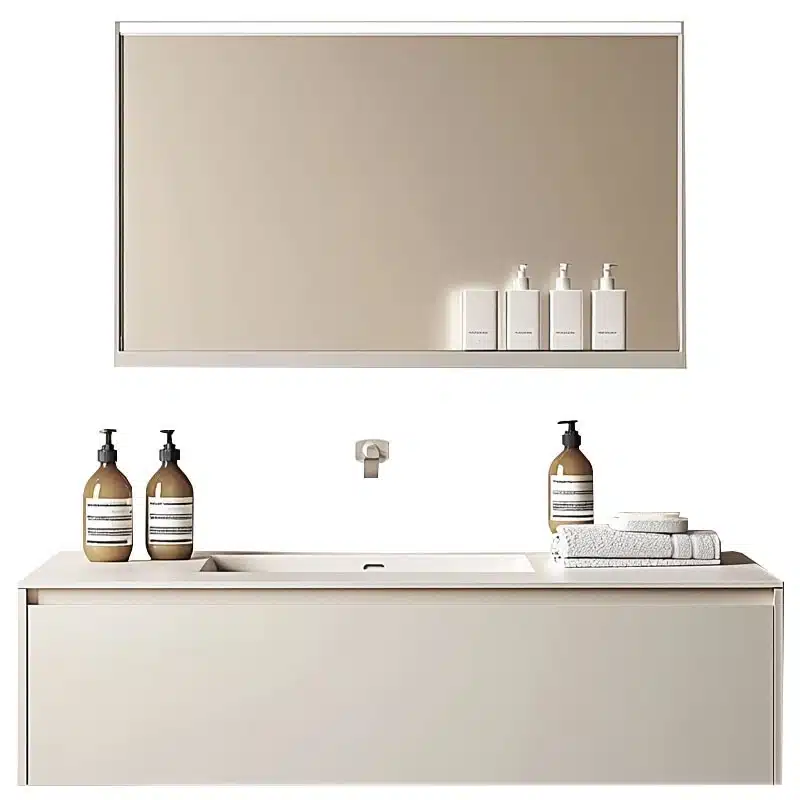
Worked example, again with assumed inputs. Assume a 20-foot container fits roughly 90 assembled 24-inch vanities; actual capacity depends on packaging and assembly state, so request a loading plan per container. The six-SKU core test above totals exactly 90 units. One container therefore carries a complete assortment test, with every SKU at minimum depth.
Contrast that with 500-unit minimums. One SKU alone would fill about five and a half containers in the same arithmetic, so no importer tests under those terms. Mixed loading collapses the commitment to a single FCL (full container load) booking. Importers weighing smaller shipments can compare options in this guide to FCL vs LCL vanity container loading.
Dimension mix changes the arithmetic. Assume the same six SKUs shift from 24-inch to a spread of 24, 30, and 36 inches; larger cabinets consume disproportionately more cubic volume. The assumed 90-unit capacity might fall to 70 or 75 units, pushing the full test into a 40-foot container or forcing one SKU to wait. This is exactly why the loading plan should be confirmed per SKU width, not per unit count.
Packaging deserves a line of its own. MFBATH offers custom packaging alongside logo printing and laser engraving, which matters when 15 units of one SKU must survive ocean transit and last-mile delivery. One damaged piece is a 6.7% loss of a 15-unit batch, versus 0.2% of a 500-unit batch. Small batches make protective packaging an economic decision rather than a courtesy.
Requesting carton dimensions before the purchase order converts guesswork into a loading calculation. Length, width, height, and gross weight per carton let a freight forwarder model the container to the last cubic meter. MFBATH’s mixed loading works in the buyer’s favor here, because the forwarder can optimize around cartons of different sizes rather than one repeated pallet pattern.
First-time importers should pair the loading plan with paperwork planning. The guide to first container import strategy for furniture covers that sequence from booking to customs. Treating the container as one controlled experiment keeps freight, duty, and SKU budget in the same spreadsheet.
Lead Time Math: When to Reorder Before You Run Dry
Small batches expose lead time weaknesses that large inventories used to hide. MFBATH quotes 10 working days for samples and 20–30 days for bulk production after order confirmation. Total door time for the United States, Canada, and Mexico runs 4–6 weeks, shipping FOB (free on board) Qingdao. Those four numbers define the replenishment window.
Run the reorder arithmetic with assumed demand. Assume one SKU sells 8 units per week. Fifteen units of stock cover roughly 1.9 weeks at that pace. A 4–6 week replenishment window plus buffer therefore needs a reorder point near six to eight weeks of demand, or 48–64 units. One 15-unit batch cannot bridge that gap by itself.
The practical consequence is stacking. Fast-moving SKUs need rolling purchase orders placed ahead of demand, not single batches fired at stock-out. Slow-moving SKUs behave differently: 15 units at one sale per week last a quarter, and standard safety stock logic says to keep such coverage lean. The split between fast and slow movers is what makes small-batch buying profitable or painful.
Cash timing interleaves with this calendar. Deposits of 30% land when each purchase order is placed, and balances fall due within a week of the draft bill of lading. Stacked orders therefore stack deposits, which belong in the same spreadsheet as the reorder points. This is where inventory turnover discipline separates profitable small-batch buyers from chronic overstockers.
Samples compress the riskiest part of the timeline. Ten working days for a sample order closes finish and construction questions weeks before bulk production starts, not during it. Skipping samples pushes those questions to arrival, after the 20–30 day production clock has already run. The time cost of sampling is small relative to the window it protects.
A Seasonal Demand Scenario
Bathroom remodel demand in North America tends to cluster around spring and early autumn, a pattern retailers plan around as general practice. Assume weekly sales on a proven SKU double from 8 to 16 units for eight weeks. The reorder point for that window jumps toward 100–130 units, which means three to four stacked purchase orders placed before the season starts. Waiting for the spike to appear in sales data means the stock-out lands mid-season.
Market-specific rules also enter the window. Mexico-bound shipments fall inside the same 4–6 week total, but product requirements there deserve their own review before the first order ships. MFBATH designs its products to meet NOM requirements; the dedicated guide to NOM certification for Mexico explains what importers must verify. Build that review into the lead time, not after arrival.
Browse the Full Bathroom Vanity Range and Start Your 15-Unit Test
Browse this product, solution, or service page to explore relevant offerings.
Custom Sizes and Colors at 15 Units: Cheap Data or Expensive Mistake?
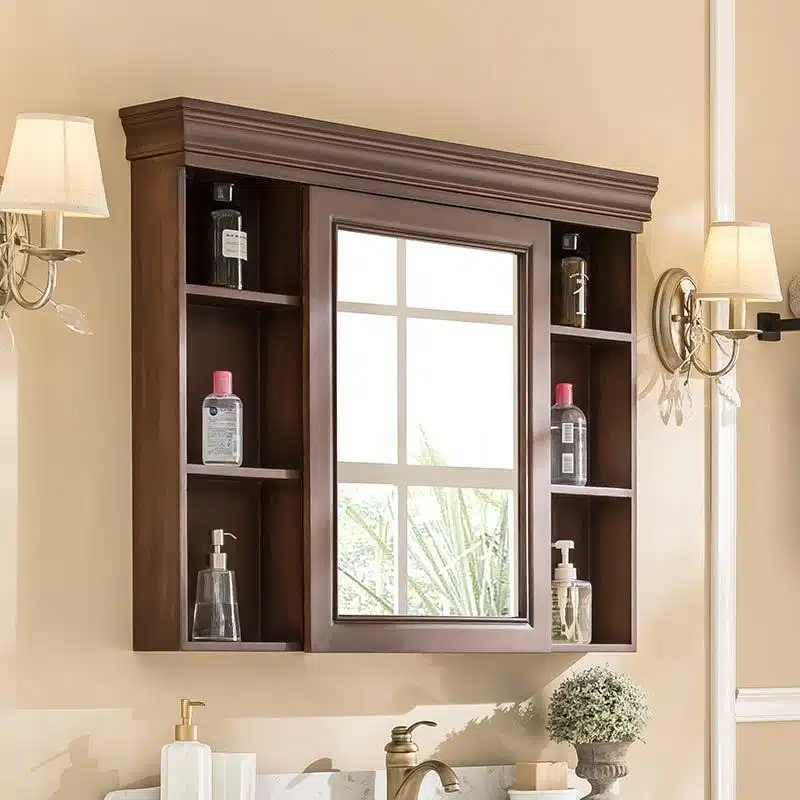
The same minimum applies to custom work. MFBATH runs custom sizes and colors from 15 sets, and its catalog lists over 40,000 custom combinations across widths of 24–60 inches and depths of 18–24 inches. Plywood carcasses accept E1, CARB P2, or FSC options, while the baseline menu holds more than 1,000 standard PVC finishes and 20 standard solid wood finishes. Customization at 15 units is unusually cheap access to differentiation.
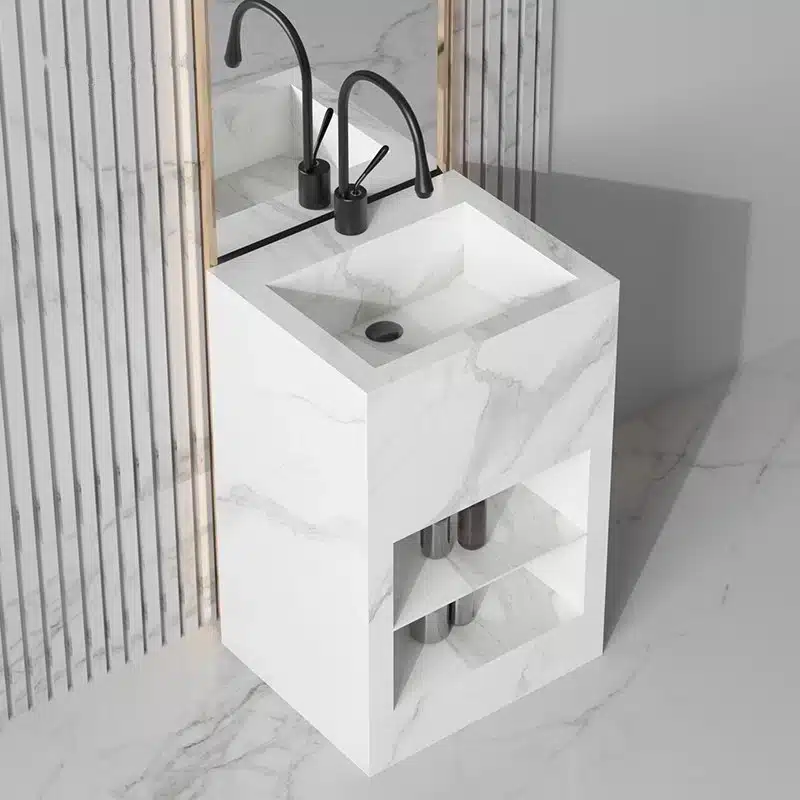
Material choice interacts with the math too. PVC vanities draw from more than 1,000 standard finishes, making a wrong guess cheaply correctable on the next order. Solid wood limits the menu to 20 standard finishes, which concentrates decisions but also concentrates risk per choice. Sintered stone surfaces add durability arguments — Mohs 7–8 hardness and 300°C heat resistance — that can justify a premium SKU slot within the same 15-unit commitment.
Cheap access still carries a specific risk. A standard finish lives in the factory’s normal production rotation and can be reordered at any time. A custom color exists only because you ordered it; if it stalls, those 15 units are the entire market. Dead stock at a 15-unit minimum hurts less than at 500, but it converts marketing spend into warehouse rent.
Plywood custom colors sharpen the stakes further. That program starts at 50+ units rather than 15. A worked example at an assumed $260 FOB puts $13,000 of goods behind one unproven color, with $3,900 due as deposit. The arithmetic says to reserve that program for colors with evidence behind them.
Private label mechanics strengthen the case for restraint. Logo printing, laser engraving, and custom packaging turn every unit into branded stock that cannot be quietly resold through neutral channels. That branding raises the switching cost of a wrong color choice. Running the first cycle with standard finishes and branded packaging keeps the brand investment intact while the finish decision stays reversible.
Here is the warning a procurement advisor gives before the first custom order. Validate demand on standard finishes for at least one or two reorder cycles. Then promote winning silhouettes into custom colors, and keep each custom SKU at the minimum until it re-earns its place. Samples make this cheaper: MFBATH offers free sample support, with samples completed in 10 working days, so color decisions can rest on physical boards rather than renderings.
From Trial to Volume: How the Math Shifts at 100 and 500 Units
The 15-unit grid is a testing system, not a permanent operating mode. Once a SKU proves demand, replenishment should move to container quantities where unit pricing improves. The unit price tier guide shows how costs step down at 15, 100, and 500 units. Production capacity matters at that stage. MFBATH produces 5,000 sets per month at its 10,000-square-meter plant in Changge, founded in 2015 by Anna Jiang, who brings over 20 years of industry experience.
Scale also raises the value of quality controls. Every unit passes five inspections, and third-party inspection by SGS or TÜV is supported before shipment. ISO 9001 and ISO 14001 were obtained in 2017 and confirmed valid through 2025 under ISO’s quality management framework; CE and UL certificates are held for applicable components. A 2-year warranty and a return rate below 1% are the terms that protect volume buyers.
Choosing where that volume gets made is its own decision. The comparison of Changge vs Foshan vanity factory clusters lays out how the two regions differ on cost structure and specialization. MFBATH’s track record includes more than 1,000 dealers across 20+ countries, supported by 95 staff on site. Those are the reference points for a supplier you may scale with over several seasons.
Proven SKUs also travel. A grid validated in the United States can be re-quoted for Canadian distributors under the same 4–6 week window, or adapted for European buyers where CE-certified components already apply. Replication multiplies the value of the original test budget without multiplying design risk. That compounding effect is what small-batch testing exists to produce.
Volume buyers should anchor the plan against the live range. The full bathroom vanity catalog covers PVC, plywood, solid wood, and sintered stone constructions. Smart LED mirrors run 24×36 to 48×72 inches with anti-fog options, while sintered stone basins rate 7–8 on the Mohs scale and withstand 300°C. A free 2025 catalog of 100+ pages is available for assortment planning before any deposit moves.
Your 15-Unit Decision Checklist Before You Sign the PO
A 15-unit minimum turns category testing from an act of faith into an arithmetic problem. Each SKU costs a few thousand dollars instead of tens of thousands, so you buy data instead of forecasts. Container loading, lead times, and custom-color rules all follow from that single change.
Key takeaways:
- Size the assortment by capital, not ambition: SKU count × 15 units × unit price is the real budget line. The 30% deposit is the cash needed on day one.
- Load the first container as one experiment: mixed models and sizes, every SKU at minimum depth, with the loading plan confirmed in writing.
- Set reorder points off the 4–6 week door window, and stack purchase orders while stock still covers six to eight weeks of demand.
- Earn custom colors with standard finishes first; plywood custom colors start at 50+ units and need proven demand behind them.
When the spreadsheet says go, start with the live product range and request the free 2025 catalog. Then price the first container against your own demand assumptions and order samples for the shortlisted finishes. The math above holds whether the first purchase order is 30 units or 270.
Frequently Asked Questions
Can different models and sizes share one container to meet the MOQ?
Yes. MFBATH supports mixed loading, so one container can combine models, sizes, and finishes. Each individual SKU still needs 15 sets, and the combined total fills the box.
What payment terms apply to a 15-unit order?
A 30% deposit places the order. The balance is due within one week of receiving the draft bill of lading. The same structure applies at larger volumes.
How long does a 15-unit order take to reach North America?
Production runs 20–30 days after order confirmation. Total time to the United States, Canada, and Mexico is typically 4–6 weeks, with goods shipping FOB Qingdao.



0 Comments