


Order one hundred solid wood vanities and moisture will find the one place the coating ran thin. Swollen door bottoms, a whitish haze around a basin cutout, hairline cracks along an end-grain edge — almost every field complaint in this category traces back to one root cause. A solid wood vanity waterproof coating is the only barrier standing between a hygroscopic material and one of the wettest rooms in a building.
This guide covers both sides of that equation. First, what a bathroom actually does to wood — humidity cycles, splash zones, and condensation working together. Then how a multi-layer polyurethane (PU) coating system answers each load, layer by layer. It closes with a verification protocol buyers can run on samples: film thickness, adhesion, water spotting, and the clauses that belong in a purchase specification.
Why Solid Wood Needs Engineered Protection in a Bathroom
Wood never stops exchanging moisture with the air around it. It absorbs vapor when relative humidity rises, releases it when the air dries, and settles at an equilibrium moisture content that tracks room conditions. A bathroom pushes that mechanism through the widest swings any cabinet will face: between uses the room may rest near 40 percent relative humidity, and during a long shower it can climb past 80 percent (indicative figures, dependent on ventilation). Every swing moves the timber underneath the finish.
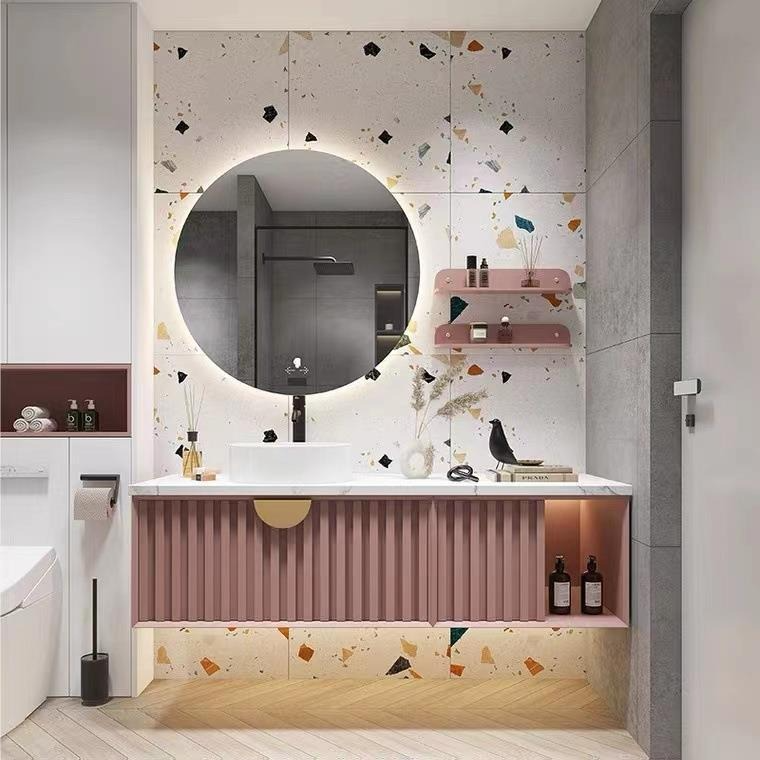
None of this argues against solid wood. It argues for treating it as an engineered system: the right species, the right moisture content at the finishing line, and a coating stack designed specifically for wet rooms. Get those three right and solid wood outlasts most alternatives — while carrying a price perception no panel product can match.
Humidity Cycles Stress the Film From Underneath
Those daily swings translate into physical movement. Wood swells across the grain as it gains moisture and shrinks as it loses it, and a family bathroom can cycle a cabinet door through hundreds of those movements per year (indicative). The coating film has to stretch and recover with every one of them. Thin or brittle films respond by developing micro-cracks, often invisible at first. Once cracked, vapor reaches the substrate directly, movement gets larger, and the damage compounds. This is why finishes fail gradually, then suddenly.
The gradient matters as much as the average. The face of a door dries fast after a shower ends, while bottom edges and the inside of the carcass stay damp longer, so different zones of the same panel sit at different moisture contents at the same moment. That differential movement concentrates stress at corners, joints, and edges — exactly where field cracking shows up first.
Splash Zones Concentrate Chemical Attack
Water is only half the load. Around the basin rim and faucet base, the vanity face collects droplets of soap, toothpaste, shampoo, cosmetics, and cleaning solution — each a mild solvent or surfactant sitting on the film until someone wipes it away. The top coat needs chemical resistance, not just water resistance. The countertop pairing matters too, because the top takes the harder hits: our breakdown of sintered stone Mohs hardness and heat resistance explains why many specifiers put solid wood cabinets under sintered stone worktops.
Condensation Works Quietly
The third load is the one nobody sees. When warm humid air meets a cooler surface — the back panel against an exterior wall, the cabinet underside, the inside of a drawer below a hot shower — vapor condenses into liquid water. Those hidden surfaces are also the ones under-coated in many factories, because inspectors look at what buyers look at. If the specification only defines the visible faces, condensation will find the gap.
Notice where field complaints cluster: swollen bottom edges, perimeter of cutouts, drill holes. Moisture attacks wherever the film is thinnest or absent. That is exactly where a properly engineered coating system spends its effort.
Inside a Multi-Layer PU Coating System, Layer by Layer
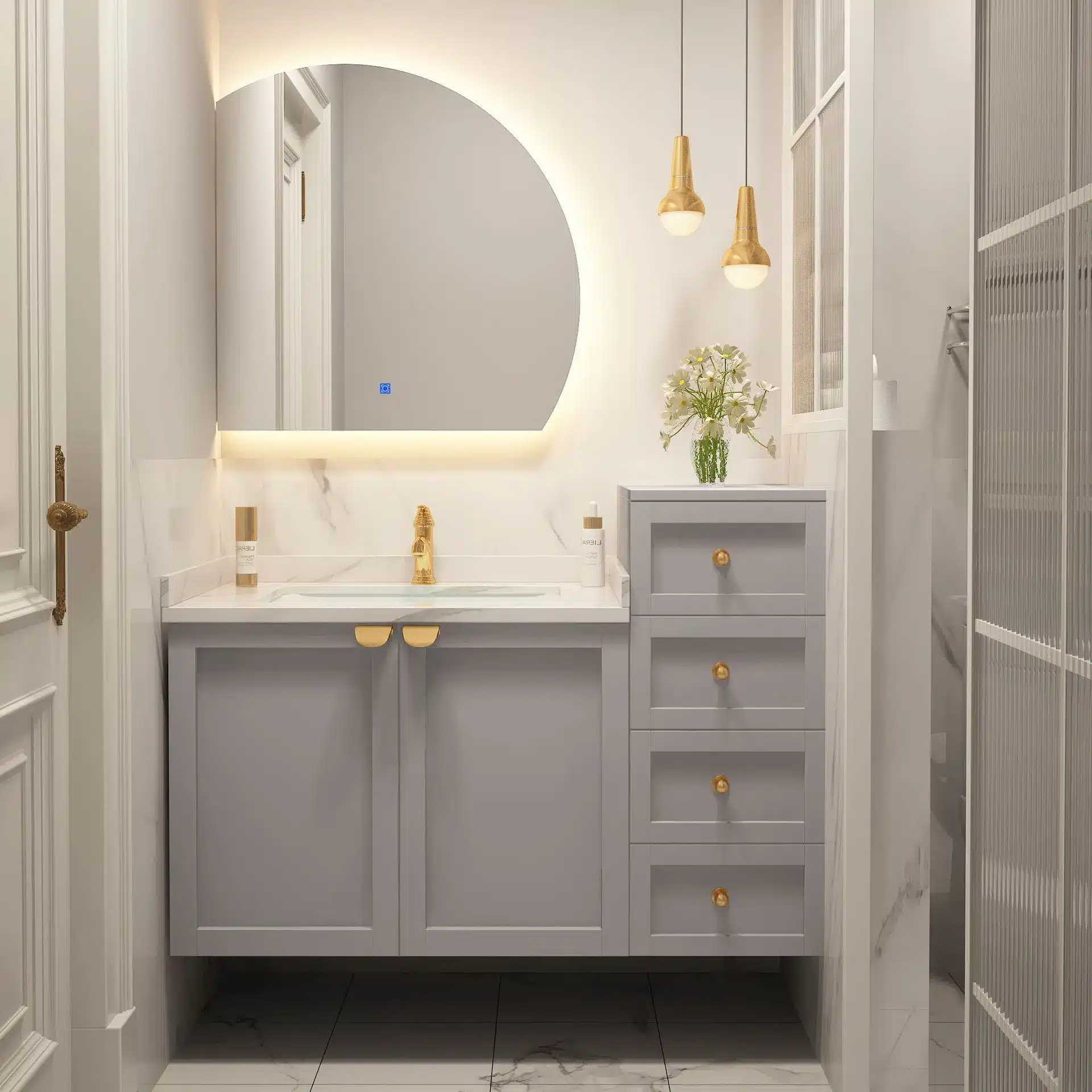
Polyurethane is a polymer formed by reacting polyols with isocyanates, and as a furniture finish it cures into a dense, continuous film that liquid water and vapor struggle to pass through — Wikipedia’s polyurethane entry covers the chemistry in depth. A solid wood vanity waterproof coating built on PU is not one layer but a stack, and each layer does a different job. MFBATH applies this multi-layer system across oak, walnut, maple, and ash.
Sealer Coats Lock Down the Grain
The first coats are thin, low-viscosity sealers designed to penetrate rather than sit on the surface. They soak into the top cell structure, partially plug open pores, and bind loose fibers, creating a uniform base for everything above them. The sealer usually raises grain fibers on the first pass, so it is sanded back before the next coat. Ring-porous species such as oak and ash demand extra attention here: their open vessels read as pinholes in the finished surface unless they are filled and capped properly.
Build Coats Create the Barrier
Intermediate coats build the dry film thickness that does the actual waterproofing. Most of a system’s moisture resistance lives in total film build, not in any single coat, so build coats are sanded level between applications to keep intercoat adhesion strong and the surface flat. Skipping a build coat is one of the quietest ways to downgrade a vanity: two panels can look identical at 80 and 140 microns (indicative) and age very differently.
The Top Coat Carries Hardness
The final layer takes the daily abuse: scratching from rings and razors, contact with cosmetics and cleaners, and the gloss or matte look that defines the cabinet. Cured PU films reach practical surface hardness for furniture service (indicative), and top coat formulation is where a factory tunes scratch resistance and hand feel. Consistency matters as much as hardness — gloss should read identical from panel to panel across the order.
Application discipline decides whether the stack performs as designed. Each coat needs a defined flash-off and cure window before the next one goes on, and sanding dust must be removed before recoating, because trapped solvent or contamination weakens the intercoat bond. Two vanities sprayed with identical materials can end up with very different service lives purely because of line discipline.
Edges and End Grain Are Where Failures Start
End grain absorbs and releases moisture several times faster than face grain (indicative), which makes every exposed end surface — door bottoms, basin cutouts, hinge mortises, drill holes — the highest-risk square centimeter on the cabinet. A proper system applies extra coating passes to these areas and re-seals any surface created by machining. Hardware penetrations deserve the same care; our comparison of undermount and sidemount drawer slides shows how differently the two mountings drill through cabinet sides, and every one of those holes is a coated breach waiting to happen.
Back-Side Balancing Keeps Panels Flat
A panel sealed on one face absorbs moisture asymmetrically, and asymmetric movement is how doors cup and carcasses twist over a heating season. The Architectural Woodwork Institute finishing guidance has long called for balanced finishing on both sides of a panel, and the rule applies with full force in bathrooms. The back of every panel, door, and drawer front should carry a balancing coat — even though nobody will ever photograph it. Our BWR versus marine-grade plywood vanity guide covers the same physics from the substrate side, and our wood and MDF bathroom vanity comparison shows where engineered boards fit the same moisture equation.
Oak, Walnut, Maple, and Ash Do Not Take Coating the Same Way
Run the same PU system over four species and you get four different finishing jobs. Pore structure, density, and extractives change how sealer penetrates, how much filling the grain needs, and how the finished film reads under showroom light. Hardness figures below are nominal Janka ratings — indicative species averages, useful for comparison, not for specification.
Oak is the workhorse and the most demanding on the finishing line. Its ring-porous grain carries open vessels that must be filled and capped, or the surface reads pitted under gloss. Tannins in the wood can interact with certain chemistries, so sealer choice matters. White oak sits around 1,360 lbf on the Janka scale (nominal). In projects, oak anchors hospitality work and traditional residential lines.
Walnut is the forgiving one. Its semi-ring-porous structure fills easily, the color does much of the selling, and a clear PU system preserves the chocolate tones buyers pay for. Hardness runs lower, around 1,010 lbf (nominal), so the top coat carries more of the dent-resistance duty. Typical fit: premium residential and boutique hotel suites.
Maple flips the problem. Diffuse-porous and dense, it closes up fast, which slows sealer penetration and makes stained finishes prone to blotching — light and natural finishes are the safer spec. Hardness is near the top of this group, roughly 1,450 lbf (nominal). Fit: bright contemporary bathrooms and high-traffic settings where surface durability leads the brief.
Ash behaves like oak’s more cooperative cousin: open ring-porous grain with bold cathedral figure, but a structure that takes stain more evenly. Around 1,320 lbf (nominal), with good elasticity. Fit: contemporary lines that want visible grain without oak’s price perception.
Finish choice also interacts with species. Dark gloss over open-grain oak or ash telegraphs every unfilled pore, while the same color reads clean on maple. Light finishes hide filling work less but flatter grain contrast less, so the pairing needs to be judged on physical samples under the lighting the end customer will actually use. When a range mixes species — say walnut vanities with oak shelving — specify one gloss level across all of them and confirm color harmony in person, because the same stain formula shifts hue on different base woods.
Whatever the species, sourcing documentation belongs in the spec. MFBATH works these four species from sustainably managed forestry, with FSC documentation available as an option. The standard lineup covers 20 finishes and widths from 24 to 60 inches; custom colors start at 15 sets per color.
Spec Solid Wood Vanities Built for Wet Rooms
Browse this product, solution, or service page to explore relevant offerings.
How to Verify Coating Quality on Samples Before Ordering
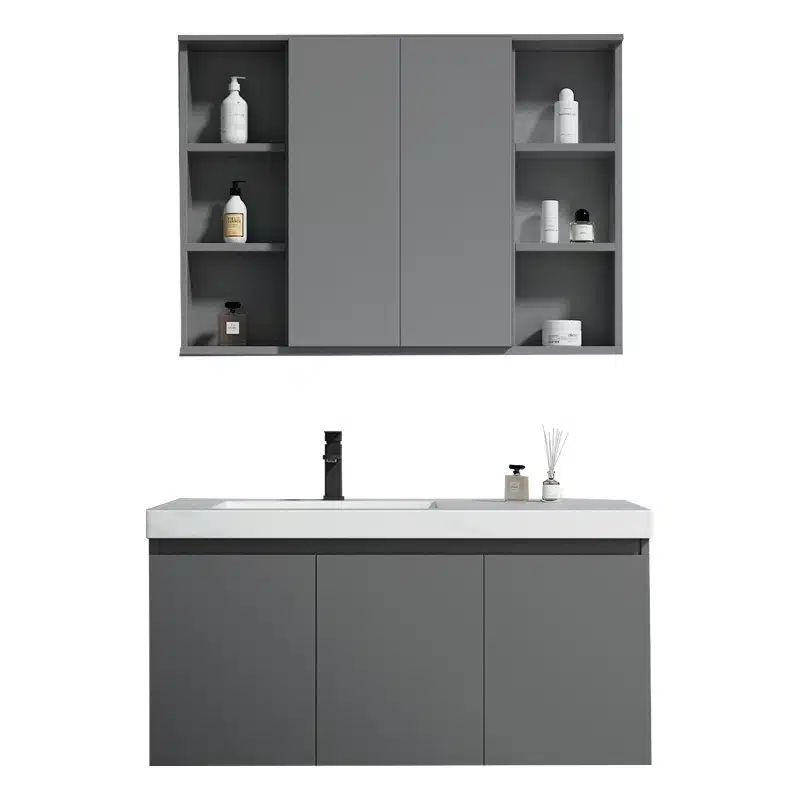
A showroom panel photographs well and hides thin edges, so a solid wood vanity waterproof coating earns its verdict in the sample room, not in the catalog. MFBATH supports free samples with a 10-working-day sample lead time — budget that window for testing, not just looking.
Measure Film Thickness, Do Not Guess It
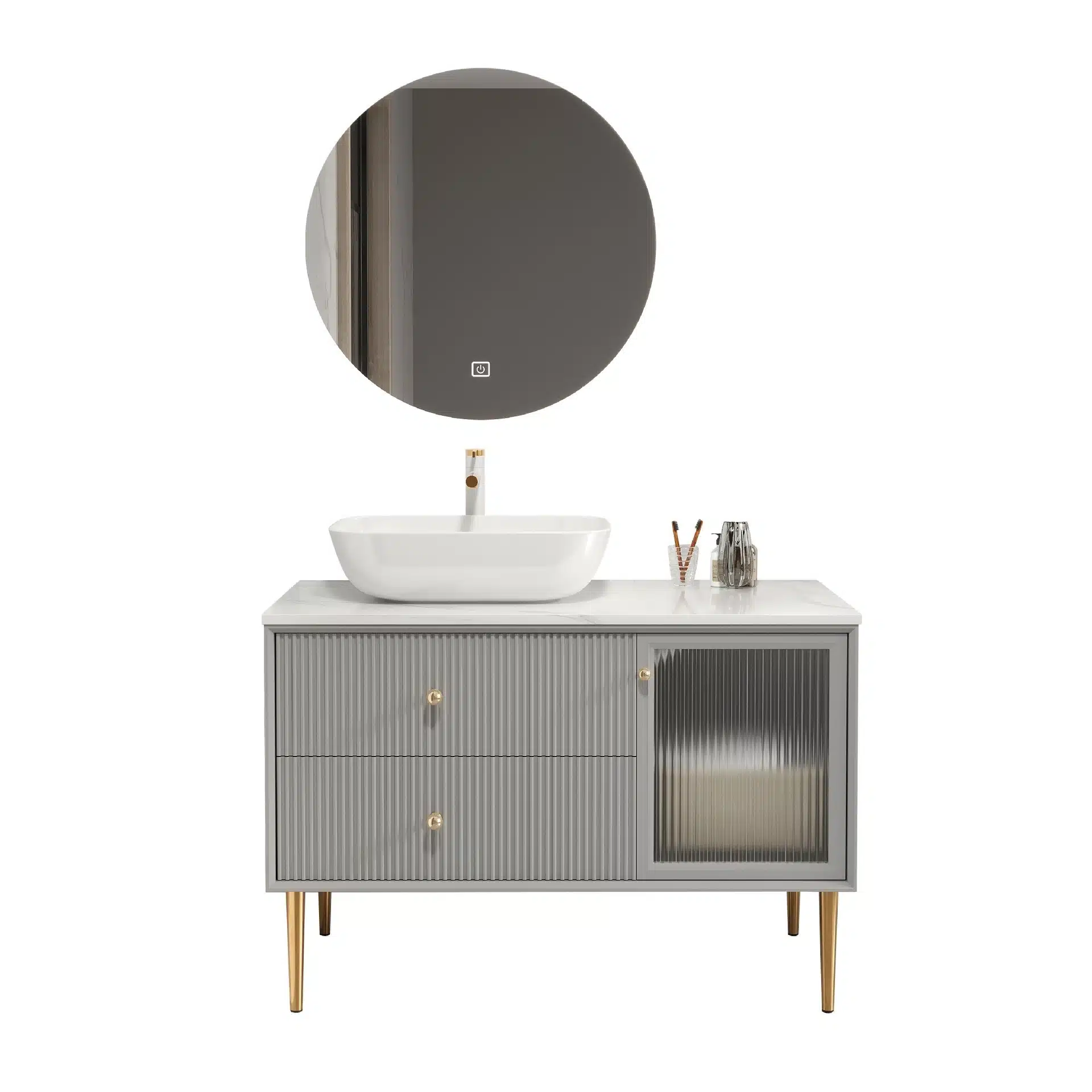
A dry film thickness gauge turns “feels well finished” into a number. For bathroom-grade furniture, total builds in the 80–150 micron range are a common indicative benchmark, varying by spec and market. Read both the face and the edge, because edges always carry less film than flat surfaces, and compare panels across the sample set for consistency. Record the numbers — they become the baseline for production checks.
Gloss deserves a number too. A gloss meter at a fixed angle — 60 degrees is the common geometry for furniture finishes (indicative) — turns “looks about the same” into a tolerance band. Read the top, middle, and bottom of each sample panel and compare across the set; a spread wider than the agreed tolerance signals spray-line drift that will only multiply at production volume.
Run a Cross-Cut Adhesion Test
Adhesion decides whether the film stays bonded while the wood underneath it moves. In the cross-cut test defined by ISO 2409 — with ASTM D3359 as the related US method — a blade cuts a lattice through the film, tape is pressed on and pulled off, and the result is graded from ISO class 0 (no removal) to class 5 (severe flaking). For bathroom furniture, class 0 or 1 is the standard indicative pass. Cut the lattice on an edge as well as the face, because that is where adhesion gets tested in service.
Stress the Sample With Water and Humidity
Two simple tests expose weak chemistry. First, the water-spot test: leave droplets on the surface for 24 hours (indicative duration), wipe them off, and check for whitening, gloss change, or softening. Second, a humidity cycle: hold the sample at high relative humidity over repeated cycles (indicative protocol), then inspect edges and cutouts for blistering or lifting. Run both again after the adhesion cuts, because in the field, moisture follows the scratch.
Face-only testing flatters a finish. The edge, the cutout, and the drill hole tell the truth.
The Coating Verification Checklist
All pass signals below are indicative benchmarks, not factory specifications — anchor your own standard to test reports. The row that earns the highlight is dry film thickness, because it is the number everything else tends to correlate with.
| Test | What to Ask For | Pass Signal (Indicative) |
|---|---|---|
| Dry film thickness | Gauge readings on face and edges | 80–150 µm total, consistent panel to panel |
| Cross-cut adhesion | ISO 2409 / ASTM D3359 report | Class 0–1 (ISO) or 4B–5B (ASTM) |
| Water spotting | 24-hour droplet plus wet-cloth contact | No whitening, gloss drop, or softening |
| Humidity cycling | Repeated high-humidity exposure cycles | No blistering, checking, or edge lifting |
| Edge and end-grain coverage | Close-up photos of cutouts, holes, bottom edges | Continuous film, no dry spots or pinholes |
| Back-side balancing | Confirmation that hidden faces are sealed | Balancing coat on every back surface |
Put the Standard in the Purchase Spec
Verbal assurance does not survive a dispute; written clauses do. The purchase spec should fix minimum dry film thickness, adhesion class, test frequency per batch, documented edge and cutout sealing, balanced back-side coating, and gloss tolerance. Then tie inspection to the contract: MFBATH runs five inspection checkpoints on every unit and welcomes third-party inspection by bodies such as SGS or TÜV arranged in advance. The factory has held ISO 9001 and ISO 14001 certification since 2017. Commercial terms follow the quality terms: a 2-year whole-cabinet warranty and a return rate under 1 percent across the line.
Define what happens at production, not just at sampling. Retention samples from each batch, inspection frequency tied to the agreed test list, and a clear escalation path when a batch misses the standard all belong in the agreement. A spec that only defines the approval sample leaves the actual order unmanaged — and the order is what ships.
Coating is only half the durability story; moving parts complete it. Specify hardware alongside the finish — our guide to soft-close vanity hardware covers the hinges and dampers that keep doors closing gently for the life of the cabinet.
What This Means for Your Next Order
A bathroom loads a cabinet continuously — humidity cycles from the air, splashes from the front, condensation from behind. A multi-layer PU system answers each load: sealer coats lock the grain, build coats stack the barrier, the top coat carries the wear, and edge sealing plus back-side balancing close the places where failures actually start. None of this can be judged from a photograph. It can be measured on a sample.
- Spec outcomes, not coat counts: a minimum total dry film thickness (80–150 µm indicative) and documented edge coverage.
- Require cross-cut adhesion of ISO class 0–1 (indicative), tested on edges as well as faces.
- Match finish plans to species: oak and ash need pore filling, maple needs stain discipline, walnut needs clarity.
- Tie quality to terms: 2-year whole-cabinet warranty, return rate under 1 percent, and a MOQ of 15 sets per model per color per size.
MFBATH solid wood vanities run oak, walnut, maple, and ash in 20 standard finishes, with widths from 24 to 60 inches, custom colors and sizes from 15 sets, and logo carving or printing from the same threshold. Review the full solid wood bathroom vanity range, request a sample, and put it through the checklist above before the order does.
Frequently Asked Questions
Do solid wood vanities really need a PU coating, or are oil finishes enough?
For commercial supply, film-forming PU wins. Penetrating oils give a natural feel but a weaker vapor barrier and scheduled re-maintenance — a hard basis for warranty claims. A cured multi-layer PU film delivers a low-maintenance barrier that distributors and contractors can stand behind.
How many coats should a solid wood vanity waterproof coating include?
Coat count matters less than outcomes. Ask for total dry film thickness (80–150 µm indicative), a cross-cut adhesion class, and documented edge sealing. A three-coat system that passes those tests beats a six-coat system with thin edges.
Can MFBATH match custom finish colors or sizes?
Yes. Beyond 20 standard finishes, custom colors start from 15 sets per color and custom sizes from 15 sets per size, with widths from 24 to 60 inches standard. Logo carving or printing is available from 15 sets, across oak, walnut, maple, and ash.


0 Comments