

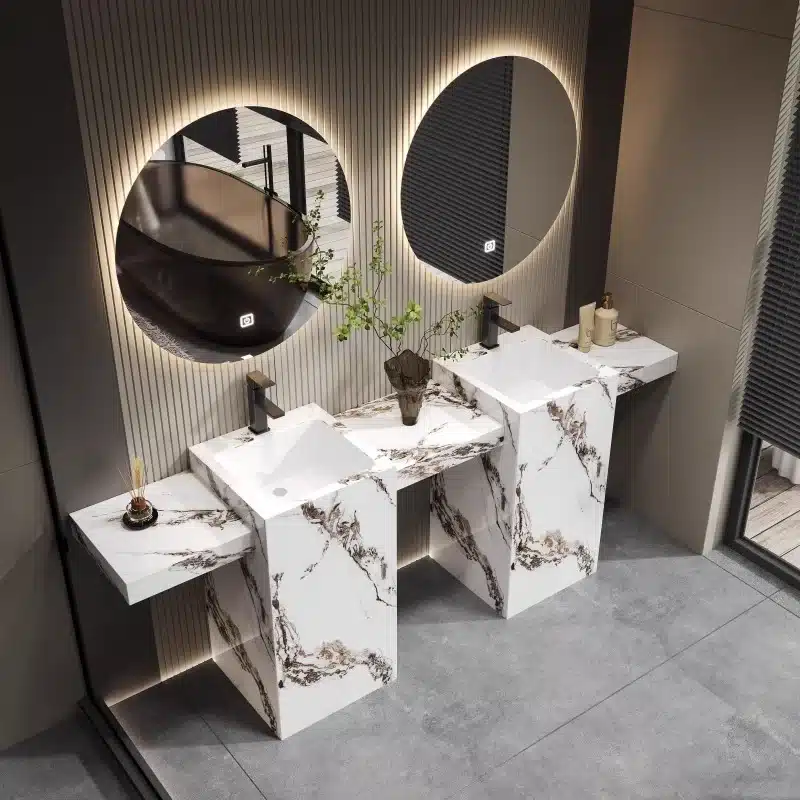
6:40 a.m. in a procurement office in Riyadh. The tender for a new-build property closes Friday, and the vanity spec sheet just came back with a third round of revisions. That is the normal rhythm of Middle East bathroom vanity hotel projects. The hard part is separating what the designer wants from what the contractor can install and the owner will accept at handover.
This guide covers that split directly. You get the buyer landscape across the Gulf, the specs that keep reappearing in hotel tenders, and the compliance notes that trip up first-time importers. The quote-to-container math matters just as much, because it protects your schedule. It is written for procurement leads, project contractors, and distributors who need one dependable line of supply.
Key Takeaways
- Hotel buyers sit in three camps: hotel groups, fit-out contractors, and regional distributors. Each orders differently, and each needs a different conversation.
- The MOQ is 15 sets per model, color, and size. Mixed containers are allowed, so one trial order can cover several room types.
- Free samples ship in 10 working days. Production runs 20–30 days at a factory with 5,000 sets of monthly capacity.
- Payment is 30% deposit, with the balance due within one week after the draft bill of lading. Shipments leave Qingdao on FOB terms.
- Every unit passes 5 inspection checks. SGS or TÜV third-party inspection can be booked in advance.
- Repeat buyers quote back two numbers: the 2-year container-level warranty and a return rate below 1%.
Table of Contents
- Who Is Buying Vanities in the Middle East
- Spec Preferences That Recur in Hotel Projects
- Compliance and Electrical Safety Notes
- Budgeting a Project Quote
- Lead Time Planning for Hotel Pipelines
- Samples, Approvals and the Path to Bulk
- Why Hotel Specifiers Come Back to One Supplier
- Frequently Asked Questions
- The Bottom Line
Who Is Buying Vanities in the Middle East
Three buyer types drive most regional demand, and they rarely buy the same way. Hotel groups and operators run brand standards across dozens of properties. Fit-out contractors buy against a tender and a construction schedule. Distributors buy for showrooms, resale, and small hospitality jobs.
Hotel groups want consistency above everything else. A group that approves one vanity for a prototype room expects the same color, the same hardware, and the same finish on every floor of every property. That is why group buyers ask about production history, sample archives, and container-level warranties before they talk price. Our hotel vanity specification guide covers the standards these teams check first.
Contractors and project management consultants operate on a different clock. Their orders follow the construction program, not the design calendar. Delivery windows are fixed, installation slots are booked, and a two-week slip can ripple through the whole fit-out. They value factories that quote real lead times and then hold them.
Distributors are the third lane. They carry stock for retail, supply renovation contractors, and occasionally feed a small hotel job. Mixed containers matter to them, because one 40-foot box can combine vanities, mirrors, and basins for several projects at once.
Read the first RFQ and you can tell which camp is writing it. Group buyers send brand manuals and ask for finish archives. Contractors send a cut-off date and a container count. Distributors ask about mix and margin. Answer the question behind the question, and the quote lands where it should.
The regional context is real and worth watching. Saudi Arabia’s official tourism authority publishes the national destination platform, and Dubai’s government tourism portal keeps a running record of new hotel launches and stay options. Neither publishes a vanity count, and you should not forecast from one. What matters operationally is that the Gulf builds hotels in clusters, and clusters create repeat orders.
The buyers are also more global than a decade ago. Many Gulf procurement teams source in English, spec in millimeters, and manage suppliers remotely. That means export discipline matters as much as the production line. The factory that documents well gets the second meeting.
Sell to the contractor and you live by the schedule. Sell to the distributor and you live by margin and mix. Sell to the group, and one approval feeds a pipeline.
Spec Preferences That Recur in Hotel Projects
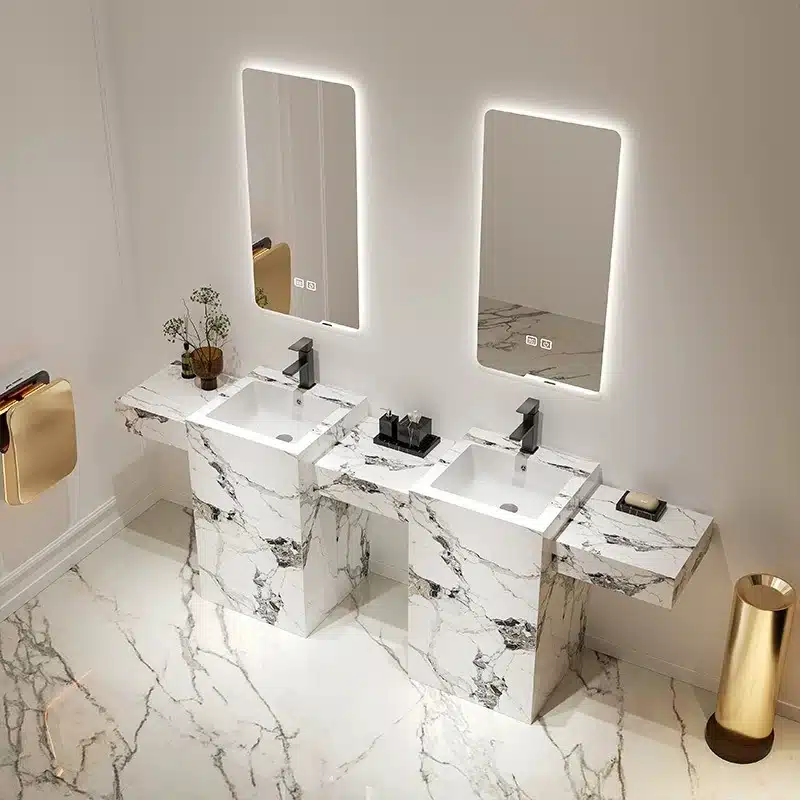
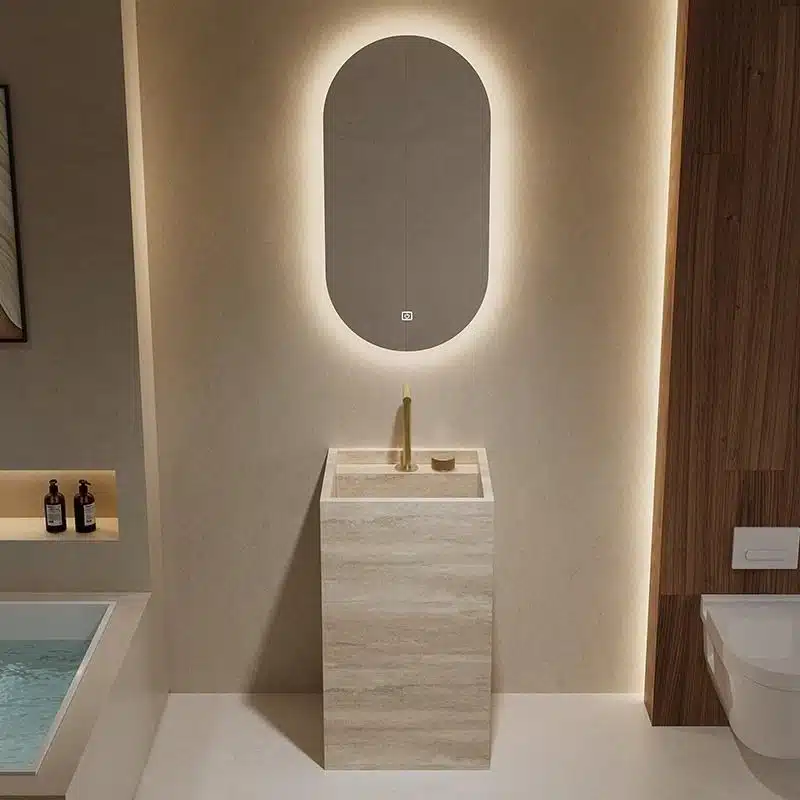
Sintered stone tops lead the spec sheet in most Gulf hotel tenders. The material shrugs off heat, moisture, and cleaning chemicals, which is exactly what a hotel bathroom demands. MFBATH builds floating sintered stone vanities from 600 to 1800 mm and floor-standing units from 800 to 2000 mm. The stone surface sits at 7–8 on the Mohs scale, resists heat up to 300°C, stays non-porous, and does not fade under UV.
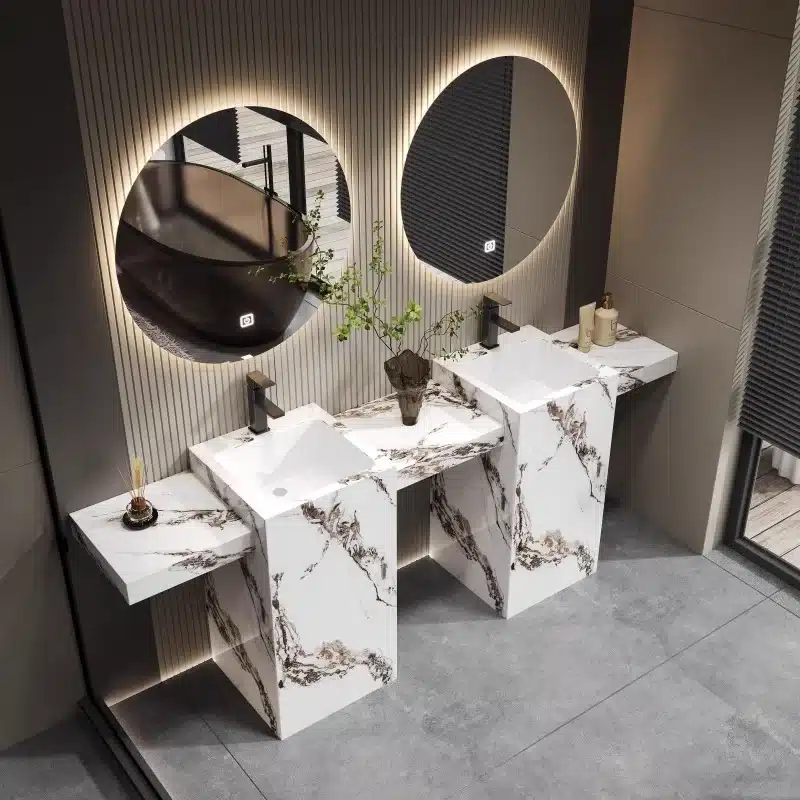
The reason is practical, not decorative. Housekeeping chemicals, hard water, and daily use punish a vanity top in ways a showroom never shows. A seamless integrated basin removes the joint where water hides, and the antibacterial surface gives owners one less item to audit. Our sintered stone and integrated basin sourcing guide walks through the full spec.
Floating units appear in most modern briefs. They give the room a cleaner line, open the floor for housekeeping, and keep cabinet bases away from standing water. The PVC line is 100% waterproof, spans 24–60 inches, and comes in 1,000+ standard finishes.
Material choice follows the climate. For humid coastal cities, the PVC line removes the moisture risk entirely. For wood-spec projects, MFBATH offers oak, walnut, maple, and ash with a multi-layer PU waterproof coating across 20 standard finishes. Plywood builds can step up to BWR or marine-grade cores when the spec demands it.
LED mirrors now ship as part of the package, not as an afterthought. Recurring requests include adjustable brightness and color temperature, anti-fog heating, touch controls, digital display, and automatic shut-off. Voice control and Bluetooth remain options for the upper tiers. The hotel lighted mirror guide covers the defogger and dimming technology behind these features.
Lighting behavior is part of the spec. A mirror that dims and shifts color temperature serves guest rooms and grooming areas with one SKU. That cuts the SKU count across a property, which is exactly what group buyers want to hear.
Hardware tells you the star rating before the room does. Gold and brushed brass finishes recur across four- and five-star briefs, and the spec often names the exact finish family. MFBATH matches Pantone colors, offers 40,000+ custom combinations, and can run branded hardware, logo printing, or laser engraving on request.
Double basins show up in deluxe and twin rooms as a matter of course. The practical lesson is simple. The spec that wins is the one that survives two years of housekeeping.
Compliance and Electrical Safety Notes
An LED mirror is an electrical product before it is a mirror. It carries drivers, heaters, touch sensors, and a power supply, and every one of those parts needs a defensible safety story. Ask the factory what it actually holds before you put it in a hotel room.
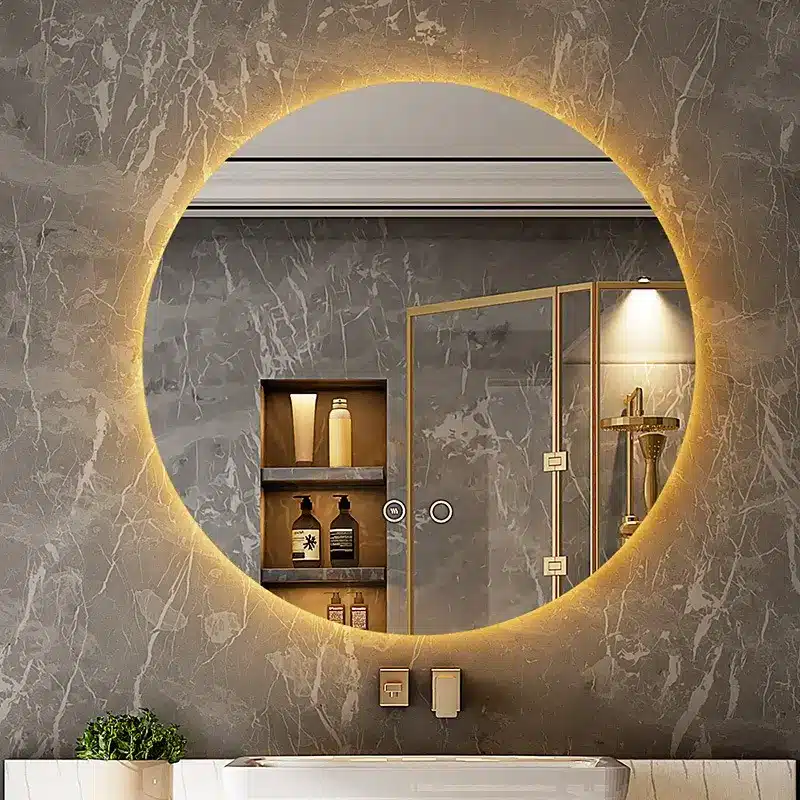
Here is what MFBATH holds today. The smart LED mirror range carries CE certification. The quality system has been ISO 9001 certified since 2017, the environmental system ISO 14001 since the same year, and both were confirmed current in 2025. We do not publish certificate numbers here; verification happens through documentation and third-party inspection.
CE marking means a product meets the safety, health, and environmental requirements of the European Economic Area. It is the manufacturer’s declaration of conformity, not a government approval stamp. Electrical products sit squarely inside that scope, and the European Commission’s CE marking page is the official explanation to read.
Regional rules need the same respect. Saudi Arabia enforces technical regulations through the Saudi Standards, Metrology and Quality Organization, known as SASO, including conformity assessment platforms for imported goods. Our products are designed to meet SASO requirements, and project documentation is confirmed case by case against the SASO official website.
SASO also operates the Saber conformity platform, where product registration and conformity certificates are verified for regulated goods. For a supplier that wants repeat business in the Kingdom, aligning documentation with that system is part of the job. We confirm project-level documentation case by case rather than guessing.
Humidity is the quiet killer in Gulf bathrooms. The PVC line is 100% waterproof by design. Plywood builds use standard, BWR, or marine-grade cores with formaldehyde emissions meeting E1 limits, CARB Phase 2, and TSCA Title VI. Low-VOC finishes keep indoor air complaints off the punch list, and anti-fog mirrors handle the steam that coastal climates produce.
Electrical safety does not stop at certification. Wiring, connectors, and driver placement are checked during our 5-step inspection, and the mirror range is built for the wet-zone reality of hotel bathrooms. Ask for the wiring diagram if the project engineer wants one; it ships with the technical file.
Never accept “we have the certificate” as an answer. Ask for the document, then book the inspection. Paper follows product; make both travel together.
Vanities Built for Gulf Hotel Pipelines
Browse this product, solution, or service page to explore relevant offerings.
Budgeting a Project Quote
Budgeting a Middle East bathroom vanity hotel order starts with MOQ math, not price per unit. The MOQ is 15 sets per model, color, and size across the product line. A 120-vanity order split across six room-type SKUs clears that bar comfortably, and our MOQ guide shows how the rule scales.
Mixed containers stretch the same budget. You can combine vanities, mirrors, and basins in one 40-foot box and reach room-complete instead of vanity-only. Terms are FOB Qingdao, and import duties are assessed at the border, so landed cost stays in your hands, not ours.
Freight efficiency is a design decision, not a logistics afterthought. Knock-down structures reduce shipping volume and protect against transit damage, while assembled units save installation time on site. Your contractor’s labor rate and your freight budget decide which one wins. Our FOB structure leaves that choice with you.
Customization is where the quote gets real. MFBATH supports 40,000+ combinations: Pantone color matching, eco-friendly materials, ceramic, resin, or sintered stone basins, and branded hardware. White-label and private-label programs cover logo printing, laser engraving, and custom packaging. The 2025 catalog, 100+ pages, is free on request. Browse the product range to anchor your spec before the first quote.
Every quote should itemize four things: the unit price, the customization line, the packaging, and the inspection. If a supplier merges them into one number, you cannot compare offers. Transparent line items are the difference between a quote and a budget you can defend in a steering meeting.
Quote the sample round first. CAD and 3D rendering are part of the approval path, so the design gets validated before any tooling or material spend. A supplier who answers in days and one who answers in weeks are different partners for a project that closes Friday.
A quote without a sample is a guess. A quote with one is a plan. Price alone never closed a hotel order.
Lead Time Planning for Hotel Pipelines
The lead time numbers are simple to state. Free samples leave in 10 working days. Bulk production runs 20–30 days. Then add ocean transit, customs clearance, and inland delivery before you name a commitment date. Our production timeline guide maps the whole chain from PO to delivery.
Payment terms follow a fixed rhythm. A 30% deposit locks the production slot, and the balance is due within one week after the draft bill of lading. That structure protects both sides, because raw materials and production capacity get committed on your deposit.
Documentation runs on the same clock. The commercial invoice, packing list, and certificate of origin are prepared with the shipment, and the draft bill of lading triggers the final payment. Projects that plan the paperwork window rarely fight surprises at customs.
Plan backward from handover. If the room must be ready in month six, the vanity needs to clear customs by month five. It should leave the factory by month four and pass sample approval by month three. Every week of approvals you compress early is a week of buffer you do not need later.
Add slack for Gulf port congestion in peak periods. When many projects ship at once, vessels and customs slots tighten, and the schedule you control is the one you planned. The factory side stays fixed; the ocean side needs buffer.
Order cycles cluster around construction milestones, and factory slots fill in waves. Book production capacity early when the pipeline looks busy, and confirm the container booking as soon as the deposit lands.
Lead time is negotiable only if you ask before you order. Ask at the RFQ stage, not the shipping stage. The calendar belongs in the first conversation.
Samples, Approvals and the Path to Bulk
Samples are free, and they ship in 10 working days. CAD and 3D rendering come first in the approval path, so the factory and the specifier agree on geometry before anything is cut.
Check the sample like an inspector, because the bulk order will match it. Verify dimensions, finish color under different light, drawer action, and hardware torque. Our pre-shipment inspection checklist gives the full list of checks to run at the factory gate.
Every MFBATH unit passes 5 inspection checks during production. For extra cover, SGS or TÜV third-party inspection can be booked with advance notice, and their report travels with the shipment.
Third-party inspection covers quantity, dimensions, finish, packaging, and loading condition against the approved sample. Photos and the signed report become your evidence if anything arrives damaged. Book the slot with advance notice so the inspector and the production schedule line up.
Approve the golden sample in writing, keep the photographs, and record the Pantone references. That document is the contract for the container that follows.
The sample is the contract. Approve it properly, and the bulk order is a production run, not a gamble. That discipline costs nothing and saves a handover.
Why Hotel Specifiers Come Back to One Supplier
Stickiness has numbers behind it. MFBATH operates a 10,000-square-meter factory with 95 employees and 5,000 sets of monthly capacity. The company was founded in 2015, which puts a decade of production behind every line. More than 1,000 dealers across 20+ countries sell the same product family, and the sintered stone basin line alone runs through 500+ dealers.
The warranty does the heavy lifting. Every container carries a 2-year warranty at the container level, and the return rate stays below 1%. Those two facts answer the questions owners actually ask at handover.
The support structure keeps the line simple for repeat buyers. The 2025 catalog runs 100+ pages, dealer support covers showroom displays and samples, and private-label programs put your brand on the box. Once a specifier learns the system, switching suppliers means relearning everything.
Consistency is what brings groups back for phase two. The same color, the same hardware, and the same finish across three renovation phases is a procurement achievement, not a given. Matched vanity and mirror sets keep the room looking like one design decision.
Any factory can ship one container. The ones you keep ship the third, the fifth, and the tenth the same way. That is the stickiness, measured in repeat orders.
Frequently Asked Questions
What is the MOQ for a Middle East hotel vanity project?
The MOQ is 15 sets per model, color, and size across the product line. Mixed containers are allowed, so a first order can combine vanities, mirrors, and basins and cover several room types at once.
How fast are samples, and what do they cost?
Samples are free and ship in 10 working days. CAD and 3D rendering are part of the approval path, and bulk production starts after written approval of the golden sample.
What are the payment terms on FOB Qingdao orders?
Orders start with a 30% deposit. The balance is due within one week after the draft bill of lading, which is standard across the product line.
Do LED mirrors ship with the vanity order?
Yes. The smart LED mirror range includes adjustable brightness and color temperature, anti-fog heating, touch controls, digital display, and automatic shut-off, with voice and Bluetooth as options. The mirrors carry CE certification and can be coordinated into the same mixed container.
The Bottom Line
The Middle East bathroom vanity hotel pipeline rewards suppliers who quote fast, sample honestly, and hold delivery dates. MFBATH has the capacity, the certifications, and the record to be that supplier. Send the spec sheet, request the sample, and lock the production slot before the next tender wave. The playbook ends here; the execution is yours.





0 Comments