

hotel multifamily bathroom vanities avoid is the first checkpoint buyers should lock before they approve a supplier, budget, or production slot. Hotel & Multifamily Bathroom Vanities: Avoid Sourcing Mistakes is the first checkpoint buyers should lock before they approve a supplier, budget, or production slot. A $50,000 order of bathroom vanities for a 120-room hotel landed in the warehouse last quarter. The FOB pricing was competitive, the pre-production sample passed visual inspection, and the container arrived on schedule. Then the project manager unboxed unit 47. The sintered stone top was 3mm thinner than the sample, the edge profile didn’t match, and the sealant bead along the back splash was visibly uneven. That single deviation triggered a full inspection, delayed the opening by two weeks, and ate up most of the margin on the deal. This is the kind of scenario that makes a commercial bathroom vanity guide essential reading for any procurement manager responsible for large-scale hospitality or multifamily projects.
The gap between a pre-production sample and mass production is where most sourcing failures hide. According to an industry report, 80% of hotel bathroom water damage traces back to poorly sealed vanity tops. The fix isn’t expensive — a 72-hour moisture exposure test during production costs less than one percentage point of the unit price. But if you don’t build that checkpoint into your quality tolerance criteria, you’re essentially gambling a six-figure order on the supplier’s internal discipline. The material choice alone — plywood versus MDF versus marine-grade plywood — shifts the failure curve in high-humidity environments by years, not months.
Do nothing, and the math is straightforward. A 200-unit multifamily project with substandard vanity tops will start showing delamination or edge swelling within 18 months. Replacement costs typically run 40–60% of the original fixture price per unit, plus labor and tenant disruption. A procurement checklist that includes material certification, moisture resistance verification, and a clear sample approval protocol isn’t bureaucracy — it’s the difference between a one-time buy and a recurring expense that drags across multiple budget cycles.
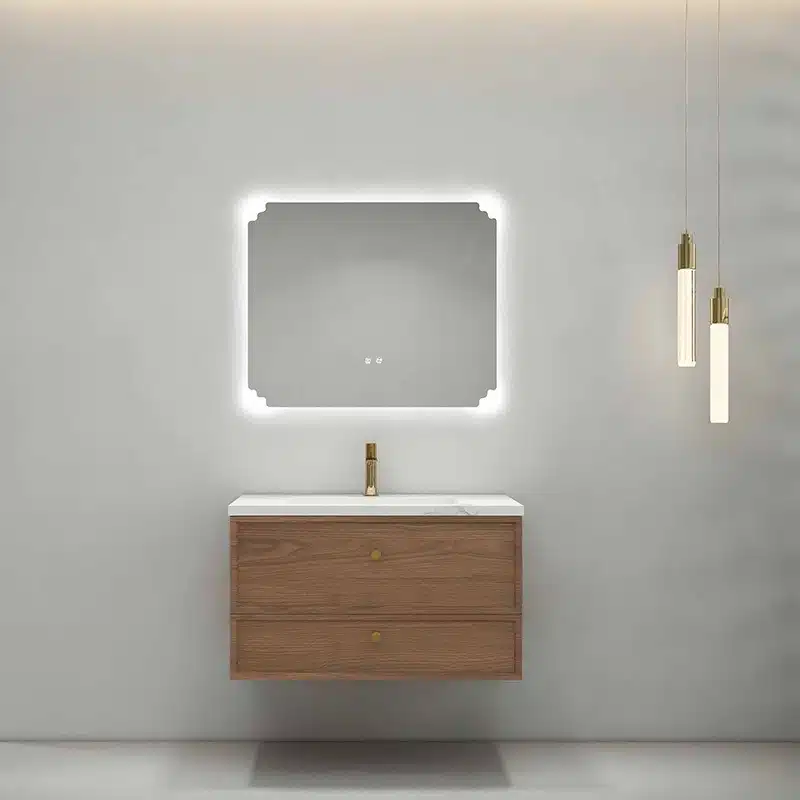
Key Challenges in Commercial Bathroom Vanity Procurement
80% of hotel bathroom water damage starts at poorly sealed vanity tops.
Moisture resistance is the primary failure point in hospitality projects. A standard 1.2mm PVC edge band or thin melamine coating will delaminate within 18 months in a Bangkok or Miami hotel bathroom. The real test is not the material brand — it’s the sealing protocol at cutouts, seams, and back panels. Focuscabinet runs a 72-hour moisture exposure cycle on every production batch, measuring edge swell and adhesive integrity. If your supplier cannot provide a documented moisture test report for the specific batch, assume the vanity will fail before the third maintenance cycle.
-
-
- Key spec:: Sealing method — ask for full immersion test data on sink cutout edges and back panel. Look for ≥48 hour accelerated aging with <2% edge swell.
- Common trap:: Sales samples use marine-grade plywood, but bulk production switches to standard plywood with only surface coating. Always request a sealed A2L sample from the actual production batch.
-
Consistency across large orders is what separates a production line from a batch-driven workshop. When you order 500 vanities for a hotel chain, every unit must match in color, grain direction, hardware alignment, and edge finish. The challenge grows with scale: one poorly calibrated CNC router can misalign 50 drawers before a QC check catches it. Focuscabinet’s five-stage QC includes first-article inspection, in-process checks every 50 units, and a final 100% visual scan under standardized lighting.
-
- Check No. 1:: Color consistency tolerance (ΔE ≤ 0.5 under D65 light). A supplier who can’t state this number is not ready for commercial volumes.
- Check No. 2:: Hardware torque test across multiple units. If the same screw type strips on 2% of units, the entire batch needs rework.
- Check No. 3:: Packaging variation — even a 3mm shift in box dimensions can cause freight damage. Request pack-out photos from three random master cartons per pallet.
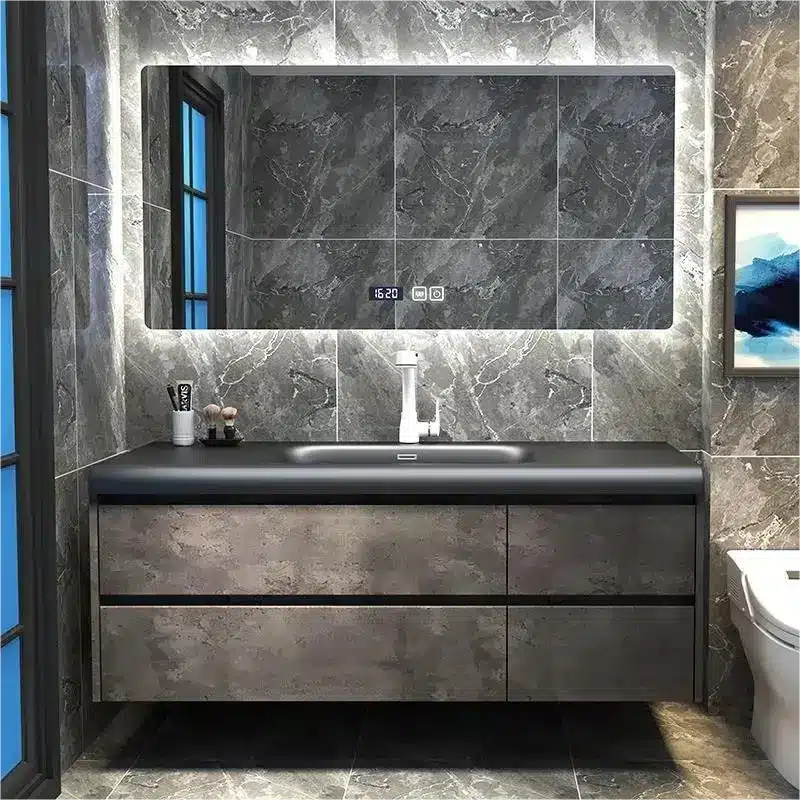
Material Selection for Durability
A poorly sealed vanity top causes 80% of hotel bathroom water damage—check the seam, not just the material.
You’re comparing FOB quotes, but the real cost difference between plywood and MDF shows up only after year two in a coastal hotel. On a 300-unit project, plywood yields a 4–6 year service life advantage in high-humidity zones, yet many suppliers still push MDF because it’s 15–20% cheaper to produce. The catch? MDF’s edge swell rate above 0.6% thickness expansion marks the point where cabinet doors no longer align—and you’re looking at field repairs at $40–$80 per door.
Marine-grade plywood solves the moisture problem outright, but only if the spec calls for 100% waterproof glue (BS 1088 standard) and a minimum 7-ply core. A leading moisture resistant bathroom vanity supplier China like Focuscabinet runs a 72-hour moisture exposure cycle during five-stage QC to validate real-world performance, not just lab conditions. If your supplier can’t show you those test reports, you’re gambling on the production run.
-
- Plywood vs MDF for high humidity: Plywood retains structural integrity up to 90% RH; MDF’s internal bond weakens above 70% RH. For hospitality in tropical climates, requiring a moisture-resistant seal on all cut edges (sample approval must include edge-band quality) separates a 5-year vanity from a 10-year vanity.
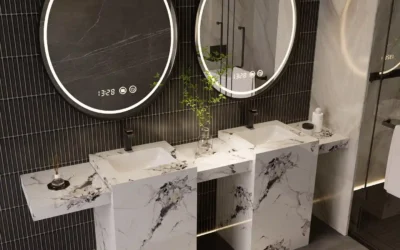
- Sintered stone vs quartz vs marble: Sintered stone tops (e.g., 6mm compact slabs) cost roughly 15% more than quartz but require zero sealing and resist 600°F thermal shock—critical for hot curling irons in hotel bathrooms. Marble, while prestigious, demands annual resealing and stains within months under typical occupancy. The practical durability benchmark: less than 0.02% water absorption (sintered stone and quartz both meet this; natural marble can exceed 0.5%). Request a 24-hour acid-resistance spot test on the production sample to verify quality tolerance before approving the bulk order.
The industry benchmark you can write down: A durable commercial bathroom vanity should pass a 24-hour water immersion test with less than 0.5 mm edge swelling on the cabinet body. Any supplier that can’t guarantee this for FOB pricing should be re-evaluated.
| Material | Core Composition | Moisture Resistance | Durability & Compliance | Best For |
|---|---|---|---|---|
| Plywood | Cross-layered hardwood veneers bonded with WBP glue | Good; sealed edges required for high-humidity zones | High structural strength; passes Focuscabinet 72-hour moisture test | Hotels and projects requiring long-term stability under variable climates |
| MDF (Medium-Density Fiberboard) | Wood fibers compressed with resin, density ~700-800 kg/m³ | Low unless treated with moisture-resistant additive or sealed | Prone to swelling in >60% RH; not recommended for coastal or humid regions | Low-humidity, budget-conscious multifamily units with proper sealing |
| Marine-Grade Plywood | BS1088-certified ply with waterproof phenolic resin layers | Excellent; resists delamination even in continuous 90% RH | Exceeds ASTM D1037 moisture cycling; complies with EU fire class B-s1,d0 | Beachfront hotels, spas, and regions with high humidity or flood risk |
| Sintered Stone | Compressed quartz minerals, feldspar, and silica fired at >1200°C | Virtually zero water absorption (<0.02%) | Resists stains, scratches, and thermal shock; UL certified for fire resistance | High-traffic commercial vanities where surface longevity is critical |
| Quartz (Engineered Stone) | ~93% natural quartz + polymer resins and pigments | Very low absorption (~0.1%); non-porous when sealed | Hardness 7 Mohs; resists chips but sensitive to high heat (use trivets) | Multifamily projects needing a balance of cost and stain resistance |
| Marble (Natural Stone) | Calcite-based metamorphic rock with natural veining | Absorbs up to 0.5% water; requires frequent sealing | Soft (3 Mohs) and prone to etching from acids; not recommended for commercial use | Luxury boutique hotels with dedicated maintenance budgets |
| Focuscabinet Sealed Vanity Top | Plywood or marine-grade substrate + sintered/quartz surface with polyurethane edge seal | Passes Focuscabinet 72-hour submersion test; meets ASTM E96 vapor barrier | Region-ready: pre-adapted to local fire codes (e.g., EN 13501, NFPA 286) and humidity levels | Procurement managers needing one supplier for varied global project climates |
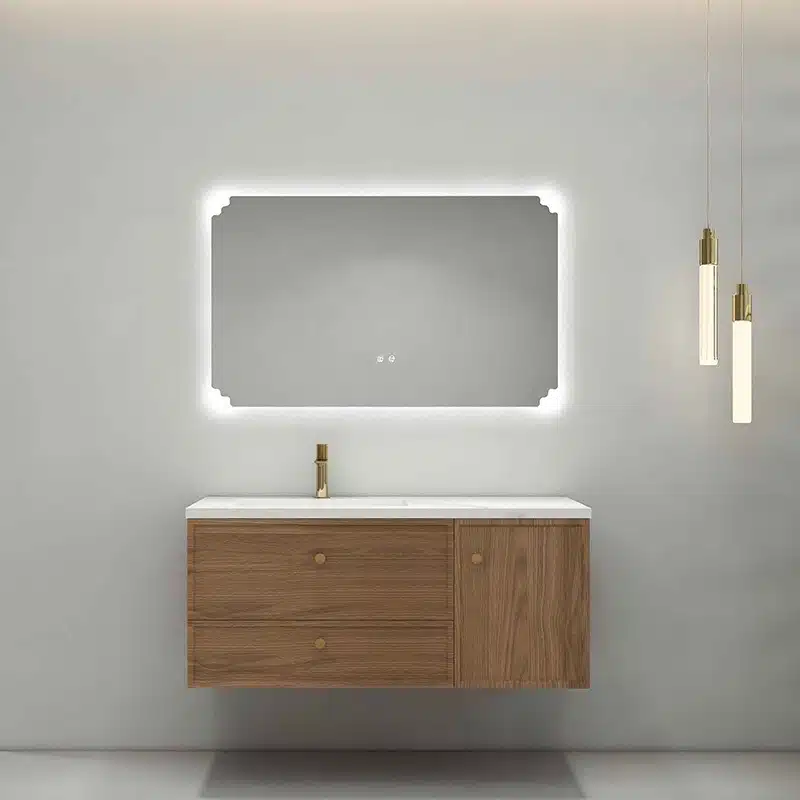
Design Considerations for Hotels
80% of hotel water damage starts at the vanity top seal — not the pipe.
Style consistency across hundreds of rooms sounds simple until you’re matching grain patterns on plywood or verifying that the color temperature of an LED mirror doesn’t shift between production batches. The issue isn’t design intent — it’s execution tolerance. A 2mm variance in cabinet depth becomes a 20cm gap across 100 units. The approved sample approval process must lock three things: material grain direction, finish gloss level within 5 units, and hardware torque specs. Skip that and you’ll be swapping hinges on-site.
-
-
- Quality tolerance: Set a maximum deviation of ±1mm for cabinet dimensions and ±2% for color coordinates (Lab values).
- Pre-production sample run: Require a 5-unit sample from the actual production line, not from the showroom. Photograph under standardized lighting.
- Hardware consistency: Specify hinge brand, screw material (304 stainless), and torque setting. Mixed batches cause misalignment over time.
-
Smart mirror integration has shifted from a luxury feature to an expected amenity in mid-scale and up hotels. But procurement managers often overlook two things: voltage compatibility and moisture ingress. A mirror designed for 110V North America will fail in a 220V European property unless the driver is swapped. And the seal around the LED strip must meet IP44 minimum — not just the glass front. Focuscabinet’s region-ready strategy pre-adapts these specs, including local fire-rated back panels and anti-fog demisters certified for the destination climate.
-
- Moisture barrier: The vanity top joint must pass a 72-hour moisture exposure test (Focuscabinet QC standard). Industry reports show 80% of hotel water damage originates at that seal.
- Smart mirror electricals: Specify dimmable LED drivers with 50,000-hour lifespan and integrated Bluetooth speakers only if paired with a vapor-sealed backplate.
- Region-ready adaptation: Confirm UL/cUL for North America, CE/UKCA for Europe, and SAA for Australia. Avoid last-minute compliance rewiring.
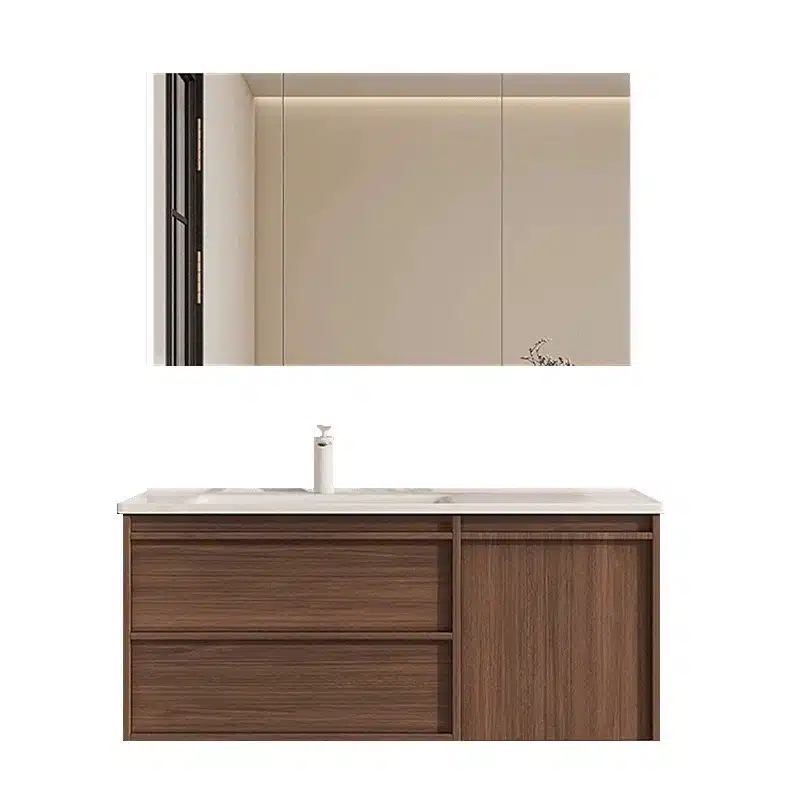
Multifamily Requirements
Poorly sealed tops cause 80% of hotel bathroom water damage.
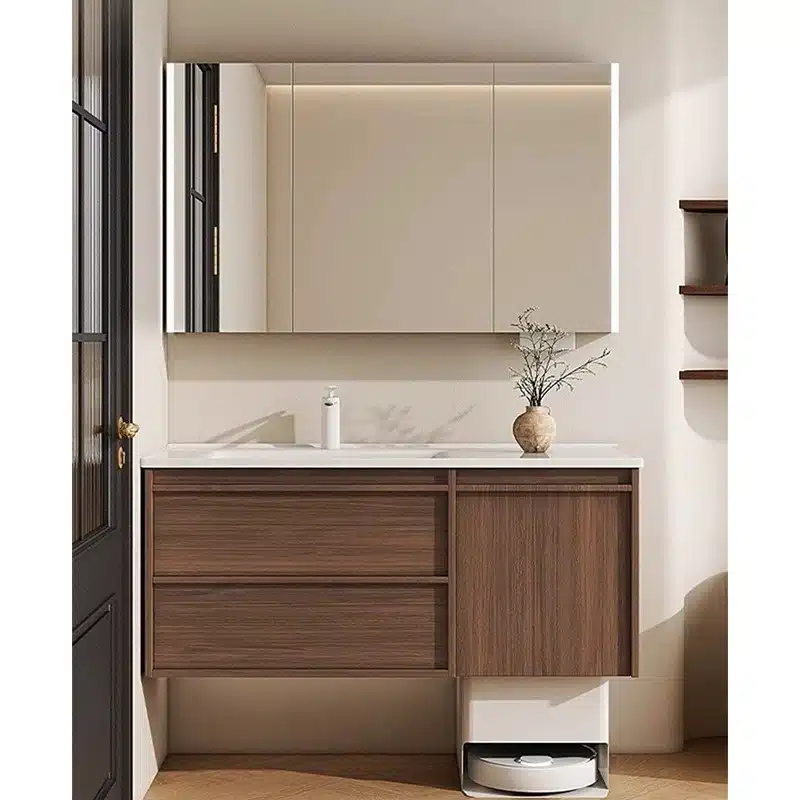
For multifamily projects, ADA compliance is a legal floor, not a design ceiling. Most procurement managers focus only on the obvious—counter height under 34 inches and knee clearance at 27 inches. What they miss is the real cost of non-compliance: a single door clearance violation can trigger a retrofit on 200 units, at roughly $4,000 per bathroom. That’s $800,000 of unplanned spend. The 30-inch by 48-inch clear floor space requirement also dictates sink placement and cabinet depth—if the vanity has a full-depth drawer below, you lose knee clearance. The standard solution is a cutout, but that weakens the cabinet structure unless the plywood is marine-grade or the design incorporates a steel reinforcing bracket.
The 48-inch vanity as a double-use solution is a space optimizer but a functional tightrope. In a 48-inch width, two 16-inch basins fit, but you have less than 4 inches between basins for elbow room. The usable counter space drops to almost zero. A smarter design for multifamily is a 48-inch vanity with a single wide basin and a split-faucet setup—two faucets sharing one basin. That preserves the double-use benefit without cramping the user. Focuscabinet’s region-ready strategy pre-adapts these vanities to specific multifamily codes: for example, units destined for California get the 2026 Title 24 fire-ratings and moisture-sealed back panels, while Nordic shipments use a deeper toe-kick (9 inches) to accommodate heated floor systems. This pre-adaptation eliminates post-production compliance rework.
-
- Knee Clearance Spec: Minimum 27 inches high, 30 inches wide. Verify the basin drain placement does not intrude into that zone.
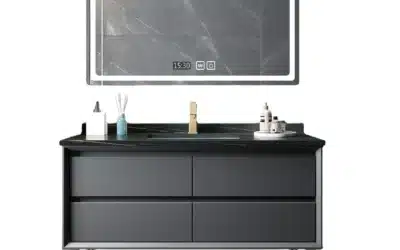
- Counter Height: 34 inches maximum. Sintered stone tops from Focuscabinet are CNC-cut to 0.5mm tolerance, ensuring consistent height across bulk orders.
- Faucet Reach: Requires a single-handle lever with maximum 4-inch reach. This forces a specific faucet mounting hole spacing—our standard templates match ADA-compliant faucets from Grohe and Delta.
- Moisture Risk: ADA does not address sealing. Standard vanities from other suppliers use only edge banding; Focuscabinet applies a full 72-hour moisture exposure test on every batch of plywood, plus 5-sided PVC lamination on the cabinet interior.
Sourcing from a Reliable Manufacturer
A single failed batch can delay your project by 6 weeks — here’s how to avoid that.
For a project procurement manager, the two numbers that matter most are the lead time and the MOQ. Many suppliers in China quote 45–60 days for a full container of commercial vanities, but that timeline often slips when sample approval drags or raw materials run short. Focuscabinet operates on a standard lead time of 35–45 days for bulk orders of sintered stone or plywood vanities, with MOQs starting at 50 units per SKU. For custom sizes or specialty finishes — like a 48-inch ADA-compliant double vanity — the MOQ climbs to 100 units and lead time extends to 55 days. The key is locking the commercial vanity lead time MOQ into the contract before production starts, not after.
-
- Stage 1: Raw material inspection: Every batch of plywood, MDF, or PVC is tested for moisture content and formaldehyde emission levels before it enters the workshop.
- Stage 2: In-process dimension check: Cabinets are measured against approved samples at three points during assembly — any deviation beyond ±1mm halts the line.
- Stage 3: 72-hour moisture exposure test: A random sample from each production lot is placed in a controlled humidity chamber at 90% RH for 72 hours. This simulates years of hotel bathroom conditions and catches seal failures early.
- Stage 4: Surface finish and hardware audit: Painted surfaces are checked for adhesion and gloss uniformity; hinges and drawers are cycled 50,000 times to confirm durability.
- Stage 5: Packing and container loading verification: Each carton is weighed and photographed. Moisture-resistant wrapping is used for sea freight, and the container is inspected for watertightness before sealing.
According to an industry report, 80% of hotel bathroom water damage originates from poorly sealed vanity tops — a failure that a 72-hour moisture exposure test directly prevents. Focuscabinet’s five-stage QC system was built to catch that kind of defect before it ships, which matters when you’re procuring hundreds of units for a 12-story multifamily tower. For a moisture resistant bathroom vanity supplier China, this depth of inspection is still the exception, not the rule. That 72-hour window is the difference between a hotel opening on schedule and ripping out vanity tops six months later.
Region-Ready Adaptation for Climate and Regulations
Skip region adaptation and your container could sit at port for fumigation or fail fire inspection.
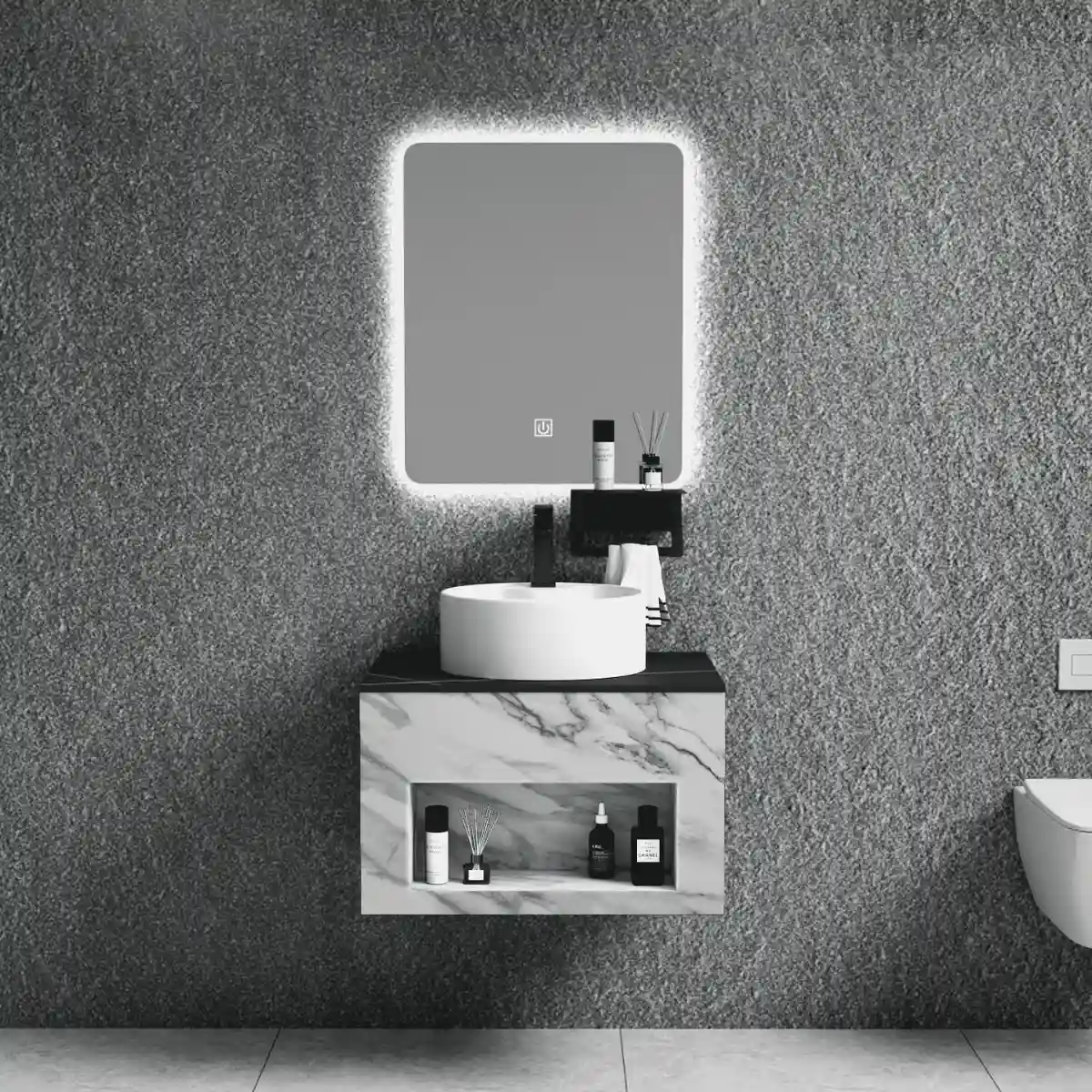
When you order 500 vanity units for a hotel chain in Florida, the same spec that passes inspection in Dubai will fail in Miami — not because of quality, but because of climate and code mismatches. Focuscabinet’s region-ready strategy starts by mapping the destination’s regulatory framework and microclimate before production begins. The factory maintains material variants that are pre-certified for specific markets: fire-retardant MDF for North American hospitality projects (meeting ASTM E84 Class A), marine-grade plywood with waterproof PU edge banding for Southeast Asian coastal resorts, and low-VOC finishes for EU compliance with EN 71-3. This isn’t a post-production label swap; it’s built into the manufacturing workflow.
-
- Humidity zones: For tropical markets (annual average RH >75%), Focuscabinet substitutes standard MDF with 12mm marine-grade plywood and applies a five-layer PU seal to all cut edges. The same cabinet in a dry climate uses E1-grade MDF — cutting cost without compromising durability. The 72-hour moisture exposure test in the QC lab confirms seal integrity before shipment.
- Fire codes: Hotels in California and New York require fire-rated construction. Focuscabinet sources MDF with fire-retardant additives that meet NFPA 286 or CAN/ULC S102. The region-ready process pre-labels each unit with the applicable standard, so your on-site inspector sees compliance documents that match local jurisdiction requirements — no rework, no delays.
- Chemical & emission regulations: European markets enforce strict VOC limits under REACH. Focuscabinet uses a separate water-based lacquer line for EU-bound orders, with TÜV-tested emission levels below 0.05 mg/m³. The alternative is formaldehyde-laced finishes that fail customs testing — a $15,000 chemical re-import bill we’ve seen more than once.
The commercial vanity lead time MOQ for region-ready variants is the same as standard production — 28–35 days — because the adjustments are integrated into the core process, not treated as custom exceptions. The alternative: ordering a one-size-fits-all vanity and paying a local contractor to retrofit fire barriers or apply moisture sealant on site. That rework typically adds 12–18% to the total project cost and voids the factory warranty. If you’re sourcing for multi-country rollout, a moisture resistant bathroom vanity supplier China that pre-adapts per region saves you three rounds of qualification testing per market. That’s roughly six weeks per market — lost if you don’t ask for it upfront.
Checklist for RFQ (Request for Quote)
A proper RFQ is your only defense against the gap between spec sheet and container contents.
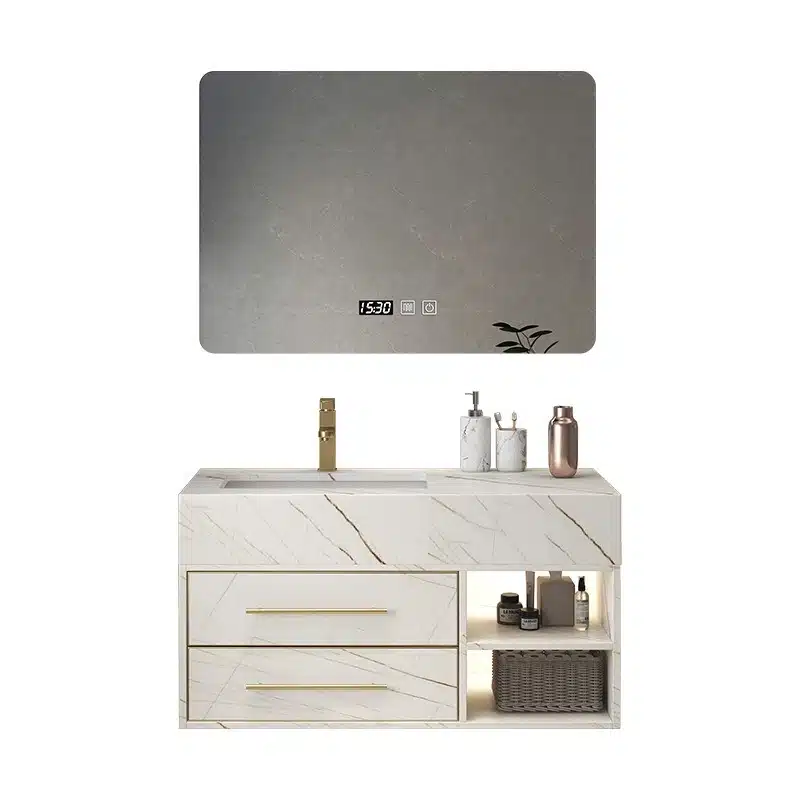
When you’re procuring 200 vanities for a hotel refurbishment, the RFQ is the single document that separates a smooth rollout from a costly retrofit. Most procurement managers focus on FOB pricing and lead time, but the real risk lives in the details that aren’t written down. I’ve seen $50K orders held at customs because the supplier’s standard packaging didn’t meet the ISPM-15 fumigation requirement for that port. The RFQ must force the supplier to put every variable on the table — or you absorb the risk.
-
- Material Grade & Core Specification: Demand the exact plywood face and core species (e.g., birch face, poplar core), thickness tolerance (±0.5mm), and formaldehyde emission class (E1 or CARB P2). If the supplier uses MDF for the back panel, that’s a separate line item. For moisture-resistant builds, specify marine-grade plywood with a minimum 72-hour moisture exposure test — Focuscabinet runs this as standard in their five-stage QC.
- Moisture Resistance Testing Protocol: Ask: ‘What is the sealed edge treatment on the vanity top?’ Industry reports show 80% of hotel bathroom water damage originates from poorly sealed tops. Require a written test result for 72-hour continuous water submersion on the top joint. If the supplier cannot provide this, move to the next candidate.
- Lead Time & MOQ Breakdown: Commercial vanity lead time MOQ is often listed as ’30 days / 100 units’, but that only covers standard sizes. Custom dimensions or region-specific adjustments (like narrower vanities for European bathrooms) add 10–15 days. Request a phased delivery timeline for orders over 500 units and a penalty clause per week of delay. Focuscabinet’s 10,000㎡ factory allows parallel production lines for bulk and custom runs.
- Packaging & Export Compliance: Specify packaging type: plywood crates vs cardboard cartons, with or without fumigation certification. State your port of entry and ask for the supplier’s standard packaging spec. For moisture resistant bathroom vanity supplier China exports to high-humidity regions, demand a desiccant pack inside each sealed box.
- Sample Approval & Production Match Guarantee: The pre-production sample must match the mass production run within a 5% tolerance on color, grain, and dimensions. Include a clause requiring a signed sample approval form and a photo report of every 50th unit during production. Focuscabinet’s region-ready strategy pre-adapts vanities to local fire codes and humidity levels before sample approval, reducing iteration cycles.
A comprehensive RFQ for hospitality and multifamily projects should cover at minimum: material grade, moisture resistance test protocol, lead time with penalty, packaging specs, and sample matching guarantee. The benchmark number to write down: any supplier that cannot provide a 72-hour moisture exposure test result for the vanity top seal should be disqualified immediately.
Conclusion
The real cost of skipping a proper material spec on a 200-room hotel project isn’t a 5% price difference — it’s the warranty claims that surface 14 months after installation, when MDF vanities begin swelling from guest-shower humidity. A single room repair runs $400, times 40 affected rooms, and that doesn’t include the brand damage from six-month renovation cycles. A sample approval that ignores sealed-edge construction turns a $50,000 order into a recurring expense.
Run your current RFQ against the checklist below. If the supplier can’t provide a 72-hour moisture test report or pre-adapted fire-rated panels for your region, that risk stays with you through the entire project lifecycle. Compare material grades and lead times on Focuscabinet’s product page to lock down the durability your build schedule demands.
Frequently Asked Questions
What material is best for moisture resistance in commercial bathrooms?
Marine-grade plywood or PVC are the best choices for high-humidity commercial bathrooms because they resist swelling and delamination better than standard MDF. Sintered stone basins further reduce water damage risk at the. Confirm your bathroom’s humidity level before finalizing the vanity material.
How does plywood compare to MDF for hotel vanities?
Plywood is stronger and more moisture-resistant than MDF, making it the preferred base for hotel vanities that see daily use. MDF can be acceptable for dry guest bathrooms if the budget. Request a plywood sample and check the edge seal before ordering.
What are the advantages of sintered stone basins over quartz?
Sintered stone resists heat, scratches, and stains better than quartz, and it is non-porous without needing sealants. Quartz is more brittle and can crack under point impact, while sintered stone. Validate sintered stone with a factory sample before committing to large volumes.
What is the typical lead time for bulk vanity orders?
Standard bulk orders from Focuscabinet run 25–35 days after sample approval, depending on the customization level. Custom colors or non-standard sizes may add 10–15 days for material sourcing. Ask the factory for a confirmed lead time after your RFQ is fully detailed.
How do you ensure consistency across large hotel vanity orders?
Focuscabinet’s five-stage quality control checks material, color, dimensions, seal quality, and packaging on every production lot. Request a sealed master sample and a mid-production inspection to catch batch variations before shipment. Insist on a pre-shipment inspection report for every container.


0 Comments