

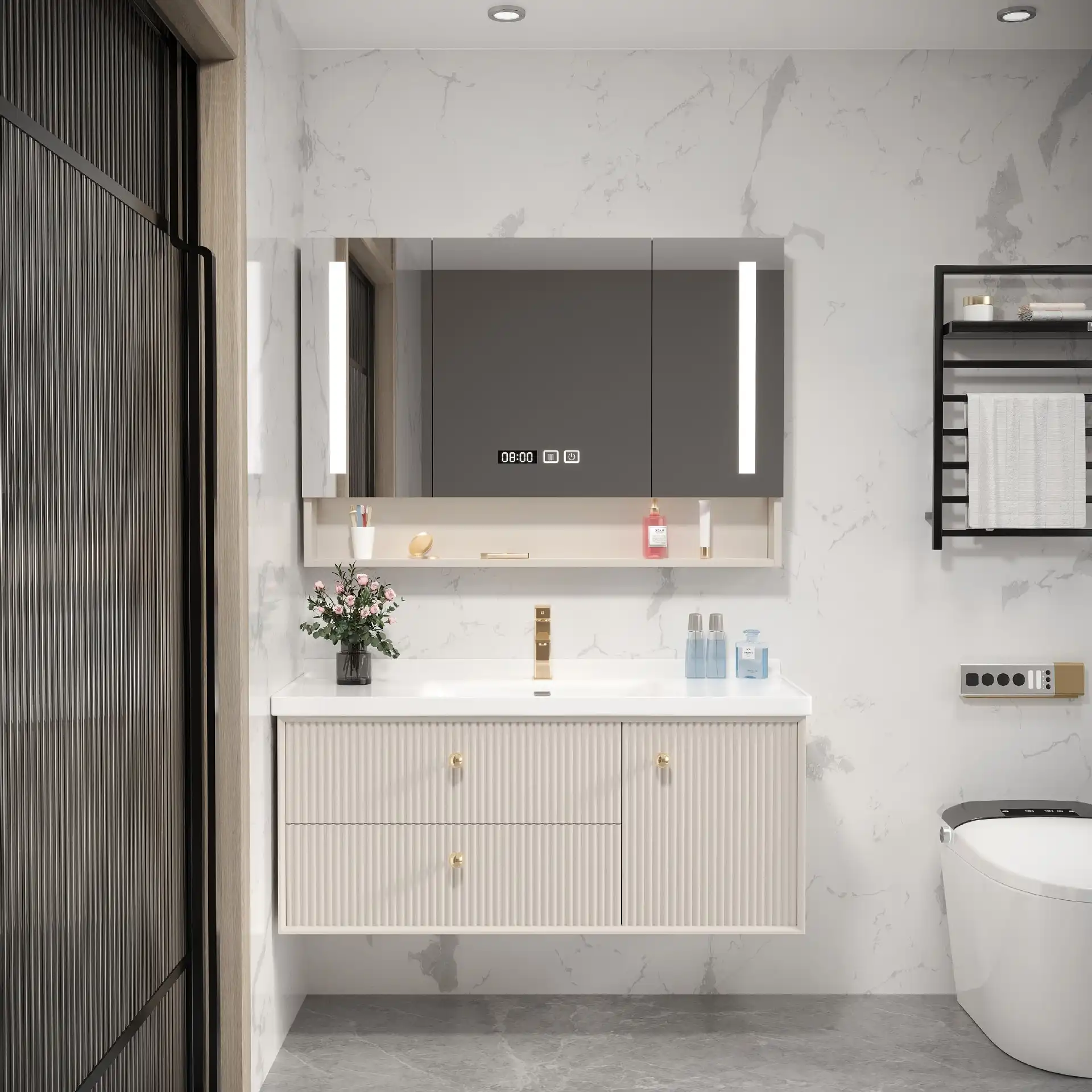
“High gloss” on a vanity spec sheet usually means one thing to a furniture buyer: a painted surface that will chip, peel, or show every flaw. On a PVC (polyvinyl chloride) vanity it means something different — a decorative film laminated onto a board that is already 100% waterproof. That distinction changes what you inspect before ordering, what you ask the factory to measure, and how the cabinet performs in a wet bathroom two years after installation. A high-gloss PVC vanity finish, ordered right, keeps its mirror look and stays easy to wipe down; ordered wrong, it becomes the first complaint in your review stream. This guide covers how gloss is measured in gloss units, how matte, satin, and high-gloss finishes compare in real use, how the finish is built and verified, where glossy units earn their keep, and the exact questions to put to a factory before you commit a container.
Key Takeaways
- High gloss on a PVC vanity is a laminated film finish over a 100% waterproof, non-absorbent core — not sprayed paint — so the surface and the board behave as one moisture-proof system.
- Gloss is measured in gloss units (GU) at a 60-degree geometry; glossy furniture films typically read in the 80-100 GU range, so ask the factory for a measured value rather than accepting a label.
- MFBATH runs 1,000+ standard finishes — matte white, glossy black, and wood grain among them — plus custom colors from 15 sets per color with Pantone matching.
- Standard vanity widths run 24-60 inches and depths 18-24 inches; MOQ (Minimum Order Quantity) is 15 sets per model, color, and size, with mixed-container loading.
- Every cabinet passes 5 inspection checkpoints; a 2-year cabinet warranty and a return rate below 1% put the finish decision under measurable risk control.
- Free samples ship in 10 working days, production takes 20-30 days, and US/Canada/Mexico delivery lands in 4-6 weeks from FOB (Free On Board) Qingdao.
In This Guide
- What “High Gloss” Means on a PVC Vanity
- Gloss Levels Compared: Matte, Satin and High Gloss
- How High-Gloss PVC Finishes Are Made and Tested
- Where High-Gloss Fits: Use Cases and Caveats
- Questions to Ask Before Ordering a Glossy Finish
- Frequently Asked Questions
What “High Gloss” Means on a PVC Vanity
Gloss is a measured quantity, not a look. Instruments read the specular reflection of a surface at fixed angles and report gloss units (GU). The 60-degree geometry is the workhorse for comparing interior surfaces, with 20 degrees reserved for very high gloss and 85 degrees for near-matte reads. As an industry convention, high-gloss furniture films typically measure in the 80-100 GU range at 60 degrees, which is the band a high-gloss PVC vanity finish lands in; matte films sit far lower. Treat that band as a measurement concept, not a manufacturer promise — the point is that “high gloss” alone is not a spec, and a number is available if you ask for one.

On a PVC vanity, the gloss lives in the film, not in paint. The build is a solid PVC board core with a decorative film laminated across the face and wrapped around the edges under heat and pressure. No spraying, no lacquer build, so there is nothing to chip, peel, or crack the way a painted MDF door does. Because the core is 100% waterproof and non-absorbent, the finish sits on a board that will not swell or warp in humid bathrooms — the two failure modes that kill painted wood vanities do not apply here.
Three measurement angles are used in practice, and which one the factory quotes changes the story. The 60-degree geometry is the reference for general furniture comparison, but very glossy films are sometimes quoted at 20 degrees, where the reading is more sensitive to surface smoothness, and very matte surfaces at 85 degrees. If the number on your spec sheet does not say which angle produced it, the number is useless for comparing two suppliers. Put the angle in the RFQ: 60 degrees, the same instrument type, the same lighting conditions.
For an importer, the practical translation is: waterproofing is a board property and gloss is a surface property, and you verify them as two line items. If a supplier cannot separate those two answers cleanly, that is the first red flag in the conversation. It also means the board behind the film does most of the durability work, so the grade you approve matters as much as the film you pick — the differences are covered in PVC board grades for vanities.
One more field note: gloss reads differently under factory showroom lighting than under a single window in a real bathroom. Judge the finish on a physical sample under the lighting your end market actually has. MFBATH sends free samples in 10 working days, which makes that check cheap to run.
Gloss Levels Compared: Matte, Satin and High Gloss
Most programs come down to three bands. The table below compresses the resale-relevant differences: the GU figures are typical industry ranges for furniture films, so use them as orientation and ask each factory for measured values on the specific films you quote.
| Finish | Typical gloss at 60 degrees | Look and upkeep | Fingerprints and scratches | Where it fits | Key trade-off |
|---|---|---|---|---|---|
| Matte | Roughly 5-25 GU | Flat, low reflection; hides dust and water streaks; weekly wipe keeps it presentable; touch-up friendly | Prints rarely visible; fine scratches hard to spot even up close | Rental stock, family bathrooms, high-turnover STR (short-term rental) units | Lowest upkeep; rooms read smaller with less light bounce |
| Satin | Roughly 25-55 GU | Soft sheen, balanced reflection; weekly wipe keeps it clean; no strong glare | Occasional prints; minor scratches blend in | Hotel guest baths, mid-range residential, office powder rooms | Balanced character; no strong selling point in either direction |
| High Gloss | Typically 80-100 GU | Mirror-like reflection; brightens small rooms; daily wipe in guest rooms | Prints and water spots show quickly; micro-scratches visible in raking light | Design-led residential, boutique hotels, showroom displays, powder rooms | Strongest visual lift; most upkeep and scratch visibility; keep spare doors |
Read the table as inventory logic. Matte is the maintenance workhorse for high-turnover STR units, because it hides the dust, streaks, and fine scratches daily guests create. High gloss is the merchandising finish — it photographs well, reads as premium, and makes a small bathroom feel larger — but it carries a housekeeping cost. Property managers should weight the fingerprint row heavily; design-led residential and boutique hotel clients are the natural glossy buyers. Many importers run both lines: glossy white and glossy black for the design segment, matte for the rental segment. Matte black vanity finishes are a standard MFBATH offering and the fastest way to test the matte side of that split.
Color and gloss interact more than buyers expect. Glossy white reads neutral and clean, while glossy black turns into a mirror the moment the lights come on — the same film behaves like two different products depending on the colorant. That is why gloss level and color are approved on one physical sample, never on two separate samples. For custom colors, MFBATH starts at 15 sets per color with Pantone matching, so a test batch of glossy white and glossy black can ride in the same mixed container as your matte stock.
Satin is not a compromise; it is a distinct inventory line that covers mid-range residential and hotel guest baths where the buyer wants visible gloss without the wipe-down schedule. Wholesalers who carry all three bands answer more RFQs with the same MOQ commitment of 15 sets per model, color, and size — the third SKU costs little to add once the container is mixed.
How High-Gloss PVC Finishes Are Made and Tested
The build order on a glossy PVC vanity is: solid PVC board core, decorative film laminated under heat and pressure, edges wrapped in the same film, then hardware boring and packing. Because film and core are both PVC-based, the finished cabinet is 100% waterproof, non-absorbent, and easy to clean, and the surface cannot delaminate from moisture the way a coating can on wood. That is the core contrast with wood vanities, which depend on external waterproof coatings on wood vanities for wet-room survival.
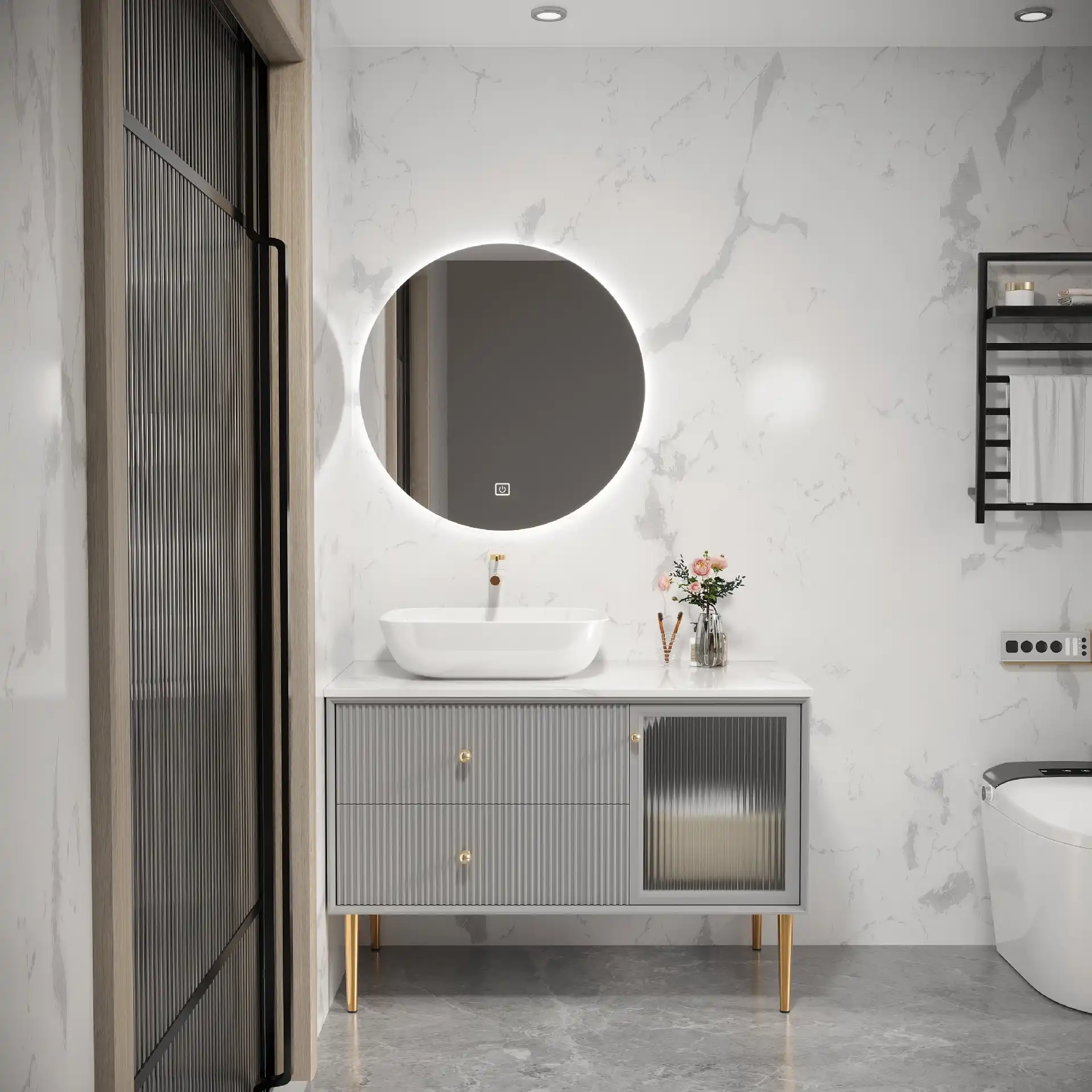
Testing is where glossy programs live or die, and the tests are standard, not secret. Specular gloss is measured with an instrument under ASTM standards for finishes and testing — ASTM D523 at the 60-degree geometry is the common method, with ISO 2813 as the international counterpart. Abrasion and film adhesion are the other two numbers to demand: the method, the cycles, and the result. High gloss shows micro-scratches earlier than matte, so on a glossy program the abrasion figure is the one that predicts guest complaints and warranty calls.
On the factory side, verification has to be a process, not a promise. MFBATH runs every cabinet through 5 inspection checkpoints — quality control (QC) gates at board receiving, film lamination, cutting and edge wrap, hardware installation, and final packing — under an ISO 9001 quality management system held since 2017 and confirmed current in 2025. Third-party inspection by SGS or TÜV can be arranged with advance notice, which is the correct place to verify a film’s abrasion claim rather than taking a brochure number. The outcome metrics are plain: a 2-year cabinet warranty and a return rate below 1%, which in practice means finish defects are caught before shipment, not discovered in the field.
Edge treatment is the detail inspectors look for first. A film that wraps the door edges in one continuous piece leaves no seam for moisture to exploit; a film that stops at the edge face leaves a line that can lift. On a PVC core that line is cosmetic rather than structural — the board cannot absorb water — but on a glossy surface any lift is immediately visible because the reflection doubles it. Ask to see the edge wrap on the sample, not in a photo.
Bathrooms cycle between steam and dry air dozens of times a week. A non-absorbent PVC board has no moisture content to gain or lose, so there is no expansion differential to distort the door — which is why PVC vanity doors stay flat where lacquered MDF doors cup. The gloss film moves with the board because it is bonded to it, and a 100% waterproof construction keeps the mirror image straight year-round.
Environmental specs ride along on the same process. Finishes meet E1 formaldehyde limits (≤0.1 ppm), CARB Phase 2, and TSCA Title VI, with FSC-certified material optional and low-VOC finishes available — points your hotel or retail clients will raise at RFQ stage. The full inspection routine is covered in the bathroom vanity QC guide.
Source High-Gloss PVC Vanities in Bulk
Browse this product, solution, or service page to explore relevant offerings.
Where High-Gloss Fits: Use Cases and Caveats
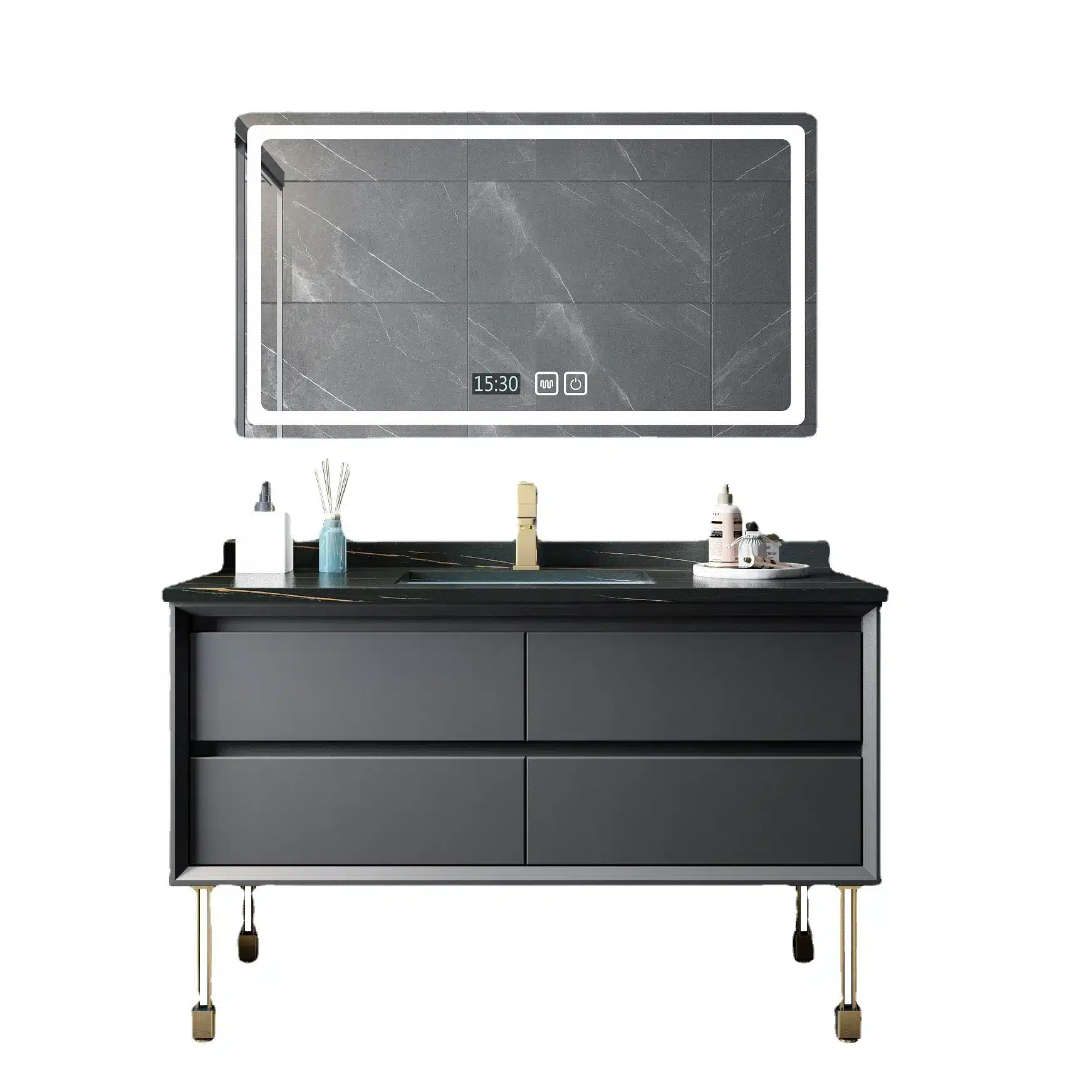
Small spaces are the clearest win. A glossy white vanity reflects what little light a powder room has, and the cabinet disappears less into dark corners. MFBATH’s standard range — widths 24-60 inches, depths 18-24 inches — covers the compact sizes where that trick matters most.
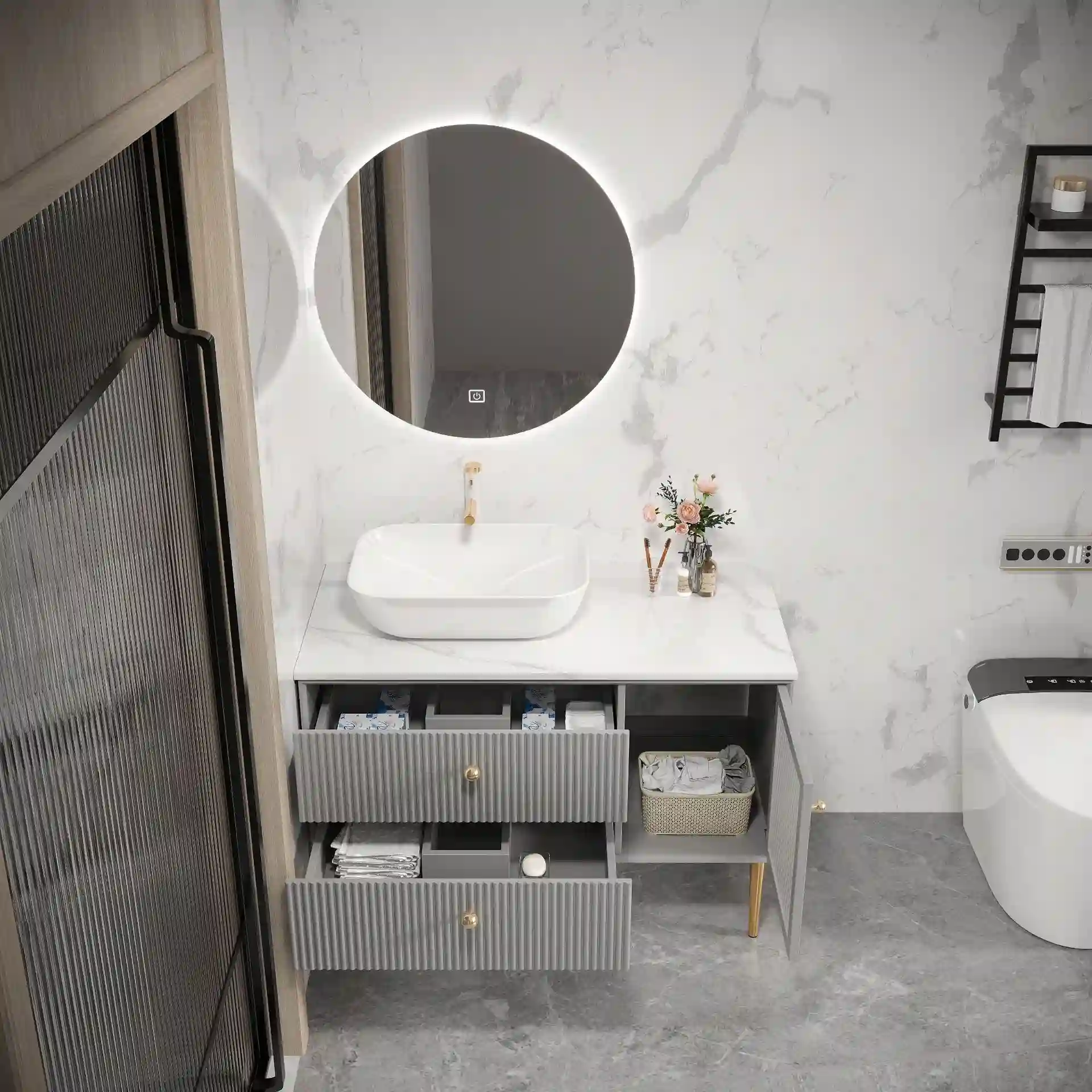
Hospitality is the second natural home. Hotel and STR operators buy gloss for photographs and perceived room grade, and glossy white is the most common finish in that segment. The housekeeping reality is that prints and water spots are visible between cleans, so a daily wipe belongs in the ops manual — glossy units in high-turnover rooms should be specced with that cost in mind. Contract tenders often reference BIFMA furniture standards for performance expectations, so check your tender language against the finish you quote.
The caveats, stated plainly: glare under direct downlights, dust that doubles in visibility, micro-scratches that appear in raking light, and hard-water spots in areas with aggressive limescale. A damaged glossy door is re-wrapped, not repainted, so factor spare doors into the order. One easy upgrade: glossy doors pair naturally with matte black metalwork, and current bathroom vanity hardware trends push in that direction, which lets a stock glossy cabinet read as a designed product. Lighting is the lowest-cost fix for gloss complaints — diffused or indirect fixtures kill the glare that makes glossy cabinets look harsh, and that advice belongs in the spec conversation, not after installation.
Showroom display is a third use that importers underrate. A glossy unit at the front of a store pulls foot traffic in a way flat finishes cannot, and it photographs better in trade catalogs and listing photos — the same reason STR owners push glossy units into their hero images. If your client base includes bathroom showrooms or design studios, one glossy SKU per line-up works as the display hero while matte carries the volume.
When to steer away from high gloss: high-turnover family STR units where guests drag luggage across the finish, projects with unmanaged lighting, or bathrooms with hard water and no water softener. In those cases matte or satin is the defensible recommendation, and it is worth having that answer ready — it is the difference between a repeat program and a one-off order.
Questions to Ask Before Ordering a Glossy Finish
Six questions, in writing, before the PO. Each maps to a line item you can verify at sample stage or at inspection, which is what separates a managed glossy program from a gamble.
What gloss value does this finish measure, and at which geometry?
High-gloss films typically read in the 80-100 GU range at a 60-degree geometry — an industry measurement concept, not a MFBATH specification. Ask for the measured value per finish. A factory that produces a number has instrument discipline; one that answers “very shiny” does not.
What abrasion test was run, and what were the cycles?
High gloss exposes scratches, so the abrasion figure predicts complaints. Ask for the method and the result, then verify it at third-party inspection — SGS or TÜV, arranged with advance notice. And order spare glossy doors up front: a scratched glossy door is re-wrapped, not repainted.
How is color and gloss controlled between batches?
Gloss drifts when line temperature and pressure drift, so batch control is a process question, not a color-chart question. MFBATH carries 1,000+ standard finishes and takes custom colors from 15 sets per color with Pantone matching, inside a base of 40,000+ custom combinations. Ask how the factory freezes a reference sample for the production line and what tolerance it holds against it — and request that tolerance in writing. A few GU of drift between batches is normal on a production line; the problem starts when it shows up on the dock instead of in the QC records.
What is the sample approval workflow?
Samples are free and ship in 10 working days. Sign off a physical reference sample before production, and evaluate it under the lighting of your end market, not the factory showroom. A structured pass/fail routine — gloss, color, edge wrap, hardware alignment — prevents the “it looked different in the catalog” conversation; the vanity sample approval checklist walks through exactly those checks.
What warranty and QC coverage comes with the finish?
A glossy finish is only as good as the inspection behind it. MFBATH checks every cabinet at 5 points — board receiving, lamination, cutting and edge wrap, hardware installation, and final packing — and backs the complete cabinet with a 2-year warranty and a return rate below 1%. Ask where finish claims sit in the warranty: film defects should be covered, and the factory should state the door replacement procedure in plain language.
What are the commercial terms?
MOQ is 15 sets per model, color, and size, with mixed-container loading; production runs 20-30 days and US/Canada/Mexico delivery lands in 4-6 weeks from FOB Qingdao. Payment is 30% deposit to start production, with the balance due within a week after the draft BL (draft bill of lading) — terms that keep a first glossy test order small and reversible.
Frequently Asked Questions
Does a high-gloss PVC vanity finish scratch easily?
The PVC surface is scratch-resistant and easy to clean, but a high-gloss film shows micro-scratches and fingerprints sooner than matte. Ask the factory for the abrasion test result on the specific film before ordering. MFBATH runs each cabinet through 5 inspection checkpoints and covers the cabinet with a 2-year warranty and a return rate below 1%.
How do I verify the gloss level before placing an order?
Gloss is measured in gloss units at a 60-degree geometry; high-gloss furniture films typically measure in the 80-100 GU range, which is an industry convention rather than a MFBATH specification. Ask the factory for the measured value for your finish and check it against a physical sample — MFBATH sends free samples in 10 working days.
What is the minimum order for a custom high-gloss color?
Custom colors start at 15 sets per color, and the MOQ is 15 sets per model, color, and size, with mixed-container loading. Production takes 20-30 days, and US/Canada/Mexico delivery runs 4-6 weeks from FOB Qingdao.
The Bottom Line
Gloss is a surface decision; waterproofing is a board decision — buy both, and verify both with numbers. High-gloss PVC earns its place in design-led residential and hospitality programs because the finish sits on a 100% waterproof, non-absorbent core that will not swell or warp, backed by 5-point inspection, a 2-year cabinet warranty, and a return rate below 1%. Ask for the measured GU, the abrasion result, and a signed physical sample before production. MFBATH will quote your mix across 1,000+ finishes with custom colors from 15 sets and mixed-container loading — start with the free sample.



0 Comments