

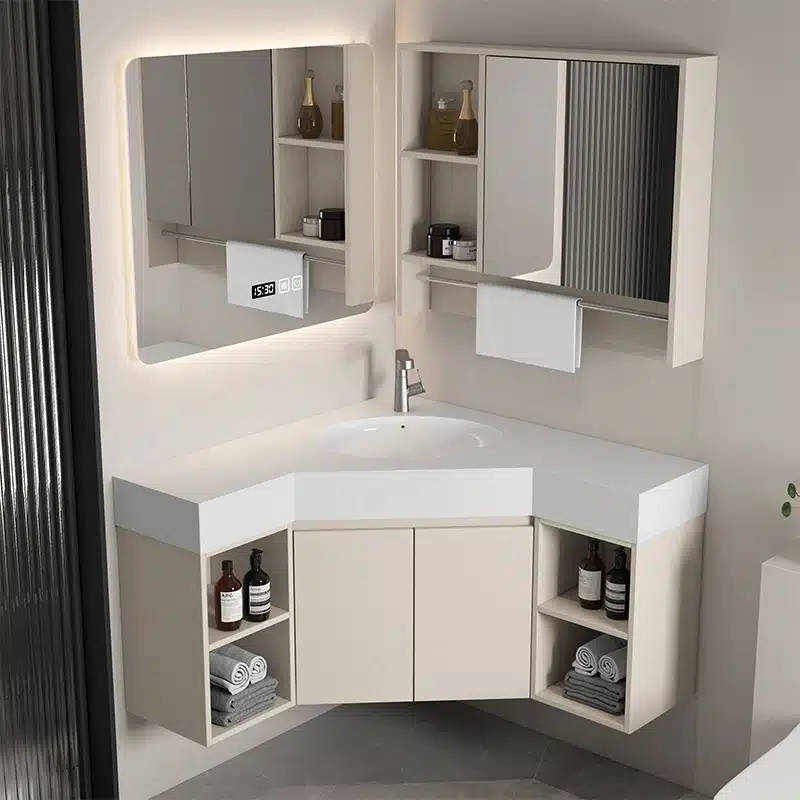
Choosing a foshan bathroom vanity factory is the default starting point for many importers, but this path is now filled with risks like rising MOQs and materials that fail US formaldehyde emissions standards. Foshan built its name as China’s sanitary ware capital, but many of its suppliers prioritize the massive domestic market. This creates a “domestic spec” trap for international buyers, leading to quality control gaps, packaging that fails ISTA 3A transit tests, and ultimately, a container of unsellable inventory that erodes your profit margins.
This guide provides a clear operational framework for sourcing bathroom vanities in China. We go beyond a simple list of manufacturers to compare the hidden costs of Tier-1 hubs against the cost and quality advantages of an inland production strategy. We will cover how to verify export-grade QC, analyze TSCA and ISTA certifications to ensure compliance, and see how smart inland logistics can deliver a significant pricing edge without sacrificing quality or safety.
Why Is Foshan Considered China’s Sanitary Ware Capital?
Foshan’s dominance isn’t just about factory count; it’s about the deep integration of its supply chains, massive wholesale markets, and export logistics, creating an unmatched, high-density sourcing environment.
Integrated Manufacturing and Wholesale Hub
Foshan’s reputation is built on an extremely dense ecosystem of hundreds of manufacturers and vast wholesale markets. The city is home to massive trading hubs like the 300,000 m² Foshan Ceramic Sanitary Ware City and Cihai International, which consolidate factory operations and showrooms into unified facilities. This concentration creates a powerful one-stop sourcing environment, allowing international buyers to evaluate and procure from a wide range of suppliers with extreme efficiency.
Comprehensive Industrial Supply Chain
The region hosts a complete industrial supply chain, covering every stage from raw material processing to final product assembly. Decades of specialized production have embedded deep expertise into the local industry. This vertical integration means manufacturers have immediate access to components, hardware, and materials, which significantly reduces production lead times and operational costs. Problems are solved faster and new designs are prototyped quickly because the entire support network is local.
Strategic Location and Logistics Network
Positioned strategically within the Pearl River Delta Economic Zone, Foshan leverages one of the world’s most sophisticated logistics networks. This geographical advantage provides a direct line to global export channels. The highly developed infrastructure of ports, highways, and freight services supports the efficient movement of large-scale shipments, ensuring that finished goods can be dispatched to international markets reliably and competitively.
What Are the Hidden Costs (Rising MOQs) of Sourcing from Tier-1 Hubs?
Sourcing from established manufacturing hubs introduces unpredictable costs through opaque tariff pass-throughs, logistical friction, and long-term margin erosion from supplier dependency.
Tariff and Material Cost Pass-Throughs
Manufacturers in major hubs like Foshan often pass on hidden tariff and raw material costs directly to buyers. Without clear visibility into the origins of sub-components, buyers cannot effectively challenge these price increases. Suppliers frequently implement these hikes pre-emptively to protect their own margins, leaving importers with little recourse or transparency.
- Suppliers frequently request pre-tariff price hikes that are not transparently justified by their actual cost increases.
- Tracking cost impacts across thousands of SKUs with complex bills of materials is nearly impossible for most buyers.
- A lack of visibility into the supplier’s own supply chain (Tier 2 and Tier 3) makes it difficult to validate claims about tariff exposure.
Logistical Friction and Geopolitical Delays
Sourcing from distant hubs introduces significant delays and uncertainties not factored into the unit price. Long shipping times, customs clearance issues, and geopolitical instability disrupt supply chains and add unpredictable costs that can cripple inventory planning and project timelines.
- Container shipping can take anywhere from two weeks to two months, creating long and unreliable lead times.
- Customs clearance adds further delays, especially during seasonal peaks or unforeseen port backlogs.
- Geopolitical instability is a major factor, disrupting strategic planning and causing sudden supply chain interruptions.
Supplier Dependency and Margin Erosion
Relying on a single supplier in a well-known hub creates significant long-term risk. Over time, this dependency allows the supplier to steadily erode a buyer’s margins through small, incremental price increases and less favorable terms that become difficult to refuse once you are locked into their ecosystem.
- Without competitive alternatives, buyers lose their negotiating leverage and are forced to accept new terms.
- Small price increases can compound significantly across high-volume orders, quietly eating into profitability.
- Suppliers often impose unfavorable terms, like higher MOQs or shorter payment windows, once a buyer’s dependency is established.
Tailor-Made Bathroom Solutions for Your Market

Who Are the Top 10 Sanitary Ware Manufacturers in Foshan?
While many Foshan manufacturers offer extensive product lines, the top players differentiate through massive production scale, decades of export experience, and specific product specializations.
A Concentrated Hub of Specialized Manufacturers
Foshan’s status as China’s sanitary ware capital is built on a dense ecosystem of manufacturers, many established during the industry boom of the 1990s and 2000s. This concentration created a diverse landscape, from mid-scale specialists to large enterprises with vast production capabilities. The region’s output covers everything from traditional ceramic sanitary ware and bathroom furniture to integrated smart bathroom solutions. Some of the area’s largest producers manage production facilities exceeding 150,000 square meters, giving them the scale to serve high-volume international orders.
| Manufacturer | Key Differentiator / Specialization | Operational Scale / Experience |
|---|---|---|
| SHKL | Vanities, LED mirrors, and shower doors with a strong global franchise network. | Founded 2004; 150,000 m² facilities; 700+ staff. |
| HEGII | Premium smart toilets, faucets, and integrated bathroom furniture. | Founded 1998; 25+ years of experience. |
| SSWW | Leading domestic and international brand for bathroom accessories. | Founded 1994; 30+ years of industry experience. |
| FRANK Bathroom | Specializes in cabinets, solid surface basins, and stone countertops. | Founded 2006; 141,000 m² facilities (China & Vietnam). |
| Dongpeng | One of China’s largest producers of ceramic tiles and integrated bathroom solutions. | 20+ years of experience in large-scale ceramic production. |
Established Infrastructure for Global Exports
The city’s competitive edge is anchored by a mature infrastructure built for international trade. This ecosystem includes massive wholesale markets like the Foshan Ceramic Sanitary Ware City, specialized supply chains for every component, and sophisticated export logistics. The entire region is optimized to handle the demands of international buyers, efficiently serving customers from more than 100 countries and ensuring a streamlined process from factory floor to port.

The Smart Alternative: Why Are Buyers Shifting to MF FOCUS CABINET?
Shifting to MF FOCUS CABINET allows buyers to sidestep the high MOQs and generic specs of traditional hubs, gaining direct-factory access to market-specific, compliant products with low entry risk.
Region-Ready Solutions for Global Compliance
Experienced buyers know that a “one-size-fits-all” product often fits no market perfectly. MF FOCUS CABINET engineers products to meet the specific regulatory, climatic, and design needs of different continents. This solves common import hurdles and ensures products are fit-for-purpose right out of the box, reducing post-delivery modifications and compliance failures.
- North America: Products are built to meet UL/CSA and ADA standards, using materials tested for functionality in extreme cold (-30°C).
- Europe: Offerings focus on CE compliance and sustainability, incorporating low-emission E1 grade materials as standard.
- Oceania: Cabinets and fixtures adhere to AS/NZS and WELS (water efficiency) standards and are engineered to resist coastal humidity.
- Asia & Middle East: Designs include compact floating vanities and materials that withstand high heat (up to 50°C), addressing local space and climate challenges.
| Feature | Standard Supplier Model | MF FOCUS CABINET Model |
|---|---|---|
| Market Compliance | Generic export specs; buyer assumes compliance risk. | Engineered for regional standards (UL, CE, AS/NZS). |
| Minimum Order Quantity (MOQ) | High MOQs (often container-level) create high entry barriers. | Low 10-20 unit MOQ for custom designs supports market testing. |
| Customization Depth | Limited to basic color or hardware changes. | 40,000+ combinations, Pantone matching, and branded hardware. |
Deep Customization with Low Market Entry Risk
Distributors and project managers gain access to extensive OEM/ODM capabilities without the burden of large initial orders. This flexibility allows partners to test new product variations or enter new markets with minimal financial exposure. Instead of being forced into high-volume orders for a single SKU, you can develop a unique product line that reflects your brand identity. Partners can select from over 40,000 customization combinations, including precise Pantone color matching and branded hardware. We also provide logo printing and engraving on mirrors and cabinets, alongside custom packaging design, to deliver a fully branded, market-ready product with a minimum order quantity (MOQ) as low as 10 to 20 units.
Direct-Factory Manufacturing with Rigorous Quality Assurance
Sourcing directly from our 10,000㎡ factory eliminates intermediaries, improves communication, and provides confidence through a transparent production process. We use high-precision CNC machines and automated lines to guarantee consistent and accurate cutting, drilling, and assembly across every unit. Every product undergoes five distinct inspections—from raw material checks to final pre-shipment verification—to validate durability, functionality, and finish. With a factory capacity of 5,000 cabinet units and 50,000 mirrors monthly, we ensure reliable fulfillment for large-scale projects and growing distributors alike.
How Do You Combine Inland Cost Advantages with Export-Grade QC?
Combining inland cost savings with export quality isn’t about compromise; it’s about embedding rigorous, multi-stage inspections and precision automation directly into the production workflow.
Achieving a lower price point from an inland factory without sacrificing quality requires a fundamental shift in process. Quality control can’t be a final gatekeeper; it must be an integrated system that runs parallel to production. This approach validates quality at every critical stage, from raw material inputs to pre-shipment checks, ensuring that international standards are met without driving up costs unnecessarily. It’s a system built on prevention, not just detection.
Implementing Multi-Stage Quality Inspections
To balance inland production costs with international quality demands, manufacturers implement rigorous, multi-stage inspection protocols. This method ensures that small deviations are corrected early, preventing them from becoming costly defects in finished goods. By embedding QC checkpoints throughout the workflow, factories can maintain high standards while benefiting from lower operational overhead. This model mirrors proven systems like five-stage QC, which guarantees both aesthetic perfection and functional durability for every unit.
- Inspections are embedded throughout the entire manufacturing process, including the casting, glazing, and firing stages.
- Before any unit is approved for shipment, it undergoes a battery of tests to confirm it meets all performance standards and export certifications.
Leveraging Automation and Precision Machinery
Advanced manufacturing technology is the key to delivering consistent, high-quality output while managing labor costs. Automation minimizes the risk of human error and ensures every product meets the precise specifications required for global markets. This investment in technology allows inland factories to compete on quality, not just on price, by producing goods that are dimensionally accurate and structurally sound every time.
- We use Computer-Aided Design (CAD) to engineer precise molds and product specifications, eliminating potential defects before production begins.
- High-precision CNC machines handle cutting and assembly, guaranteeing consistent fits, minimizing material waste, and improving the final product’s structural integrity.
- Computer-controlled kilns maintain exact firing temperatures between 1260–1280°C, a critical step for achieving vitreous china standards for durable, non-porous surfaces.

How Do TSCA and ISTA 3A Certifications Defeat the “Domestic Spec” Trap?
Verifiable certifications like TSCA for material safety and ISTA 3A for packaging durability are the most direct way to filter out suppliers offering products unfit for international markets.
Defining the ‘Domestic Spec’ Trap: Products Unfit for Export
The “Domestic Spec Trap” is a common and costly sourcing failure where international buyers purchase products engineered only for the Chinese local market. These goods are not built to withstand the regulatory scrutiny or physical demands of global distribution. This oversight leads to seized shipments at customs, high rates of transit damage, and unsellable inventory.
- Materials often contain chemical levels, like formaldehyde in particleboard, that are acceptable locally but illegal in North America and Europe.
- Product construction and finishes are not specified to handle different climate stresses, such as high humidity in a coastal region or extreme cold, leading to warping or delamination.
- Packaging is engineered for simple, short-distance domestic truck routes and disintegrates during the complex, multi-stage handling of international freight.
TSCA Compliance: The Mandate for Chemical Safety
The Toxic Substances Control Act (TSCA) is a non-negotiable U.S. federal regulation targeting the chemical safety of composite wood products. For bathroom vanities, it specifically limits formaldehyde emissions from materials like plywood, MDF, and particleboard. This law acts as a functional barrier, preventing non-compliant domestic-grade cabinets from legally entering the American market.
| Compliance Area | Typical ‘Domestic Spec’ Product | Export-Grade Certified Product |
|---|---|---|
| Material Safety | Uses standard boards with no verified emissions data; fails import inspection. | TSCA Title VI compliant; materials certified as low-emitting and safe for U.S. market. |
| Packaging Durability | Thin, 3-layer carton designed for palletized domestic trucking; fails under parcel carrier stress. | ISTA 3A tested packaging with reinforced corners and foam; built to survive drops and vibration. |
| Verification | Supplier offers verbal assurances but no official, third-party documentation. | Provides official third-party test reports and certificates for both TSCA and ISTA 3A. |
- TSCA mandates that all imported composite wood goods are tested and certified, stopping unsafe products at the border.
- This forces a manufacturer to build their entire production process around compliant, export-grade raw materials from the very beginning.
- It provides buyers a verifiable guarantee that the products are legal for resale, eliminating the risk of customs penalties and forced product recalls.
ISTA 3A Certification: A Blueprint for Surviving Global Transit
While TSCA secures material compliance, the ISTA 3A certification secures the product’s physical journey. This is a rigorous packaging performance standard simulating a worst-case freight scenario. A supplier who certifies their packaging to this level proves they have engineered their product to arrive intact, directly solving the weak packaging problem of domestic-spec goods. It is especially critical for e-commerce sellers whose products are handled individually, not on protected pallets.
- The test protocol includes shocks, drops, and multi-axis vibrations that replicate everything from rough seas to automated sorting conveyors and final-mile delivery trucks.
- Achieving this certification demonstrates a real commitment to reducing damage rates and the high costs of returns, replacements, and negative customer reviews.
- It is a clear differentiator that separates professional export suppliers from domestic factories trying to sell abroad without investing in proper logistics engineering.
How Does Seamless Inland Logistics Create a FOB Pricing Edge?
Mastering pre-port operations is the most direct way for a manufacturer to lower your FOB price without compromising on product quality.
Optimizing Pre-Port Operations to Reduce FOB Quotes
Under Free On Board (FOB) terms, the price a factory quotes includes all the costs required to get your products from their production line to the vessel at the designated port. This covers inland transportation, port loading charges, and export clearance documentation. A manufacturer with a streamlined internal logistics system can significantly reduce these operational costs through efficient packaging, optimized transport routes, and expedited customs paperwork. This efficiency isn’t just about their internal savings; it translates directly into a more competitive FOB price for the buyer, ultimately lowering your total landed cost in price-sensitive markets like bathroom fixtures.
Enhancing Delivery Reliability as a Competitive Advantage
A sophisticated logistics network offers more than just cost savings—it builds supply chain resilience. Smooth coordination between the factory, trucking, and port authorities accelerates loading times and minimizes the risk of costly delays from container rollover or customs holds. For B2B buyers in 2026, predictable, on-time delivery is a non-negotiable factor. A supplier’s logistical excellence becomes a key differentiator that builds the trust needed for long-term partnerships, because in industrial supply, reliability is often just as valuable as the unit price itself.

Conclusion
Foshan is the established center for sanitary ware, but its premium costs and high MOQs are not a fit for every business model. An inland manufacturing partner can offer significant cost advantages without sacrificing export-grade quality or packaging standards. This approach gives importers the flexibility to meet specific price points while ensuring product durability and compliance.
If our flexible MOQs and certified quality align with your sourcing needs, contact our team to discuss your project specifications. You can also request a fully refundable sample to assess our manufacturing standards firsthand.
Frequently Asked Questions
Best bathroom vanity factory in Foshan?
The “best” bathroom vanity factory in Foshan depends entirely on your specific business needs, such as price point, material specialization, and order volume. For the premium market, brands like Arrow and Jomoo are well-regarded for their quality and design. For mid-range or project-based work, a direct audit of factories in the Nanzhuang or Shiwan districts is recommended to find a supplier that aligns with your specific quality and cost targets. The key is to define your requirements first, then identify a factory that specializes in that market segment.
Where is the sanitary ware hub in China?
Foshan, situated in Guangdong’s Pearl River Delta, is the primary sanitary ware hub in China. The city is recognized as the industry’s capital due to its vast concentration of manufacturers, comprehensive industrial supply chains, and large-scale wholesale trading hubs like the Foshan Ceramic Sanitary Ware City. Its advanced logistics network facilitates efficient distribution both domestically and internationally.
Cost difference between Guangdong and inland furniture?
Furniture produced in Guangdong is typically 10-25% more expensive than from inland provinces. This premium is due to higher labor costs and stricter regulations but is justified by a more mature and efficient supply chain, higher quality standards, and greater access to skilled labor and design innovation. Inland regions offer lower production costs, making them ideal for high-volume, price-sensitive products, but may require more intensive quality control and logistics management from the buyer.
Reliable alternatives to Foshan vanity suppliers?
While Foshan is the primary hub, several reliable alternatives exist for sourcing vanities. Key regions include Hangzhou (Zhejiang province), known for its modern and e-commerce-focused designs; Chaozhou (Guangdong), a major hub for ceramic components; and Xiamen (Fujian province), which specializes in stone countertops and integrated vanities. These regions offer different strengths in materials, design styles, and cost structures, providing excellent alternatives.
How to audit a Chinese cabinet factory?
A successful Chinese cabinet factory audit focuses on five key areas. First, verify their Quality Management System (QMS), checking for ISO 9001 certification and robust procedures for incoming, in-process, and final quality control. Second, assess production capability by inspecting machinery, line capacity, and worker skill. Third, analyze their supply chain management for raw materials like wood panels and hardware. Fourth, check for social compliance (e.g., BSCI) and workplace safety. Finally, evaluate their R&D and engineering team’s ability to handle your technical specifications.
Is sourcing outside of Guangdong safe?
Yes, sourcing outside Guangdong is safe and can be very cost-effective, provided you perform thorough due diligence. While Guangdong’s ecosystem is more mature and experienced with export, other provinces have developed strong manufacturing clusters. The key to safety is not the location but the rigor of your supplier vetting process. A comprehensive factory audit, clear contractual terms, pre-shipment inspections, and a well-defined quality standard are critical for success, regardless of the province.





0 Comments