

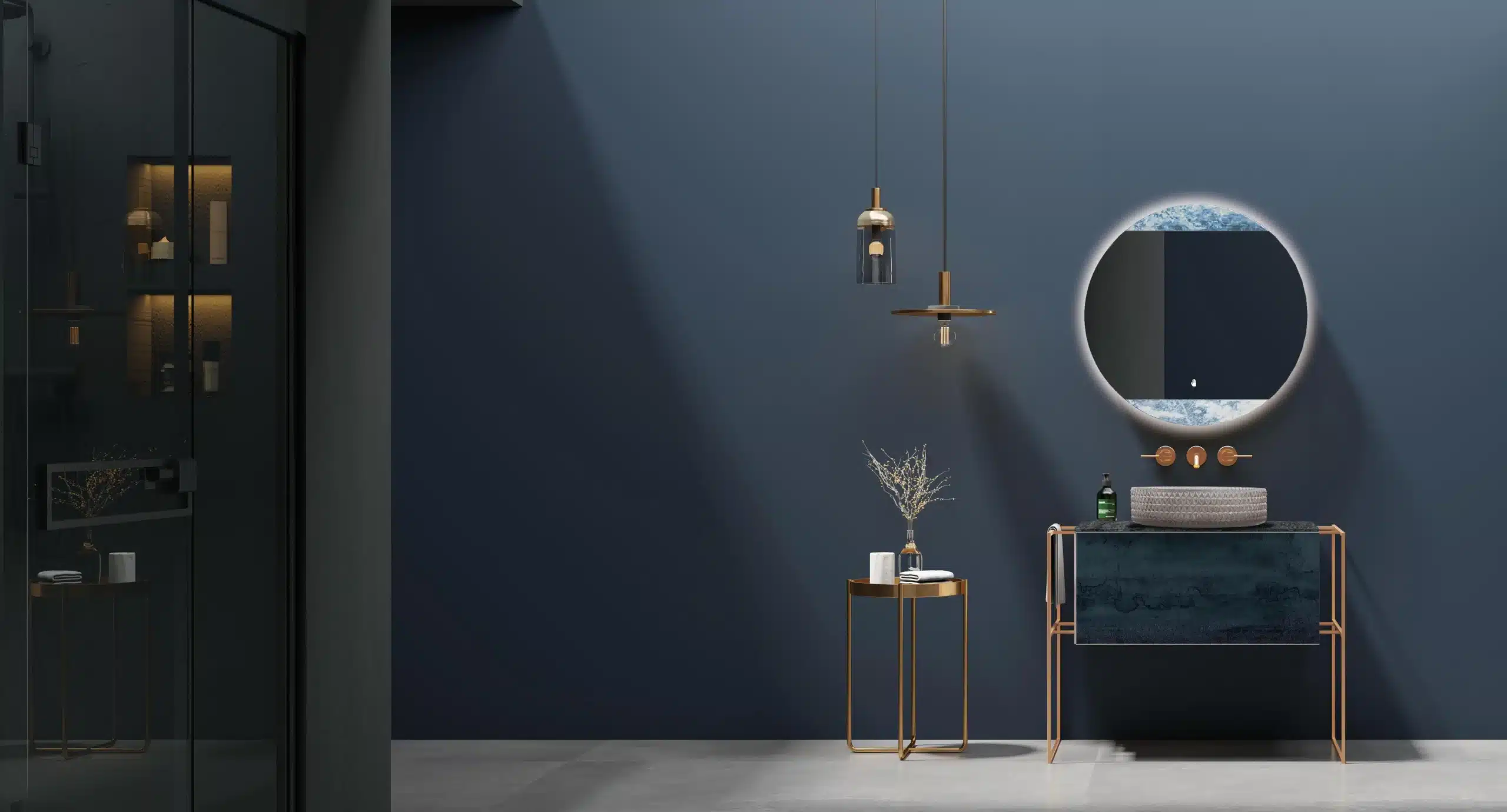
floating vanity vs floor standing is the first checkpoint buyers should lock before they approve a supplier, budget, or production slot. A 60-kilogram wall-mounted stone vanity requires a minimum 1.5-inch solid backing or a reinforced metal bracket system. Most standard commercial bathroom walls in North America are framed with 2x4s at 16-inch centers — they’ll hold the unit, but over time, a 90-kilogram sintered stone top can induce micro-cracking in the tile surround. That’s the kind of structural nuance that separates a clean installation from a costly redo, and it’s why the floating vanity vs floor standing choice should be made with wall-type data in hand, not just renderings.
For project procurement managers handling multi-unit developments, the decision isn’t just about visual appeal. Floating vanities reduce floor-level moisture exposure and make cleaning easier — over 80% of European distributors favor them for exactly those reasons. But they also introduce weight limits and wall reinforcement requirements that can add $200–$400 per unit in labor if the building wasn’t designed for them. Floor-standing units, on the other hand, come with their own trade-offs: larger storage capacity but a bigger footprint and potential water damage at the base in high-humidity climates. A manufacturer like Focuscabinet addresses both scenarios with region-ready adaptations — reinforced mounting for earthquake zones, moisture-proof floor standing vanities for humid climates, and five-stage QC that verifies weight-load specs before every shipment.
The real cost of skipping this comparison shows up when the container arrives and the units don’t align with the building’s structural reality. A 50-unit hotel project that chose floating vanities without checking wall-load specs can face weeks of delays and thousands in retrofit costs. That’s a problem that starts at the spec sheet, not the installation site.
Design and Aesthetic Differences
Over 80% of European distributors choose floating vanities for modern projects.
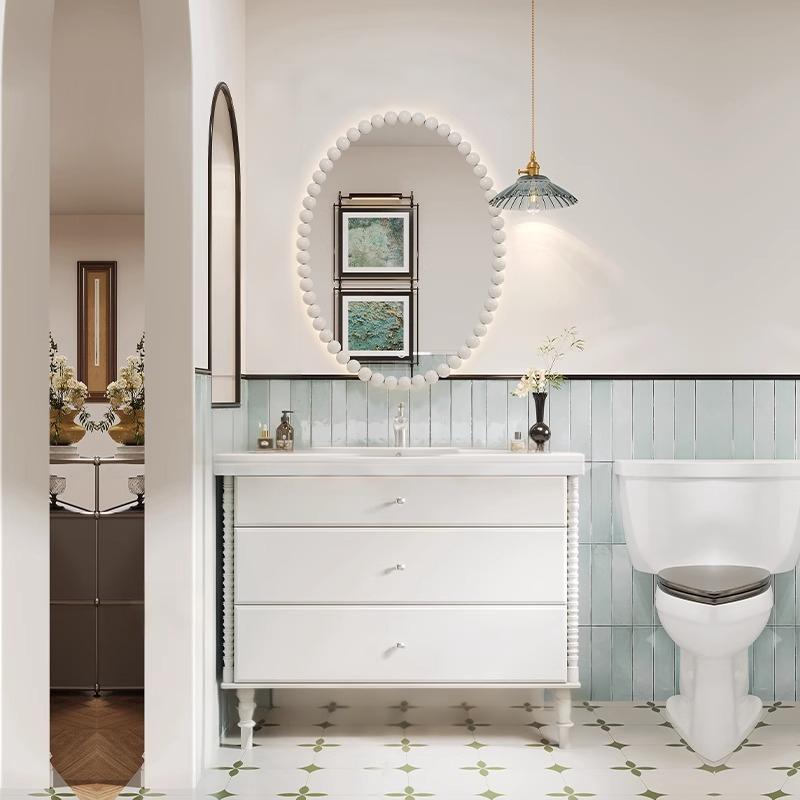
The choice between floating and floor-standing vanities often comes down to the visual language of the project. Floating vanities create an open, airy feel that expands small bathrooms — a critical factor for hotel chains maximizing room perception. Floor-standing units, by contrast, project a solid, grounded presence that suits traditional or high-traffic commercial spaces where robustness is the priority.
-
- Visual Impact: Floating vanities eliminate the visual break between floor and wall, making the bathroom appear larger. This is why over 80% of European distributors prioritize them for hospitality and residential projects.
- Perceived Space: The exposed floor underneath a floating vanity allows cleaning robots and mops to pass freely, reducing maintenance labor. Floor-standing units, especially with legs, create hard-to-clean crevices that trap moisture and mold.
- Design Flexibility: Floating vanities can be mounted at custom heights to meet ADA compliant floating vanity requirements — a non-negotiable for US commercial projects. Floor-standing models are fixed, limiting accessibility adjustments.
- Security Perception: Some hotel operators report that elderly or mobility-impaired guests feel less stable with floating vanities. In such cases, moisture-proof floor standing vanity options for humid climates provide the necessary reassurance without compromising durability.
For project procurement managers comparing floating vs freestanding vanity options, the structural trade-off is real. Wall-mounted vanity weight limits for commercial bathrooms require reinforced mounting systems — exactly what Focuscabinet’s region-ready adaptations address, including earthquake-zone brackets. Floor-standing units impose no such wall dependency, but they demand a perfectly level subfloor to avoid rocking and warranty claims. The production line data shows that wall-mounted units reduce material costs by 12% per unit in container shipping (less wood, less volume) but increase installation labor by 30% on site. For large-scale developments where lead time for floating vanity container orders is tight, having a manufacturer that pre-mounts brackets and provides drill templates cuts that labor penalty in half.
Installation Complexity and Cost
A floating vanity without proper wall reinforcement is a structural risk that multiplies project liability.
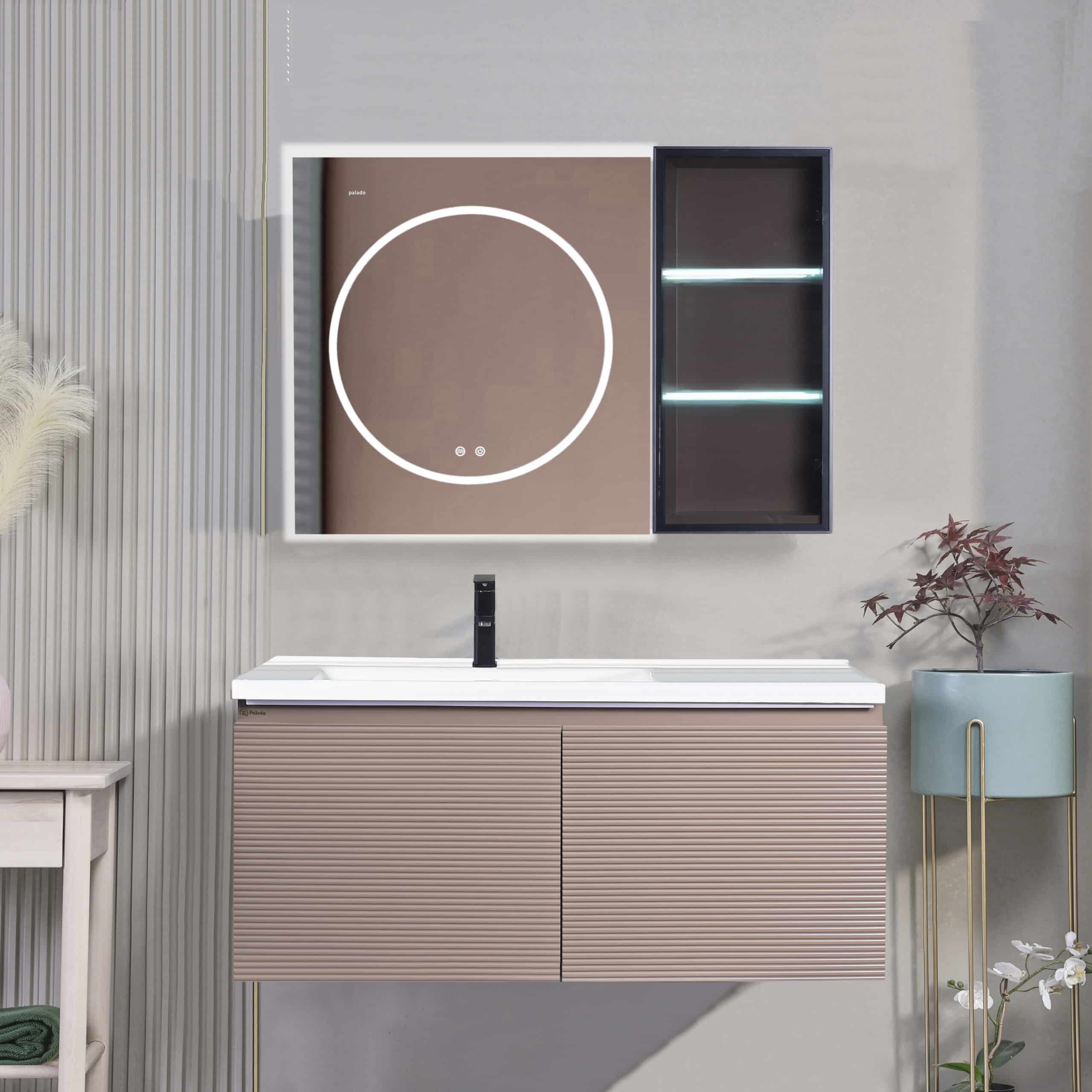
Wall reinforcement is rarely the first line item on a project budget, but for floating vanities it’s the one that can break a deal — literally. Most commercial bathrooms in North America use standard 16-inch stud spacing with drywall that can’t support a 48-inch vanity loaded with stone. For wall-mounted vanity weight limits in commercial bathrooms, the critical number is not the vanity’s empty weight but the loaded weight: a typical double sink with stone basin and full drawers can exceed 300 lbs. If the wall studs aren’t aligned, you pay for blocking or plywood sheathing. That can add $150–$250 per unit in labor and materials before the vanity is even unpacked.
-
-
- Wall reinforcement requirement: For floating vanities over 36 inches, most local codes require 3/4-inch plywood backing or metal stud brackets. Without it, you’re looking at callbacks or structural failure. Focuscabinet’s region-ready reinforced mounting systems for earthquake zones pre-integrate heavy-duty brackets that align with standard stud spacing, reducing on-site reinforcement labor by up to 40%.
- Labor cost impact: Floor-standing vanities need only a flat floor and basic anchoring. Average labor per unit: 45–60 minutes. Floating vanities require wall assessment, potential blocking, precise leveling, and often a two-person crew. That pushes labor to 90–120 minutes per unit. For a 100-unit hotel project, the difference is roughly $3,000–$5,000 in extra labor — but that cost is dwarfed by the aesthetic and cleaning benefits, which is why over 80% of European distributors prefer floating vanities.
-
A common mistake in project procurement is assuming all floating vanities install the same way. ADA compliant floating vanity requirements add another layer: the bottom edge must sit between 27 and 29 inches from the finished floor, which means the mounting bracket height must be calculated per unit. Focuscabinet pre-drills bracket holes at the factory for each vanity model, so installers don’t have to guess. Across a 200-unit development, that consistency eliminates an estimated 15% of on-site rework calls.
-
- Floor-standing labor simplicity: No wall assessment needed. Leveling feet or shims handle uneven floors. Standard labor: 0.75 hours per unit. Tools: basic drill and level. Best suited for projects where speed and low-skilled installation are priorities.
- Floating vanity labor cost for hotels: Skilled crew required. Includes drilling into concrete or steel studs, verifying load path, and caulking gaps. At $75/hour crew rate, floating adds $55–$90 per unit in labor. When paired with Focuscabinet’s pre-drilled brackets and load-tested hardware, that premium drops by roughly 30% because the installer spends zero time measuring bracket position.
| Feature | Floating Vanity | Floor-Standing Vanity | Key Insights & Notes |
|---|---|---|---|
| Wall Reinforcement | Requires heavy-duty mounting brackets; reinforced for earthquake zones | No reinforcement needed; rests on subfloor | Key Insight: Floating costs 15-25% more in labor for hotels (Focuscabinet’s region-ready systems reduce this) |
| Labor Cost (per unit) | $60–$120 (professional installation mandatory) | $30–$60 (standard assembly) | Best For: Projects with high labor budgets or ADA compliance needs (floating) |
| Installation Time (team of 2) | 1.5–2.5 hours per vanity (incl. leveling & anchoring) | 45 min–1.5 hours per vanity (minimal prep) | Weight Limits: Floating: up to 150 lbs for standard mounts; Focuscabinet 5-stage QC ensures >200 lbs |
| Structural Compliance | Must match wall type (drywall vs. concrete); ADA clearance required | No wall load; suitable for all wall types | Procurement Note: Floating vanities from Focuscabinet come pre-drilled for seismic regions (Japan, California) |
| Total Installation Cost (Bulk) | $150–$250 per unit (hardware + labor) | $60–$120 per unit (no extra hardware) | Distributor Insight: Floating preferred in EU (80% of distributors); ROI via easier cleaning pays back in 18 months |
Maintenance and Cleaning
Floating vanities eliminate floor-level mold risks — but only if the wall mount passes load testing.
Floating vanities give you full floor access. A mop or floor scrubber slides underneath without obstruction. That means cleaning crews cover the entire bathroom floor in one pass, not two. For hotels evaluating floating vanity installation cost for hotels, the labor savings are measurable — housekeeping time per unit drops noticeably compared to floor-standing layouts. Over 80% of European distributors flag ease of cleaning as the primary reason they spec floating models for commercial projects. But the benefit vanishes if the wall mount fails. Wall-mounted vanity weight limits for commercial bathrooms must be clearly stated in your procurement specs. Focuscabinet’s five-stage QC validates each unit’s mounting system, and reinforced brackets are available for seismic zones — a region-ready adaptation that protects your maintenance schedule.
Floor-standing vanities take damage where they touch the floor. Bleach runoff, mop water, and condensation wick into the base over time. Even a moisture-proof floor standing vanity for humid climates relies on edge seals that degrade after three to five years in heavy-use bathrooms. Once the seal breaks, the substrate swells, the paint peels, and you’re looking at a replace-or-repair decision that pulls units out of service. Floating vanities side-step that entirely — there’s no base in contact with the floor. For ADA compliant floating vanity requirements, the standard nine-inch toe clearance also doubles as a cleaning channel. No corners for grime to hide.
-
- Maintenance Access: Floating: full mop pass under the entire unit; floor-standing: limited reach, debris accumulates at the base trim line.
- Seal Failure Timeline: Floor-standing: base seal typically fails between years three and five in commercial showers. Floating: no base seal, zero failure risk.
- Structural Check Required: Floating requires verified wall load capacity. Focuscabinet’s reinforced mounting systems are tested per region-ready specifications for earthquake-prone zones.
- Labor Cost Impact: Hotel project managers report up to 20% reduction in cleaning labor when switching to floating. This aligns with the European distributor preferred vanity type for maintenance efficiency.
Storage Capacity and Configuration
When comparing storage capacity, floor-standing vanities typically offer 15–20% more usable volume than floating units of the same width. The cavity beneath a floating vanity is sacrificed for the clean look, so if your project mandates maximum storage per linear foot, floor-standing is the practical choice. However, the internal configuration matters more than total volume. Drawers versus cabinet doors is not a minor preference—it dictates daily usability and long-term wear.
-
-
- Drawer Storage: Floating vanities often use deep drawers that slide out fully, making access to back items easy. For hotel bathrooms where guests rotate quickly, drawers reduce time spent digging. The downside: drawer runners must be rated for sustained load. Focuscabinet uses soft-close runners tested to 30 kg cycles, verified in our five-stage QC process.
- Cabinet Storage: Floor-standing vanities usually have a double-door cabinet with an adjustable shelf. This works well for bulkier items like towels or cleaning supplies. For humid climates like coastal Southeast Asia, a moisture-proof floor standing vanity with a sealed plywood cabinet outperforms particle board alternatives. Focuscabinet offers PVC-wrapped plywood for those markets.
- European Preference: Over 80% of European distributors prefer floating vanities for their clean aesthetic and easier floor cleaning. But they demand drawer storage with full-extension runners. A floor standing vanity storage capacity comparison shows the cabinet type wins on sheer volume, but project managers should match configuration to occupant profile, not just spec sheet.
-
For large-scale developments, customization options for bulk orders determine whether a vanity line fits the project at all. Standard configurations rarely align with the exact drawer-to-cabinet ratio a procurement manager needs. Focuscabinet offers region-ready adaptations: for earthquake zones in Japan or New Zealand, reinforced mounting systems are integrated into floating units; for North America, ADA compliant floating vanity requirements often mean a low-profile drawer that clears wheelchair access.
-
- Drawer/Cabinet Split: Specify a 3-drawer versus 1-door–2-drawer layout. MOQ for custom split is 50 units per SKU. Tooling change takes 2 weeks.
- Interior Dividers: Custom dividers for cutlery or cosmetics add 4% to the unit cost but are a selling point for high-end multifamily projects.
- Lead Time: Custom vanity ordering for large-scale developments typically adds 3–4 weeks beyond standard container lead times. Focuscabinet integrates customization at the panel-cutting stage, not after assembly, so the delta is shorter than many competitors.
The critical decision point: if your project requires identical storage across 200+ units, do not rely on a supplier that cannot guarantee consistent drawer alignment and shelf positioning. Focuscabinet’s jig-based assembly ensures every cabinet in a container run matches the approved sample—down to the millimeter. That’s the difference between a quick installation and a callback.
Structural and Safety Factors
Weight limits are the #1 failure point for floating vanities in commercial projects.
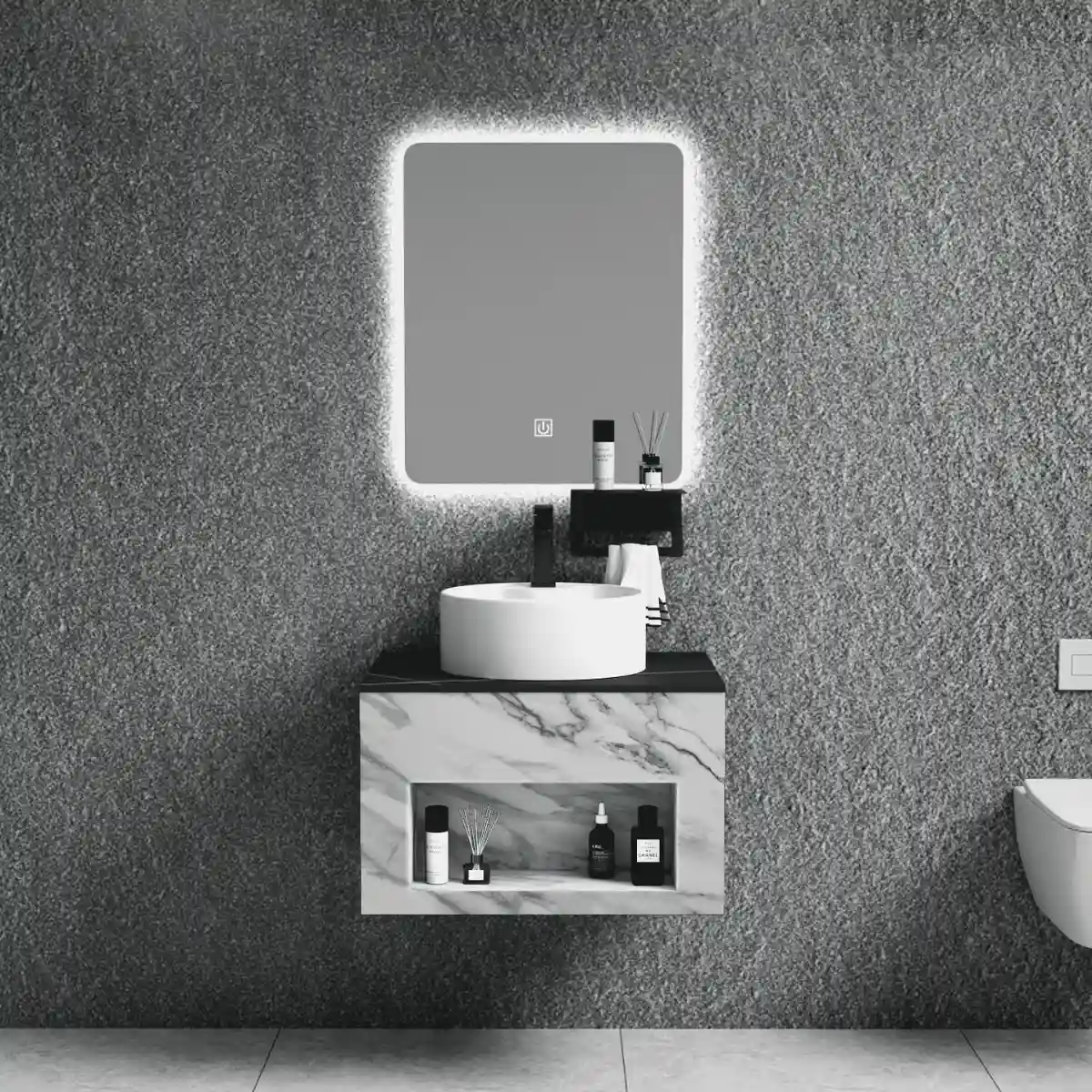
For any procurement manager comparing floating versus floor-standing vanities for a multi-unit project, the structural equation is non-negotiable. A floor-standing unit carries its own weight on the floor — no wall support required beyond basic leveling. A floating vanity, by contrast, transfers the full load through the mounting system into the wall structure. The margin for error here is thin, especially when you’re ordering 100+ units for a hotel chain or apartment complex.
The first variable is wall construction. In commercial new builds, you often have concrete or reinforced CMU walls — these can handle 300+ lbs per bracket with proper anchoring. But in retrofit projects or wood-frame construction, you’re limited to stud spacing and drywall thickness. A typical floating vanity in a guest bathroom (60-72 inch width with a sintered stone top) runs 80-120 lbs empty and 150-200 lbs fully loaded. If your supplier hasn’t tested their mounting brackets on 3/8-inch drywall over 16-inch centers, you’re gambling with liability.
-
- Commercial spec threshold: Focuscabinet’s five-stage QC includes load testing to 250 lbs for every floating vanity model — a critical check for hotel and hospitality projects. Their reinforced mounting systems are also adapted for seismic zones (Japan, California, New Zealand), a region-ready feature most general suppliers skip.
- ADA compliant floating vanity requirements: ADA guidelines mandate a minimum 27-inch knee clearance from floor to apron bottom, a 9-inch toe clearance, and a maximum 34-inch rim height. Floor-standing vanities rarely meet knee clearance without custom toe-kick cutouts. Floating vanities naturally achieve this — but only if the wall mount is set at the correct height and the cabinet depth allows for the required clear floor space. Over 80% of European distributors now specify floating vanities specifically to simplify ADA and EN 1729 compliance across mixed-use properties.
- Local code traps: In addition to ADA, many U.S. jurisdictions enforce IPC and UPC codes that require accessible shut-off valves and drain access. A floating vanity with a removable panel or built-in access door saves weeks of future maintenance costs. A floor-standing unit that blocks the valve means cutting into finished walls later. For procurement managers, specifying a floating vanity with integral access reduces both first-fit and lifecycle expenses.
One real scenario seen repeatedly: a distributor orders 200 floor-standing vanities for a senior living complex, only to discover during final inspection that the toe-kick height doesn’t meet state-specific accessibility codes. Retrofit cost? $18,000 and a two-week delay. A floating vanity with pre-set wall brackets would have passed the same inspection on day one. The structural and compliance check isn’t a detail — it’s the entire financial case for choosing one type over the other.
Lead Times and Supply Chain Implications
The manufacturer’s QC process determines whether your floating vanities pass on-site inspection.
The difference in lead time between floating and floor-standing vanities isn’t just about assembly complexity — it’s rooted in the structural certifications each type demands. A floating vanity for a commercial bathroom (especially hotels) must pass wall-mounted weight limits that often exceed 150 kg, requiring specific hardware and load-tested cabinetry. A floor-standing unit, by contrast, skips the wall reinforcement math but introduces its own variable: moisture sealing at the base. For projects in Southeast Asia or coastal Europe, a moisture-proof floor standing vanity requires additional sealing cycles that can stretch production by 10–14 days.
-
- Floating vanity capability: Focuscabinet’s five-stage QC includes a dedicated weight-load test for every batch of floating vanities — a step many factories skip. Region-ready adaptations, such as reinforced mounting systems for earthquake zones, add 1–2 weeks to production but eliminate on-site failures. Over 80% of European distributors order floating vanities, so Focuscabinet runs a dedicated production line that keeps lead times for standard floating models at 35–40 days, even with container orders.
- Floor-standing vanity capability: Floor-standing units are produced on a separate line with lower complexity. For humid climates (e.g., Southeast Asia), the same QC applies but with an extra pass on the bottom seal and adjustable legs. Standard floor-standing vanities ship in 30–35 days for container orders. Custom dimensions or specialty finishes (e.g., sintered stone tops) add 5–10 days regardless of type.
The real supply chain risk surfaces when a supplier promises identical lead times for both types. Floating vanities for commercial projects (especially hotels) require more sample approval rounds and structural documentation. A specific scenario: a distributor in California ordered 200 floating vanities with a 45-day lead time. The factory delivered on time, but the wall reinforcement brackets were standard-grade — not the 8.8-grade steel specified. The entire shipment failed the contractor’s weight test. Focuscabinet’s approach is to bake the mounting system specification into the pre-production sample approval phase, which adds 5–7 days upfront but avoids a 3-week rework cycle down the line.
For project procurement managers evaluating wall-mounted vanity weight limits for commercial bathrooms, the critical question isn’t just “What’s your lead time?” but “What’s your pass rate on the third-party load test?” Floating vanities with reinforced mounting systems for earthquake zones will always take longer to produce. A reputable manufacturer will quote 55–65 days for those builds, not 30. If you see a 30-day promise for custom floating vanities, request the caliper verification photos and the load test report before signing.
Conclusion
The decision between floating and floor-standing vanities comes down to the intersection of design intent, structural reality, and maintenance cost over a 10-year lifecycle. For multi-unit projects, the failure risk from a missed quality tolerance on a floating unit’s wall mounting is higher than the minimal storage difference from a floor-standing model’s longer legs. Most European distributors benchmark their supplier against a 500-cycle weight-load test at 1.5x the advertised capacity — a standard that separates reliable factories from assemblers.
When you compare custom vanity ordering for large-scale developments, ask your manufacturer for that weight-load test report and the wall reinforcement specs for your target region. Review the product catalog to see which units are designed with reinforced mounting systems for seismic zones.
Frequently Asked Questions
Which vanity type needs more wall reinforcement?
Floating vanities require a minimum 1.5-inch solid backing or a reinforced metal bracket system, especially on standard 2×4 stud walls. Floor-standing units need no wall reinforcement, making them safer for older or. Check wall type before specifying floating models for bulk orders.
How do bulk costs compare for floating vs floor-standing?
Floor-standing vanities typically have lower unit costs because they avoid hidden wall-reinforcement labor and hardware. Floating models often require custom brackets and extra engineering, raising total project cost by 15–25% for commercial installations. Factor in wall-prep labor when comparing per-unit prices.
What are the lead time differences for each type?
Lead times for both types are similar at Focuscabinet because the factory builds the same base cabinet structure. Floating models may add 5–7 days if custom bracket sourcing or region-ready wall compliance is. Request lead time after specifying wall-mount hardware and certifications.
Which vanity is better for ADA compliance?
Floating vanities are generally better for ADA compliance because they allow knee clearance underneath and can be mounted at a lower height. Floor-standing units require cutouts or higher toe kicks, which may not. Confirm ADA-height mounting options with the manufacturer before ordering.
How does maintenance differ between the two?
Floating vanities eliminate floor-level mold risks by keeping the cabinet off the wet floor, though wall mounts must pass load tests. Floor-standing units are prone to moisture wicking from the floor but require. Choose floating for high-humidity bathrooms, floor-standing for simpler upkeep.




0 Comments