

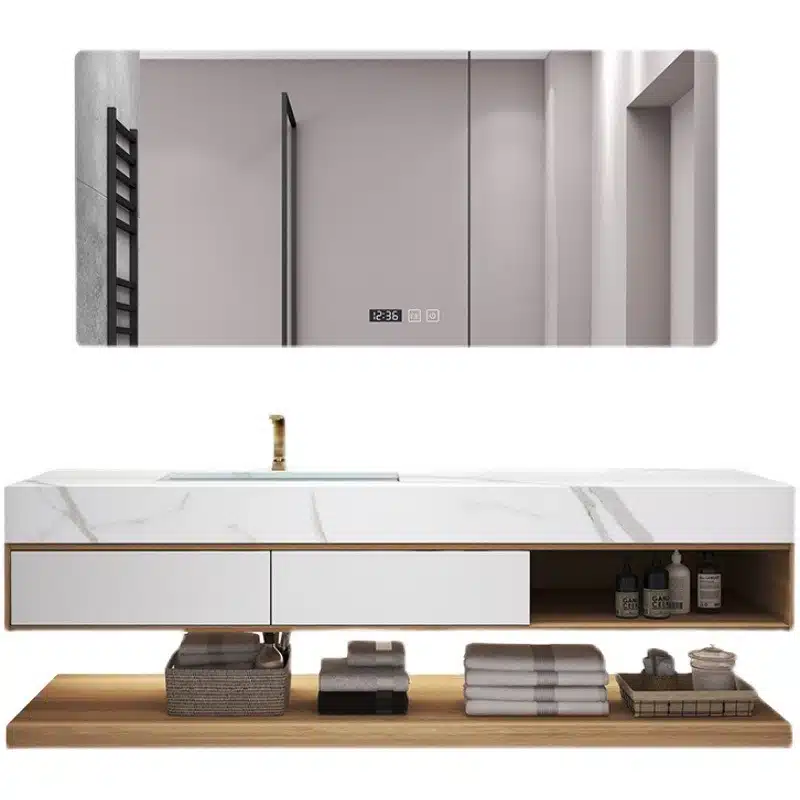
Every sourcing guide tells you to start a custom sintered stone basin regional order with sample approval. It’s the right first step, but it’s not the safeguard people pretend it is. A buyer can sign off on a flawless pre-production sample and still take a hit on the mass production run — that’s how a $50K order turns into a problem.
The real answer is to treat the sample as the starting line, not the finish line. What matters is what happens after approval: whether the factory can repeat the same quality tolerance on basin depth, edge profile, and tap-hole spacing across the full production run. FOB pricing quoted off a sample mold doesn’t cover the cost of rework if the mass run drifts from that approved sample.
Regional markets make this issue worse. Europe wants a single-hole mixer with minimal lines; North America expects 4-inch or 8-inch centerset tap holes in standard vanity dimensions; the Middle East wants deeper basins and richer colors; Asia tends toward compact layouts with integrated storage. Each spec is easy on paper, but the factory’s ability to switch between them without a new tooling cycle is what separates a reliable partner from a sample-only vendor.
Focuscabinet, which supplies over 1,000 distributors in more than 20 countries, addresses this with a region-ready modular design system backed by a 10,000-square-meter factory and a five-stage quality control process. Standardized basin blanks and interchangeable edge templates mean a custom sintered stone basin for Europe or a decorative Middle East profile doesn’t require a separate mold. That cuts custom tooling costs by 60% and lets distributors order as few as 50 units per custom color without a factory-minimum charge.
Skipping these checks to save time costs more. If a container lands with tap-hole spacing that misses US standards or a color that no longer matches the approved Pantone reference, the rework cycle is at least six to eight weeks — and the replacement order will be priced at current FOB rates, not the original quote. That’s the cost of inaction: one $50K order, then a second one at a tighter margin, plus a distributor relationship you didn’t mean to gamble.
Regional Preferences Overview
Regional bathroom preferences are cost structures — wrong hole spacing or dimensions erases margin before the container leaves port.
The biggest sourcing mistake new sintered stone buyers make is treating the basin like a universal SKU. The same design that clears warehouse space in Rotterdam will gather dust in Riyadh — not because of quality, but because regional bathroom dimensions, plumbing codes, and design expectations diverge sharply. A custom sintered stone basin regional strategy starts with four questions before you request a quote: what size, which faucet-hole pattern, what edge profile, and what finish.
-
- Europe — Minimalist, Large Single Basins: European distributors lean minimalist: a single, large rectangular basin, often 600 to 1,200mm wide, with clean lines and no visible overflow. Matte white, warm greys, and sandstone tones lead sales. The compliance detail that matters is the faucet configuration — European mixers use one pre-drilled 35mm hole. A custom sintered stone basin for Europe that arrives with US-style 8-inch centerset spacing gets re-drilled at the distributor’s cost, which can double the landed price per piece.
- North America — Double Vanities, Standard Sizes: The US market anchors on double vanities in 60-inch and 72-inch standard widths — two basins per countertop, each pre-drilled for 8-inch or 4-inch centerset faucets to match standard US plumbing. Project buyers measure against the spec sheet, and a 1/4-inch deviation triggers a site callout. MFBATH’s region-ready modular design system keeps this cost-controlled: custom tooling runs 60% below conventional dies, and the sintered stone basin MOQ for custom colors is 50 units with no factory-minimum charge.
- Asia — Compact Designs, Integrated Storage: In Hong Kong, Singapore, and Tokyo, compact bathrooms drive the market. Basins in the 400–600mm range are typical, and integrated storage is non-negotiable. Sintered stone molds thin, precise edges, preserving drawer depth that a bulky ceramic basin wastes. Run a sintered stone vs ceramic wholesale comparison and ceramic looks modestly cheaper per unit; factor in container shipping lead times and a sintered stone run becomes the better test for regional demand.
The pattern is clear: regional preferences are not a style menu — they are a cost structure. Verify the supplier’s MOQ and tooling policy before you request samples. That decision determines whether you can test two or three regions in one container without paying factory-minimum penalties.
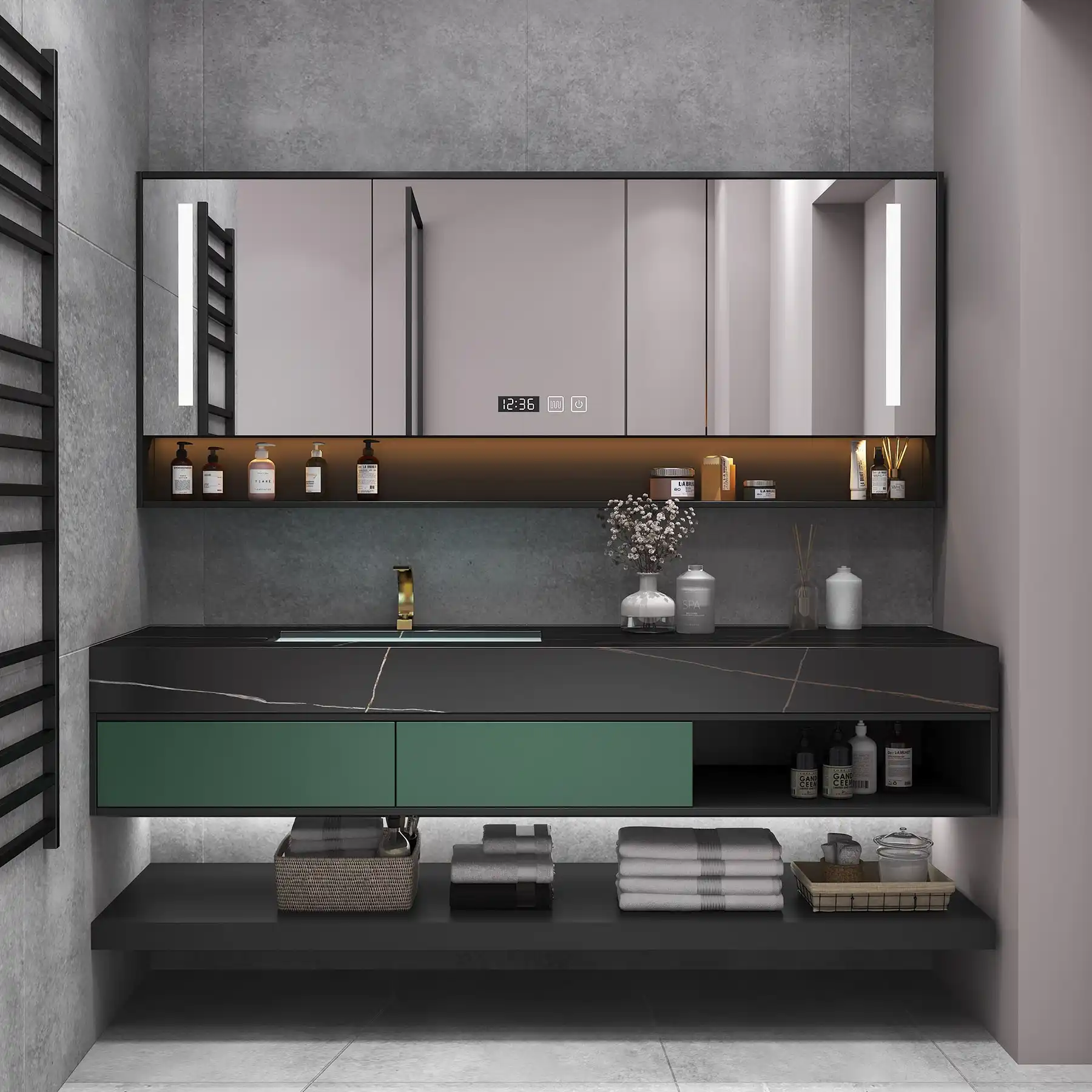
Technical Customization Options
A basin can be customized in four dimensions — but each one changes cost, lead time, or compliance.
The customization of a sintered stone basin isn’t about how many colors you can offer — it’s about whether the factory can control tolerance when the spec changes. Most distributors ask for low MOQ first, then discover that color, edge, sink depth, and tap hole geometry each carry their own ripple effects through production. In our system, these four variables are modular: changing a basin from a square edge to a bullnose swaps a profile insert instead of triggering new tooling for the entire sink. That modular approach cuts custom tooling costs by roughly 60% and allows a MOQ of 50 units for a custom sintered stone basin from China — without a factory-minimum surcharge.
-
- Color Matching (Pantone / RAL): Sintered stone body color is mixed into the material before pressing, so sample approval must be done on a full-size pressed slab, not a color chip. Batch consistency across multiple containers depends on locking the same raw material lot and pressing recipe in the production file. Ask any supplier for the last three batch photos of the same RAL code before you commit to a custom color.
- Edge Profiles: Square, Beveled, Bullnose: Square is the low-cost production default. Beveled is the most common profile for European minimalist lines. Bullnose shows up frequently in Middle East projects. Changing the profile changes the polishing step and can add 2–3 days of setup time per order, which is why edge profile should be locked before sample production begins.
- Integrated Sink Shapes and Depths:Standard basin depth typically runs 120–150mm. The depth can be adjusted to 100mm for compact European vanities or up to 180mm for commercial U.S. projects. Shape changes — rectangular, oval, asymmetrical — do not require new tooling in the modular system, but deeper basins use more material and will shift the unit price.
- Pre-Drilled Tap Holes and Overflow: The U.S. market commonly requires 8-inch or 4-inch centerset faucet spacing; Europe typically uses a single-hole mixer. Overflow can be formed during pressing or added via CNC, but the tolerance must match the drain assembly or the basin fails on-site installation. Confirm both tap hole spacing and overflow position against your target market’s plumbing code before approving the prototype.
Adapting to Local Regulations
Get the tap hole pattern wrong and a container of otherwise perfect basins becomes uninstallable inventory.
The most common reason a sintered stone basin gets rejected at installation isn’t material quality — it’s the tap hole pattern. A basin that looks perfect in a showroom can fail a plumbing inspection in Chicago or Frankfurt because faucet spacing requirements differ by region. No quality tolerance on the stone itself can fix a wrong drilling configuration.
US faucets follow two spacing conventions: 4-inch centerset or 8-inch widespread. A centerset faucet integrates the spout and handles into one deck unit, requiring holes placed 4 inches (102 mm) apart. A widespread configuration puts the hot and cold valves 8 inches (203 mm) apart with a separate center spout hole. Send a European single-hole basin to a US project and the plumber is left with an unworkable deck. The reverse fails just as badly: mount a single-hole mixer on a US 4-inch basin and the spare side holes sit open, exposed to splash water.
Europe runs on single-hole mixers. A monobloc mixer passes through one 35 mm hole and connects to G1/2 supply lines. The requirements extend past the hole: the deck must be flat enough for the mixer base to seal, and underside clearance must accommodate the locking nut and inlet hoses.
-
- US 4-inch centerset: Two outer holes at 102 mm centers, common in mid-tier residential. Requires a 3-hole drilling template.
- US 8-inch widespread: Two valve holes at 203 mm centers plus a separate spout hole. Standard for premium residential and hospitality.
- Europe single-hole: One 35 mm hole centered on the basin deck, compatible with most monobloc mixers from European brands.
- Failure mode: Re-drilling sintered stone in the field voids the surface warranty and leaves a visible chip around the hole. Replacement is the only safe option.
Focuscabinet’s region-ready strategy handles this with pre-set drilling templates for all three configurations. Hole spacing is checked against the customer’s nominated faucet model at sample approval, and each batch QC report records the measured hole centers. Distributors can also order undrilled basins if they prefer to drill after landing to match local faucet inventory.
For a veteran distributor, the real question isn’t whether a factory offers both options — every serious supplier does. It’s whether they hold the correct template, verify it at sample stage, and document spacing per batch. Ask for the drilling template diagram inside the sample approval package. If a supplier can’t produce one, you’re about to become the quality control department for a full container of non-compliant basins.
Minimum Order Quantities and Lead Times
MOQ: 50 units per custom color with no factory-minimum charge — the exception in this industry.
The MOQ question most buyers lead with is the wrong one. For sintered stone basins, the real issue is whether a custom color or dimension forces a full production-line reset. Focuscabinet’s region-ready strategy treats the basin as a modular system: the stone body, color layer, edge profile, and tap-hole configuration are handled as separate changeovers. That’s why a distributor can request a sintered stone basin MOQ of 50 units from a Chinese factory and skip the factory-minimum surcharge entirely.
The modular system cuts custom tooling costs by roughly 60% compared with a dedicated mold per SKU. For a veteran importer, the math is straightforward: you can test a custom sintered stone basin for Europe in a RAL 7016 or Pantone-matched finish with a fraction of the usual risk. The alternative is committing a full container to an untested regional variant, which is exactly how distributors end up with slow-moving stock.
-
- Standard items: Move first in the production queue because the modular molds stay set. No tooling changeover, no color re-matching, no sample re-approval. Standard orders also consolidate faster for container loading, so the lead time is easier to predict.
- Custom items: The added time sits in the approval loop, not the molding process. A custom color match or a US 8-inch centerset modification locks the spec before casting starts. Ask for the lead-time breakdown in writing: production days, curing time, and container shipping are separate line items, and conflating them hides risk.
Most lead-time blowouts in this category trace to one of three points: sample approval delays, container consolidation, or compliance rework. Sintered stone can’t be patched after casting. A missed dimension or wrong tap-hole spacing sends the whole batch back through rework, which is why Focuscabinet’s five-stage quality control matters more than any single day count in a quote.
On logistics, ask where the lead time ends. Some suppliers quote production days but leave the container-stuffing schedule open. For a buyer planning a consolidated shipment, a production date is meaningless if the basins sit on the dock for two weeks. Confirm the FOB point and the container loading window before you commit to a downstream delivery date.
Samples and Prototyping Process
Sample approval is the last point where a regional compliance mistake costs hundreds instead of thousands.
A custom prototype request starts with a spec sheet, not a “make it like this photo” message. Send the dimensioned drawing, regional tap-hole spacing — 8-inch centerset for the US, single-hole for Europe — overflow position, edge profile, and the color reference as a Pantone or RAL code. Focuscabinet’s engineering team reviews that brief against the modular mold library before cutting anything. This modular system is what reduces custom tooling costs by 60%, which is why the sintered stone basin MOQ stays at 50 units per custom color instead of triggering a full custom-mold contract that pushes the minimum into the hundreds.
When the prototype arrives, measure it physically before approving. Tap-hole spacing is the leading cause of regional compliance rejections — a 4-inch mounted faucet will not fit an 8-inch centerset basin, and that only surfaces at installation. The approved unit becomes your sealed sample. Require the factory to keep a signed counterpart with the same batch number marked on the underside. Every inspection checkpoint on the mass run compares against that physical reference; a WeChat photo at 72 dpi is not a standard.
-
- Spec Review: The engineering team checks your drawing against the modular mold library and confirms regional compliance before production starts — US 8-inch centerset, EU single-hole, overflow placement. Ask for the FOB pricing line here, so any tooling surcharge is visible before you commit.
- Prototype Build: One unit is produced with the exact color, edge profile, and tap-hole layout. Insist on the batch number being marked on the sample itself. It is the only way to trace a rejected container back to production records.
- Mass Production: The run starts with a first-article check, then the five-stage QC tracks dimension, surface, and color consistency against the sealed sample. A failed stage means rework or scrap before the unit reaches the carton.
Cost Implications of Customization
The tooling charge — not the piece price — is where custom basin margins get destroyed.
The real cost of custom sintered stone basins isn’t the unit price. It’s the mold. Standard factory practice quotes a one-time tooling fee that you amortize across 500+ units before seeing any margin. If the design flops in your region, you’re holding inventory priced against tooling you’ll never reuse.
Focuscabinet’s region-ready system attacks that math differently. Instead of carving a fresh mold for every custom size, the factory builds from a modular design framework and adjusts only the finished surface. Tooling costs drop about 60% as a result. That structural difference is why a distributor can order as few as 50 units of a custom Pantone or RAL color without a factory-minimum charge — not as a concession, but because the production setup genuinely costs less.
-
- Tooling ownership: If a supplier quotes a mold fee, get a written buyback clause. If you stop ordering, the mold should be yours to move to another factory.
- Quality tolerance: Five-stage QC gives you measurable batch consistency, but only if the tolerance is written into the contract. Silent color drift between production runs is how distributors get stuck with unsellable regional stock.
- Compliance retrofits: US 8-inch centerset spacing and EU single-hole mixer configs need pre-drilling at the factory. Retrofitting after production adds labor and breakage risk — and customs delays when the product doesn’t match regional codes.
Factor in shipping before comparing against ceramic wholesale prices. Sintered stone‘s density lowers transit breakage, so the landed cost per intact unit often favors sintered stone over ceramic despite a higher FOB price.
Lead times follow the same logic. Custom work adds a pre-production sample approval loop before the batch run begins. Submit Pantone references and regional compliance specs with the first request, and that loop stays at one round instead of three.
| Cost Factor | Standard (Catalog) | Custom Regional Option | Bottom Line for Distributors |
|---|---|---|---|
| Tooling / Mold Setup | Existing molds with zero tooling charge | Modular design system for bespoke edges, sizes, and integrated sink shapes | Modular tooling cuts custom mold costs by 60%, making regional customization viable for mid-volume importers |
| Minimum Order Quantity | Factory-standard MOQ of 100+ units per SKU | 50 units per custom color (Pantone/RAL) without factory-minimum penalty | Lets distributors test new regional aesthetics with lower inventory risk and faster sell-through |
| Tap Hole & Plumbing Configuration | No pre-drilled holes; shipped blank for local drilling | Pre-drilled US 8-inch or 4-inch centerset spacing; EU single-hole mixer compatibility | Eliminates field rework and plumbing callbacks, protecting margins on regional bathroom basin compliance EU US |
| Color & Finish Matching | Limited in-house color palette | Exact custom color sintered stone basin Pantone RAL matching for European minimalist or Middle Eastern rich tones | Command premium pricing with designer-matched finishes while keeping unit cost within 8–12% of standard |
| Lead Time | 15–20 days production, consolidated container shipping | 25–35 days for custom tooling and color approval; same container shipping window | Predictable sintered stone basin lead time container shipping lets you plan seasonal regional launches without excess buffer stock |
| Compliance & Certification | General export packing with basic drop-test certification | Region-specific adaptations for US, EU, Middle East, and Asia regulatory and climate requirements | Pre-certified regional variants reduce customs delays and after-sales warranty claims on every container |
| Material Comparison | Sintered stone basin at 10–15% premium vs ceramic wholesale | Same premium position with added customization flexibility and lower breakage rates | Higher perceived value and lower damage-related write-offs justify the sintered stone vs ceramic wholesale price gap |
Conclusion
Can the factory translate the regional compliance spec — US 8-inch centerset or EU single-hole mixer — onto the exact basin model you plan to import? Does the custom color hold across the full mass production run, with the same quality tolerance you approved on the pre-production sample? And does the 50-unit custom color MOQ and modular tooling cost still make sense against your FOB pricing and container economics?
Start by reviewing the current sintered stone basin lineup on the product page and check which base models accept regional modifications without custom tooling. Then request a prototype with your target Pantone or RAL color to validate batch consistency before you sign off on the full order.
Frequently Asked Questions
What is the MOQ for custom sintered stone basins?
MOQ depends on customization level; stock items can be trialed in small quantities while full custom runs may require higher commitment. Confirm MOQ only after the spec, colors, and regional plumbing. Ask for a written MOQ quote with your exact regional spec.
Can you customize tap hole spacing for US and Europe?
Yes, we pre-drill basins to regional standards, like 8-inch or 4-inch centerset spacing for North America and single-hole patterns for Europe. This is a standard adaptation, but the exact hole configuration must be approved before. Send your tap hole drawing for confirmation.
What lead times for custom vs standard basins?
Standard items ship faster from scheduled production, while custom basins need extra time for prototyping, material approval, and regional compliance checks. Lead time depends on order size and how many technical changes are involved. Request a production calendar after prototype sign-off.
How do regional climates affect sintered stone basin choices?
Climates mainly affect edge profiles, mounting style, and installation tolerance; humid markets often prefer simpler edges that resist water trapping. We bake those choices into the design review before sampling rather than treating them. Share your market climate and installation conditions early.





0 Comments