

The finish that looks flawless in the showroom is often the first thing to fail in a humid bathroom. Hinges rust along the barrel, plated handles peel at the screw holes, drawer slides stiffen — usually within the first year, while the cabinet body still looks new. Corrosion on bathroom vanity hardware is a question of when, not if, so buyers need an objective way to compare finishes before committing to a container order. The cabinet hardware salt spray test is that measure: a standardized, repeatable method that shows how a plated surface behaves under salt-laden moisture. This guide covers what the test actually measures, what finish grades such as chrome, brushed nickel, and matte black really mean, and how B2B buyers verify hardware quality on bathroom vanities. It answers the questions importers, distributors, and hotel specifiers ask before a container ships.
What a Cabinet Hardware Salt Spray Test Measures
Salt spray testing is straightforward in principle: place a finished part in a sealed chamber, fill the air with a fine salt fog, and record how long the finish takes to corrode. The method suppliers cite most often is ASTM B117, ASTM International’s standard practice for operating salt spray (fog) apparatus. Under B117, the chamber runs a neutral salt solution — about 5 percent sodium chloride — atomized into a continuous fog at roughly 35°C (95°F). Test pieces are inspected at scheduled intervals, and the technician records the first visible defect: a rust spot, a blister, or pitting along a cut edge.
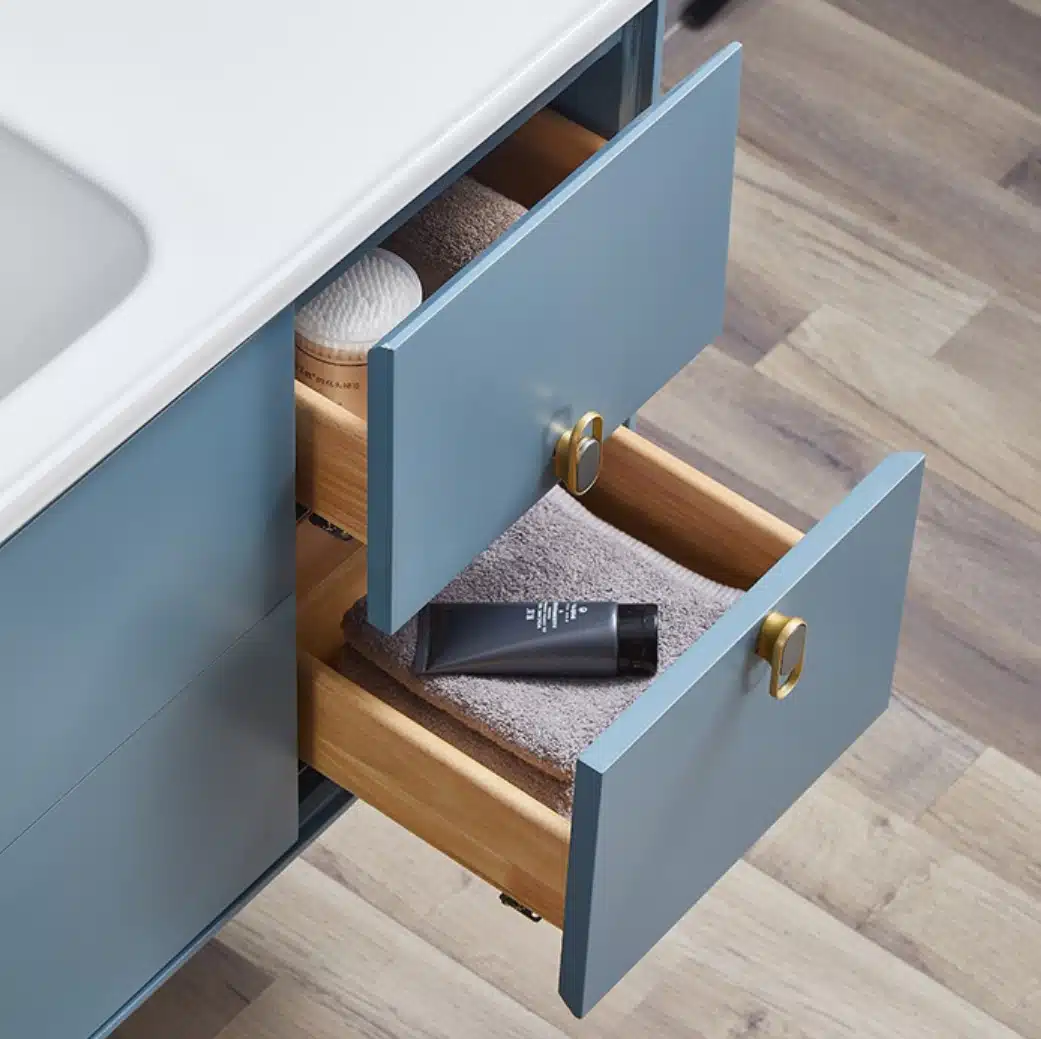
The deliverable is a number — hours to first corrosion — plus a note on where the defect appeared and how it was judged. The standard defines how the chamber is operated, not how long any finish should last. That distinction trips up most buyers. As common practice, test programs run anywhere from 24 to 500 hours depending on the product and its intended duty, and the acceptance criteria belong to whoever commissions the test. A supplier can truthfully report a 48-hour salt spray pass on a flat coupon, in a single finish, with generous failure criteria — and that report says nothing about the hinge on the cabinet you are actually buying.
Salt spray hours also do not convert into bathroom years. A real vanity sees condensation cycles, cleaning chemicals, and daily friction, not a uniform fog, so treat the cabinet hardware salt spray test as a comparative tool: it ranks finish A against finish B under identical conditions. For exposure closer to real life, ASTM G85 covers modified salt spray methods with acidified solutions and wet-dry cycling. A buyer who wants tougher evidence can request G85, but for most vanity hardware, a clean B117 report on the exact finish being purchased is the working baseline.
So when a supplier quotes a salt spray figure, the first question is not “is that good?” It is “show me the report.” The document should name the standard, the duration, the number of samples, and the failure criteria. If the report covers a different finish or a different part than the one you are buying, it says nothing about your order. Keep that lens on while you review the finish grades below, and browse the product-knowledge library for the companion guides on hinge selection, cycle life, and regional specs.
Finish Grades and Plating Systems
Most bathroom vanity hardware specified by North American and European buyers lands in one of three finishes: chrome, brushed nickel, or matte black. Each is a process stack, not just a color. Bright chrome is typically electroplated copper-nickel-chromium over a zinc-alloy or brass base, and its corrosion resistance lives in the nickel underlayer — so the same chrome topcoat can behave very differently depending on what sits beneath it. Brushed nickel is nickel plating with a satin texture, usually sealed with a clear lacquer; it hides fingerprints and water spots, which is why hotel projects favor it. Matte black is the one to watch: it can be painted, electroplated, or applied by PVD (physical vapor deposition), and the three routes do not perform alike.

Electroplating vs. PVD
Electroplating deposits metal from a solution onto the part using an electric current. PVD bonds a thin, hard film onto the surface inside a vacuum chamber — no solution, no current, just vaporized material condensing onto the part. As a rule of thumb in the industry, PVD coatings resist scratching and corrosion better than plated or painted blacks, which is why they are common on faucets and premium hardware. The trade-off is cost: PVD tooling and cycle times make the finish more expensive, so budget-tier matte black is more likely painted or plated. Neither system survives poor preparation. If the base part is rough, oily, or badly polished, the topcoat fails early regardless of process — blisters and peeling start at the substrate, not in the finish.
Adhesion is the failure mode to ask about. Plating that peels in sheets is a preparation problem, and it shows up fastest at edges, screw holes, and moving joints — exactly the spots where a hinge flexes. On a door that opens thousands of times a year, the finish wears at the friction points first, then corrosion follows. That is why finish quality and mechanical quality are reviewed together on soft-close vanity hardware configurations: a soft-close damper only helps if the hinge metal underneath survives the room.
Base Metal Sets the Ceiling
The base material matters as much as the topcoat. Zinc alloy casts cheaply and takes plating well, which is why it dominates handles and hinges. Stainless steel skips plating entirely and resists corrosion natively, but it costs more and cannot match the polished look of plated finishes. Brass plates beautifully and suits premium lines, though it tarnishes where the topcoat wears through. When a spec sheet lists only the color, ask for the base material too. A matte black handle over zinc alloy and a matte black handle over stainless steel are different products with different price points and different failure modes.
Humidity and the Bathroom
A bathroom is not a kitchen. It cycles humidity from near-zero to saturation every time someone showers, and cleaning chemicals add chlorides and acids that accelerate corrosion. Hardware failure in bathrooms concentrates in the same places every time: the underside of the hinge cup, the slide rails under the drawer, and the back of a handle where condensation collects. On floating vanities, hardware carries real load as well. The sintered stone line is a useful example — its floating models come with soft-close drawers as standard, so the slides and hinges work harder than they do on a cabinet that sits on the floor.
| Finish | Typical process | Corrosion behavior | Watch-out |
|---|---|---|---|
| Bright chrome | Electroplated nickel + chromium | Strong when the nickel layer is sound | Peels at edges if prep is poor |
| Brushed nickel | Nickel plate, satin texture, clear seal | Good; hides water spotting | Seal wears on high-touch edges |
| Matte black (PVD) | Vacuum-deposited hard film | Strong scratch and corrosion resistance | Higher cost per part |
| Matte black (paint/plate) | Paint or black plating | Weaker; chips at edges | Ask for the salt spray report |
Specify the finish by process, not just by color. When a quotation says “matte black hardware,” the next question is whether that is PVD, plated, or painted, because the three answers carry different corrosion profiles and different price points. Put the finish system in writing on the spec sheet, and tie it to the salt spray report you request.
How to Read a Supplier’s Hardware Claims
Hardware claims come in two forms: numbers and adjectives. The numbers are testable — hours of salt spray, hinge cycles, return rates. The adjectives are not. When a supplier says “premium hardware,” ask for the documents behind it. A credible response to a request for a cabinet hardware salt spray test report names the standard (B117 or an ISO equivalent), the duration, the sample count, and the acceptance criteria, and the report matches the finish you are buying. A response that names none of those is a marketing statement.
Match the Report to the Part
Reports are easy to mismatch. A supplier may hold a salt spray report for a handle from one line while the hinge on your cabinet comes from another, or the report may cover a stainless-steel part when you are buying zinc alloy. Verify three things: the part family, the finish, and the test date. Also check whether the report comes from the component maker or from an independent lab — third-party results carry more weight, which is why third-party verification exists.
Third-Party Inspection and Factory Controls
Beyond component reports, finished-goods inspection is where buyers protect themselves. Third-party inspection by firms such as SGS and TÜV — Société Générale de Surveillance and the German technical inspection associations, respectively — can be arranged on finished vanities before shipment, and it covers the assembled hardware along with the cabinet. Factory-level quality systems are the background check. Main Focus Cabinet (MFBATH), a bathroom vanity manufacturer in Changge, Henan, China founded in 2015, holds ISO 9001 (quality) and ISO 14001 (environmental) certification — certified since 2017, confirmed current in 2025 — and runs five QC checks on every product, with a monthly capacity of 5,000 sets. Its documented return rate is under 1 percent, and the whole-cabinet warranty runs two years. None of those numbers replace a test report; they tell you the factory is organized enough to produce one.
Watch the Compliance Language
Certification language is precise, and precision matters in sourcing documents. ISO certification is certification, period. CE and UL markings are held — CE (Conformité Européenne) marking and Underwriters Laboratories (UL) listing are conformity and safety-evaluation marks, not management-system certificates. CSA, NOM, and ADA compliance, where relevant to your market, should be described as designed to meet rather than certified, unless the supplier produces a current certificate. If a supplier blurs those lines in a quotation, apply the same skepticism to its salt spray claims.
A Five-Point Hardware Verification Checklist
| Check | What to request | What a pass looks like |
|---|---|---|
| 1. Salt spray report | B117 report for the exact finish | Standard, hours, samples, criteria stated |
| 2. Finish system | Plating or PVD stack on the spec sheet | Process named, not just color |
| 3. Cycle data | Hinge and slide cycle ratings | Maker datasheet or test report on file |
| 4. Third-party inspection | SGS or TÜV inspection of finished goods | Inspection arranged before shipment |
| 5. Warranty and returns | Warranty term and documented return rate | 2-year whole-cabinet warranty, under 1% returns |
Cycle data deserves its own mention, because moving parts fail differently from static finishes. Humidity plus repeated loading is the combination that kills hinges and slides, and that is exactly what our 100K cycle hardware test write-up documents — including a 45,000-cycle failure case in humid conditions. Read it before you set your own acceptance criteria.
Hardware is a small line on a large purchase order, but it is the line your customers touch every day. If the finish or the hinges fail, the whole cabinet reads as cheap — no matter how good the casework is. Review the bathroom vanity product range with these checks in hand, and put the report requirements into the quotation request from day one.
Bathroom Vanities with Specified Hardware and Finishes
Browse this product, solution, or service page to explore relevant offerings.

Specifying Hardware for Your Market
Specs that work in one market fail in another, and hardware is where the differences surface first. European buyers tend to specify hinge systems by maker and cycle rating, while North American projects often prioritize quick installation and compliance documentation. The gap between the two approaches is detailed in Bathroom Hardware Standards EU vs NA, which walks through the compliance and labeling differences point by point.
Hinge Systems
The hinge decision splits into two questions: attachment and cycle life. Clip-on hinges mount on a base plate and snap the door arm into place — faster installation and easy door removal for service, which is why commercial projects like them. Screw-on hinges are simpler and slightly cheaper, but adjustment is more labor-intensive. The trade-offs are laid out in the clip-on vs screw-on hinge types guide. On cycle life, a commercial bathroom door gets opened far more than a residential one, so the expectation gap is real; whatever the duty, the cycle rating should be written into the spec rather than assumed.
Drawer Slides
Drawer slides deserve the same scrutiny as hinges, and their specs are easier to compare: load rating, extension type, and cycle rating. Under-mount slides with soft-close mechanisms are standard on the floating sintered stone vanities, where the drawer hardware is visible and the mechanism has to perform under real weight. Cheap slides fail by sagging first — the drawer drops a few millimeters and the gap becomes visible — long before they stop closing. Check the slide brand on the sample, because the brand is usually stamped into the rail, and cross-check it against the cycle rating on the spec sheet.
Compliance and Delivery Terms
Compliance expectations differ by destination. European buyers typically confirm CE marking, E1 emission limits (≤0.1 ppm), and FSC-certified wood options; North American buyers check UL and ADA-relevant configuration. The International Code Council (ICC) publishes the model codes many U.S. jurisdictions adopt, so a hotel specifier should know what the local authority enforces. None of this changes the hardware finish spec, but it changes the paperwork.
Commercial terms belong in the spec as well. MFBATH quotes FOB (free on board) Qingdao, with a 30 percent deposit and the balance due within a week of the draft bill of lading. Sample lead time is 10 working days; bulk production runs 20–30 days; total delivery to the United States, Canada, or Mexico lands at 4–6 weeks. The minimum order quantity (MOQ) is 15 sets per model, color, and size, with mixed containers supported — which matters when you want to spread hardware risk across a small first order instead of betting everything on one finish.
Practical Verification Steps Before Your First Order
Documents are the first layer of verification; physical samples are the second. Order the free samples first — 10 working days gets them to you — and test the hardware the way your customers will use it. Open and close every door a hundred times, pull the drawers fully out, and look at the finish under bright light after wiping it with a damp cloth. Cheap plating fails the wet-wipe test fast: water beads, dulls, or leaves a residue along the edges.
What to Ask on the Spec Sheet
Before the sample arrives, the spec sheet should answer: the base material of the hinge and handle (zinc alloy, stainless steel, or brass), the finish process (plated, painted, or PVD), whether a clear topcoat is applied, the salt spray duration the supplier commits to in writing, and the hinge cycle rating. If a supplier hesitates on any of these, that is the answer. The guide on verifying soft-close hardware quality covers the same questions from the $50K-order angle — worth a read before you draft the RFQ.
What to Photograph at Inspection
At inspection — whether you attend or a third-party firm does — photograph the hardware systematically: hinge brand marks and logos, screw heads (stripped screws signal poor tooling), finish edges and corners (peeling starts there), mounting holes, and the slide rails fully extended. Photograph the same five details on at least three cabinets, not one. If you use a third party, SGS or TÜV inspection of finished goods can be arranged before shipment, and the inspector should run the hardware checklist, not just check cabinet dimensions.
Spare Parts Planning
Spare parts are the step most first-time buyers skip. A container full of vanities with no spare hinges or slides becomes an expensive headache when a single hinge fails in the field — replacement shipping costs more than the part. Plan a spare-parts allocation into the order, and if you are white-labeling, hardware branding can be built into the same purchase order: logo printing or laser engraving on handles and hinges is available through the custom vanity hardware program, including custom packaging. Ordering spares with the initial container also locks the same finish batch — a replacement hinge ordered a year later from a different batch may not match.
Spread the Risk on the First Order
Spreading risk across a first order is a numbers game, and the low MOQ helps. With 15 sets per model, color, and size, a buyer can trial two or three finish configurations in one mixed container instead of betting the whole container on a single finish. That is the practical value of the minimum: you test the hardware claim against reality at trial scale before the big program. The 4–6 week total lead time to North America keeps the trial cycle short enough to feed learnings back into the next purchase order.
Finally, write the numbers into the PO. The 2-year whole-cabinet warranty and the under-1-percent documented return rate mean nothing unless they are on the contract, and the five QC checks per product are a factory process — they get verified when you or your inspector walks the line. Samples first, documents second, inspection third: that sequence costs a few weeks and saves a container’s worth of returns.
Frequently Asked Questions
How many hours of salt spray does bathroom vanity hardware need?
There is no universal pass number. Test programs commonly run 24 to 500 hours depending on the product and duty, and the acceptance criteria are set by the buyer or supplier, not by the standard. What matters is the report: the standard used, the duration, the sample count, and the failure criteria — matched to the exact finish you are buying.
What is the difference between PVD and electroplated finishes?
Electroplating builds metal layers from a solution using an electric current; PVD (physical vapor deposition) bonds a thin, hard film onto the part in a vacuum. PVD finishes generally resist scratching and corrosion better and are common on matte black and premium hardware, but they cost more. Both fail early if the base part is poorly prepared.
Can I verify hardware quality before placing a container order?
Yes. Request free samples (10 working days), ask for the salt spray report and hinge cycle data on the spec sheet, and arrange third-party inspection of finished goods — SGS or TÜV — before shipment. Photograph hinges, slides, and finish edges during inspection, and include spare hinges and slides in the first order.
The Bottom Line
Salt spray testing does not predict exactly how many years a hinge will last in a humid bathroom — no test does. What it provides is comparability: a standardized way to rank finishes, a document trail behind every claim, and a reason to walk away from suppliers who quote numbers without reports. Ask for the report, match it to the finish you are buying, verify with samples and third-party inspection, and plan spares from the first container. Hardware is the part of the vanity your customers touch daily, so verify it like the load-bearing component it is.




0 Comments