

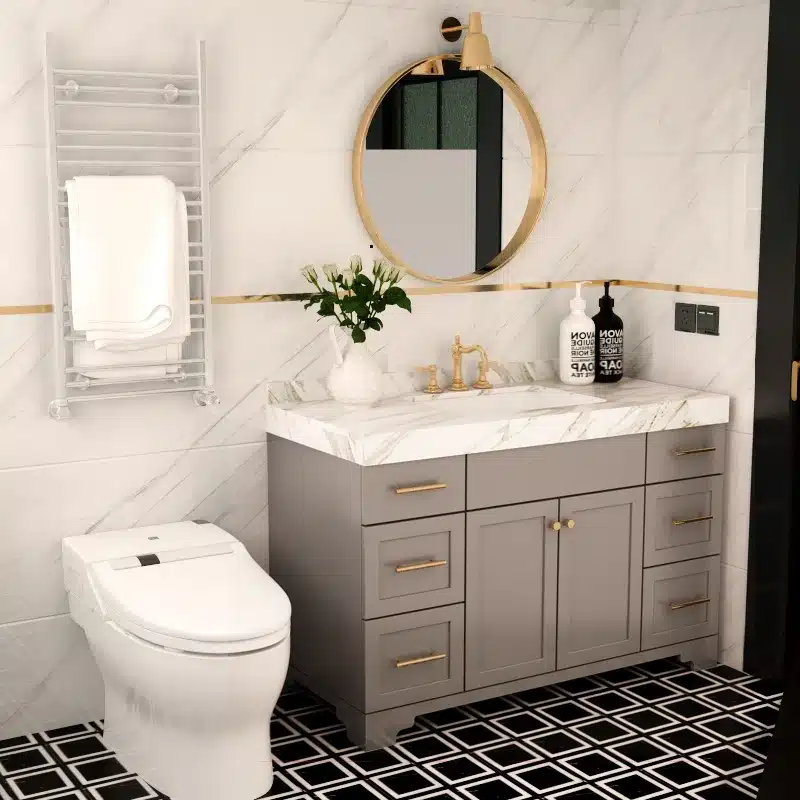
On a commercial vanity order, the hinge is the smallest line item and the one that generates the most maintenance calls. A hotel guest-room door cycles thousands of times a year, opened by people with no reason to be gentle, and public restrooms push that abuse further. When a door sags, rubs or hangs loose, guests see a furniture problem, but the failure almost always started at the mounting point. That makes the choice of vanity door hinge, clip-on or screw-on, a procurement decision rather than a hardware afterthought.
This comparison breaks down clip-on and screw-on mounting for commercial vanities: how each system attaches to the cabinet, how the two compare on installation speed, three-dimensional adjustment, door removal, sag resistance and total cost, and which test reports buyers should request before approving a shipment.
Clip-On and Screw-On Hinges Explained
Both systems belong to the concealed European-style hinge family. The arm carries the door, while the pivot itself hides inside a cup bored into the back of the door panel, typically 35 millimeters across. The two designs diverge at one point: how the arm attaches to the cabinet box.
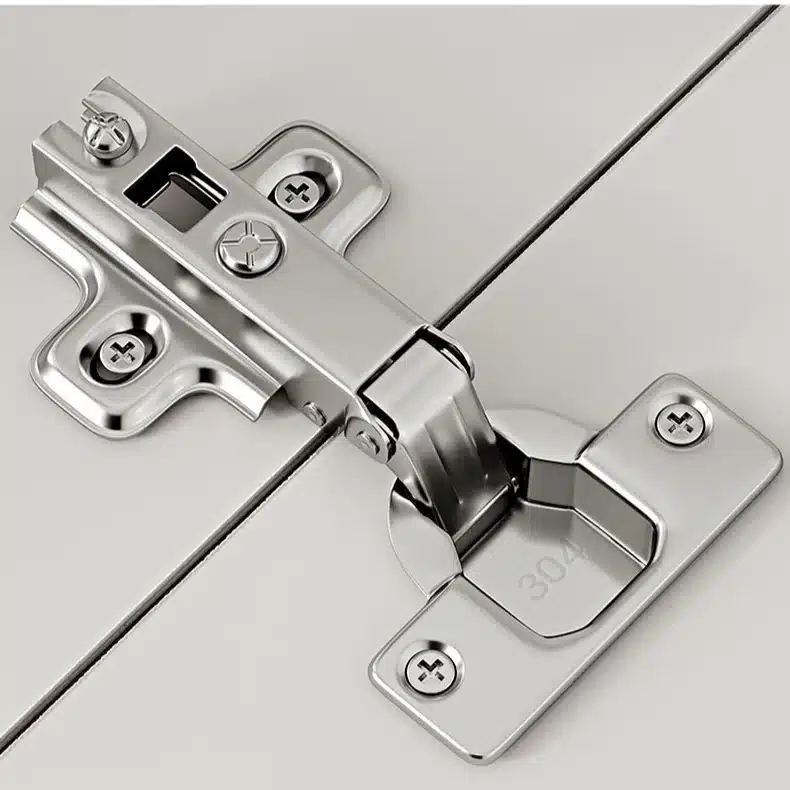
A screw-on hinge is the direct approach. The installer holds the arm against the cabinet panel or face frame and drives screws through its base into the substrate. Some versions slide onto a rail first and lock with screws, while the classic version uses no separate plate at all. Whatever the mounting style, the job is the one every hinge has done for centuries: a controlled pivot that carries the door’s weight into the frame. The load path is short: hinge, screw, wood.
A clip-on hinge splits the job into two parts. A mounting plate is screwed to the cabinet once, at the factory on production orders, and its position decides the door gap because the boring and plate placement are done by machine. The hinge arm carries a spring-loaded clip. The installer presses the arm onto the plate until it clicks, and a release tab or lever takes it off again in one motion. That click is why factories call these quick-install hinges, and why installation crews ask for them.
When you evaluate samples, test the clip the way an installer will use it. Press the arm onto the plate and release it twenty times. Listen for a consistent click, feel for side-to-side play once engaged, and check that the release tab still springs back cleanly. Then mount a door and lean on it gently: any flex you can feel by hand will read as a loose door within months of service. A hinge that passes this bench test still needs its paperwork, but it has earned the right to have paperwork.
Two confusions are worth clearing up before going further. First, clip-on versus screw-on describes the mounting, not the damping. Both mounting styles come soft-close or standard, because the damper is a separate mechanism inside the arm. Our Blum vs DTC hardware guide covers the brand question that usually arrives at the same time. Second, mounting depends on what the cabinet offers the screw. A frameless box offers a side panel, while a face-frame cabinet offers a hardwood stile, and the two accept screws differently. The frameless vs framed vanity construction guide explains the cabinet side of that decision.
One caution about clip designs. The spring clip is exactly the part where cost-focused factories cut corners: thin stampings, weak springs, loose tolerances. A poor clip feels solid on day one and walks loose by month six. Spec sheets will not reveal the difference. Only a sample tested in hand will, which is why sample testing belongs in every commercial order.
Why Commercial Bathrooms Punish Hinge Hardware
A residential vanity door might cycle a handful of times a day. A hotel guest-room door cycles every time housekeeping services the room and every time a guest reaches for a towel. A public restroom in a station or stadium can see hundreds of cycles on a single door in one day. The hinge absorbs every one of them.
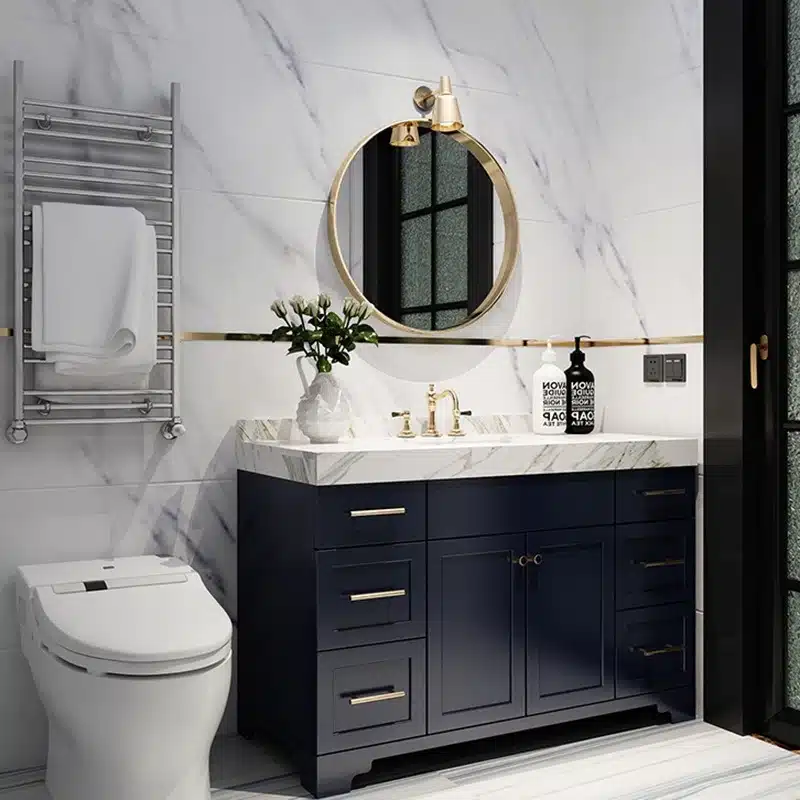
Moisture is the constant. Guest bathrooms hold steam, wet towels and condensation, and public restrooms get wiped down with disinfectants. Chloride-based cleaning agents attack plated finishes without pause, and rust streaks running down a door front read as neglect even when the cabinet itself is sound. Wet-room specifications lean toward 304 stainless steel hinges over plated zinc alloy for this reason. The alloy saves money on day one and spends it back on refinishing.
The loads are rude as well as frequent. Guests lean on doors. Children hang on them. Luggage clips corners on the way past. None of those forces appear in any design brief, but every shock travels through the mounting screws into the substrate. Each one widens the hole it sits in slightly, and that slow chewing is where sag begins.
Humidity swings add a quieter load. Door panels swell slightly in steam and shrink in dry air, and every dimensional move tugs at the mounting screws. Panels with stable cores handle this calmly, while panels built from thin particleboard transmit the movement straight into the screw holes. The hinge decision, again, cannot be separated from the cabinet decision.
The commercial consequence is visibility. A sagging door shows an uneven gap, rubs the cabinet face and eventually chips its own finish. Housekeeping notices, the punch list grows, and the maintenance budget quietly doubles. Choosing between clip-on and screw-on systems is really a question of which one survives this environment with fewer service calls, and none of it shows in a showroom. Hinge problems declare themselves months after handover, which is why the decision has to be made on paper, from duty ratings, test reports and mounting specifications, before the order ships.
Clip-On vs Screw-On Comparison for Commercial Projects
Six criteria decide most commercial hinge calls: installation speed, adjustability, door removal for service, sag resistance, unit cost and spare-parts simplicity. The table below compares the two systems on each one.
Clip-On vs Screw-On Hinges for Commercial Projects
| Criterion | Clip-On Hinge | Screw-On Hinge |
|---|---|---|
| Mounting method | Arm snaps onto a factory-screwed mounting plate | Screws driven through the hinge base into the cabinet |
| Installation speed per door | Seconds per hinge, no alignment hold | Minutes per hinge, held and aligned by hand |
| Three-dimensional adjustment | Cam screws tune all three axes after mounting | Limited; slots, shims or screw loosening |
| Tool-free door removal | Yes; release the clip and lift off | No; screws must be driven out |
| Sag resistance | Strong where plate screws and clip are quality parts | Direct metal-to-wood load path, simple and robust |
| Unit hardware cost | Higher; the clip mechanism adds parts | Lower; fewer components |
| Repeat service cycles | Designed for frequent removal | Screw holes degrade with repeated removal |
| Natural commercial fit | Hotels, tight install windows, serviced buildings | Budget projects, low-cycle areas, heavy doors |
The installation-speed row deserves numbers, so here is a worked example with nominal values. Take a 240-room hotel where each vanity carries two doors on two hinges each: 960 hinges. A screw-on installation, holding each hinge level while driving its screws, runs about three minutes per hinge in this example, roughly 48 crew-hours. The same job on clip-on hardware, plates already screwed at the factory, runs about 30 seconds per hinge, roughly 8 hours. That is 40 hours of carpentry on one project, before counting the alignment rework that hand-screwed doors usually need once the corridor lighting comes on. The figures are nominal, but the direction holds: the larger the room count, the more clip-on labor savings dominate the invoice.
Consistency matters as much as speed. Factory-mounted plates go on with jigs, so every door gap starts identical. Site-screwed hinges depend on the skill and patience of whoever holds them, and a corridor of hand-aligned doors rarely looks as uniform as a corridor of clipped ones. Guest rooms reward that uniformity, which is why hotel specifications pair clip-on hardware with stable cabinet construction. The plywood bathroom vanity range shows how the two sides of that specification work together at project scale.
Factory plate mounting is also an ordering instruction, not a favor. Specify that mounting plates ship pre-installed, with door boring done on the same production line, and confirm plate positions on the shop drawings before production starts. Retrofitting plates on site costs the same minutes that clip-on hardware is supposed to save.
Standardization pays off again at the spare-parts stage. One clip-on hinge and one mounting plate can cover an entire project, which keeps attic stock simple for the maintenance team. Doors are half the hardware story, by the way. Drawers take the other half of daily abuse, so it makes sense to settle undermount versus sidemount drawer slides while the bill of materials is still open.
Spec Hinges and Cabinets Together for Your Next Project
Browse this product, solution, or service page to explore relevant offerings.
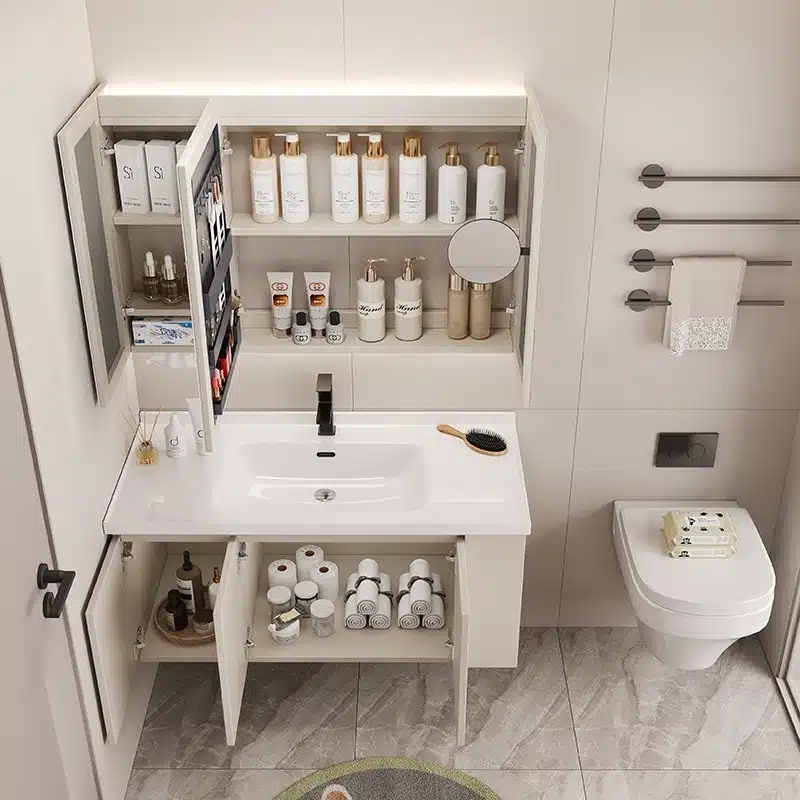
Adjustability, Door Removal and Sag Resistance
Three-dimensional adjustment sounds like a luxury until someone aligns two hundred doors in a row. Cabinet boxes shift slightly in transit, walls are never perfectly plumb, and a gap that measured right at the factory can read wrong once installed. Commercial specifications run two hinges per door as standard, and oversized fronts sometimes carry three, so every adjustment minute gets multiplied across the corridor.
Clip-on systems treat adjustment as routine. Cam screws on the arm and plate move the door in and out, up and down, left and right, while the door hangs in place. One person with a screwdriver can tune a hundred doors in a shift. Screw-on hinges usually require loosening the mounting screws, shifting the door, holding it and retightening: a two-person job done one door at a time, and each loosen-and-retighten cycle chews the screw holes slightly wider.
The adjustment order matters too. Tune the top hinge first, then the bottom, and check the reveal with a consistent spacer rather than by eye. Once the corridor reads even, walk it again with a driver to confirm every cam and plate screw is snug, because a cam left loose will drift back within weeks.
Door removal follows the same logic. Housekeeping deep-cleans behind doors. Plumbers need access to traps and supply lines hiding behind vanity panels. Damaged fronts get swapped without pulling the cabinet. A clip release handles all three in seconds with no tools. Driving screws out works too, but particleboard loses grip after three or four removal cycles, and the screw that once bit hard starts turning free. That is usually the moment a door gets declared broken, when the real failure is the mounting.
Sagging doors rarely fail at the knuckle. They fail where the screw meets the board.
On raw sag resistance, screw-on deserves credit. Its load path is short, hinge to screw to substrate, with no intermediate interface. A clip-on hinge passes the same load through plate screws and the clip engagement, and each added interface is one more place that can loosen. In practice, a quality clip-on mounted with the right screws holds a standard vanity door without measurable sag against a screw-on. Field sag almost always traces to missing screws, thin substrate or a clip from a cost-cut batch. The substrate matters more than the badge: plywood holds screws across repeated service cycles better than particleboard, which is one reason commercial specifications lean toward plywood boxes, offered in standard, boiling-water-resistant (BWR) and marine-grade for the wettest rooms, with E1 (0.1 ppm or less) and CARB (California Air Resources Board) Phase 2 panels.
The practical call for commercial guest rooms: quality clip-on hinges on plywood cabinets. For oversized solid-wood doors or vandal-prone public areas, the screw-on’s direct connection remains the conservative specification.
Cost Structure and Acceptance Testing
Unit price is the wrong place to start this decision. A clip-on hinge costs slightly more per piece because the clip mechanism adds stamped parts and a spring. Set against installed cost, the order often flips: the cheaper screw-on hardware gets paid for in slower installation, slower alignment and slower service for the life of the asset. On a rollout of a few hundred rooms, that labor difference frequently exceeds the hardware delta.
Whichever mounting wins, commercial acceptance should ride on documents rather than promises. Four belong in every order file:
- A salt-spray test report for corrosion performance. Check the recorded hours, the test standard cited and the appearance rating after exposure. A report that does not name the hinge model tells you nothing.
- An open-and-close endurance test report. Compare the cycles completed and the recorded failure mode against the traffic the site will actually see.
- A material grade declaration. 304 stainless is the wet-room benchmark, with 201 stainless and plated zinc alloy sitting below it. For plated parts, ask for the plating thickness.
- A screw specification. Thread and pilot matched to the cabinet material, because the wrong screw defeats even a good hinge.
In North America, the Builders Hardware Manufacturers Association (BHMA) publishes the A156 series of performance standards for building hardware, including cabinet hinges. Asking a supplier which standard a hinge is tested to, and requesting the matching report, separates manufacturers from traders quickly.
It is also the moment to vet the factory behind the hardware. Main Focus Cabinet, maker of MFBATH vanities, has produced cabinets since 2015 from a 10,000-square-meter facility in Changge, Henan, with a 95-person team and monthly capacity of 5,000 sets. Every unit passes a five-step inspection before packing, and third-party inspection by SGS or TÜV can be arranged ahead of shipment. Vanities carry a two-year whole-cabinet warranty, the return rate sits below 1 percent, and the company’s ISO 9001 and ISO 14001 certifications, first issued in 2017, remain active.
Plan for arrival checks as well. Pull a small sample of hinges from the first carton of each batch, clip them to their plates, drive the supplied screws into offcut board and hang a door. Photograph the results and file them with the test reports. A third-party inspection firm can run the same drill at the factory before the container is sealed, which is the cheaper moment to find a problem.
Buyers can request free samples, with sample lead time of 10 working days and production lead time of 20 to 30 days. The minimum order quantity (MOQ) is 15 sets per model, color and size, with mixed-container loading supported, and shipments move Free On Board (FOB) from Qingdao. Hardware specifications, from mounting type to steel grade to damping, get locked at the order stage. That is exactly where this checklist belongs: in the purchase contract, not in a later email thread.
More hardware and cabinet-construction comparisons live in the product knowledge library.
Frequently Asked Questions
Do clip-on hinges hold heavy vanity doors as securely as screw-on hinges?
For standard vanity doors, yes. A quality clip-on screwed properly to its mounting plate carries normal loads without working loose, and field sag usually traces to thin substrate or loose plate screws rather than the clip itself. For oversized solid-wood doors or vandal-prone areas, the screw-on’s direct metal-to-wood connection is the safer specification.
What test reports should I request before approving a commercial hinge order?
Request the salt-spray test report for corrosion, the open-and-close endurance test report for service life, and a material grade declaration, with 304 stainless as the wet-room benchmark. Check that each report names the hinge model and the test standard it follows. If a supplier hesitates on these documents, treat the hesitation as an answer.
Can clip-on hinges be ordered with soft-close damping?
Yes. The damper is a separate mechanism from the mounting method, so clip-on and screw-on hinges both come soft-close or standard. Guest-room noise comfort is part of that call, and the soft-close and sound-dampening technical guide covers how the mechanism works.
Match the Hinge to the Service Plan
Clip-on and screw-on hinges both keep commercial vanity doors swinging. The difference is how they treat the people who install, align and service those doors over years. For hotel rollouts and high-traffic restrooms, clip-on’s fast installation, tool-free removal and cam adjustment usually win on total cost. Screw-on holds its ground where budgets are tight, cycles are low or doors are heavy.
- Clip-on wins installation speed, three-dimensional adjustment and repeat door removal. Screw-on wins unit price and the direct load path.
- Field sag traces to substrate and screws more often than to hinge design, and plywood boxes survive repeat service cycles.
- Acceptance rides on documents: salt-spray report, endurance report, material grade declaration and screw specification.
- Lock mounting type, steel grade and damping into the purchase contract alongside cabinet construction.
If a hotel or public-restroom project sits on your calendar, request samples early and test the clip mechanism with your own hands. Ten working days of sample lead time costs less than a corridor of sagging doors.





0 Comments