
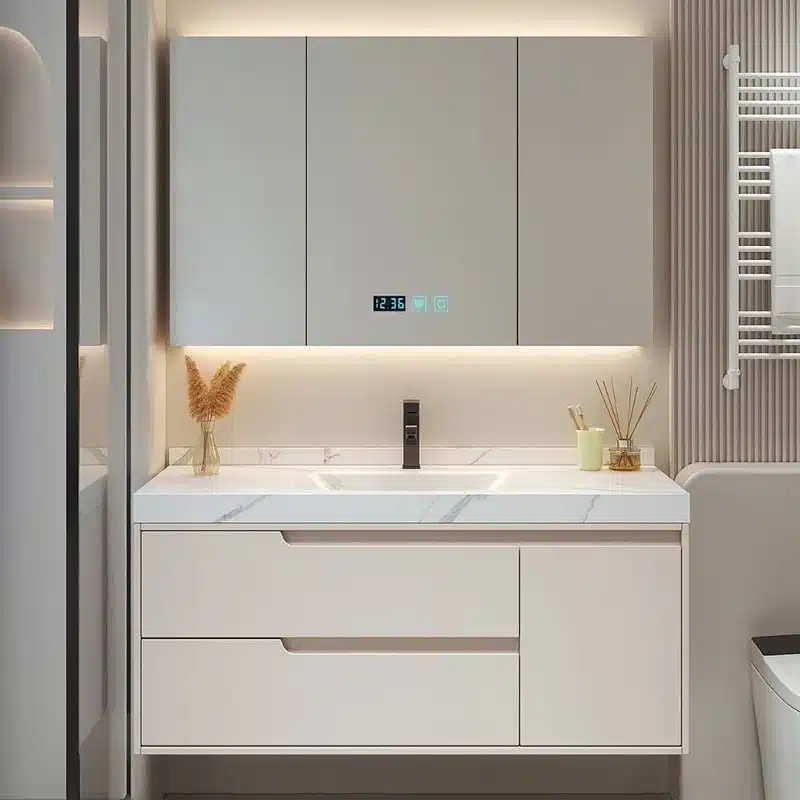
The carton lands on the warehouse floor, and your sample order suddenly becomes real. A bathroom vanity from a Chinese factory sits in front of you, and with it the question every first-time importer meets: what do I check before I sign this off? Approving on looks alone feels fast, but it converts a small oversight into a container-scale problem weeks later. The check you skip at the sample stage is the one that shows up in your first full shipment.
This guide walks you through the bathroom vanity sample approval process step by step, using the same standards MFBATH applies on its own production floor. Main Focus Cabinet (MFBATH), a bathroom vanity manufacturer in Changge, Henan, founded in 2015, runs 10,000 square meters with 95 employees and a monthly capacity of 5,000 sets. Samples are free and ship within 10 working days, so the approval side of the calendar usually decides your timeline. You will find the exact checks, the pass marks, and the documents to keep before production starts.
Key Takeaways
- Free samples leave MFBATH within 10 working days, so the approval step, not the factory, controls your calendar.
- Every MFBATH product passes 5 quality checks on the floor; your sample should survive the same five before you sign.
- The MOQ is 15 sets per model, color, and size, and mixed loading lets you test several models in one container.
- A signed, photographed sample becomes the reference for bulk production, which runs 20–30 days after approval.
- Third-party inspection with SGS or TÜV needs advance notice; book it when production starts so the inspector’s calendar matches your 20–30 day run.
- MFBATH reports a return rate below 1% across 1000+ dealers in 20+ countries — the record your approval should confirm.
Table of Contents
- Why the Sample Stage Decides Your Whole Order
- The Sample Request: What to Send the Factory
- The 7-Step Approval Process
- Sample Checklist: 10 Checks Before You Approve
- From Sample to Mass Production: Protecting Consistency
- Frequently Asked Questions
- The Bottom Line
Why the Sample Stage Decides Your Whole Order
The sample is the only physical evidence you hold before production money moves. A quote can promise 20–30 day lead times and an MOQ of 15 sets, but those numbers stay paper until a cabinet sits on your floor. Everything after approval — color, size, material, hardware, packaging — inherits whatever you accepted. A loose approval chain here puts the whole container at risk.
The scenario repeats in sourcing reports. An importer approves a plywood vanity sample in good light, signs nothing, and never photographs the drawer joints. Bulk production runs 20–30 days, the container lands, and the first dealer complaint is about drawer fronts that swell in a humid bathroom. The factory points to the sample you approved, and the 2-year whole-cabinet warranty opens a claim cycle instead of a sales cycle.
Approval locks four variables: dimensions, materials, finish, and hardware. Change any one after sign-off, and the factory re-quotes, re-cuts, and re-presses at your cost. That is why the sample request and the approval must carry the same detail as the purchase order (PO).
What a Sample Can and Cannot Prove
A sample proves workmanship, materials, and finish on one unit. It cannot prove batch consistency, packaging discipline, or how the factory behaves at container scale. That gap is why experienced importers treat the sample as the first step of quality control (QC), not the end of it. The QC methods behind a factory’s floor matter more than the sample photo in your inbox.
Compliance becomes physical at the sample stage, so name your standards before the first panel is cut. MFBATH holds ISO 9001 and ISO 14001, both certified in 2017 with validity confirmed in 2025, and carries CE and UL for applicable product lines. The International Organization for Standardization (ISO) 9001 quality management standard is the framework behind the factory’s process controls. If your market requires ADA or CSA compliance, state it in the sample brief. The factory then designs the cabinet to meet it, and the sample can prove it.
The Sample Request: What to Send the Factory
A vague request produces a vague sample. One line that says “send me a sample” gives the factory nothing to build against, and the resulting cabinet will match the factory’s guess instead of your market. The brief below prevents most of the rework you would otherwise meet.
Start with the product identity: PVC, plywood, solid wood, or stone slab construction. Choose a smart light-emitting diode (LED) mirror or a standard one, and a stone slab sink or a specified alternative. MFBATH builds these lines with 40,000+ custom combinations, so your brief should lock every visible choice. Add the exterior dimensions, the color code from the factory catalog, the hardware finish, and the carton quantity you plan to ship. The minimum order quantity (MOQ) of 15 sets per model, color, and size means each combination you request becomes its own approval line.
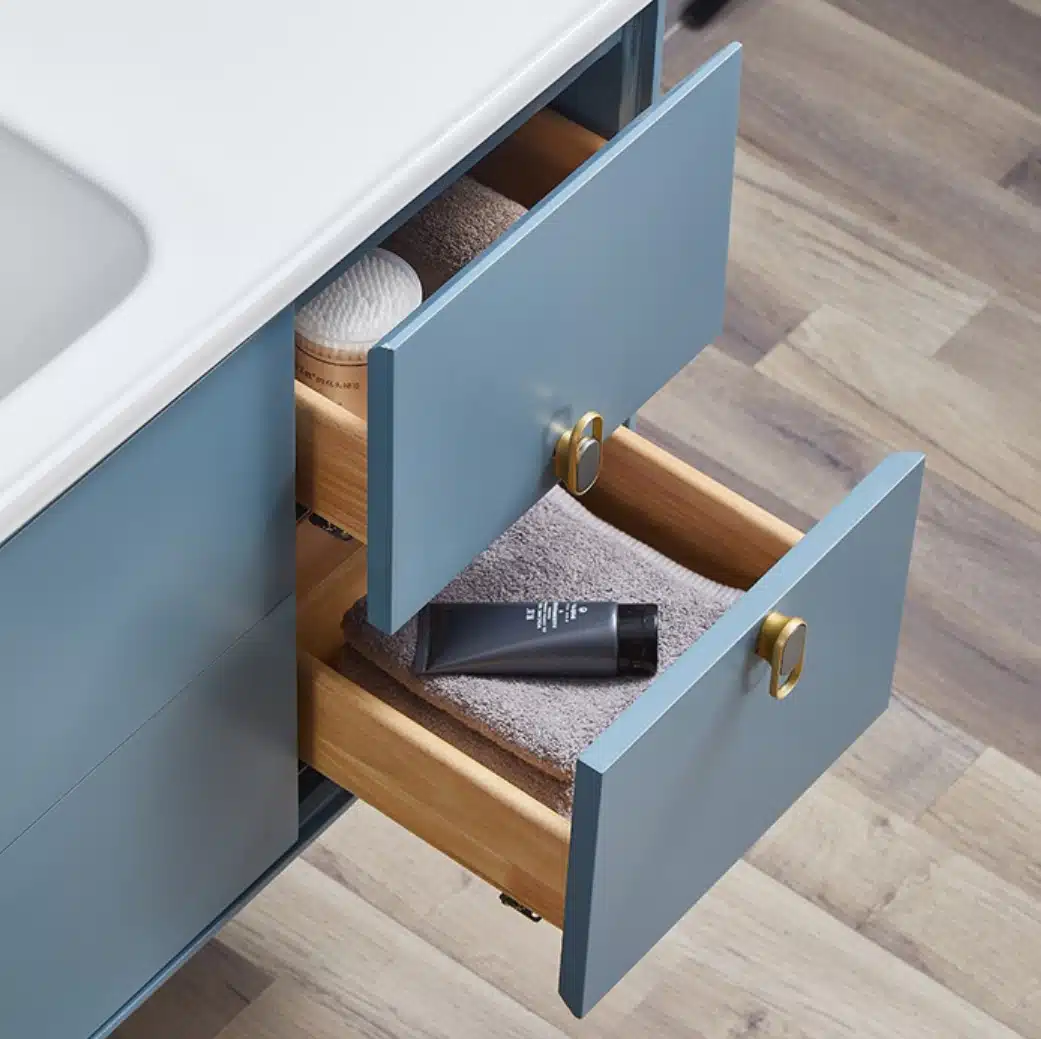
Compliance requirements belong in the sample request, not in a later email. If your market needs the E1 emission class at or below 0.1 ppm, name that limit before the sample is cut. The same goes for California Air Resources Board (CARB) Phase 2 and Toxic Substances Control Act (TSCA) Title VI. MFBATH also offers Forest Stewardship Council (FSC)-certified wood and low-VOC finishes as options when the brief names them. A sample built to the standard you quote costs nothing extra to request; adding the standard later costs a rework cycle.
The Sample Brief in Six Fields
Six fields cover almost every vanity sample order. Fill each one with the factory’s catalog codes where they exist. Leave a field blank only when you are deliberately delegating the choice.
- Construction: PVC (100% waterproof), plywood, solid wood, or stone slab
- Dimensions: width, height, depth, and door or drawer layout
- Finish: color code, paint type, and low-VOC requirement
- Mirror and sink: smart LED mirror, stone slab sink, or your specified alternative
- Hardware: hinge type, soft-close, handles, and metal finish
- Compliance: E1, CARB Phase 2, TSCA Title VI, FSC wood, or ADA and CSA needs
Send the brief in a written form the factory can quote against. Verbal calls produce memories, not records, and memories disagree after a dispute starts. The trial order guide for 15-set MOQs shows how to pair this brief with a small production run so the approval and the order share one specification.
One warning before you press send. Treat each color, size, and material combination as a separate approval line, because the MOQ applies per model, color, and size. Custom sizes and colors also start at 15 sets per configuration. A two-color order is two approvals, two retained samples, and two QC records, even inside one container.
The 7-Step Approval Process
The bathroom vanity sample approval process works as a fixed sequence, because every step feeds the next. You unpack before you measure, you measure before you judge the finish, and you photograph everything before you sign. The seven steps below follow that order, and each one carries a decision standard.
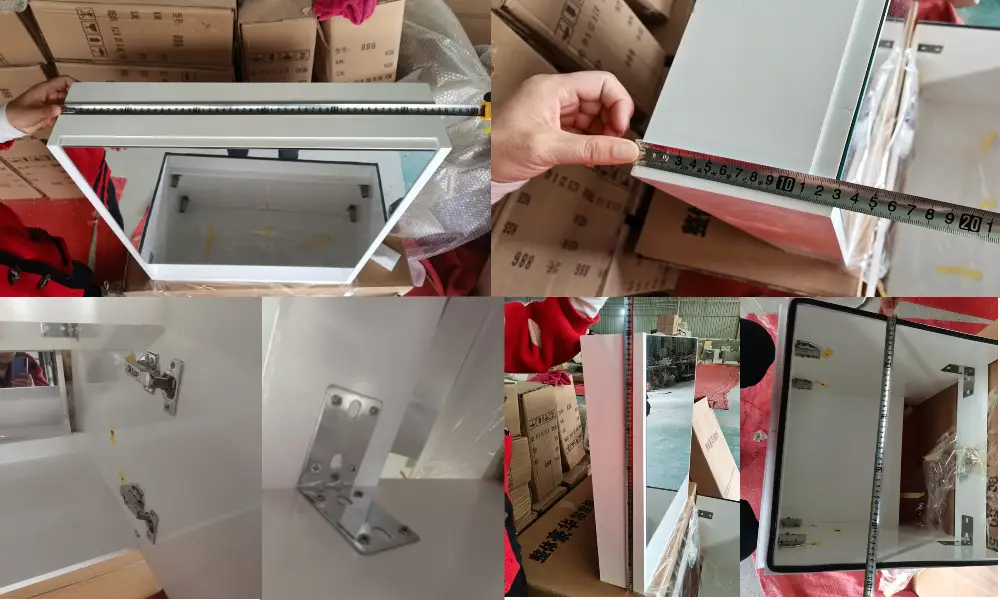
Step 1: Unpack and inventory. Remove the carton layer by layer and check for transit damage before you judge the cabinet. Match the packing list against the carton contents, because hinges, handles, mirror, and accessories ship separately. Photograph the carton and the contents before anything moves.
Step 2: Measure against the PO. Run a tape over width, height, and depth and compare them with the PO. Any deviation matters when the cabinet must sit between existing walls or under a fixed sink line. Mark a mismatch in writing on the same day you find it.
Step 3: Inspect materials and construction. Check the panel core, the edge sealing, and the joints on every door and drawer. On PVC cabinets, confirm the 100% waterproof claim by checking the edge bands for gaps; on plywood, look for delamination at the corners. Clean edges and square frames are the visible result of a factory’s 5-check discipline.
Step 4: Judge the finish in your lighting. Paint color shifts between the factory workshop and your showroom, so compare the sample with your color code under the light your customers will use. Look for orange peel, drips, and color banding on the faces, not just the front panel. Low-VOC finishes should smell neutral, not chemical.
Step 5: Test hardware and functions. Open and close every door, and run every drawer through its full travel with the soft-close engaged. Test the smart LED mirror wiring, the touch switch, and the stone slab sink surface for chips. Hardware is where vanity claims usually start, so test the sample the way a guest in a hotel bathroom would.
Step 6: Run the odor and emission check. Hold the doors closed for a few hours, then open the cabinet and smell the interior. A sample built to the E1 emission class at or below 0.1 ppm and CARB Phase 2 should not irritate your eyes or nose. Treat a strong solvent smell as a failed test.
Step 7: Document, then sign off. Take photos of every face, the interior, the back panel, the hardware, and the carton, with the PO number in frame. Label the sample with the approval date, because it becomes the reference for bulk production. Send the factory a written approval that names the accepted items and any conditional fixes; verbal approval is not a record.
The seven steps compress into a decision table your team can run without rereading this article. Each row names the step, the core check, and the pass mark. Print it, and keep the signed copy with the retained sample.
| Step | Core Check | Decision Standard |
|---|---|---|
| 1. Unpack and inventory | Transit damage, packing list match | Carton and contents photographed; damage logged in writing |
| 2. Measure against PO | Width, height, depth | Dimensions match the PO; mismatches recorded the same day |
| 3. Materials and construction | Panel core, edge sealing, joints | Clean edges, square frames, no delamination |
| 4. Finish and color | Paint, color code, low-VOC | Color matches the code in your lighting; no drips or orange peel |
| 5. Hardware and functions | Doors, drawers, soft-close, LED mirror | Smooth travel, damping on every cycle, wiring works |
| 6. Emissions | Interior odor, E1, CARB Phase 2 | Neutral smell; E1 at or below 0.1 ppm and CARB Phase 2 as specified |
| 7. Documentation | Photos, retained sample, written approval | Signed approval names accepted items and fixes |
Move From Approved Sample to Full Production
Browse the product range behind the sample brief and match each configuration to your market before production starts.
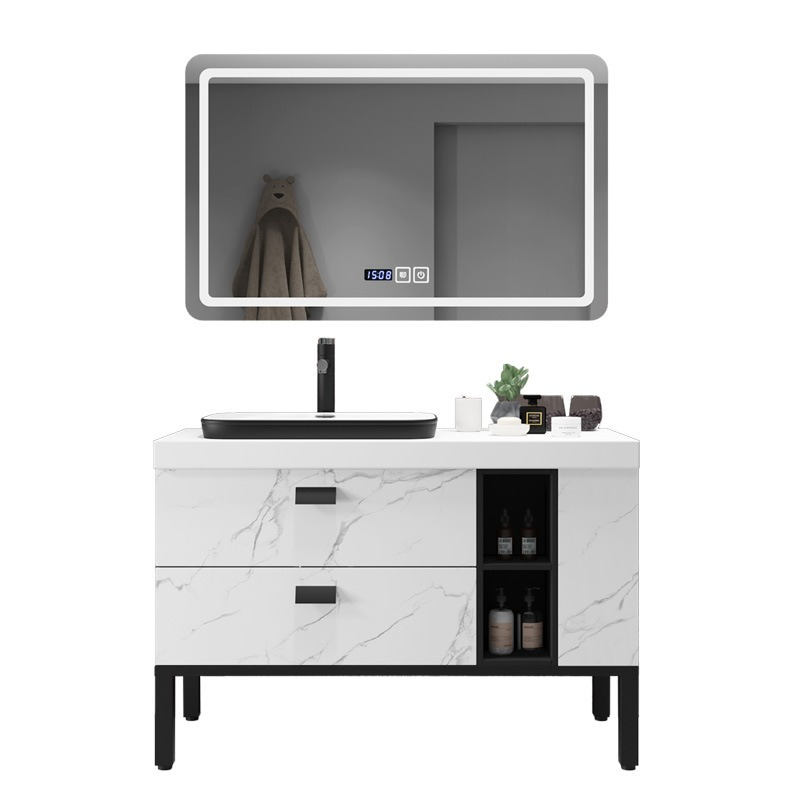
Sample Checklist: 10 Checks Before You Approve
The 10-point checklist below turns the bathroom vanity sample approval process into a single sign-off gate. Run it once on arrival, then once more before you write the approval email. Two passes catch what one emotional look misses.
Each check has a pass mark, and a fail on any line is a written issue, not a negotiation. The printable sample approval checklist pairs with this table, so your warehouse team marks the same standards you reviewed here. Use one checklist per sample, and date every signature.
| Check | Pass Mark |
|---|---|
| 1. Carton condition | No crushing or moisture staining; photos taken |
| 2. Packing list match | All parts and accessories present and accounted for |
| 3. Dimensions | Match the PO; fits the planned installation space |
| 4. Construction | Square frames, sealed edges, no joint gaps |
| 5. Material identity | Core and panels match the requested PVC, plywood, solid wood, or stone slab |
| 6. Finish and color | Color code matched under your lighting; no visible defects |
| 7. Hardware | Doors and drawers cycle smoothly; soft-close works every time |
| 8. Mirror and sink | Smart LED mirror functions; stone slab sink surface is intact |
| 9. Emissions | Neutral odor; E1 at or below 0.1 ppm, CARB Phase 2, and TSCA Title VI as specified |
| 10. Documentation | Photos stored, retained sample labeled, written approval sent |
Run the table in order and sign each line. A sample that passes all ten still needs the factory’s retained copy and your photos to protect the bulk run. The price tier guide shows what each approved configuration should cost at volume, so your sign-off also sets your negotiation range.
From Sample to Mass Production: Protecting Consistency
Approval is a midpoint, not a finish line. The gap between one approved cabinet and a 5,000-set monthly capacity is where consistency is won or lost. Three controls close that gap: a retained sample, a first article check, and third-party inspection. The factory’s own numbers give each control a concrete shape: samples in 10 working days, bulk production in 20–30 days, and a 2-year whole-cabinet warranty on the back end.
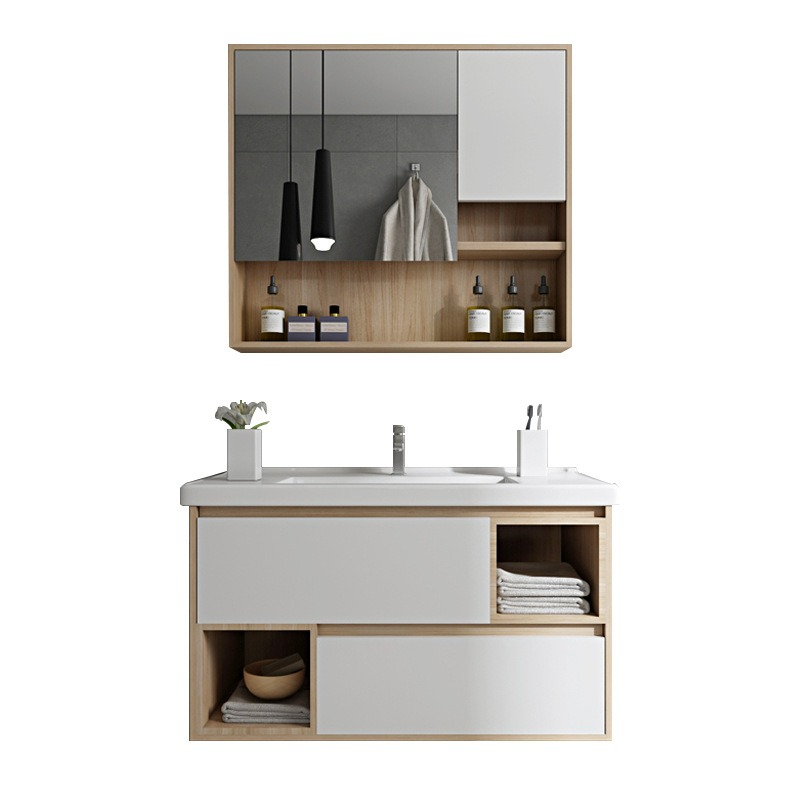
Retain the Sample, Both Sides
Keep your approved sample, and ask the factory to keep its copy, labeled with the same approval date. That pair becomes the visual contract for the bulk run: every panel, hinge, and finish comparison starts from them. Ask for the retained copy in writing, because a factory that resists the request has a reason you should hear before production starts.
First Article Inspection
When bulk production starts, the first finished cabinet is the one to check hardest. Compare it against the retained sample and your photos before the line continues, because defects compound faster than corrections. MFBATH runs 5 checks per product before packing, so ask for the first article’s QC record and expect it to exist.
Third-Party Inspection Before Loading
Third-party inspection is the buyer’s own QC layer, and it belongs before loading, not after arrival. MFBATH supports inspections by SGS, TÜV, and similar agencies when they are arranged in advance, because the inspector’s calendar sets the date. Book the slot when production starts, and hand the inspector your approved checklist as the reference standard.
The container then moves under published terms: free on board (FOB) Qingdao Port, 30% prepayment, and the balance within one week of the draft bill of lading. Mass production turns one approved cabinet into a repeatable output only when the process is documented, and your sample approval is that document. The published lead times — samples in 10 working days, bulk in 20–30 — keep the sequence predictable.
Reality check: MFBATH reports a return rate below 1% across 1000+ dealers in more than 20 countries. That record is the factory’s, and your sample approval is how you protect your share of it. Treat the checklist, the retained sample, and the inspection booking as one system. More sourcing playbooks, including lead times and document standards, live in the purchase guide library.
Frequently Asked Questions
How long does it take to receive a bathroom vanity sample?
MFBATH ships samples free within 10 working days of a confirmed sample brief. Add shipping time to your address, then run the 10-point checklist before you approve. The approval step, not the factory, usually sets the rest of your calendar.
What should I do if the sample does not match the sample brief?
Document the difference with photos and a written list of the mismatched items, then send both to the factory in the same week. A factory that works to a 15-set MOQ and a 10-working-day sample cycle expects to rework on a written record. A verbal complaint has no file to attach the fix to.
Can I approve a bathroom vanity sample from photos alone?
Photos are a checkpoint, not an approval. Color, edge sealing, and hardware feel cannot be judged from an image, so sign only the physical cabinet in hand. Keep the photos regardless: they become the comparison set for the first article and the third-party inspector.
The Bottom Line
The bathroom vanity sample approval process decides more of your order than any email that follows it. Run the seven steps, pass the ten checks, photograph everything, and sign in writing, then hand the same standard to the retained sample and the third-party inspector. MFBATH’s free samples leave within 10 working days, so the calendar works in your favor from the first request. Send the sample brief with all six fields filled, and treat the approved cabinet as the contract it is.




0 Comments