
The bathroom vanity drawer soft close mechanism earns its keep at 3 a.m. A guest slides a drawer shut in a hotel corridor, and the damper catches the final inches instead of letting the drawer slam the frame. In commercial bathrooms that quiet catch happens hundreds of times a day, and every silent cycle protects the cabinet front, the drawer box, and the guest’s sleep. When the mechanism fails, the same drawer announces itself to every room nearby.
Main Focus Cabinet (MFBATH), a bathroom vanity manufacturer in Changge, Henan, founded in 2015, builds soft-close doors and drawers as standard options on its PVC vanities. The factory runs 10,000 square meters with 95 employees and a monthly capacity of 5,000 sets. This guide explains how the mechanism works, what testing proves, and what bulk buyers should verify before a container ships.
Key Takeaways
- Soft-close doors and drawers are standard options on MFBATH PVC vanities, with custom hardware programs for project specifications.
- Free samples ship within 10 working days, so you can test the damper action on a physical drawer before you commit to bulk.
- Every product passes 5 quality checks on the floor, and a lab test rig performs soft-close damping tests on production hardware.
- The MOQ is 15 sets per model, color, and size, and mixed loading lets you combine several drawer configurations in one container.
- The 2-year full-cabinet warranty covers hardware, and MFBATH reports a return rate below 1% across 1000+ dealers in 20+ countries.
- ISO 9001 and ISO 14001 have been certified since 2017, with validity confirmed in 2025; CE and UL marks are held for applicable product lines.
Table of Contents
- Anatomy of a Soft-Close Drawer
- How the Damping Action Works
- Under-Mount vs Side-Mount Slides for Vanity Drawers
- What Testing Tells You
- What Bulk Buyers Should Verify Before Ordering
- Frequently Asked Questions
- The Bottom Line
Anatomy of a Soft-Close Drawer
A bathroom vanity drawer soft close mechanism has two parts that work as one: the slide that carries the drawer and the damper that slows it down. The slide handles travel, weight, and alignment. The damper handles the final inches of the closing motion. Together they replace a hard slam with a controlled stop.
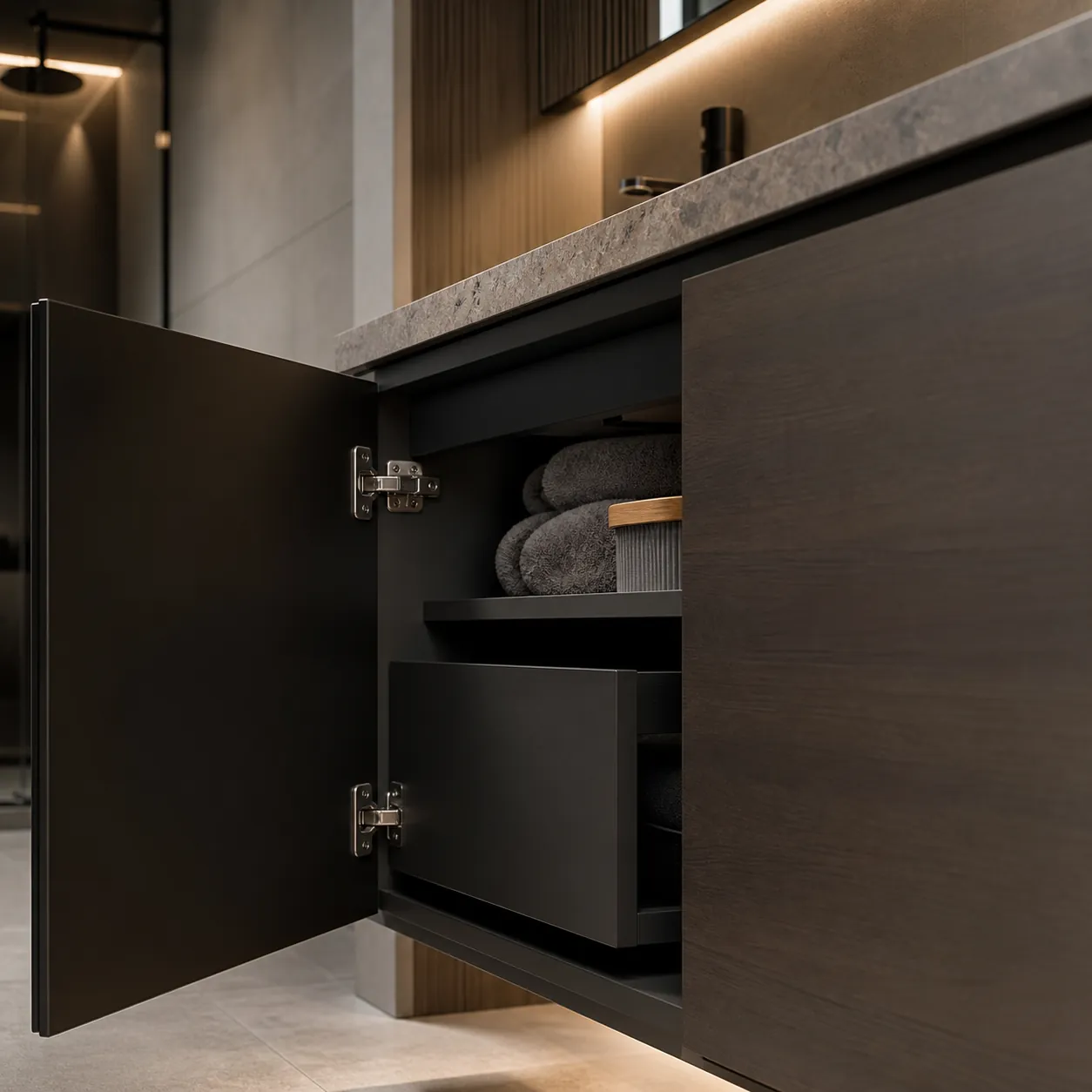
Slides come in two mounting families. Under-mount slides fix under the drawer box, so the hardware stays out of sight and the drawer appears to float inside the cabinet. Side-mount slides attach to the drawer sides and the cabinet frame, and they show a metal rail on each side when the drawer is open. Both families accept a damper, and the mounting choice changes how the drawer feels and how much it can carry.
The damper and the drawer must be matched. A damper tuned for a light drawer stops a loaded one too abruptly, and an oversized damper makes an empty drawer feel sluggish. Quality hardware is specified for a drawer weight range, and the factory sets the mechanism for the cabinet size it ships. That is why the sample must carry the same drawer box, hardware, and loading as the production unit.
Where the Damping Happens
The damper sits at the rear of the slide and engages the drawer only in the final inch or two of travel. A small arm or catch connects the damper rod to the drawer box as the drawer nears the closed position. From that point the damper controls the drawer speed until the drawer seats against the frame. The front of the drawer never meets the cabinet at speed, which is why the whole unit stays quiet.
What Wears Out
Seals and fluid age first. A hydraulic damper depends on a sealed cylinder of oil, and a worn seal lets oil escape or air enter, so the damping weakens and the drawer snaps shut. Rollers and bearing points on the slide wear as well, and an overloaded or misaligned drawer wears its slide faster than a lightly used one. Busy commercial bathrooms accumulate that wear quickly, so cycle life matters as much as initial feel.
How the Damping Action Works
A fluid damper is a piston inside a sealed tube of oil. When the drawer pushes the piston rod, the piston moves through the oil, and the oil escapes through a small opening around or through the piston. That restriction creates resistance, and resistance slows the drawer. Move the piston slowly and the oil flows easily; move it fast and the oil fights back.
The resistance grows with closing speed, which produces the soft-close curve. The drawer travels freely for most of its run, then the damper engages and the speed falls smoothly to zero at the frame. A well-tuned damper settles the drawer instead of stopping it abruptly. You read the difference as a controlled glide rather than a catch or a bounce.
Temperature shifts the feel. Hydraulic oil thickens when it is cold, so the same damper feels firmer in an unheated storage unit and lighter in a warm bathroom. Quality dampers use oil that keeps a stable viscosity across normal room temperatures, and a mechanism that works in the factory must work in your climate. Note the temperature range on the data sheet, and test the sample in conditions close to the final installation.
Commercial bathrooms multiply the value of that curve. In a busy hotel, the bathroom vanity drawer soft close mechanism pays for itself several times a night, because every quiet close protects guest sleep and the cabinet veneer. A fast-closing drawer also risks pinched fingers, a real concern in public washrooms. The controlled stop takes that risk out of the fixture.
The engineering behind this behavior is well documented. Drawer system manufacturers publish mounting specs, load tables, and damping curves, and Blum’s product resources are a practical reference when you compare mechanisms across suppliers. Use the same data sheet format for every factory you evaluate, so the comparison stays direct. A supplier that cannot produce the document usually cannot produce the test either.
Under-Mount vs Side-Mount Slides for Vanity Drawers
Mounting choice decides how the bathroom vanity drawer soft close mechanism feels in the showroom and on the job site. Under-mount slides ride beneath the drawer box, hidden from view, and carry the load from below. Side-mount slides bolt to the drawer sides and the cabinet frame, showing a rail on each side when the drawer opens. The two designs differ in load behavior, damping feel, and typical use.
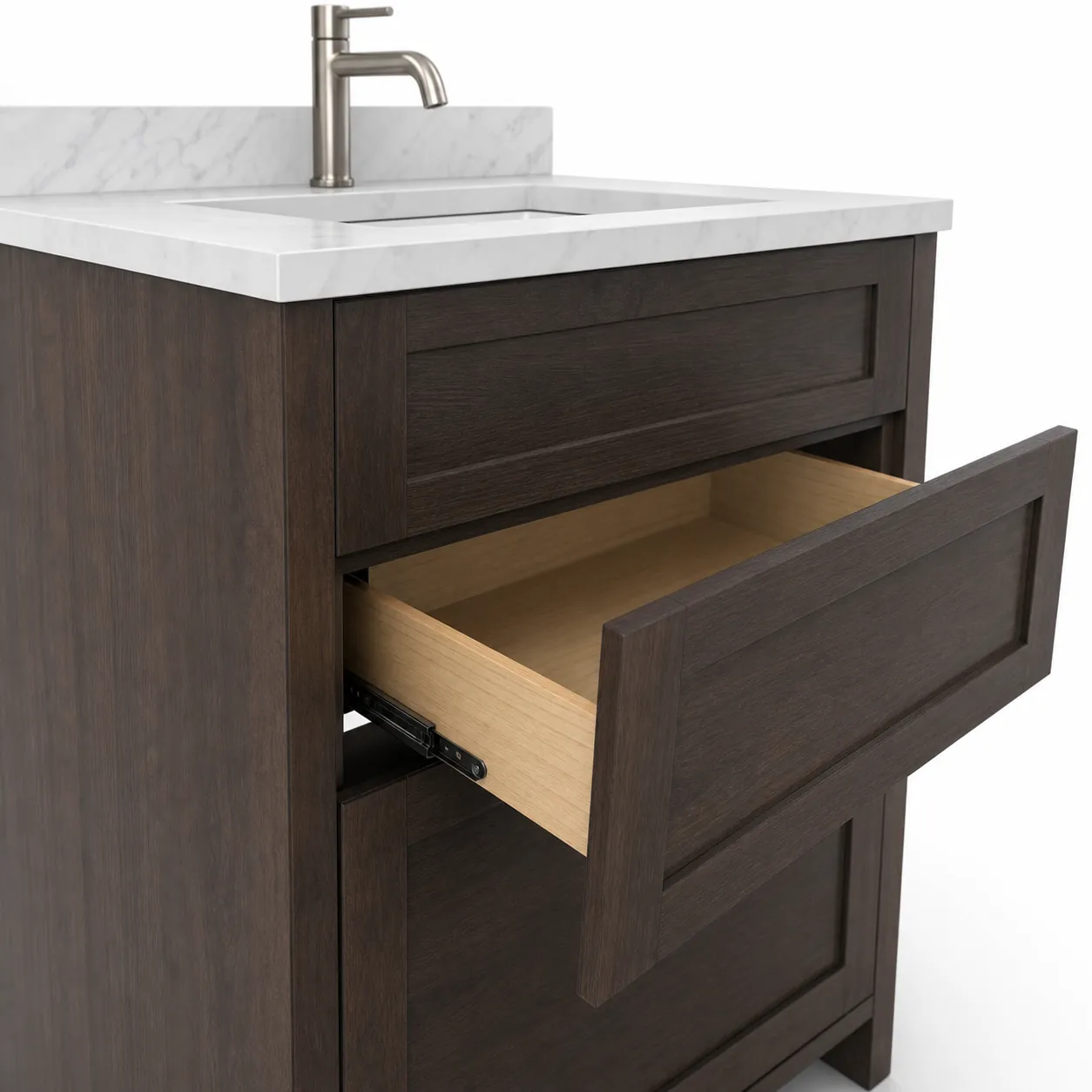
Load behavior separates the designs first. An under-mount slide supports the drawer across its full width from underneath, which handles heavier loads and keeps the drawer stable at full extension. A side-mount slide carries the weight on two side rails, so its rating depends on the rail size and the fixing points. Full-extension travel, which lets the drawer pull completely out of the cabinet, is standard on quality under-mount designs and common on premium side-mount rails.
| Type | Load Behavior | Damping Feel | Typical Use |
|---|---|---|---|
| Under-mount soft-close slide | Carries the drawer from below; stable at full extension under heavier loads | Integrated hydraulic damper; smooth stop in the final inches | Hotel and apartment vanities, project bathrooms |
| Side-mount slide | Weight rides on two side rails; rating follows rail size and fixing points | Damper mounts on the rail or the drawer back; feel varies by damper size | Budget lines, retrofit cabinets, value production runs |
| Side-mount, non-damped slide | Same side-rail layout without damping hardware | None; the drawer slams at the end of travel | Lowest-cost builds, utility cabinets |
For vanity drawers in commercial bathrooms, under-mount with an integrated hydraulic damper is the better choice. The hardware stays out of sight, the drawer carries towels and toiletries without sagging, and the damping stays consistent through full extension. Side-mount rails earn their place in budget lines and retrofit work, where visible rails are acceptable and price drives the spec. The full under-mount vs side-mount drawer slides comparison covers load, retrofit, and replacement cases in more depth.
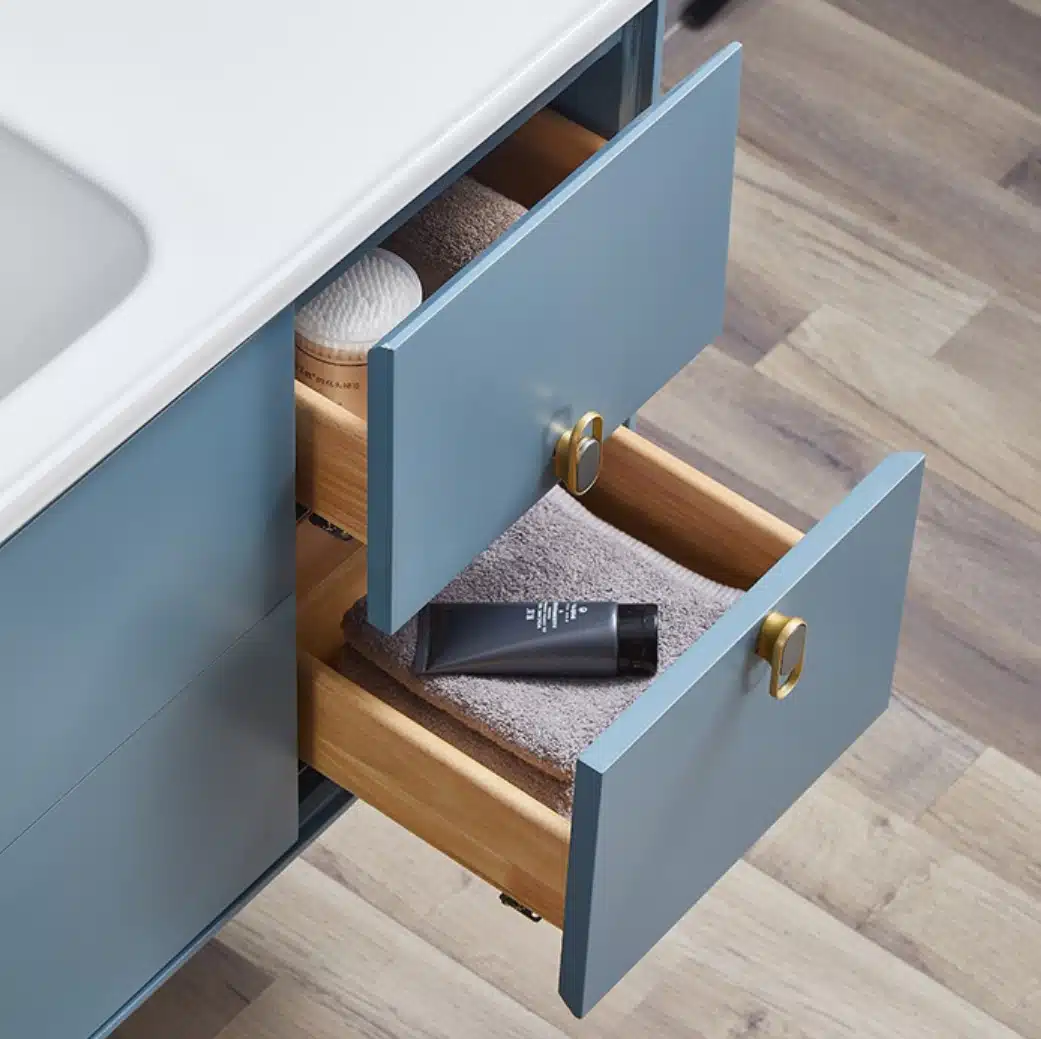
MFBATH fits soft-close doors and drawers as standard options on its PVC vanities and runs custom hardware programs for project specifications. Drawer hardware options include modern handles, classic knobs, and pull bars in chrome or brushed nickel, so the mechanism and the pull get specified together. The same options apply across the bathroom vanity product range, which keeps the hardware story consistent from sample to container.
Service access matters once the vanity is installed. Quality slides release with a clip or lever, so the drawer box lifts out and the damper can be replaced without pulling the whole cabinet. Ask for the release mechanism on the sample, and confirm that spare dampers match the production hardware. In a hotel with hundreds of rooms, a drawer that can be serviced in place keeps maintenance costs low.
Drawer Systems That Pass Real Testing
Browse this product, solution, or service page to explore relevant offerings.
What Testing Tells You
A soft-close claim is only as strong as the test behind it. MFBATH operates a lab test rig that performs soft-close damping tests on production hardware, measuring how the damper behaves through repeated open-close cycles. The rig gives the factory a measurable answer to the question every buyer should ask: does this drawer still close softly after real use?

The rig records what your hand notices in the first few seconds: the point where the damper engages, the closing time, and whether the drawer bounces or settles. It also tracks the force needed to start the drawer and the consistency of the stop from cycle to cycle. A damper that weakens under heavy use fails a test that a fresh sample would pass.
Ask what the test report contains before you order. A useful report names the cycles completed, the failure mode if one occurred, the sample size, and the date of the run. MFBATH’s lab records sit alongside the 5 quality checks per product, and the factory can share the damping results for the hardware it installs. Request the report for the exact model you are buying, not a catalog average.
Cycle testing sets the industry expectation. Slides and dampers are rated for tens of thousands of open-close cycles, and 100,000-cycle tests are a common industry spec for quality hardware. Treat those figures as the market’s benchmark rather than a factory promise, and ask which standard the supplier tests against. The guide to soft-close hinge cycle life in commercial bathrooms applies the same logic to the doors above the drawers.
Ask the factory for the QC records behind its 5 quality checks per product, and for the damping test results the lab rig produces. MFBATH supports third-party inspection by SGS or TÜV when it is arranged in advance, so your own inspector can repeat the damping checks on the sample. ISO 9001 and ISO 14001 have been certified since 2017, with validity confirmed in 2025, and CE and UL marks are held for applicable product lines.
Testing language varies between factories, so compare mechanisms with the same questions every time. The product knowledge library keeps hardware terms and checklists consistent across suppliers and projects. Bookmark the terms you will repeat in purchase orders: damper type, slide mounting, cycle rating, and load rating. A shared vocabulary shortens the sample round and prevents spec drift between order and delivery.
What Bulk Buyers Should Verify Before Ordering
Before you commit to a container, verify the bathroom vanity drawer soft close mechanism on paper and in hand. The spec sheet names the damper type and the slide; the sample proves they work. Run the checklist below against both, and treat a missing answer as a reason to keep asking.
- Damper type on the spec sheet: hydraulic, integrated or add-on, and which slide it mounts to.
- Slide load rating: the rated load for the drawer size you order, stated in the factory’s data sheet.
- Replacement parts: dampers and slides available as spares, so a field failure becomes a swap, not a cabinet replacement.
- Sample test: free samples ship within 10 working days, and the damping check runs on the physical drawer, not the catalog photo.
- Warranty scope: the 2-year full-cabinet warranty and what it covers for hardware wear and damper failure.
- Factory record: a return rate below 1% across 1000+ dealers in 20+ countries, confirmed in writing.
Two checks deserve extra attention in commercial orders. First, confirm that the drawer box and its joints match the cabinet’s construction standard. A soft-close slide cannot fix a drawer box that twists under load, and the cabinet box joint construction guide shows what to inspect on the box and the frame. Second, confirm the hardware finish and the spare-parts route. A damper or slide that cannot be replaced in the field turns a small failure into a full cabinet claim.
Certification claims belong on the verification list as well. ISO 9001 and ISO 14001, certified since 2017 and confirmed in 2025, cover the management system behind the factory’s processes, and CE and UL marks cover applicable product lines. Check the marks against the products you order and against the safety resources UL publishes when your market requires electrical or fire-rated hardware.
Batch consistency is the final gate. Hardware that performs in the sample must perform in the container, so confirm that production uses the same damper model, slide brand, and finish as the approved sample. Keep the spec sheet, the test report, the photos, and the retained sample together, because that file is the reference for the whole order. When every drawer in a project behaves the same, the mechanism stops being a risk and becomes a selling point.
Match the order size to the MOQ of 15 sets per model, color, and size, and use mixed loading to test several drawer configurations in one container. Bulk production runs 20–30 days after sample approval, and the retained sample stays the reference for the whole run. The factory’s published record — a return rate below 1% across 1000+ dealers in 20+ countries — is the baseline your verification confirms.
Frequently Asked Questions
How long does a soft-close drawer mechanism last on a bathroom vanity?
Slides and dampers are cycle-rated parts, and industry practice tests quality hardware for tens of thousands of open-close cycles; 100,000-cycle tests are a common industry spec. Commercial bathrooms reach those counts faster than homes, so match the rated cycles to your usage and keep spare dampers on hand. MFBATH backs its cabinets with a 2-year full-cabinet warranty.
Are soft-close drawers available on every MFBATH vanity?
Soft-close doors and drawers are standard options on MFBATH PVC vanities, and custom hardware programs cover project-specific mechanisms and finishes. Drawer hardware options include modern handles, classic knobs, and pull bars in chrome or brushed nickel. The MOQ of 15 sets per model, color, and size applies, and free samples ship within 10 working days for a hands-on test.
What should I check in a vanity drawer sample before bulk production?
Run the drawer through its full travel and watch the final inches: the damper should engage smoothly, stop without bounce, and stay quiet. Compare the damper type and the slide load rating on the spec sheet with the hardware in the sample. Confirm replacement parts, the 2-year full-cabinet warranty, and the factory’s return rate below 1% before you approve.
The Bottom Line
Every quiet drawer close in a hotel corridor starts with a bathroom vanity drawer soft close mechanism that was specified, tested, and verified before the container shipped. Choose under-mount slides with hydraulic damping for commercial work, check the damper on a free sample within 10 working days, and keep the QC records and warranty terms on file. MFBATH builds soft-close drawers as standard options on its PVC vanities, so the mechanism can be tested before the MOQ of 15 sets per model, color, and size goes into production.




0 Comments