


When a vanity cabinet ships across an ocean, the finish on its handles and knobs is the first detail a buyer inspects — and one of the first to fail. For B2B importers and wholesalers, bathroom hardware finish durability is not a cosmetic afterthought: it drives warranty claims, showroom perception, and repeat orders. Chrome, brushed nickel, and matte black are the three finishes most often specified in bathroom cabinetry, yet each behaves differently under steam, cleaning chemicals, and daily contact. This guide compares them across appearance, abrasion resistance, corrosion risk, care difficulty, and commercial suitability, explains how finishes are actually built — electroplating versus physical vapor deposition (PVD) — and shows you how to verify quality with salt spray testing and contract terms before you commit to a purchase order.
Why Finish Lifecycles Determine Your Real Cost per Vanity
Hardware is the highest-touch component on any bathroom vanity. Doors swing, drawers slide, and handles are gripped dozens of times a day in hotels, rental units, and busy family bathrooms. Every touch transfers skin oils, lotions, and hand cream; every wipe with a multipurpose cleaner adds microscopic abrasion; every steam cycle from a shower raises the humidity load on the same small surface. A finish that photographs beautifully in a factory catalog can degrade within months in a real bathroom. And when hardware tarnishes, chips, or rusts, the buyer’s first call is to the importer — not the factory.
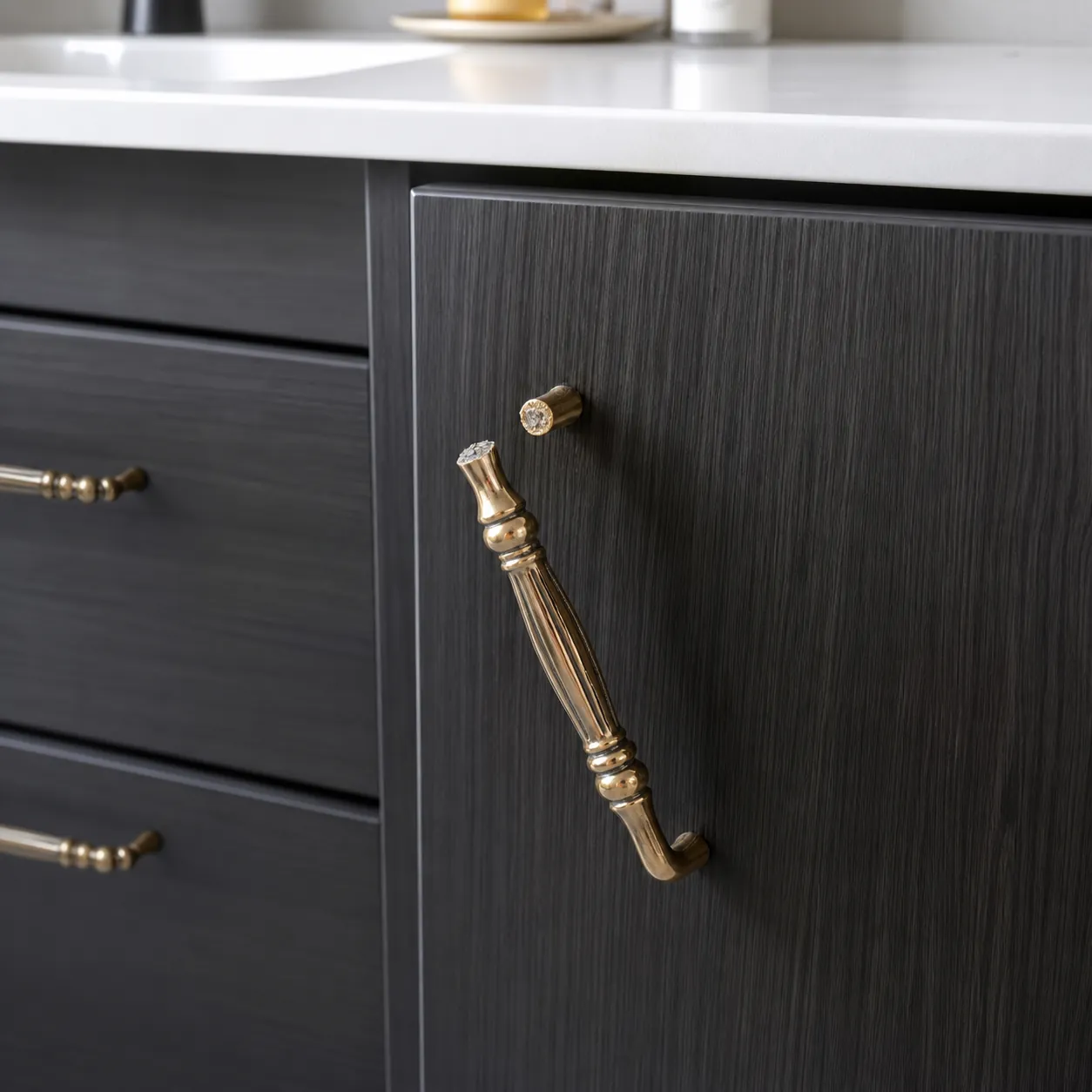
Think of a finish’s life in phases. The showroom phase is the first impression — the reflection, the warmth, the contrast that helps close a sale. The break-in phase covers the first year, when installation scuffs, cleaning habits, and humid-season stress expose weaknesses that plating quality should have prevented. The service phase is everything after, when process discipline — not marketing — decides whether hardware looks maintained or tired. Each phase fails differently, and each failure lands on a different desk: the retailer’s, the distributor’s, or yours.
The timing of finish failure is what makes it expensive. Most defects that surface during the first year of ownership land inside the warranty window, which means replacement parts, service labor, and freight back to the distributor. A single finish-related return on a vanity with branded hardware costs more than the handle itself: the cabinet is unboxed, the customer is unhappy, and the retailer starts asking questions about your quality standards. That is why bathroom hardware finish durability flows directly into your landed cost per unit, not just your aesthetics budget. Importers who have lived through one season of tarnished pulls rarely repeat the mistake — they verify finish quality before the container sails.
Main Focus Cabinet, brand name MFBATH, builds vanity cabinets in Changge, Henan, China, where it has operated since 2015. The company employs 95 people, produces about 5,000 vanity sets per month, runs five quality control (QC) checkpoints on every product, and reports a return rate below 1 percent — a figure that depends as much on finish consistency as on cabinet joinery. Its product line spans modern handles, classic knobs, and bar pulls in chrome and brushed nickel, and its custom vanity hardware program covers logo engraving and printing for buyers who want branded pulls. MFBATH holds ISO 9001 and ISO 14001 certification, certified since 2017 and confirmed current in 2025.
Finish durability is also half of a larger story. The hardware experience on a vanity is judged on both surface and motion: the finish is what buyers see, and the soft-close mechanism is what they feel. MFBATH equips doors and drawers with soft-close vanity hardware, and the mechanical side deserves the same verification discipline as the finish. This article stays on the surface, literally — the finishes, the processes behind them, and the contract language that protects them.
The Three Finishes Compared: Chrome, Brushed Nickel, and Matte Black
Selection starts with an honest side-by-side. The table below compares chrome, brushed nickel, and matte black across the five attributes that matter most to buyers who will live with the decision: appearance, abrasion resistance, corrosion risk, care difficulty, and commercial suitability. The ratings are directional — real performance depends on process quality, which the next section explains — but they capture the practical differences you will feel in the field.
| Attribute | Chrome | Brushed Nickel | Matte Black |
|---|---|---|---|
| Appearance | Bright, mirror-like reflection; classic and neutral | Warm gray-silver tone with a fine satin grain | Flat, dark, high-contrast; modern and design-forward |
| Abrasion resistance | Hard plated surface resists scratching, but scratches show clearly against the mirror finish | Brushed texture hides fine scratches and fingerprints | PVD-applied versions resist abrasion well; powder-coated versions can chip at edges |
| Corrosion risk | Good in most interiors; depends on plating quality and base metal preparation | Moderate; can tarnish or dull in humid bathrooms if the protective layer is damaged | Low with PVD; powder-coated black can corrode once the coating is breached |
| Care difficulty | Shows water spots and fingerprints; needs regular wiping | Forgiving; masks fingerprints and spotting | Can show fingerprints and dust on some formulations; avoid abrasive cleaners |
| Commercial suitability | Safe default for most projects; works in traditional and contemporary settings | Popular in North American residential and hospitality projects | Strong in mixed-metal and minimalist designs; confirm trend fit for your market |
Chrome: the reflective standard
Chrome is the default finish of the bathroom industry because it reads as clean, premium, and neutral. It pairs with virtually any cabinet color, from white shaker to espresso, and it is the finish most specifiers picture when they think of commercial restrooms. Chrome is typically produced by electroplating layers of nickel and chromium onto a prepared substrate; the corrosion resistance buyers experience comes from the integrity of that layer stack, not from the bright top surface alone. In well-ventilated bathrooms with sensible cleaning products, well-executed chrome plating performs reliably for years. In steamy rooms cleaned with aggressive chemicals, lower-grade plating eventually shows its limits — which is why experienced buyers ask for salt spray evidence rather than product adjectives.
Brushed Nickel: the forgiving workhorse
Brushed nickel is the finish North American buyers most often associate with upgraded kitchens and baths. Its warm gray-silver tone sits between the cold flash of chrome and the darkness of matte black, and the directional brushing does real work: it catches light softly and hides fingerprints, water spots, and fine scratches far better than a mirror surface can. That makes brushed nickel a low-maintenance choice for family bathrooms, rental properties, and hospitality corridors where cleaning time is limited. The trade-off is that brushed nickel can develop a patina or dullness in persistently humid conditions if its protective top layer is thin or damaged. Ask the supplier how the brushed texture is created and whether a clear protective coat follows the brushing — the answer shows up in year two.
Matte Black: the design-forward contender
Matte black has moved from trend to staple in modern residential and hospitality design. Its flat, low-glare surface creates strong contrast against light cabinetry and coordinates naturally with black faucets, shower frames, and towel bars. But matte black is less a single finish than a family of processes. Premium lines use physical vapor deposition (PVD) to build a hard, dense film; value lines often rely on powder coating, which is thicker but can chip when a handle is struck or dropped during installation. Both can look identical in a catalog photo, so the process specification — not the color swatch — is where the difference lives. Before committing to matte black across a whole program, confirm your market’s tolerance: what reads as modern in one region can read as a fad in another.
Finish choice also has to harmonize with the cabinet surface it sits on. Our guide to high-gloss bathroom vanity finishes walks through how reflective surfaces and hardware interact, which matters when you are pairing chrome with high-gloss lacquer or matte black with matte laminate. Many programs also run more than one finish — chrome for the volume line, matte black for a design series — which means your contract needs a specification for each finish, not a single blanket description.
How Finish Durability Is Built: Electroplating, PVD, and Protective Layers
A finish is not a coat of paint; it is an engineered system of layers, each with a job. When you read a supplier’s technical sheet, you are really reading about three things: substrate preparation, the metallic layers, and the protective top coat. Understanding the main production routes will tell you which questions to ask — and which answers to treat as red flags.
Electroplating: layers that carry the load
Electroplating deposits metal ions onto the hardware surface using an electric current. Chrome and nickel finishes are typically built as a sequence of layers — commonly copper and nickel beneath a thin chromium top layer — and the process demands a clean, smooth substrate first. Any porosity, seam, or pit in the base metal eventually surfaces as a defect, because plating cannot fully heal what lies underneath. The corrosion resistance of an electroplated part is governed by the thickness, density, and uniformity of those layers and by the quality of the base metal. Two handles that look identical in a showroom can have very different life expectancies because of what is invisible below the surface. When a supplier cannot describe its layer sequence or base material in concrete terms, treat the sample with suspicion.
PVD: the vacuum alternative
Physical vapor deposition (PVD) is a vacuum-based process in which material is vaporized and condensed onto the part as a thin, dense film. The film bonds tightly, is hard, and resists scratching and tarnishing, which is why many premium matte black, gunmetal, and dark bronze finishes are produced this way. PVD also gives manufacturers precise control over tone and color consistency, which matters when you order the same finish across multiple models, seasons, and production batches. The trade-off is cost: PVD equipment is capital-intensive, and the process is typically reserved for finishes where buyers will pay for the durability.
Powder coating and protective topcoats
For matte black finishes at value price points, powder coating is common: a dry polymer is applied electrostatically and cured in an oven into a tough, continuous layer. Powder coating resists abrasion and chemicals well, but it is a coating rather than a metallic layer, so impacts can chip it — and once chipped, moisture can travel between coating and metal, starting corrosion that spreads outward from the damage. Many suppliers also add a clear protective topcoat over plated or brushed finishes to slow tarnishing, reduce fingerprints, and make surfaces easier to clean. Ask which topcoat is used, how it is applied, and how it reacts to the cleaning chemicals your market actually uses.
The substrate and the environment both deserve attention. Brass, zinc alloy, and stainless steel each behave differently under plating, and the same finish will perform differently in a ventilated powder room, a steamy family bath, and a coastal hotel corridor where salt air adds to the load. A finish that survives one setting can fail in another, which is why regional specification matters as much as process specification.
Regulation shapes finish chemistry too. Chrome plating involves chromium compounds that receive close regulatory attention; the U.S. Environmental Protection Agency (EPA) maintains guidance on chromium in plating operations, and importers shipping to the United States should be aware of how those rules affect supplier processes and documentation. On the code side, the International Code Council (ICC) publishes model building codes that many jurisdictions adopt, including provisions that touch commercial bathroom hardware. Neither of these is a product certification you can print on a box — they are context every responsible supplier should be able to discuss.
Branded Hardware Programs for Vanity OEM Buyers
Browse this product, solution, or service page to explore relevant offerings.
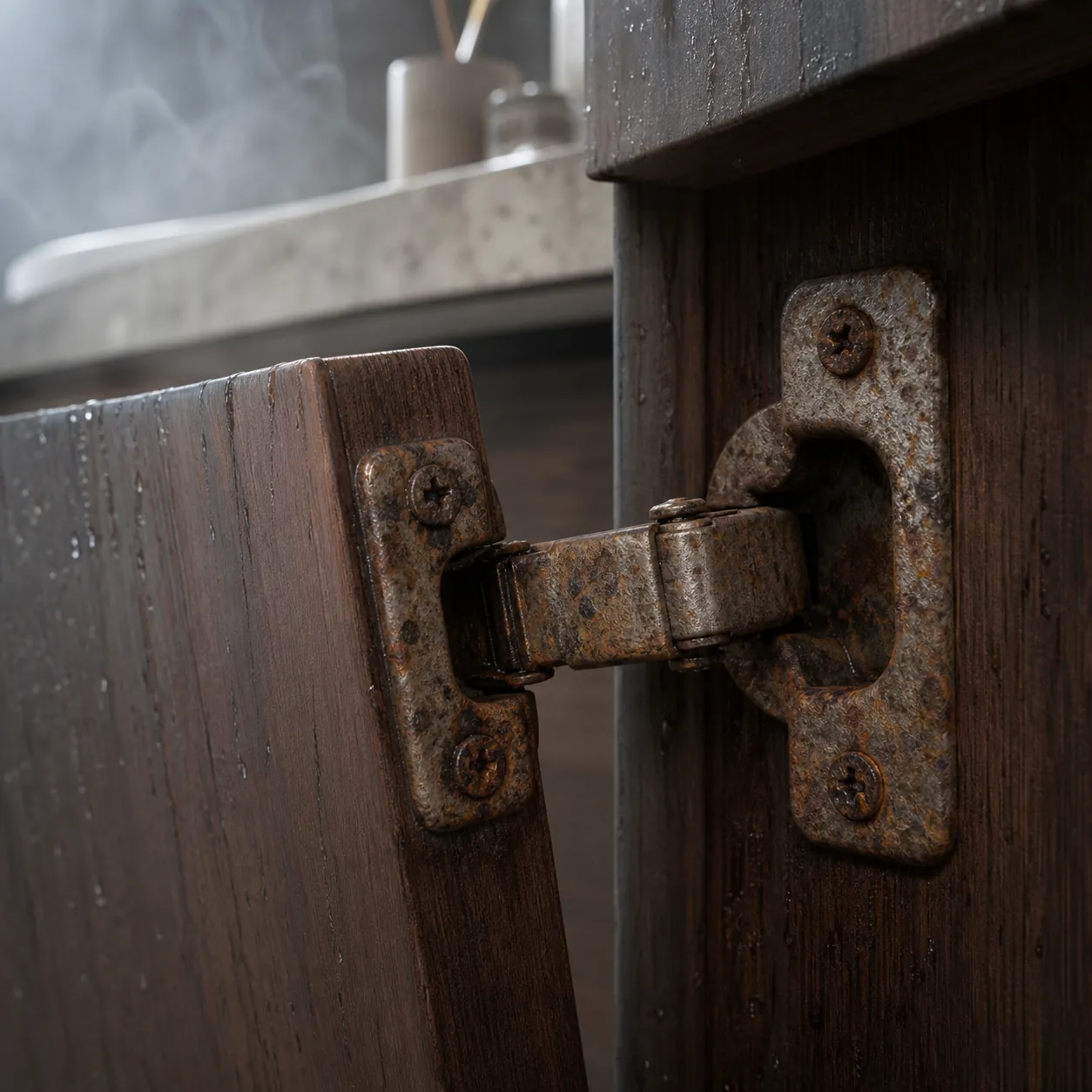
How to Verify Finish Quality Before You Commit
Every supplier will tell you their finishes are durable; verification is what separates sourcing professionals from everyone else. Four structured checks — on paper, on samples, in a pilot order, and on the mechanical side — will tell you what a manufacturer actually controls. Each check is cheap compared with a container of disappointed customers.

Start with salt spray evidence
Salt spray testing is the industry’s standard way to compare corrosion resistance. The test, most commonly run to the ASTM B117 practice, exposes coated parts to a controlled salt fog inside a sealed chamber to accelerate corrosion in a repeatable way. The ASTM B117 standard page documents the practice, and it is worth reading the scope carefully: the test is a comparative tool, not a prediction of real-world service life. That means the numbers that matter are the ones you negotiate — test duration, acceptance criteria, and how the result maps to your use environment. For bathroom hardware finish durability, salt spray evidence is the closest thing to a common currency between buyer and factory. Ask suppliers which salt spray duration they run, request the latest test reports, and, for large orders, ask whether reports can be issued per batch. A supplier who shares test data freely is signaling process control; one who deflects is telling you something as well.
Read the physical sample like an inspector
Test reports cannot show every flaw, so physical inspection matters. Check the edges and corners of handles, where plating is thinnest; check threaded areas on knobs and mounting screws; check the underside of bar pulls, where cleaning water collects; and check any logo area if you have brand customization, because engraving can expose base metal and printed logos can wear. Run a simple spot check with a soft cloth and a neutral cleaner to confirm the finish reacts the way it should. Color consistency across batches deserves the same attention as within one batch: a brushed nickel pull from production run two should match run five. MFBATH’s five QC checkpoints per product exist precisely because these defects are found in inspection, not in the field. When your program uses custom colors, Pantone color matching provides a common reference language between your brand book and the factory floor.
Run a pilot before you scale
Finish problems are cheap to fix at 15 sets and expensive at 500. MFBATH’s minimum order quantity (MOQ) is 15 sets per model, color, and size, and custom hardware also starts at 15 sets — a structure designed for exactly this kind of validation. Use the pilot to confirm finish consistency, packaging that protects surfaces in transit, and installation behavior under real conditions before you commit to volume. Transit is where a surprising share of finish damage happens: handles that arrive scratched are usually victims of packaging, not plating, and the fix belongs on the packing line. For a map of the errors that commonly derail hardware programs, our guide to vanity hardware sourcing mistakes covers packaging damage, finish mismatches, and specification gaps that show up months after arrival.
Verify the mechanical side in parallel
A finish is half of the hardware story; motion is the other half. Soft-close doors and drawers depend on hinges and slides with their own verification path, and a drawer that slams or a hinge that squeaks will generate complaints even when the finish is perfect. Our guide to verifying soft-close hardware quality walks through the checks to run on samples and the questions to ask in audit. Plan finish inspection and mechanical inspection as one event, because both share the same master sample and the same batch records.
What to Write Into Your Sourcing Contract
Verification only becomes enforceable when it is written down. The clauses below reflect how a typical MFBATH order is structured — and they double as a checklist for evaluating any supplier’s terms. If a manufacturer hesitates to commit any of these points to writing, that hesitation is data.
Specify the finish and the master sample
Name the finish precisely: the process (electroplated chrome, PVD matte black, powder-coated black), the tone reference, and any brand marks. Attach a sealed master sample signed by both parties and state that it is the arbitration reference for color and texture disputes. If you use custom hardware with logo engraving or printing, define where marks sit, how deep engraving may go, and how engraved areas are protected from moisture.
Write down the test criteria and QC records
Agree on the salt spray standard (such as ASTM B117), the duration, and the pass/fail criteria, and require test reports with each shipment or per batch. Require QC records with the same transparency MFBATH applies: five quality control checkpoints per product and a return rate below 1 percent, confirmed in writing. If you are importing into markets with different expectations, review our comparison of EU and North American bathroom hardware sourcing and our guide to specifying vanity hardware by region before finalizing the clause.
Lock in quantities, lead times, and payment
Plan quantities around the MOQ: 15 sets per model, color, and size, with custom hardware starting at 15 sets. On lead times, expect samples within 10 working days and bulk production in 20–30 days, with 4–6 weeks of shipping to the United States, Canada, and Mexico. MFBATH ships free on board (FOB) from Qingdao, with 30 percent prepayment and the balance due within one week of the draft bill of lading — a structure that lets you review shipping documents before releasing final payment.
Define warranty and remedies in advance
MFBATH backs its cabinets with a two-year warranty, and your contract should state what happens when a finish fails within that window: replacement parts, rework, credit, or a combination. Define how failure is confirmed — photographs, returned samples, or third-party inspection — so claims are resolved on evidence rather than argument. Clear remedy language is more useful than a page of adjectives about quality, because the remedy is what your buyer actually receives.
Frequently Asked Questions
How long does chrome, brushed nickel, or matte black hardware last in a bathroom?
Bathroom hardware finishes are not rated by a single clock. Real-world service life depends on the plating or coating process, the environment, and the cleaning products used. Chrome and brushed nickel from a well-controlled electroplating line hold up for years in normal residential bathrooms, while PVD-applied matte black offers strong scratch and corrosion resistance in commercial settings. What matters for buyers is not a universal number but the evidence behind the finish: salt spray results, master samples, and QC records tell you more than any blanket lifespan claim.
What is a salt spray test, and why should I ask for one?
A salt spray test places coated hardware inside a sealed chamber and exposes it to a controlled fog of salt solution, following practices such as ASTM B117. The goal is to accelerate corrosion so weaknesses in plating or coating become visible quickly under repeatable conditions. It is a comparative tool, not a prediction of real-world life: run the same test on two suppliers’ chrome handles and it tells you which resists corrosion longer. Specify the standard, duration, and acceptance criteria in your contract, and request reports with each batch.
Can I order custom hardware with my brand logo in chrome or brushed nickel?
Yes. MFBATH’s custom hardware program supports logo engraving and printing on handles, knobs, and bar pulls in chrome and brushed nickel, with custom hardware available from a 15-set minimum order quantity (MOQ). Engraving removes part of the protective layer, so ask how engraved areas are sealed against moisture; printed logos should be tested with the same cleaners your market uses. Custom hardware also pairs with other brand touches — Pantone-matched cabinet colors, basin choices, and material options are part of the 40,000+ customization combinations MFBATH offers.
The Bottom Line
Chrome, brushed nickel, and matte black are not interchangeable finishes: they differ in appearance, abrasion resistance, corrosion risk, and care requirements, and those differences compound in real bathrooms. Choose the finish that fits your market, then verify it with salt spray evidence, a signed master sample, and QC records rather than marketing claims. Finally, put the deal in writing — specify finish and test criteria, plan around the 15-set MOQ, and use the two-year warranty and defined remedies so your investment in bathroom hardware finish durability holds up through the warranty window and beyond.





0 Comments